
Antiviral agents, glucocorticoids, antibiotics, and intravenous immunoglobulin in 1142 patients with coronavirus disease 2019: a systematic review and meta-analysis
Key words: coronavirus disease 2019, drug therapy, meta-analysis


 CC BY-NC-SA 4.0
Antiviral agents, glucocorticoids, antibiotics, and intravenous immunoglobulin in 1142 patients with coronavirus disease 2019: a systematic review and meta-analysis
CC BY-NC-SA 4.0
Introduction: The treatment effects of antiviral agents, glucocorticoids, antibiotics, and intravenous immunoglobulin are controversial in patients with coronavirus disease 2019 (COVID‑19).
Objectives: This study aimed to evaluate the impact of drug therapy on the risk of death in patients with COVID‑19.
Patients and methods: The PubMed, Embase, Web of Science, Cochrane Library, and major preprint platforms were searched to retrieve articles published until April 7, 2020. Subsequently, the effects of specific drug interventions on mortality of patients with COVID‑19 were assessed. Odds ratios (ORs) and relative risks (RRs) with corresponding 95% CIs were pooled using random effects models.
Results: Of 3421 references, 6 studies were included. Pooled results from retrospective studies revealed that antiviral agents may contribute to survival benefit (OR, 0.42; 95% CI, 0.17–0.99; P = 0.048; I2 = 82.8%), whereas a single randomized controlled trial found no effects of an antiviral agent on mortality (RR, 0.77; 95% CI, 0.45–1.3; P = 0.33). Glucocorticoid use led to an increased risk of death (OR, 2.43; 95% CI, 1.44–4.1; P = 0.001; I2 = 61.9%). Antibiotics did not significantly affect mortality (OR, 1.13; 95% CI, 0.67–1.89; P = 0.64; I2 = 0%). Similarly, intravenous immunoglobulin had a nonsignificant effect on mortality (OR, 2.66; 95% CI, 0.72–9.89; P = 0.14; I2 = 93.1%).
Conclusions: With the varied heterogeneities across interventions, the current evidence indicated a probable survival benefit from antiviral agent use and a harmful effect of glucocorticoids in patients with COVID‑19. Neither any of antibiotics nor intravenous immunoglobulin were associated with survival benefit in this population.
What's new?
Coronavirus disease 2019 (COVID‑19) has become a health crisis worldwide. Until now, there has been no evidence showing that any drug had definite beneficial effects in patients with COVID‑19. Although antiviral agents, glucocorticoids, antibiotics, and intravenous immunoglobulin are widely used in clinical practice, their efficacy is still controversial. In this meta‑analysis, we evaluated the association between drug therapy (antiviral agents, glucocorticoids, antibiotics, and intravenous immunoglobulin) and the risk of death in patients with COVID‑19. We found that current evidence indicated a probable survival benefit of antiviral agent use and a harmful effect of glucocorticoids in this population. Neither any of antibiotics nor intravenous immunoglobulin were associated with survival benefit. Our study provides physicians with evidence‑based knowledge on drug therapy in patients with COVID‑19.
Introduction
Since the outbreak of coronavirus disease 2019 (COVID‑19) emerged in Wuhan, Hubei, China, in December 2019, the novel coronavirus (severe acute respiratory syndrome coronavirus 2 [SARS‑CoV‑2]) has rapidly spread to 199 countries and territories around the world. As of April 18, 2020, the pandemic of SARS‑CoV‑2 resulted in 2 160 207 confirmed cases of infection and 146 088 deaths globally.1 At present, the number of confirmed cases and deaths related to SARS‑CoV‑2 infection are still rising, posing a big challenge to healthcare professionals.
The management of patients with SARS‑CoV‑2 infection has raised concerns worldwide. However, there was insufficient evidence to prove that any drug in clinical use had definitive effects on COVID‑19. Most published studies on COVID‑19 were retrospective and adopted an observational design with inadequate sample size, making it difficult to evaluate whether a specific intervention was effective or not. Among all the pharmacological interventions for patients with COVID‑19, antiviral agents, glucocorticoids, antibiotics, and intravenous immunoglobulin were most controversial drugs. Therefore, we carried out a systematic review and meta‑analysis to evaluate the effects of antiviral agents, glucocorticoids, antibiotics, and intravenous immunoglobulin on clinical outcomes of patients with COVID‑19, hoping that our study will provide up‑to‑date information on the treatment of this novel coronavirus.
Patients and methods
Search strategy
We followed a comprehensive search strategy to identify any relevant articles on the topic, mainly from 4 medical databases including PubMed, Cochrane Library, Web of Science, and Embase. We also searched relevant papers using the Google search engine and major preprint platforms including Medrix, bioRxiv, and SSRN. Tailored search terms featured “2019‑nCoV,” “COVID‑19,” “Coronavirus,” “SARS‑CoV‑2,” and “Wuhan Coronavirus” (Supplementary material, Table S1). No language restriction or publication status criteria were set. Reference lists of relevant articles were also screened for eligible studies. The last search was performed on April 7, 2020.
Study selection
Two investigators (LP and LH) independently screened the manuscripts of the potentially eligible studies. Another investigator (SH) checked the results, and disagreement was resolved by consensus. Inclusion criteria were as follows: 1) randomized controlled trials (RCTs), cohort studies, case control studies, and cross‑sectional studies; 2) study settings and patient characteristics were provided; and 3) detailed data on drug interventions and outcomes were available. Drug interventions included the use of antiviral agents, glucocorticoids, antibiotics, and intravenous immunoglobulin. Outcomes referred to the number of survivors and nonsurvivors at the end of the follow‑up of each study. Exclusion criteria were: 1) duplicate reports; 2) preliminary studies that included patient groups overlapping with those presented in most recent reports.
Quality assessment
The Newcastle–Ottawa quality assessment scale was used to assess study quality and risk of bias for retrospective studies.2 The scale consists of 3 elements (selection, comparability, and exposure) and is covered by 8 items. According to this scale, the number of stars was used to evaluate study quality. A total of 4 stars can be awarded for selection, 2 for comparability, and 3 for exposure. Studies with 1 to 3 stars were considered as those of low quality; studies with 4 to 6 stars, of moderate quality; and studies with 7 to 9 stars, of high quality. The modified Jadad score (7 points) was used to assess the quality of RCTs, with classification criteria of high quality (6–7 points), moderate quality (4–5 points), and low quality (1–3 points).3 Two investigators (LP and LH) independently performed quality assessment, and the third investigator (WL) checked the results and resolved any disagreement.
Definition of interventions and outcomes
All‑cause mortality at the end of follow‑up of each study was regarded as the primary outcome. A pharmacological intervention was defined as a situation in which patients received a specific drug of interest (including antiviral agents, glucocorticoids, antibiotics, and intravenous immunoglobulin). Pooled analyses were performed to evaluate the association of intervention effects and patient outcomes according to the study definitions.
Data extraction
We used a standard strategy to extract the following data from each study: study characteristics (authors, date of publication, study design, duration of follow‑up, and sample size), participants (age and sex), patients with COVID‑19 who received pharmacological interventions (antiviral agents, glucocorticoids, antibiotics, and intravenous immunoglobulin) or not, and outcomes (number of nonsurvivors and survivors). Data were independently extracted by 2 investigators (XG and WJ) and checked by the third investigator (DC). Our protocol was not published or registered owing to the rapid emergence of this infectious disease.
Statistical analysis
Statistical analyses were performed using the STATA software, version 14 (StataCorp, College Station, Texas, United States). As most studies were retrospective and expected to be heterogenous, we chose the random effects model for data synthesis.4 For retrospective studies, we used odds ratios (ORs) and 95% CIs as effect measures. For RCTs, we pooled results using relative risk (RR) and 95% CIs. All the ORs and RR with corresponding 95% CIs were graphically visualized on forest plots. Heterogeneity across studies was evaluated using the Cochrane Q test and the I2 test (I2 = 100% [(Q – df) / Q]). The I2 value of 0% to 49%, 50% to 74%, and higher than 75% indicated low, moderate, and high heterogeneity, respectively.5
Subgroup analyses and sensitivity analysis plans were proposed based on the quality of studies, study design, participants, and types of drugs, as appropriate. Publication bias was assessed by funnel plots if more than 10 studies were included. A 2‑sided P value less than 0.05 was considered significant.
Results
Search results and study selection
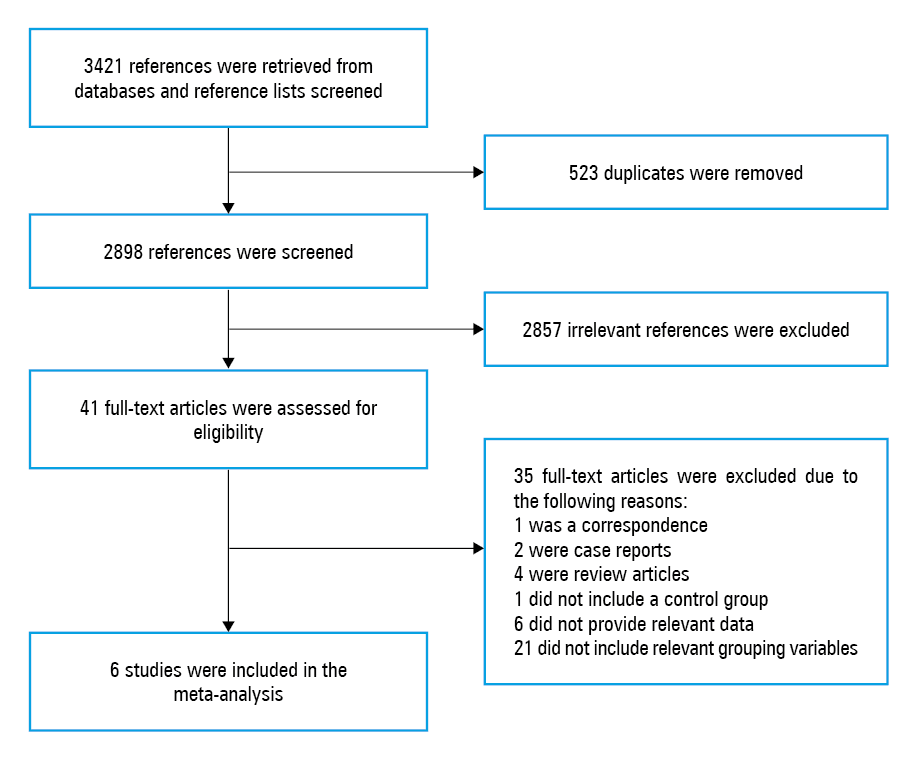
The flowchart of study selection is presented in Figure 1. We identified 3421 references by the initial database query and manual search. Among them, 523 were removed as duplicates and 2857 were excluded after title and abstract screening. Eventually, 41 articles were eligible for full‑text review. Thirty‑five studies were excluded due to the following reasons (Supplementary material, Table S2): 21 did not include relevant grouping variables; 6 did not report relevant data on pharmacotherapy; 4 were review articles; 2 were case reports; 1 did not include a control group; and 1 was a correspondence. Six studies presenting patients’ pharmacotherapy data and outcomes were included for systematic review and meta‑analysis.
Characteristics of the included studies
The main characteristics of the included studies are shown in Table 1. A total of 1142 patients were included. Geographically, all studies originated from China, with varied sample sizes ranging from 52 to 274 patients. Of these, 5 were retrospective and observational6-10 and there was a single RCT.11 Of the 6 included studies, all except the study by Yang et al7 received funding. Patients enrolled in these studies were at a median age of 40 to 69 years and predominantly male (55% to 67%).
Study | Country | Design | Time | Follow‑up, d | Patients, total n | Male sex, n (%) | Age, y |
a In this study, the age of the whole study cohort was not available.
Abbreviations: IQR, interquartile range | |||||||
- World Health Organization (WHO). Coronavirus disease 2019 (COVID‑19) Situation Report – 89. Updated April 19, 2020. https://www.who.int/docs/default‑source/coronaviruse/situation‑reports/20200418‑sitrep‑89‑covid‑19.pdf?sfvrsn=3643dd38_2. Accessed April 19, 2020.
- Stang A. Critical evaluation of the Newcastle‑Ottawa scale for the assessment of the quality of nonrandomized studies in meta‑analyses. Eur J Epidemiol. 2010; 25: 603‑605. | Crossref
- Oremus M, Wolfson C, Perrault A, et al. Interrater reliability of the modified Jadad quality scale for systematic reviews of Alzheimer’s disease drug trials. Dement Geriatr Cogn Disord. 2001; 12: 232‑236. | Crossref
- DerSimonian R, Laird N. Meta‑analysis in clinical trials. Control Clin Trials. 1986; 7: 177‑188. | Crossref
- Higgins JP, Thompson SG, Deeks JJ, Altman DG. Measuring inconsistency in meta‑analyses. BMJ. 2003; 327: 557‑560. | Crossref
SUPPLEMENTARY MATERIAL
ARTICLE INFORMATION