
An asymptomatic course of SARS-CoV-2 infection in a patient with 3 different neoplasms and treated with bortezomib: a coincidence or new therapeutic possibility?


 CC BY-NC-SA 4.0
An asymptomatic course of SARS-CoV-2 infection in a patient with 3 different neoplasms and treated with bortezomib: a coincidence or new therapeutic possibility?
CC BY-NC-SA 4.0
According to the consensus statement of the European Myeloma Network,1 “patients with multiple myeloma (MM) seem to be at increased risk for more severe COVID‑19 and associated complications due to their immunocompromised state, the older age, and comorbidities.” We present a case of a patient with 3 different cancers who was diagnosed with SARS‑CoV‑2 infection and spontaneously eliminated it during current treatment.
A 63‑year‑old woman was diagnosed with left breast cancer stage IIA (T2 N0 M0) in 2008. In 2019, chondrosarcoma grade 1 was found in Th12 vertebra (Figure 1). She developed acute renal failure (creatinine, 7.8 mg/dl; estimated glomerular filtration rate, 6 ml/min/1.73 m2) due to light chain disease lambda III B stage III according to the International Staging System for Multiple Myeloma. Remission‑inducing chemotherapy according to the VTD protocol (bortezomib, thalidomide, dexamethasone) was started. In April 2020, a consecutive dose of bortezomib was administrated just prior to a routine control test for SARS‑CoV‑2 (a reverse transcriptase–polymerase chain reaction 2‑gene test) which yielded a positive result. The patient was asymptomatic, in good general condition, and self‑isolated at home. Control tests for SARS‑CoV‑2 performed 2 weeks later were negative; she did not develop any SARS‑CoV‑2 antibodies.
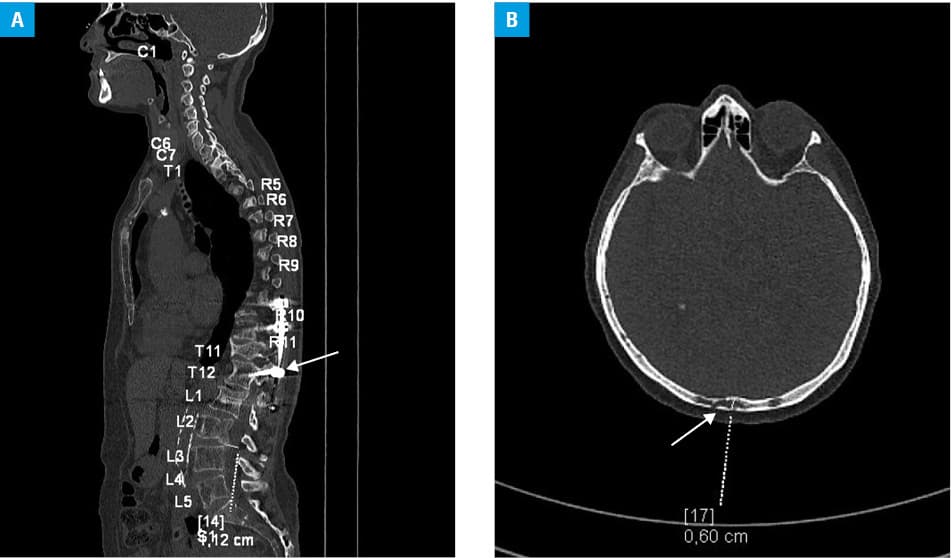
The patient continues to receive remission‑inducing treatment and dialysis. Selected results of laboratory test performed at the times of MM and SARS‑CoV‑2 infection diagnosis are presented in Supplementary material, Table S1.
Hereby we report a case of a patient with 3 different malignancies: breast cancer diagnosed several years ago, followed by recently found chondrosarcoma and MM. She was treated with bortezomib, thalidomide, and dexamethasone when asymptomatic SARS‑CoV‑2 infection was diagnosed. In such scenario, a severe course of COVID‑19 would be expected because of profound immunosuppression; in fact, the infection was asymptomatic and disappeared quickly.
The role of Bruton tyrosine kinase inhibitors in the therapy of COVID‑19 has been previously discussed. They can be effective in the treatment of COVID‑19 due to their anti‑inflammatory and antiviral activity. Bruton tyrosine kinase is involved in sustained inflammation through nuclear factor–kappa B (NF-κB) activation, production of proinflammatory cytokines, and cellular senescence, leading to organ damage and spread of viral particles.2
Our patient received bortezomib, which inhibits the NF-κB/IκB transcription factor. Activation of the NF-κB pathway by coronaviruses can increase viral replication and lead to hyperactivation of immune mechanisms such as cytokine storm in SARS‑CoV‑2 infection.3 Inhibitors of NF-κB improved survival among mice infected with SARS‑CoV, which is similar to SARS‑CoV‑2 in terms of reducing the amount of proinflammatory proteins.4 Suppression of NF-κB may enhance interferon‑mediated antiviral activity and improve the disease outcome.2-4 It means that both mechanisms connected with NF-κB can be involved in the therapy with bortezomib in patients with MM and SARS‑CoV‑2 infection.
In the RECOVERY trial, dexamethasone was the most effective drug among critically ill COVID‑19 patients, but not in less severe cases.5 Nevertheless, its anti‑inflammatory effect in our patient cannot be excluded.
Although our conclusions may be controversial, we cannot exclude the possibility that the use of bortezomib with dexamethasone in a patient with MM was the reason for the mild course of SARS‑CoV‑2 infection due to its anti‑inflammatory and probably antiviral effect. To our best knowledge, this is the first report suggesting the efficacy of treatment with bortezomib in coronavirus infection.
- Terpos E, Engelhardt M, Cook G, et al. Management of patients with multiple myeloma in the era of COVID‑19 pandemic: a consensus paper from the European Myeloma Network (EMN). Leukemia. 2020; 34: 2000‑2011. | Crossref
- Barate C, Mavilia F, Benedetti E, et al. Bruton’s tyrosine kinase (BTK) inhibitors: new possible good candidates against COVID‑19. Br J Cancer. 2020; 3: 389‑396. | Crossref
- Hirano T, Murakami M. COVID‑19: a new virus, but a familiar receptor and cytokine release syndrome. Immunity. 2020; 52: 731‑733. | Crossref
- DeDiego ML, Nieto‑Torres JL, Regla‑Nava JA, et al. Inhibition of NF-κB‑mediated inflammation in severe acute respiratory syndrome coronavirus‑infected mice increases survival. J Virol. 2014; 88: 913‑924. | Crossref
- Ledford H. Coronavirus breakthrough: dexamethasone is first drug shown to save lives. Nature. 2020; 582: 469. | Crossref
SUPPLEMENTARY MATERIAL
ARTICLE INFORMATION