
Pseudo–high-risk acute pulmonary embolism resulting from large paradoxical saddle embolus of the aorta with subclavian artery occlusion

 CC BY 4.0
Pseudo–high-risk acute pulmonary embolism resulting from large paradoxical saddle embolus of the aorta with subclavian artery occlusion
CC BY 4.0
A 75‑year‑old woman with acute dyspnea was diagnosed with suspected acute pulmonary embolism (APE). Initially, she was stable, with blood pressure (BP) of 135/80 mm Hg, tachycardia of 105 bpm, and oxygen saturation of 84%. Computed tomography pulmonary angiography (CTPA) showed bilateral central pulmonary embolism and enlarged right ventricle (RV). After examination, a sudden drop in systolic BP to 80 mm Hg was reported. She was classified as high‑risk APE and immediately referred to a tertiary cardiology care unit.
On admission to our department, the patient was in a good general condition, without peripheral hypoperfusion. Her left hand was colder, without a palpable pulse; however, there were no signs of acute ischemia. A difference of 60 mm Hg in systolic BP values between the upper extremities was found. Reassessment of the previously performed CTPA identified a large (14 cm) aortic thrombus lodged in the left subclavian artery, with a free‑floating part extending to the distal aortic arch (Figure 1A and 1B). Echocardiography showed RV overload typical of APE, along with massive right‑to‑left shunting via patent foramen ovale (PFO) following intravenous injection of agitated saline (Figure 1C‑1E).
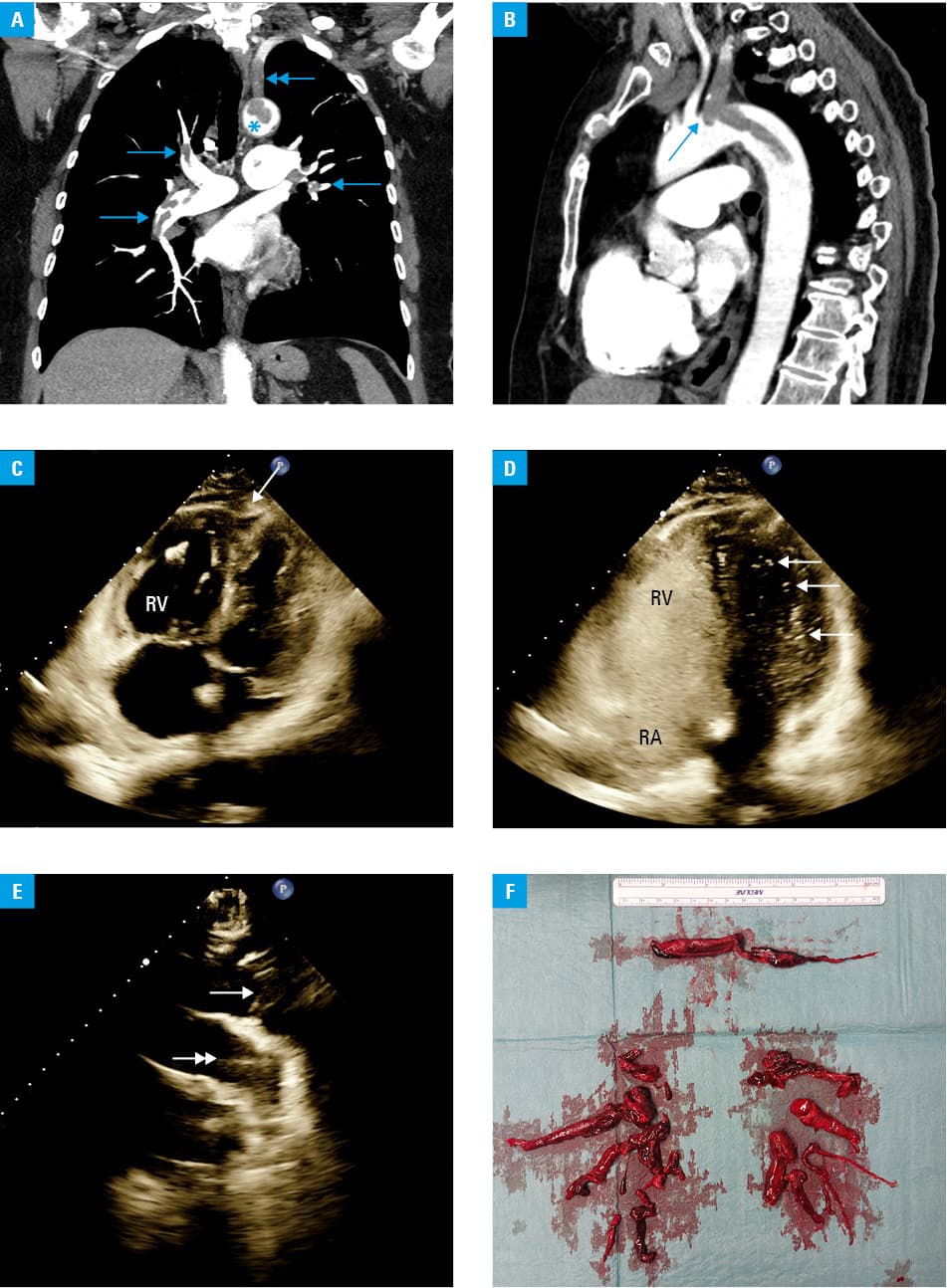
The patient was consulted by a pulmonary embolism response team (PERT). Parenteral anticoagulation was continued. To prevent arterial embolization in the case of aortic thrombus fragmentation, she was scheduled for urgent surgery. Bilateral pulmonary embolectomy was performed under moderate hypothermia (28 °C), with complete circulatory arrest lasting for 7 minutes. Additionally, a large thrombus, probably a venous material lodged in the left subclavian artery, was removed from the aortic arch, which required a 3‑minute–long circulatory arrest with selective cerebral perfusion through the right carotid artery (Figure 1F). Eventually, PFO was sutured. days after the successful surgery the patient was discharged home in a good general condition, on long‑term oral anticoagulation, with no clinical signs of peripheral embolization.
Paradoxical embolism is a well‑known complication of APE resulting from right‑to‑left intracardiac shunt, mostly via PFO, leading to systemic embolization caused by thrombi originating from the venous system.1 A notable complication of paradoxical embolism that occures in patients with acute APE and RV dysfunction is ischemic stroke.2 This considerable complexity requires a multidisciplinary approach, established within a PERT.3
We report on a patient with intermediate‑high–risk APE and large aortic thrombus, who was successfully treated with simultaneous pulmonary and aortic surgical embolectomy. The optimal management of saddle emboli located in the aortic arch is yet to be determined. Although such lesions can be successfully treated conservatively, anticoagulation may result in displacement of thrombus fragments and further complications, such as ischemic stroke or peripheral embolization.4 Despite finding only a single report of successful aortic arch thrombolectomy with simultaneous pulmonary artery embolectomy, we think that surgical management should be preferred in such cases.5
Our case demonstrates the need for awareness of systemic embolism risk in patients with APE and RV overload; hence the crucial role of early echocardiography in screening for thrombi in transit, particularly in patients who may require percutaneous interventions. It also emphasizes the role of detailed physical examination, which helped identify the cause of low BP values and led to a change in treatment. Eventually, it shows that surgical treatment of APE is effective and should be considered in the presence of additional indications.
- Pietrasik A, Gąsecka A, Smyk JM, et al. Acute‑on‑chronic pulmonary embolism and concomitant paradoxical embolism: two diseases, one intervention. Pol Arch Intern Med. 2022; 132: 16155. | Crossref
- Goliszek S, Wisniewska M, Kurnicka K, et al. Patent foramen ovale increases the risk of acute ischemic stroke in patients with acute pulmonary embolism leading to right ventricular dysfunction. Thromb Res. 2014; 134: 1052‑1056. | Crossref
- Kopeć G, Araszkiewicz A, Kurzyna M, et al. Role of catheter‑directed therapies in the treatment of acute pulmonary embolism. Expert opinion of the Polish PERT Initiative, Working Group on Pulmonary Circulation, Association of Cardiovascular Interventions, and Association of Intensive Cardiac Care of the Polish Cardiac Society. Kardiol Pol. 2023; 81: 423‑440. | Crossref
- Mancuso E, Winterbottom AP, Boyle JR, et al. Management and clinical outcome of concomitant pulmonary embolism and paradoxical saddle aortic arch embolism. BMJ Case Rep. 2019; 12: e230024. | Crossref
- Kim RJ, Girardi LN. “Lots of clots”: multiple thromboemboli including a huge paradoxical embolus in a 29‑year old man. Int J Cardiol. 2008; 129: e50‑e52. | Crossref
ARTICLE INFORMATION