
Transient severe precapillary pulmonary hypertension caused by eosinophilic granulomatosis with polyangiitis in a patient with asthma

 CC BY 4.0
Transient severe precapillary pulmonary hypertension caused by eosinophilic granulomatosis with polyangiitis in a patient with asthma
CC BY 4.0
Although asthma is a common pulmonary disease, it rarely leads to pulmonary hypertension (PH). We report a case of an 80‑year‑old woman who required urgent hospitalization due to symptoms of acute heart failure. Her comorbidities included asthma confirmed by spirometry, lasting for at least 10 years, systemic hypertension, and prediabetes. Despite various modifications of pharmacotherapy, asthma has never been satisfactorily controlled.
On admission, the patient was dyspneic, with prominent peripheral edema. Laboratory workup showed significant eosinophilia (eosinophil blood count [EBC], 9/µl; reference range [RR] <0.3/µl), elevated level of N‑terminal pro–B‑type natriuretic peptide (NT‑proBNP; 5881 pg/ml; RR <450 pg/ml), and a stable elevation of the high‑sensitive cardiac troponin T level (hs‑cTnT; 670 ng/l; RR <14 ng/l).
Electrocardiography showed negative T waves in precordial leads. Transthoracic echocardiography (TTE) revealed markedly increased right ventricular systolic pressure (RVSP) of 80 mm Hg with signs of right ventricular pressure overload, including flattening of the intraventricular septum and shortened acceleration time of pulmonary ejection (55 ms), with preserved left ventricular ejection fraction and only mild diastolic dysfunction. Pulmonary embolism was excluded on computed tomography (CT) pulmonary angiography; however, subtle ground‑glass opacities in the lung parenchyma were detected. Right heart catheterization (RHC) was performed to verify the suspicion of PH and to assess its type; mean pulmonary artery pressure was 35 mm Hg. Based on pulmonary vascular resistance of 4.9 Wood units and low pulmonary artery wedge pressure of 13 mm Hg, a diagnosis of precapillary PH was made. Approximately 13 000 monomorphic premature ventricular complexes were detected on 24‑hour Holter monitoring. Cardiac magnetic resonance (CMR) imaging showed myocardial involvement typical of active myocarditis (Figure 1A–1C). No overt heart or lung diseases explaining PH were found, nor was the cause of hypereosinophilia established.
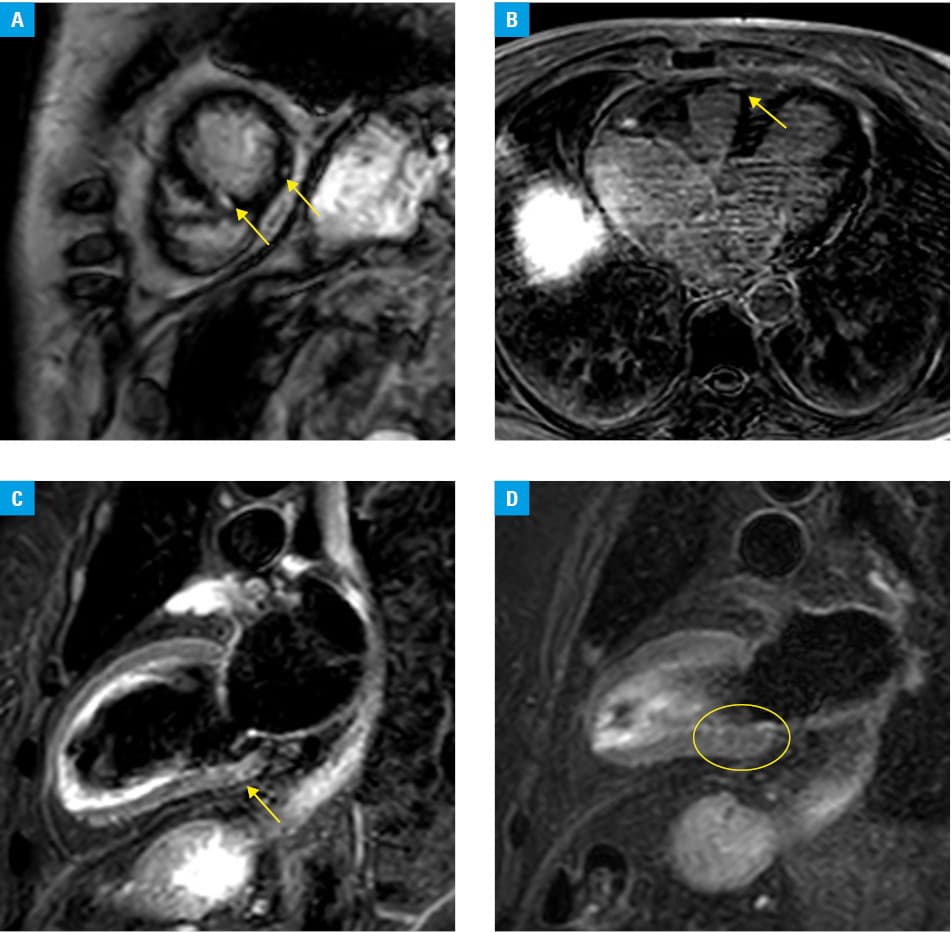
Apart from intravenous loop diuretics as the right ventricular heart failure treatment, the patient was started on oral prednisone at 0.5 mg/kg/day, which resulted in rapid improvement and normalization of EBC. Control TTE showed no signs of right ventricular overload; RVSP was only mildly elevated at 38 mm Hg. CT revealed rhinosinusitis with polyps in the paranasal sinuses. Skin biopsy of chronic purpuric lesions demonstrated vascular eosinophilic infiltration with granulomas. Finally, eosinophilic granulomatosis with polyangiitis (EGPA) was diagnosed, with negative antineutrophil cytoplasmic antibody (ANCA) titers.
Remission was achieved and maintained on 10 mg of prednisone and 1000 mg of mycophenolate mofetil twice daily. NT‑proBNP and hs‑cTnT levels decreased to 600 pg/ml and 50 ng/l, respectively. Significant reduction in ventricular arrhythmia was observed. On follow‑up CMR, symptoms of active myocarditis resolved (Figure 1D). Over the next 2 years, the patient has remained free from exacerbations.
Even though patients with EGPA usually show slightly higher RVSP than healthy controls,1 cases with severe PH confirmed with RHC are not well documented.2,3 It seems that the reported patient showed another complication, not directly related to myocarditis, common in ANCA‑negative cases,4 predominantly manifesting with arrythmias and heart failure.5 We assume that pulmonary vasculitis, possibly in combination with parenchymal lung involvement, was the cause of precapillary PH. Importantly, successful treatment of EGPA resulted not only in clinical and laboratory improvement but also in ongoing restoration of right ventricular function and significant reduction of PH.
This case highlights the importance of a thorough assessment of patients presenting with newly diagnosed PH. Existing comorbidities may turn out to be part of a pathology that ultimately requires a completely different treatment. Appropriate modification of the diagnosis resulted in remission of potentially life‑threatening complications.
- Ahn SS, Park ES, Jung SM, et al. Echocardiographic features in patients with ANCA‑associated vasculitis within 3 months before and after diagnosis. Clin Rheumatol. 2017; 36: 2751‑2759. | Crossref
- Mularek‑Kubzdela T, Ciurzyński M, Kowal Bielecka O, et al. An expert opinion of the Polish Cardiac Society Working Group on Pulmonary Circulation and the Polish Society for Rheumatology on the diagnosis and treatment of pulmonary hypertension in patients with connective tissue disease. Kardiol Pol. 2021; 79: 917‑929. | Crossref
- de Menezes MB, Albuquerque de Andrade I, Cintra MB, et al. Pulmonary arterial hypertension and orbital involvement in a patient with eosinophilic granulomatosis with polyangiitis. Clin Exp Rheumatol. 2015; 33: S‑182.
- Sokolowska BM, Szczeklik WK, Wludarczyk AA, et al. ANCA‑positive and ANCA‑negative phenotypes of eosinophilic granulomatosis with polyangiitis (EGPA): outcome and long‑term follow‑up of 50 patients from a single Polish center. Clin Exp Rheumatol. 2014; 32: S41‑S47.
- Guzek K, Świerczewski M, Pyszno‑Prokopowicz D, et al. Asystolic cardiac arrest with chest pain as initial features of eosinophilic granulomatosis with polyangiitis (Churg‑Strauss syndrome). Pol Arch Intern Med. 2021; 131: 184‑186. | Crossref
ARTICLE INFORMATION