

 CC BY 4.0
Antineutrophil cytoplasmic antibodies (ANCAs) have been very rarely reported in patients with classic polyarteritis nodosa (PAN). PAN is characterized by fibrinoid necrosis and severe inflammation leading to wall destruction and luminal narrowing of medium‑sized vessels. Granulomatosis with polyangiitis (GPA), which involves granuloma formation and vasculitis, affects small and medium‑sized vessels in many organs, most commonly the upper respiratory tract, lungs, and kidneys, and is associated with leukocyte proteinase 3 ANCA (PR3‑ANCA) positivity.1 Both PAN and GPA belong to a category of systemic necrotizing vasculitis.2,3
We present a case of a 45‑year‑old man with classic symptoms of PAN and cytoplasmic ANCA (c‑ANCA)–positive vasculitis (without previous adequate diagnosis and treatment), who was admitted to a department of nephrology with a loss of exteroceptive sensation in all extremities and necrosis of the distal phalanges (Figure 1A) following central retinal artery occlusion. The patient had an ANCA titer of 1:80 (reference range [RR], positive ≥1:10) and a PR3‑ANCA level of 28 IU/ml (RR, positive >3 IU/ml). Four years earlier, he had been treated in another medical center for pericarditis.
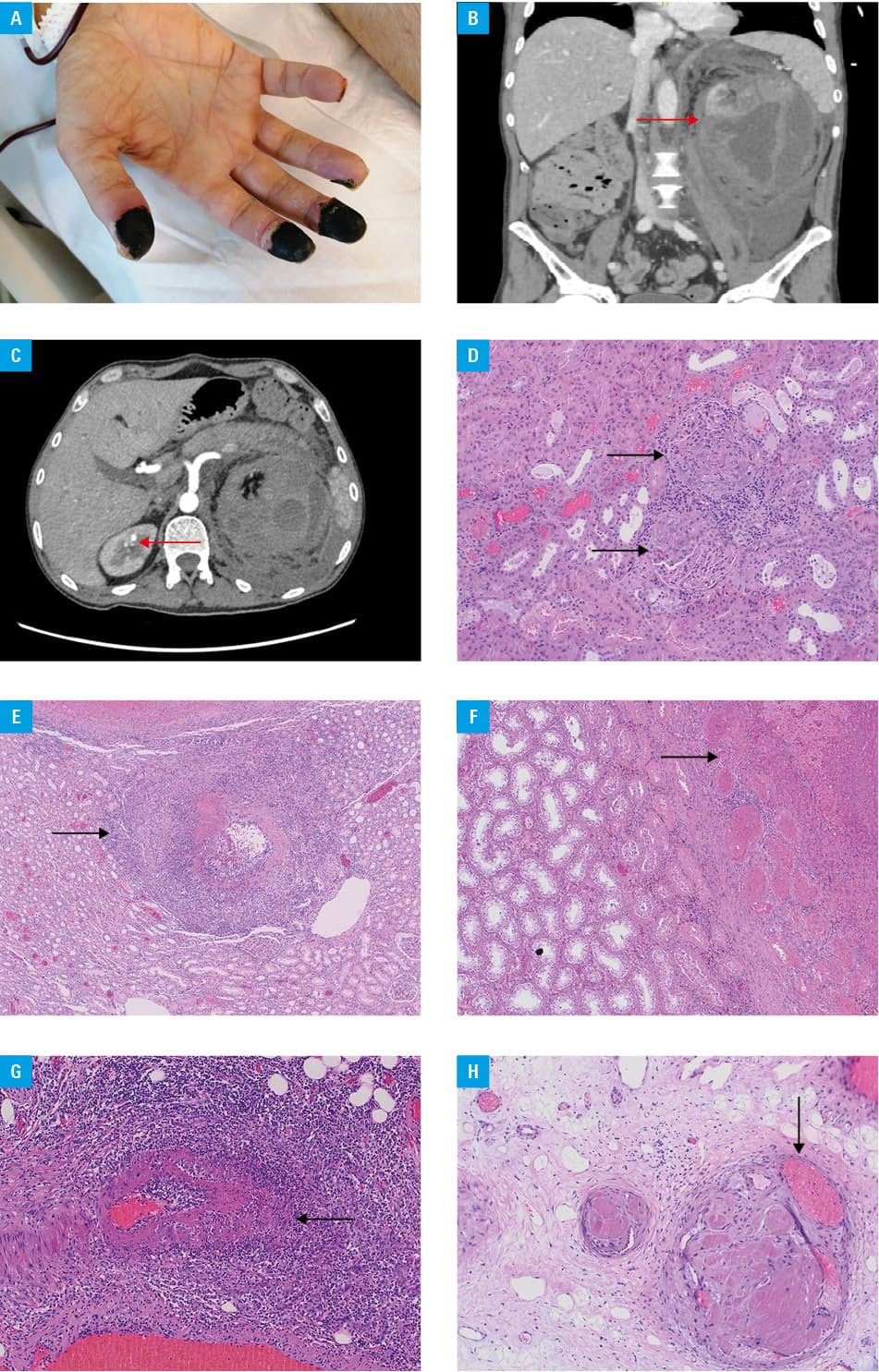
On admission to our hospital, computed tomography (CT) of the chest revealed interstitial pneumonia. The patient received 3 doses of intravenous prednisolone (500 mg daily, on the first 3 days of hospitalization), 2 sessions of plasmapheresis (days 1 and 3 of hospitalization), a single dose of cyclophosphamide (1000 mg on day 4), and a single dose of immunoglobulins (20 g on day 1). On day 6 of hospitalization, he reported sudden onset of severe left‑sided abdominal pain and rapidly developed hypovolemic shock. CT angiography of the abdomen showed a ruptured left kidney and a hematoma in the right kidney, multiple aneurysms in both kidneys (Figure 1B and 1C), and splenic granulomas. Left‑sided nephrectomy was urgently performed. Histopathologic examination showed small and medium‑sized vessel vasculitis with fibrin necrosis and mesangial proliferative glomerulonephritis with necrosis and cellular crescents (Figure 1D and 1E). Shortly thereafter, the patient developed scrotal pain and bilateral testicular hematoma was found on ultrasound examination. Bilateral orchidectomy was performed due to increasing scrotal pain refractory to analgesics and serum testosterone concentration of 6.7 ng/ml (RR, 8.64–29 ng/ml), indicating hormonal testicular insufficiency. Histopathologic examination showed hemorrhagic necrosis with granulomas and small vessel vasculitis consistent with GPA (Figure 1F and 1G). Intensive treatment with 4 doses of rituximab (total, 2 g) was administered. Follow‑up laboratory tests showed a c‑ANCA titer of 1:10, a PR3 level of 13 IU/ml, and leukopenia. On day 34 of hospitalization, the patient experienced gastrointestinal bleeding. Abdominal CT, gastroscopy, and colonoscopy did not identify the source of the bleeding. Laparoscopy revealed a microperforation of the small bowel. Four days later, worsening anemia led to reoperation—small bowel resection was performed. Histopathologic examination showed vasculitis with fibrin necrosis and neutrophil infiltrate, changes more typical of PAN than of GPA (Figure 1H). The patient developed multiorgan dysfunction with respiratory and cardiac failure (ejection fraction, 15%). He was transferred to an intensive care unit, where he received mechanical ventilation, broad‑spectrum antibiotic therapy, and antiulcer and antithrombotic prophylaxis. A CT scan of the head showed numerous microhemorrhages. Despite treatment, the patient’s condition remained critical. He died on day 93 of hospitalization.
Both types of vasculitis, GPA and PAN, are treated in a similar way. Our patient received full state‑of‑the‑art treatment, but the disease was highly aggressive with many complications. The mortality rate for severe vasculitis is high, reaching about 53%.4,5
- Almaani S, Fussner LA, Brodsky S, et al. ANCA‑associated vasculitis: an update. J Clin Med. 2021; 10: 1446. | Crossref
- Hoang MP, Park J. Vasculitis. In: Hoang MP, Selim MA, eds. Hospital‑based Dermatopathology. Cham: Springer; 2020; 245‑296. | Crossref
- Ralli M, Campo F, Angeletti D, et al. Pathophysiology and therapy of systemic vasculitides. EXCLI J. 2020; 19: 817‑854.
- Zhang Y, Guo J, Zhang P, et al. Predictors of mortality in critically ill patients with antineutrophil cytoplasmic antibody‑associated vasculitis. Front Med (Lausanne). 2021; 8: 762004. | Crossref
- Rodriguez‑Pla A, Rossello‑Urgell J. Trend and geographic disparities in the mortality rates of primary systemic vasculitis in the United States from 1999 to 2019: a population‑based study. J Clin Med. 2021; 10: 1759. | Crossref
ARTICLE INFORMATION