
Hydatid liver cyst rupture complicated with pleural empyema: a long way to the diagnosis


 CC BY-NC-SA 4.0
Hydatid liver cyst rupture complicated with pleural empyema: a long way to the diagnosis
CC BY-NC-SA 4.0
We present a case of a 52‑year‑old woman with a history of a liver hydatid cyst diagnosed about 20 years before. The cyst was recognized as Echinococcus granulosus with a serological enzyme‑linked immunosorbent assay. At the time of the diagnosis, the patient refused surgery and periodically received albendazole.
The first symptoms appeared in December 2023, during the patient’s stay in a psychiatric hospital due to alcohol addiction and adjustment disorders. She reported flank pain radiating to the right shoulder and was transferred to a local surgery department. There, based on computed tomography (CT), hydatid cyst rupture was suspected; however, no surgical procedure was conducted, and albendazole was commenced. During her stay at the psychiatric facility, the patient displayed symptoms of pneumonia and was treated with piperacillin‑tazobactam. A follow‑up CT scan showed fluid in the right pleura. Subsequently, in February 2024, the patient was transferred to a pneumonology department (outside our center) for video‑assisted thoracoscopic surgery (VATS). According to available documentation, serosanguineous fluid with “white necrotic masses” was drained, but we did not have access to laboratory test results. Two weeks after discharge, the patient was admitted to a district hospital with right pleural pain and cough with blood‑streaked, purulent sputum production. Meropenem was administered with no clear clinical improvement. A follow‑up CT scan showed signs of right pleural empyema with suspected communication with the liver cyst (Figure 1A). The patient was transferred to our center for further diagnostics and treatment.
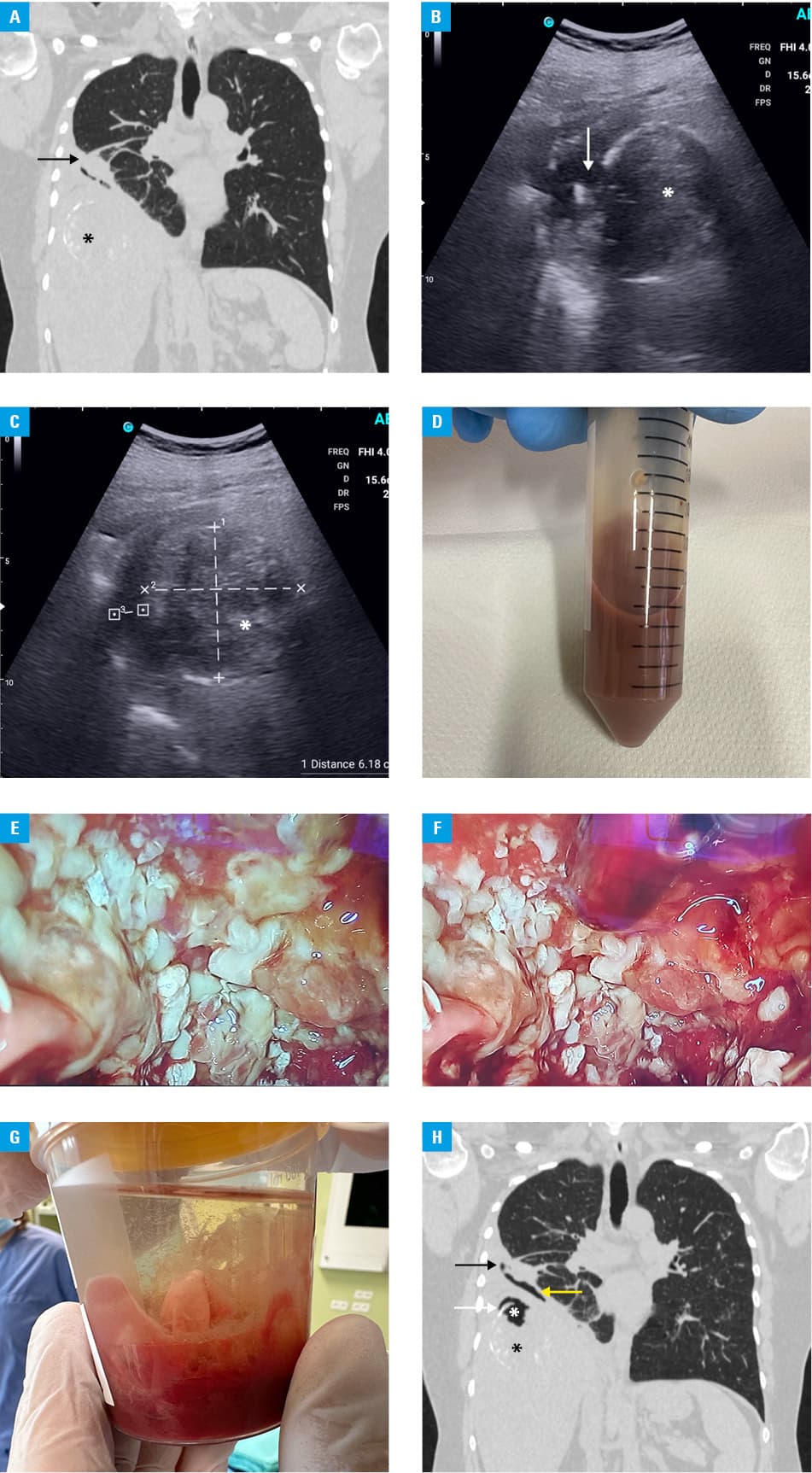
Upon admission in March 2024, she was in surprisingly good general condition. On physical examination, features of fluid in the right pleural cavity were noted. Ultrasonography showed complex, loculated pleural effusion in the right pleural cavity and a ruptured hydatid cyst in the liver (Figure 1B and 1C). Thoracentesis was performed, and bloody‑purulent fluid (Figure 1D) was drained, with laboratory features of empyema (pH, 6.623; 93% granulocytes). During VATS, a large volume of pus was evacuated, exposing the pleural cavity covered with “tufts” of fibrous tissue (Figure 1E and 1F). Histopathologic examination of the collected specimens (Figure 1G) showed necrotic‑purulent content with numerous neutrophils and eosinophils. No fragments of the parasite were found, and polymerase chain reaction tests for Echinococcus were negative, probably due to advanced necrosis. Doubts arose as to the correct identification of Echinococcus. A Western‑Blot test performed on serum confirmed the presence of E. granulosus and excluded E. multilocularis. Fluid drainage, along with meropenem and albendazole (800 mg/day) treatment were continued, resulting in resolution of cough and chest pain, and reduction of inflammatory marker levels. The patient remained in good general condition and was transferred to the care of a liver surgeon (Figure 1H).
Echinococcosis is an endemic disease,1 infrequently encountered outside endemic regions. In 2021, a total of 26 new echinococcosis cases were reported in Poland.2 Consequently, diagnosis and treatment of rare complications, such as thoracic involvement,3 present a significant challenge due to limited clinical experience.
Cyst rupture can occur spontaneously (due to lesion growth and pressure within the cyst), after injury, or during albendazole treatment.4 Symptoms depend on the location of the lesion and may include cough, fever, dyspnea, and hypotension, resembling pneumonia.5
- Borhani M, Fathi S, Lahmar S, et al. Cystic echinococcosis in the Eastern Mediterranean region: neglected and prevailing! PLoS Negl Trop Dis. 2020; 14: e0008114. | Crossref
- European Centre for Disease Prevention and Control. Echinococcosis. In: ECDC. Annual epidemiological report for 2021. Stockholm: ECDC; 2024.
- Manterola C, Otzen T. Hepatic echinococcosis with thoracic involvement. Clinical characteristics of a prospective series of cases. Ann Hepatol. 2017; 16: 599‑606. | Crossref
- Karakaya K. Spontaneous rupture of a hepatic hydatid cyst into the peritoneum causing only mild abdominal pain: a case report. World J Gastroenterol. 2007; 13: 806‑808. | Crossref
- Bulut N, Dagıstanli S. A case of ruptured pulmonary hydatid cyst of the liver and review of the literature. Case Rep Radiol. 2017; 2017: 7639056. | Crossref
ARTICLE INFORMATION