
New diagnostic technologies in laboratory medicine: potential benefits and challenges
Key words: clinical laboratory services, decision support system, machine learning, point-of-care systems, sensitivity and specificity


 CC BY-NC-SA 4.0
New diagnostic technologies in laboratory medicine: potential benefits and challenges
CC BY-NC-SA 4.0
Laboratory tests play a central role in medicine, as they help to make diagnoses, assess prognosis and risk of disease, and monitor therapies, thus contributing to 70% of all medical decisions. This cross‑sectional function offers great potential for technologic and organizational innovation to influence health care as a whole. In recent years, a variety of technologies have emerged and entered the field of medical research, or even medical care. A new generation of biosensors enables laboratory tests to be carried out at the point of care and allows for faster medical decisions. Modern devices allow for patient‑centric blood sampling, which eliminates the need for painful blood draws, patient traveling, and limits the workload of health care professionals. Analytical techniques, such as metabolomics, lipidomics, or proteomics can identify biomarkers extremely sensitively, even down to individual cells. Pharmacogenomics allows for determination of genetic polymorphisms that predict a response to chemotherapeutic agents. Machine‑learning approaches can handle large amounts of multilayered data for diagnostic applications. However, this enormous diagnostic potential is far from being utilized and only very few applications have been implemented in clinical practice. Why is this the case? In this article, we describe the key technologic fields, discuss their medical potential, and list obstacles to their implementation. In addition, we present a methodologic framework to support researchers, clinicians, and authorities in development and implementation of novel diagnostic approaches.
Introduction
Contributing to 70% of all medical decisions, laboratory testing plays a central role in clinical practice.1,2 Laboratory tests facilitate a diagnosis of diseases, and thus determine what we should treat. Laboratory tests also support a prognosis, that is, assessment of severity and risk of complications, and thus define how (intensively) we should treat our patients.3 Laboratory tests can also guide treatment through monitoring, detect diseases early, and predict future diseases.4 While all this is already happening today, we are seeing a number of developments that will further strengthen the importance of laboratory testing in medicine.
Several technologies have been developed that allow biomarkers to be determined within minutes at the patient’s bedside, at the point of care.5 The decisive advantages of this approach include significant acceleration of the health care processes and, in the best case, application in primary care without laboratory specialists. Development of microsampling techniques is moving toward a similar direction. The idea is to allow patients to collect capillary blood samples at home, saving time, effort for the health care professionals, and costs.6 The new omics technologies, which can measure hundreds of biomarkers, including proteomics, metabolomics, and lipidomics in parallel with high sensitivity—sometimes down to the level of individual cells—are already being used extensively in translational research.7,8 Pharmacogenomics demonstrates an idea of personalized or precision medicine by determining susceptibility to certain drugs through identification of genetic variants.9 Finally, artificial intelligence (AI), perhaps the most far‑reaching development, can handle large amounts of heterogeneous data and detect subtle patterns to answer diagnostic questions.10
This article discusses the expected evolution of these key innovations and their potential to address the major problems facing health care systems: the increasing number of patients, the growing shortage of qualified professionals, and the limitations of existing budgets. We will also briefly describe a methodologic framework that promotes new innovations and overcomes barriers to their implementation.
Point‑of‑care testing
Today, a majority of laboratory testing is performed in a central laboratory, where automated processes allow for a large number of heterogeneous samples to be analyzed at a relatively low cost, while maintaining a high level of quality.11 While this is efficient in terms of laboratory costs, patient management is interrupted until results are received, which may result in fragmented processes, dissatisfied patients (and professionals), and follow‑up costs. Point‑of‑care testing (POCT) is an aspect of patient‑centered care that aims to address the problem of fragmented health care.12 Utility of POCT is highly dependent on the setting and clinical problem, but the following characteristics must be met: 1) a device is easy to use, 2) reagents are robust in storage and use, 3) sensitivity is high, and 4) the device and associated reagents are safe to use.5,11,13
The implementation of POCT is particularly successful when a specific diagnostic problem is resolved for a large number of patients for whom the previous diagnostic procedure has been cumbersome or time‑consuming. A POCT assay’s most successful example illustrates another ideal feature: β-hCG–based pregnancy tests are almost entirely and independently performed by patients rather than health care professionals, which is often forgotten, since they have already become part of our daily lives.14 For decades, dipsticks have been used in primary care in diagnostics of urinary tract infections in urine.5 Another successful example is a blood glucose meter, without which self‑monitoring and self‑management of blood glucose levels in patients with diabetes mellitus would not be possible.5,15 A similar example of self‑monitoring of a chronic condition is self‑management of anticoagulation with vitamin K antagonists, which has become less common with the introduction of direct oral anticoagulants (for the latter, several rapid tests are available for emergency situations, mostly in urine and mostly qualitative, but routine monitoring is not necessary)16,17. Blood gas analyzers, despite their greater complexity, are classified as POCTs and solve the preanalytical problem of transporting arterial whole blood samples while providing fast results.18 When implemented in the emergency department, they can be used for early risk stratification, which can influence management decisions and resource allocation.19 A nice example of solving a previously unsolved problem is POCT troponin testing in primary care, which enables cardiologist‑assisted management of patients with myocardial infarction in rural areas.20 POCT is particularly useful in diagnosing infectious disease, where a single piece of diagnostic information, the presence of a pathogen, not only determines clinical management, but also leads to behavioral changes and isolation measures. Examples include SARS‑CoV‑2 antigen tests used as self‑tests during the COVID‑19 pandemic, or rapid tests to detect sexually transmitted diseases, such as HIV or chlamydia.21,22 Another illustrative example is the use of viscoelastic methods to monitor coagulation in the setting of massive bleeding (thromboelastometry / thrombelastography). Despite relatively limited evidence, the method has become widely established, because it provides clear management guidance that was previously lacking.23 The application of POCT devices can also be particularly beneficial in low- and middle‑income countries, where health care resources are often low and clinical needs are high.24 From all these cases, it is clear that a key barrier to POCT adoption is a lack of clinical need, and the key success factor is high practicality.
Various technologic advances and health care challenges have accelerated POCT development in recent years, and we can expect to see which devices shall be adopted in clinical practice. Today, the most prominent technologies for POCT are glucose biosensor strips and immunostrips (eg, lateral flow strips), which use immobilized antibodies to detect, for example, antibodies, cardiac biomarkers, or infectious agents.11 Immunostrips are read by reflectance or fluorescence spectrophotometers; quantitative measurements are possible with small readers.25 Biosensors measure blood glucose using an enzymatic reaction (glucose oxidase, glucose dehydrogenase, or hexokinase) with photometric or electrochemical detection systems.26 Several technologies have recently been introduced that will change the market in the future. Integrated cartridge systems are used to measure multiple parameters in the same instrument.27 Electrochemical sensors using nanomaterials or microfluidic technologies enable miniaturization and precision, making it increasingly used types of sensor.28,29 Microneedles allow for essentially painless sampling of blood to be analyzed by accompanying sensors.30 In addition, AI algorithms integrated with POCT will improve readout of the results and allow for better interpretation.
Patient‑centric sampling
POCT adds value in clinical settings where a rapid result is desired to guide patient management. However, when a short turnaround time is not required, it may be preferable to rely on high performance and cost‑effectiveness of advanced laboratory instruments. One attractive approach, called patient‑centered sampling or patient‑to‑lab testing, involves the use of devices that allow patients to collect samples themselves and send them to a laboratory (Figure 1). Multiple sample types, such as urine, saliva, or stool samples, can be collected. Capillary blood samples can be obtained noninvasively by a finger prick followed by blood collection on filter paper cards for dried blood spots (DBS) or into microtubes for liquid capillary blood samples.
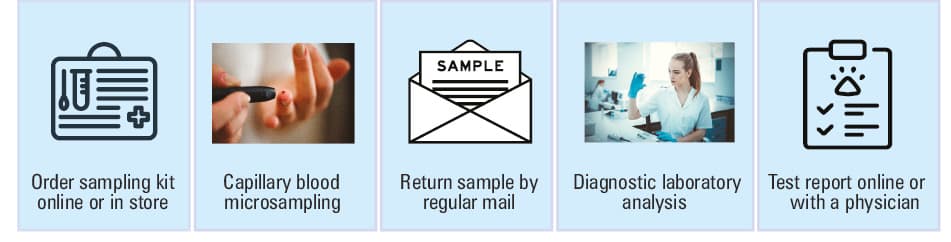
We can trace the concept of microsampling back to Robert Guthrie’s introduction of neonatal screening programs for phenylketonuria.31 In addition, longitudinal monitoring with DBS is used in the management of phenylketonuria and other metabolic disorders.32 Therapeutic drug monitoring (TDM) is an important use case for DBS to monitor and adjust the blood concentration of drugs, such as antiepileptics, immunosuppressants, antimicrobials, or antihypertensives.33 To improve follow‑up of kidney transplant recipients, home volumetric microsampling was used to measure tacrolimus levels, but also those of creatinine and hemoglobin simultaneously, combining TDM with renal function monitoring.34,35 Volumetric sampling can also offer advantages in toxicology, where drugs of abuse or markers of alcohol use can be measured both at home and in the field.36-39 In the case of infectious diseases, serologic screening for HIV, hepatitis, or syphilis has a potential to better reach high‑risk populations.40
Innovative technologies have been introduced to improve reliability, overcome problems, and enhance the user experience. A limitation called the hematocrit effect results from a variation of blood spot size with the patient hematocrit level, which can influence the levels of measured analytes.41 Novel devices allow for precise collection of a defined volume (from 2.7 µl to 50 µl) on filter paper or hydrophilic polymer tips, thus eliminating the problems associated with these methods.32,42 In addition, vacuum‑assisted sampling devices eliminate the inconvenience of fingerpricking by placing the device on the user’s arm, pressing a button to activate a lancet or microneedle array, creating a vacuum, and collecting a liquid sample into a microtube.42
Convenience of decentralized collection has a potential to further transform the patient experience. Technologic advances could enable new use cases with broader impact and participate in a successful transition to patient‑centered care, together with telemedicine consultations, digital biomarkers, or wearable sensors. In a pilot study using capillary blood collection into microtubes, glycated hemoglobin, total protein, or C‑reactive protein measurements were shown to have good interchangeability with venipuncture, while liver function tests showed only a small bias, suggesting that this method could be used for longitudinal monitoring of patients with diabetes or other commonly tested conditions.43 Using a vacuum‑assisted capillary blood collection device, it is now even possible to obtain a comprehensive metabolic and lipid panel of 20 biomarkers from a single sample measured with automated clinical chemistry analyzers.44
However, important limitations remain, and this method will not replace, but rather complement, conventional sampling. First, some analytes may not be compatible with preanalytical conditions using current technologies. Second, it requires a special effort on the part of the ordering physician and the diagnostic laboratory to ensure that appropriate methods are available for a given analysis. Third, the small sample volume may limit the number of analyses that can be performed and require prioritization of the desired parameters. Finally, the complex value chain and regulatory issues may slow the adoption of patient‑centered sampling, even in the cases where patient benefit has been demonstrated.
Metabolic phenotyping
In this section, we describe metabolic phenotyping as an advanced example of the new omics technologies. Metabolic phenotyping facilitates biochemical characterization of an individual’s physiological or pathologic conditions relevant to disease diagnosis or prognosis. It can provide clinicians with specific biologic insights, patient stratification to optimize diagnosis, and treatment strategies.45 As a complement to genotyping and RNA sequencing, mass spectrometry (MS)-based metabolomics / lipidomics has emerged as a primary tool for metabolic phenotyping, swiftly establishing its position in clinical chemistry laboratories for screening and diagnosis. High‑resolution MS offers precise mass measurement, enhancing identification of novel molecules, as well as annotation and identification through reference databases such as Lipidmaps,46 Human Metabolome Database,47 and in‑house databases. Validated analytical techniques utilizing this approach yield novel and accurate physiological insights, aiding in patient characterization.8,48,49 However, precise biologic interpretations require high analytical reproducibility with standardized and transparent data processing. Advance computational approaches are pivotal in large‑scale metabolic phenotyping analysis, facilitating detection of phenotypic variations and associated biologic pathways.50 Despite the challenge posed by the complexity of large‑scale metabolic phenotyping, integration of computational models of metabolism, particularly genome‑scale metabolic models and constraint‑based modeling of metabolism can provide mechanistic insights into genotype‑phenotype relationships, especially when integrated with relevant data.51,52 Computational algorithms are instrumental in uncovering molecular signatures, stratifying patients, and predicting phenotypes, particularly in the exploration of multiomics data.
Pharmacogenomics
Pharmacogenomics is the study of how an individual’s genetic makeup affects their response to drugs. This field combines pharmacology (the study of how drugs work in the body) with genomics (the study of an individual’s genetic makeup) to develop personalized drug treatments. By understanding how genetic variations affect a person’s response to medications, health care providers can adjust treatment plans to optimize efficacy and minimize side effects. Pharmacogenomics has a potential to revolutionize the way drugs are prescribed and administered, providing patients with more personalized and effective treatment options.
Despite the huge potential to improve health care, several barriers and challenges remain to incorporating pharmacogenomics into routine clinical practice, including a lack of standardized guidelines, its cost and accessibility, data interpretation, a limited evidence base, ethical and legal considerations, as well as patient acceptance and understanding, and various technical challenges. Due to rapid development of modern sequencing and genotyping technologies, the main technical hurdles for achieving sufficiently fast turnaround time for pharmacogenomic testing, ensuring timely, personalized, and effective health care interventions based on individual genetic profiles prior to the start of a therapy, have been largely overcome, while other major hurdles still persist in many countries. Other important challenges that are being overcome at increasing rate in recent years are the lack of guidelines and the evidence level for many gene‑drug pairs, which is well reflected by the growing information on the Pharmacogenomics Knowledge Base. This database is an important and valuable resource for researchers, clinicians, and patients interested in personalized medicine, and understanding how genetic differences can influence individual responses to medications. In particular, it enables diagnostic laboratories to maintain up‑to‑date interpretation of their pharmacogenetic test results by providing access to curated collection of guidelines and information about how genetic variations affect drug efficacy, toxicity, and other pharmacologic properties.
The current example of successful clinical implementation of pretreatment dihydropyrimidine dehydrogenase (DPD) deficiency in Europe provides important insights on how different countries faced and overcame various major implementation barriers and challenges. In particular, it highlights the central role of the treating physicians who are the main prescribers of pharmacogenetic tests.
Fluoropyrimidines (FPs), such as 5‑fluorouracil (5‑FU) and its oral prodrug capecitabine, are among the most frequently used anticancer drugs. However, severe FP‑related toxicities occurring in 10% to 40% of the patients (depending on the treatment regimen) are an important drawback of these drugs, causing severe morbidity or treatment cessation. Reduced activity of DPD, the rate‑limiting enzyme for 5‑FU catabolism, is one of the main causes of FP‑related toxicity. Patients with reduced DPD activity are at a high risk of supratherapeutic drug concentrations with standard dosing, and consequently are at a risk of developing severe or sometimes even lethal FP‑related toxicities. DPD activity is highly variable in the population, with an estimated 3%–8% being partially DPD‑deficient, which can partly be attributed to genetic variability in its encoding gene, DPYD. Four variants have shown consistent correlations with increased FP toxicity risk, and routine pretreatment genotyping of these 4 variants for genotype‑guided FP dosing and FP toxicity prevention has been implemented in most European countries. A recent systematic review and meta‑analysis of 35 studies encompassing 13 939 patients showed that carriers of these DPYD risk variants have 25.6 times increased risk of FP–related mortality.
In 2020, the European Medicines Agency (EMA) recommended DPD deficiency testing in clinical practice by genotyping for the presence of certain of the 4 established DPYD risk variant alleles or by phenotyping. A recent survey analyzed the adoption of DPD testing across Europe both before (2019) and after (2021) the release of the EMA recommendations. The findings demonstrated a significant increase in genotype testing after publication of the recommendations, with 87% of countries respectively reporting upticks. Moreover, 21 respondents (27%) indicated implementation of new local guidelines. Notably, reimbursement for both tests expanded in 2021, with only 4 countries (18%) offering no coverage for any testing. In 2019, the main driver for implementation was retrospective assessment of toxicity (39%), whereas in 2021, guideline publication emerged as the primary impetus (40%). Despite persistent challenges, such as a lack of reimbursement and recognition of clinical relevance, these hurdles decreased after publication of the recommendations. Following EMA guidance, 25% of the countries reported encountering no obstacles in adopting new testing practices. The study concluded that EMA recommendations have facilitated the implementation of DPD deficiency testing in Europe and underscored the significance of reimbursement and clear clinical guidelines. In line with findings from other studies, the prescribers (ie, oncologists in this case) were the most often mentioned major implementation stakeholders in the survey, both before and after the EMA recommendations, while oncologic societies became the second most important stakeholders for implementation of the recommendations, emphasizing the key importance of the awareness of clinical relevance among the prescribing clinicians and their societies for successful implementation of a pharmacogenetic test.
Another instructive example is genotype‑based warfarin dosing (CYP2C9 and VKORC1). This case was studied intensively at the beginning of the millennium, and was treated as a model example of precision medicine. However, when after several randomized controlled trials it failed to show a clear benefit, and most patients in the Western world switched to direct oral anticoagulants, attention waned.53 The concept has been pursued in India and China, the algorithms have been improved, and recent trial data suggest that a clear benefit is crystallizing.54
Machine learning
Machine learning (ML) is one of the most influential technologic innovations in recent years and has already impacted many aspects of our lives (eg, instant language translation, voice assistance on our smartphones, etc.). ML has a potential to revolutionize health care by integrating data from new analytical techniques, finding patterns that humans typically do not perceive, and continuously monitoring the state of our patients.55 Figure 2 illustrates potential applications of ML in medicine. However, while much effort is being invested in developing these models, why are so few reaching clinical practice? One of the reasons is that a large part of this effort comes from outside of the health care and fundamental steps of the development process (discussed in the next part of the article) are often overlooked. For ML to benefit our patients, we as doctors and medical scientists must familiarize ourselves with ML and actively participate in its further development.56

ML is one of the main branches of AI. Broadly speaking, it describes training of a computer program (also called a model) on training data to perform a task typically associated with human‑level intelligence.57 As compared with the human brain, ML algorithms have greater potential for handling large multidimensional datasets and probabilities.58 This makes them especially useful in a world where the amount of available patient data through electronic health records and new laboratory techniques steadily increases.59,60
One of the key capabilities of ML models is classification, which can be used to diagnose patients or stratify them. The most commonly used approach for classification ML models is supervised learning.61 This approach uses prelabeled data for training, meaning the diagnosis according to some reference standard is already known.62 As an example, our group recently developed a model to rapidly diagnose life‑threatening adverse drug reaction in heparin‑induced thrombocytopenia (HIT). We used the data of 1393 patients with suspected HIT and a heparin‑induced platelet activation assay as a reference standard.63 The model demonstrated superior performance to the currently recommended diagnostic algorithm proposed by the American Society of Hematology.64 For stratification, a French group recently published a model that can identify a subtype of acute leukemia solely based on routine hematology laboratory parameters, making the diagnosis accessible even in settings where experts and costly reference tests are unavailable.65
Another key application of ML models is pattern recognition, which can be used to identify patient subgroups. Typically, these ML models use an unsupervised learning approach, meaning that the subgroups are not known before (unlabeled data).66 An illustrative example of this approach is a study by Cikes et al,67 which integrated echocardiographic measurements, clinical data, and laboratory tests to identify the phenotype of subgroups of patients with heart failure who would benefit from cardiac resynchronization therapy.
For treatment monitoring and prognosis, a commonly used approach is reinforcement learning. This approach trains a model that can act in a changing environment and is rewarded if it performs a desirable action.68 Zeng et al69 trained a model that aims to monitor anticoagulation with warfarin after heart valve replacement. The model was rewarded when the international normalized ratio was within the target range.
While classification, pattern recognition, and prediction make ML models ideal for assisting physicians with diagnosis, patient stratification, and monitoring, few ML models have reached clinical practice. The American Food and Drug Administration (FDA) lists 692 medical devices or software that utilize some form of ML.70 Most of these devices (76.7%) are used in radiology, which embraced ML early on.70 What are the barriers to ML implementation in other fields?
For an ML model to be effective in improving patient care, a relevant clinical need must be met.71 This means that clinicians, patients, and all other relevant stakeholders must be involved from the planning phase.72 Another major problem is that models are often trained on data collected for a different purpose, which increases the risk of training biases.73 Appropriately designed studies should therefore be used. A recent survey by the American Medical Association found that only 60% of the polled physicians were willing to implement ML models into their clinical practice. Moreover, many of the models available today are actually “black boxes.” As a result, interpretable ML techniques have been developed in recent years to provide a better understanding of how models make predictions.74 These considerations show that clinician involvement and a structured framework for development of new diagnostic tests are essential for clinically useful ML.
Methodologic framework
While many of novel technologies are widely used in research, only a small fraction has been implemented in routine clinical practice. What is the reason for this huge implementation gap and what are the barriers? There are various reasons, ranging from deficiencies in the development and validation process and lack of clinical problems to regulatory issues.10 What is missing, is a standardized methodologic framework that researchers can follow, covering all aspects of successful implementation. We have proposed such a methodologic toolkit, which we briefly present in this section (Figure 3).4,10,75,76 This framework builds on decades of experience of the research community with a variety of diagnostic tools and addresses key methodologic aspects. It is structured in phases because a phased approach has important advantages. It ensures that no important issues are overlooked, that the most critical aspects are addressed first, and that the more expensive phases of development are not implemented until all basic aspects have been successfully completed.

Abbreviations: LC‑MS, liquid chromatography mass spectrometry; ML, machine learning
Clinical needs and research question
A diagnostic instrument that does not meet a clinical need will, at best, go unused and, at worst, harm patients in various ways.77 Health care professionals, patients, and other stakeholders need to be involved to address this issue as early as possible. There are the following crucial questions that should be asked for this purpose75: 1) What are the patient management problems and how can a new tool help? 2) Is there an existing solution? 3) How does the new tool contribute to the existing solution? 4) Is the tool feasible for clinical use? By answering these queries, a research question is formed, which guides us through the development process.
Development
The methodologic details of the development phase can be derived from the general research question. The most important aspects are the right population and setting, consecutive enrollment of participants, and realistic implementation of the reference and index tests. A prospective study (cross‑sectional or cohort study or randomized controlled trial), in contrast with a retrospective study, can ensure good selection, establish some form of blinding, and achieve high quality of all measurements. A realistic population of patients is crucial, as it influences prevalence and patient characteristics, 2 factors that critically affect performance of diagnostic tests.
Implementation and validation
Appropriate validation and implementation, both seemingly self‑evident, are often cut short, which may lead to a failure of new diagnostic tests. In general, validation should include external validation, that is, validation in a different setting with a different patient population. The same methodologic principles should be followed as in the development phase, in particular a prospective cohort design rather than a case‑control study. Just as important is the implementation of new diagnostic tools into modern health care processes. Health care professionals, and even patients, have busy schedules and will only use the tools that seamlessly integrate into their workflow. The involvement of future users is also extremely valuable at this stage.
Regulatory approval and impact evaluation
Two additional steps are required before widespread adoption of new tools: regulatory approval and study of their impact on clinical and health outcomes. In most countries, new diagnostic tools cannot be used in patients without regulatory approval. The major authorities, such as the FDA and the European Union, offer 2 main approval routes: as a medical device or as an in vitro diagnostic tool. There is a special process for ML algorithms or “software as a medical device.” The actual approval process is based on a risk assessment of the product, and is beyond the scope of this article.10 The final step is to analyze the impact of the diagnostic test on clinical practice. Both clinical end points (eg, the number of correct or incorrect diagnoses, adverse events, in‑hospital mortality) and health outcomes (eg, time to diagnosis, length of hospital stay) are analyzed. An ideal study design is a pragmatic randomized clinical trial, but this is very costly and rarely funded by sponsors.
Conclusions
As shown in this article, many new technologies are available. They not only have a great diagnostic potential, but they could also help solve health care problems. They could speed up processes, reduce the burden on the health care system, save costs, and prevent misdiagnosis and wrong treatment. And the new technologies give us a glimpse of the future of diagnostics. However, there are still very few applications in clinical practice. This adoption gap not only hinders progress, but also blocks solutions to major problems, such as staff shortage, cost pressure, and increasing patient volumes. It is therefore important to understand the barriers and obstacles and to provide tools to overcome them. With the above framework, we want to stimulate discussion and provide guidance to researchers, physicians, start‑ups, and authorities.
- Strengthening Clinical Laboratories CDC. 2018. https://www.cdc.gov/csels/dls/strengthening‑clinical‑labs.html. Accessed May 14, 2024.
- Graber ML. The incidence of diagnostic error in medicine. BMJ Qual Saf. 2013; 22: ii21‑ii27. | Crossref
- Miettinen OS. Epidemiological research: terms and concepts. Dordrecht: Springer Netherlands; 2011. | Crossref
- Nagler M. Translating laboratory tests into clinical practice: a conceptual framework. Hamostaseologie. 2020; 40: 420‑429. | Crossref
- Price CP. Regular review: point of care testing. BMJ. 2001; 322: 1285‑1288. | Crossref
ARTICLE INFORMATION