
External jugular vein aneurysm: unexpected clinical outcome in a patient diagnosed with a tumorous lesion of the parotid gland

 CC BY 4.0
External jugular vein aneurysm: unexpected clinical outcome in a patient diagnosed with a tumorous lesion of the parotid gland
CC BY 4.0
Aneurysms of the external jugular vein (EJV) are extremely rarely reported in the literature. They may occur as congenital lesions developing without a known cause, secondary to trauma, hypertension, and heart disease (atrial fibrillation, coronary artery disease), or as a complication of endovascular procedures within the head and neck vessels.1 Most venous aneurysms are asymptomatic. In some cases, they may present as a palpable, nonpainful mass that enlarges during the Valsalva maneuver.2 One of various complications of venous aneurysms is thromboembolic event, such as deep vein thrombosis and pulmonary embolism.3
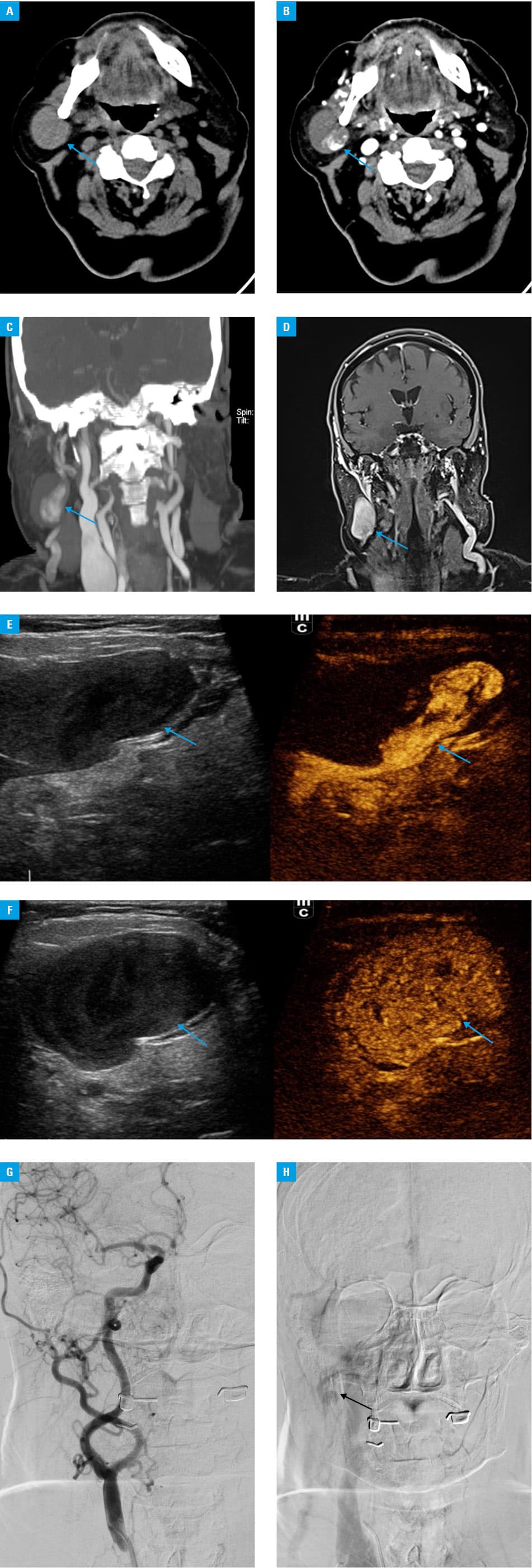
An 80‑year‑old woman was admitted to a hospital due to a right‑sided mass of the gonial angle that has been growing for a year. She was in a car accident and has been taking rivaroxaban due to atrial fibrillation for a year. The patient was referred for an outpatient computed tomography scan, further verified by magnetic resonance imaging due to a clinical suspicion of a neoplastic lesion. A cross‑sectional scan showed a hyperintense tumorous lesion within the salivary gland, in the proximity of the lower part of the mandibular body and angle on the right side, more likely an aneurysm of the external carotid artery than a malignancy (Figure 1A–1D). Laboratory test results showed no significant abnormalities. Doppler ultrasound showed hypoechoic fluid collection with very slow blood inflow on compression of the EJV and on diastole; on contrast‑enhanced ultrasound, the described lesion showed slow contrast inflow from the posterior wall, while it was uniformly filled with contrast at a later stage (Figure 1E and 1F). Altogether, it indicated venous, not arterial, aneurysm with no thrombus within the lumen. The examination ruled out a neoplasm of the right parotid gland. To confirm the nature of the lesion, carotid and jugular angiography was performed, on which no apparent arterial lesions were present. However, the late venous phase of the study depicted a slow‑flow accumulation of the contrasted blood at the site of the EJV (Figure 1G and 1H). No endovascular treatment was proposed after interventional radiologist and otolaryngologist consults. The patient was referred to a vascular surgery department, where parotidectomy with concomitant vascular lesion removal was proposed. However, the patient did not consent to the procedure, because of possible complications, including hemorrhage and facial nerve palsy. Therefore, an alternative algorithm of clinical observation and follow‑up imaging every 6 months was implemented.
Differential diagnosis of palpable masses within the lateral neck region includes several etiologies, comprising both benign lesions (developmental abnormalities, ie, external laryngeal diverticula, reactive lymph nodes, abscess) and malignancies. Venous aneurysmal dilatations are rare and often remain undiagnosed due to an absence of clinical symptoms. The most common location of neck venous aneurysms is the internal jugular vein. However, the superficial location of the EJV predisposes it to traumatic injuries. Recent trauma and cardiovascular disease are reported as some of the most significant risk factors for jugular phlebectasia. A majority of jugular aneurysms can be left untreated, requiring only clinical surveillance. Symptomatic cases (pain, tenderness, compression of adjacent structures) require interventions (surgical or ultrasound‑guided compression) due to a potential thrombus or for esthetic reasons.4,5
- Nucera M, Meuli L, Janka H, et al. Comprehensive review with pooled analysis on external and internal jugular vein aneurysm. J Vasc Surg Venous Lymphat Disord. 2022; 10: 778‑785. | Crossref
- Parashi HS, Rawekar KH, Joshi MM, et al. Saccular aneurysm of external jugular vein with partial thrombosis. Asian Cardiovasc Thorac Ann. 2018; 26: 625‑627. | Crossref
- Kovacs T, El Haddi S, Lee WA. Internal jugular venous aneurysm‑a report of two cases with literature review. J Vasc Surg Cases Innov Tech. 2020; 6: 326‑330. | Crossref
- Chapman DR, Ho RE, Gangemi A. A case report of a rare, spontaneous external jugular vein aneurysm. Int J Surg Case Rep. 2018; 52: 8‑10. | Crossref
- Boutakioute B, Benzalim M, Chehboun A, et al. Spontaneous external jugular vein pseudoaneurysm: a rare cause of neck swelling. Radiol Case Rep. 2022; 17: 4790‑4794. | Crossref
ARTICLE INFORMATION