
Kidneys and commonly used medications: how to reduce a risk of acute kidney injury in everyday practice?
Key words: acute interstitial nephritis, acute kidney injury, acute tubular injury, crystalline nephropathy, drug-induced kidney injury


 CC BY-NC-SA 4.0
Kidneys and commonly used medications: how to reduce a risk of acute kidney injury in everyday practice?
CC BY-NC-SA 4.0
Medications are a common cause of acute kidney injury (AKI). There are various mechanisms in which medications can induce AKI, and better understanding of their pathophysiology can aid in clinical recognition, treatment, and prevention of this condition. Hemodynamic‑mediated AKI is often associated with drugs that alter renal perfusion and its autoregulation. Acute tubular injury is a result of direct renal tubular cell toxicity. Acute interstitial nephritis is a T‑cell–mediated immune hypersensitivity reaction to drugs leading to tubule‑interstitial inflammation and AKI. Crystalline nephropathy can be caused by crystallization of medications or by altered urinary chemistry caused by medications. Some medications can evoke AKI through uncommon mechanisms, such as glomerulonephritis and thrombotic microangiopathy. Notably, some medications may cause a phenomenon called “pseudo‑AKI,” where serum creatinine is elevated without actual reduction in kidney function. Medications commonly used in clinical practice are reviewed with a focus on their mechanisms of injury, diagnosis, treatment, and prevention. Recognizing common medications associated with AKI is an important first step in reducing the risk of this condition. For each medication, understanding general and specific risk factors for AKI allows for early identification and timely discontinuation of offending agents. These measures can help mitigate the risk of AKI and promote renal recovery.
Introduction
Acute kidney injury (AKI) is defined as an abrupt decline in glomerular filtration rate (GFR) resulting in increasing serum creatinine (SCr) and decreasing urine output.1 AKI is common in hospitalized patients, especially those in an intensive care unit (ICU).2-4 AKI is also prevalent in ambulatory settings, and is associated with significant morbidity and mortality.5,6 Medications are one of the common causes of AKI, and this requires prompt recognition.7 In this review, we describe common mechanisms of drug‑induced AKI, diagnosis, treatment, and approaches to ameliorate the risks of AKI.
Epidemiology of acute kidney injury
Prevalence of AKI ranges from below 1% to 66%, with significant variation owing to different AKI definitions and clinical settings.8 In high‑income countries, the estimated incidence of AKI in non‑ICU hospitalized patients ranged between 3% and 18.3%, whereas in the ICU setting, it could be up to 30%–40%.3,8 In ambulatory patients, the incidence of AKI was 500/100 000 person‑years in individuals not requiring dialysis, and 30/100 000 person‑years in those requiring dialysis.9 The Kidney Disease Improving Global Outcomes (KDIGO) workgroup suggests that nephrotoxic agents contribute to AKI in 20%–30% of cases.6 There are several risk factors for drug‑induced AKI, including age above 65 years, volume depletion, female sex, drug‑drug interactions, and other comorbidities, such as diabetes mellitus (DM), chronic kidney disease (CKD), liver disease, heart failure (HF), cancer, or anemia.6,8,10
Renal handling of drugs
Drugs or their metabolites are delivered to the kidneys and are excreted by glomerular filtration and / or tubular secretion. The drugs that undergo filtration are immediately exposed to the apical surface of the proximal tubular cells and can be toxic. From the tubular lumen, drugs are transported into cells via active transporters or endocytosis. For example, cationic drugs, such as aminoglycosides, have innate attraction to the negatively charged apical membrane, and subsequently bind to an endocytic receptor complex where they are translocated into the lysosomal compartment. While in the cell, a lack of enzymes capable of metabolizing these drugs can lead to drug accumulation and tubular injury.7,10
Tubular secretion of drugs occurs primarily via proximal tubular transport from peritubular capillaries to the proximal tubular cells and subsequently the tubular lumen. Drugs are transported into proximal tubular cells via active human organic anion transporters (hOATs) and human organic cation transporters. They then traverse across the tubular cells and rely upon apical efflux transporters, such as multidrug resistant proteins (MRP2 and MRP4) to export them into the tubular lumen. Disruption of the efflux mechanisms can also lead to intracellular accumulation and tubular injury. A classic example is tenofovir, which is delivered to the proximal tubule via a hOAT, where it can accumulate and cause proximal tubular dysfunction.7,10,11
Drugs that can cause creatinine elevation without causing acute kidney injury (pseudoacute kidney injury)
Several drugs can influence glomerular filtering or tubular secretion of creatinine, which leads to an increase in SCr but does not reflect pathologic injury (pseudo‑AKI).12 In addition, some drug formulations may contain creatinine, which results in an elevation of plasma creatinine without actual change in renal function.7 There are also scenarios where drug metabolites can interfere with creatinine measurement.7 In these situations, alternative biomarkers, such as cystatin C or direct measurement of GFR may be used to estimate and assess kidney function.13 A list of common medications and their mechanisms are shown in Table 1.
Mechanism of pseudo‑AKI | Medications |
Abbreviations: ABL, Abelson murine leukemia; ACEI, angiotensin‑converting enzyme inhibitor; ALK, anaplastic lymphoma kinase; AKI, acute kidney injury; ARB, angiotensin receptor blocker; BCR, breakpoint cluster region; B‑RAF, B‑rapidly accelerated fibrosarcoma; CDK, cyclin dependent kinase; HER2, human epidermal growth factor receptor‑2; MET, mesenchymal epithelial transition; PARP, poly ADP‑ribose polymerase; SGLT2i, sodium‑glucose cotransporter 2 inhibitor | |
Alteration of creatinine secretion in proximal tubular cells | Cimetidine |
Trimethoprim | |
Dronedarone | |
Cobicistat and dolutegravir | |
Tyrosine kinase inhibitors (eg, imatinib, sorafenib, sunitinib) | |
Pyrimethamine | |
Targeted chemotherapy (ALK inhibitors, MET inhibitors, CDK4/6 inhibitors, PARP inhibitors, BRAF inhibitors, BCR‑ABL inhibitors, HER2 inhibitors) | |
Alteration of glomerular blood flow | ACEIs/ARBs (lisinopril, captopril, losartan, irbesartan, olmesartan) |
SGLT2is (empagliflozin, dapagliflozin, canagliflozin) | |
Fenofibrate | |
Interference with creatinine analysis | Cefoxitin |
Flucytosine | |
Increased catabolism | Corticosteroids |
Formulation containing creatinine | Dexamethasone |
Mechanisms of drug‑induced acute kidney injury
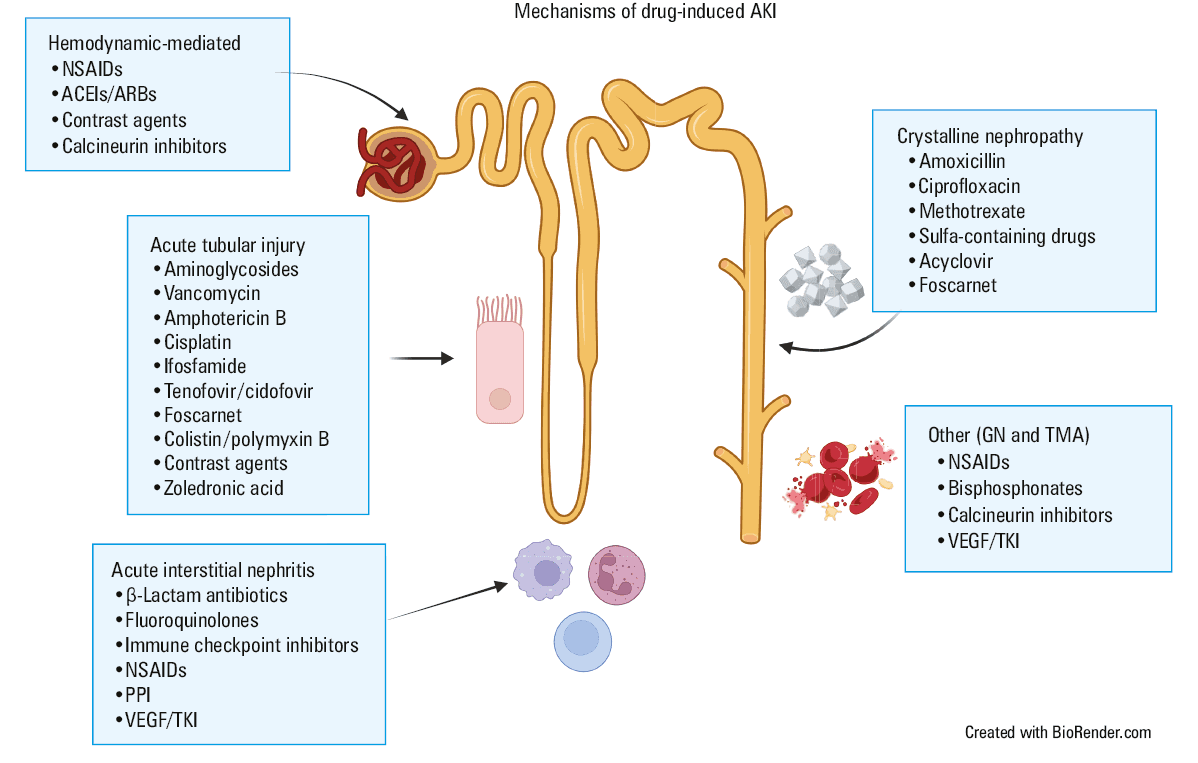
Hemodynamic‑mediated acute kidney injury
Several medications can alter renal hemodynamics. The most common drugs include those that inhibit the renin‑angiotensin‑aldosterone system (RAAS), nonsteroidal anti‑inflammatory drugs (NSAIDs), and diuretics. Side effects of these drugs may include prolonged decrease in perfusion and ischemic injury.14-17 There are certain risk factors, such as advanced age, CKD, volume depletion, and prior kidney transplantation that can affect renal autoregulation and increase the risk of AKI.18,19
Acute tubular injury
Direct tubular injury can result from an interaction of a drug with the tubular epithelial cells in the kidneys. Alternatively, this has been described as acute tubular necrosis. This is a common cause of AKI reported for various classes of drugs. Often, there is a dose‑dependent effect. In many cases, there are preventive strategies to limit nephrotoxicity, but there are often limited treatment options.7 Common drugs that can cause acute tubular injury (ATI) include aminoglycosides, vancomycin, platinum‑based chemotherapy, or amphotericin B.
Acute interstitial nephritis
Drug‑induced acute interstitial nephritis (AIN) has been described as a T‑cell–mediated type‑4 delayed hypersensitivity reaction. Classically, this has been associated with a triad of rash, fever, and peripheral eosinophilia, but this historic ensemble only occurs in less than 10% of cases.20 There are over 120 drugs that have been associated with AIN, but the most common include NSAIDs, β-lactam antibiotics, fluoroquinolones, proton pump inhibitors (PPIs), and immune checkpoint inhibitors (ICIs).7,21,22 Of β-lactam groups, methicillin is the most common AIN‑causing agent with an incidence up to 17%.23
A temporal relationship (commonly 7–10 days after an initial drug exposure), and no other explanation of AKI increase a suspicion of AIN.24 Occasionally, patients may develop fever or morbilliform rash in response to β-lactam antibiotics, sulfa drugs, and phenytoin.20 However, a rash is uncommon with NSAIDs and PPIs.20,24 Complete blood count may show eosinophilia but this finding is also nonspecific and can occur in other AKIs, such as cholesterol emboli and vasculitis.20,25 Urinalysis may show mild to moderate proteinuria, though typically below 1 g/day. Sterile pyuria may be observed, and in some cases with white blood cell casts.26 Hematuria is common and can be found in half of the cases.25 However, AIN cannot be entirely excluded despite an absence of these features.20 Importantly, urine eosinophils have low sensitivity for diagnosing AIN (ranging from 31% to 40%).22 Recently, a new biomarker, chemokine C‑X‑C motif ligand 9, has shown some promise in evaluation of AIN.27
Crystalline nephropathy
Some drugs may form crystals inside the tubular lumen, causing tubular obstruction and AKI. This can either be due to the drug directly causing crystal formation or to metabolic derangement leading to formation of more classic crystals, such as calcium, oxalate, phosphate, or uric acid ones.28 The crystals can also be phagocytosed into tubular cells which incites cellular injury and necrosis.29 Several risk factors that promote crystal formation include volume depletion, sluggish urinary flow, supratherapeutic drug dosing, CKD, and certain urine characteristics, such as urinary pH.7,29 Urinalysis and examination of urine sediment is helpful in identifying drug crystals. There are several drugs that can result in crystalline nephropathy, such as sulfa containing medications, methotrexate, acyclovir, fluoroquinolones, amoxicillin, and protease inhibitors.29
Other mechanisms
Glomerulonephritis (GN) and thrombotic microangiopathy (TMA), albeit rare, may be precipitated by drugs.30 In GN, drugs may incite autoimmune processes, such as minimal change disease (MCD), focal segmental glomerulosclerosis (FSGS), membranous nephropathy, vasculitis, or lupus.30 The most common drug culprits are NSAIDs, interferons, methyldopa, hydralazine, procainamide, ampicillin, penicillin, gold, lithium, propylthiouracil, and pamidronate. Drugs may induce TMA via direct endothelial injury or through an immune mechanism.31 Direct endothelial injury typically has a late onset and is dose‑dependent, whereas an immune mechanism may occur early during drug administration.31 Common agents that can cause TMA include antineoplastic drugs, immunomodulatory agents, clopidogrel, quinine, oxymorphone, and thienopyridines.30
Drugs commonly associated with acute kidney injury
Nonsteroidal anti‑inflammatory drugs
NSAIDs inhibit cyclooxygenase (COX) which in turn reduces prostaglandin production leading to vasoconstriction of the afferent arteriole.18 Prolonged vasoconstriction can culminate to decreased intraparenchymal perfusion and ischemic injury, particularly in the tubules supplied by the vasa recta. In ambulatory patients with infrequent use, NSAIDs do not typically lead to AKI unless other predisposing factors are present. Frequent use, especially in volume depleted states, can lead to AKI. In addition, patients with HF, cirrhosis, critical illness, or concomitant use of diuretics and RAAS blockade are at a much higher risk of AKI with NSAID use.
While most NSAIDs cause AKI via hemodynamic‑mediated mechanisms and ATI, NSAIDs can also cause AIN, particularly in elderly patients on long‑term treatment.22 Pathophysiology may be related to a specific characteristics of each drug rather than a class effect.24 Hence, NSAIDs of an alternative structure may be tolerated. Aryl propionic acids (ibuprofen, naproxen, etc.) are more frequently associated with AIN, as compared with other structural NSAIDs (salicylic acids [aspirin], COX‑2 inhibitors [celecoxib], enolic acid derivatives [meloxicam]).24 The onset of AIN is more delayed in patients on NSAIDs, ranging from 3 to 12 months.18,23
GNs, such as MCD and secondary membranous nephropathy (MN), have been reported.32,33 MCD is most common in patients on fenoprofen; however, patients often achieve clinical remission with drug discontinuation without the need for corticosteroids.33 Recently, a new target antigen, proprotein convertase subtilisin / kexin type 6, has been discovered in the kidneys of patients with NSAID‑associated MN.34 Similarly to MCD, the prognosis in NSAID‑associated MN is favorable and seldom requires immunosuppression.18
Prevention of AKI is largely focused on avoidance or limiting to the lowest effective dose and duration, particularly in patients who are considered high‑risk, as detailed above18 (Table 2). Mechanisms and common agents in drug‑induced AKI are presented in Figure 1.
Medication class | Medication | Pattern of injury | Strategies for prevention |
Abbreviations: AIN, acute interstitial nephritis; ATI, acute tubular injury; AUC, area under the curve; CYP3A, cytochrome P450 system; eGFR, estimated glomerular filtration rate; FSGS, focal segmental glomerulosclerosis; irAEs, immune‑related adverse events; MCD, minimal change disease; MN, membranous nephropathy; NSAID; nonsteroidal anti‑inflammatory drug; PPI, proton pump inhibitor; TMA, thrombotic microangiopathy; TKI, tyrosine kinase inhibitor; VEGF, vascular endothelial growth factor; others, see Table 1 | |||
NSAIDs | Ibuprofen, naproxen, ketorolac, celecoxib18,22-24,33 | ATI, AIN, MCD, MN, hemodynamic | Avoid in the setting of concomitant ACEI/ARB and / or diuretic, avoid in intravascular volume depletion, lowest effective dose |
ACEI/ARB | Lisinopril, losartan35,37 | Hemodynamic | Avoid intravascular volume depletion, drug holiday in the setting of AKI, hypotension, or periprocedurally |
Diuretics | Furosemide, chlorthalidone19,112-114 | Hemodynamic | Avoid intravascular volume depletion, monitor with concomitant ACEIs/ARBs/NSAIDs, drug holiday in the setting of AKI, hypotension, or periprocedurally |
SGLT2is | Empagliflozin, dapagliflozin, canagliflozin46-49,115 | Hemodynamic | Avoid intravascular volume depletion, drug holiday when at risk for volume depletion |
Antibiotics | β-Lactam22,24,26,54 | AIN, crystalline nephropathy (amoxicillin) | Ensure euvolemia and adjust dosing for renal function in prolonged use |
Aminoglycosides7,10,11,30,50,51,55,57,116 | ATI | Once on daily dosing, ensure euvolemia and adjust dosing for renal function | |
Vancomycin7,10-12,30,54,64,116 | ATI, vancomycin cast nephropathy | Adjust dosing for renal function, utilize AUC rather than trough levels for active drug monitoring, avoid combination with piperacillin / tazobactam, may use cystatin C to estimate kidney function for dosing regimen | |
Fluoroquinolones7,28,30,54,58,59,117 | AIN, crystalline nephropathy (ciprofloxacin) | Avoid alkaline urine, consider crystalloid infusion to restore euvolemia, avoid long‑term use | |
Bactrim (sulfa‑containing antibiotics)7,12,23,28,54,60,61,118 | AIN, crystalline nephropathy | Urine alkalinization to pH >7, adjust for renal function, administer with crystalloid fluid if used intravenously | |
Colistin7,11,12,23,54,119 | ATI | Adjust dosing for renal function, avoid long‑term treatment, use alternative agents if possible | |
Antiviral agents | Acyclovir7,10-12,23,28-30,70,75,116 | Crystalline nephropathy, AIN | Administer as an oral dose, when possible, administer with crystalloid infusion, adjust dosing for renal function |
Tenofovir, cidofovir7,10,11,30,53,71,75,116 | ATI | Preference for tenofovir alafenamide, adjust dosing for renal function, surveillance for tubular dysfunction (Fanconi syndrome) | |
Foscarnet7,11,28,29,74,75 | ATI, crystalline nephropathy | Use alternative agents, administer with crystalloid fluid | |
Antifungal agents | Amphotericin B7,11,12,30,75-79,116 | ATI | Use lipid or liposomal formulations, administer with crystalloid infusion |
Chemotherapy agents | Cisplatin7,10-12,30,53,64,84,85,87,88,116 | ATI | Adjust dosing for renal function, administer with crystalloid fluid, maintain normomagnesemia, close renal function monitoring, use alternative agents if possible |
Ifosfamide7,11,30,53,85,89 | ATI | Close monitoring of renal function, discontinuation if toxicity presents | |
Methotrexate7,10-12,28-30,85,86,120 | Crystalline nephropathy | Urine alkalinization to pH >7, administer with crystalloid fluid, high‑flux hemodialysis in specific situations | |
Immune checkpoint inhibitors90-93,96 | AIN | Avoid concomitant use with PPIs, closely monitor kidney function and signs of irAEs | |
VEGF / TKI31,94,97 | AIN, TMA | Closely monitor blood pressure, kidney function, and proteinuria | |
Calcineurin inhibitors | Tacrolimus, cyclosporin30,82,83,116 | Hemodynamic, TMA | Dose adjust for renal function, active drug monitoring, particularly in situations impacting drug metabolism: diarrhea (increased absorption) or CYP3A inhibitors (increased drug level) |
Bisphosphonates | Zoledronate, pamidronate11,12,30,33,101 | FSGS (pamidronate), ATI (zoledronate) | Use longer infusion time, zoledronate contraindicated in AKI and eGFR <30 ml/min/1.73 m2, use alternative agents (denosumab) in advanced kidney disease |
Statins | Atorvastatin, simvastatin, rosuvastatin103-107 | ATI secondary to rhabdomyolysis | Routine monitoring of renal function, consider lower‑intensity statin or transition to atorvastatin in elder patients or those at risk for rhabdomyolysis |
PPIs | Omeprazole, pantoprazole20,22-26,102 | AIN | Drug withdrawal when no longer indicated, monitor kidney function and serum magnesium if longer treatment is needed |
Radiocontrast agents | Iopamidol, iohexol40-45 | ATI, hemodynamic | Assess the necessity of imaging, administer with intravenous crystalloid volume expansion prior to and after exposure, hold ACEIs/ARBs or diuretics prior to contrast, continue statin medications if administered previously |
Renin‑angiotensin‑aldosterone system blockers
Angiotensin‑converting enzyme inhibitors and angiotensin receptor blockers are the most commonly prescribed RAAS blockers. Their mechanism of action involves promoting efferent arteriole dilation and enhancing afferent arteriole vasoconstriction leading to reduction in intraglomerular pressure.35 RAAS blockers can incite AKI by disrupting renal hemodynamics and autoregulation of glomerular pressure.36 Modest increase in SCr or decrease in estimated GFR (eGFR) (typically <30%) from a reduced intraglomerular pressure is acceptable.35,36
Preventive strategies focus on ensuring adequate kidney perfusion and briefly withdrawing RAAS in the setting of altered renal blood flow. Commonly, RAAS blockers are discontinued during an episode of AKI, sepsis, hypotension, contrast exposure, and in a periprocedural period, although the data supporting this practice are limited.36 RAAS blockers should be resumed promptly once AKI has resolved, or in the early postoperative period to prevent adverse cardiovascular outcomes37-39 (Table 2).
Iodinated contrast agents
Iodinated contrast agents cause AKI via direct toxicity to tubular epithelial cells and release of vasoactive substances, such as endothelin, nitric oxide, and prostaglandins leading to vasoconstriction.40 The low‑osmolar and iso‑osmolar agents used in the current practice are associated with a much lower risk of AKI as compared with high‑osmolar agents.41 In addition, large volumes of contrast (>350 ml or >4 ml/kg) and its repeated administration (within 72 h) entail a higher risk of AKI.40 Intra‑arterial contrast tends to increase AKI risk, particularly when administered upstream from the renal arterial system.41,42 The general population is considered at a low risk for contrast‑induced AKI, unless risk factors, such as concomitant CKD, DM, cirrhosis, HF, volume depletion, or exposure to other nephrotoxins, such as NSAIDs or RAAS blockers, are present.8,40,41
Prevention of contrast‑induced AKI has undergone several iterations, including the use of renal replacement therapy, nephroprotective medications (such as sodium bicarbonate, N‑acetylcysteine, statins), forced diuresis (RenalGuard system)43,44, and intravenous volume expansion with crystalloid fluids.40 Despite these recommendations, there are limited data to support that these prevent AKI.40,41,45
It is of utmost importance to determine if the contrast is necessary, and if so, proceed to individual risk assessment. For patients at a high risk, the American College of Radiology guidelines recommend intravenous volume expansion (so long as euvolemic), with isotonic crystalloid at 100 ml/h for 6–12 hours before and 4–12 hours after the contrast exposure, while utilizing low- or iso‑osmolar contrast agents.40 A shorter protocol can be utilized for outpatients with crystalloid infusion 1–3 hours prior and 6 hours after the procedure.40 This should be done in conjunction with avoiding other nephrotoxic agents, such as NSAIDs or RAAS blockers. Statins should be continued for patients who were previously taking them, but there is insufficient evidence to initiate any statin to reduce the risk of AKI40,41 (Table 2).
Sodium‑glucose cotransporter 2 inhibitors
Recently, sodium‑glucose cotransporter 2 inhibitors (SGLT2is) have been enthusiastically adopted for treatment of DM, HF, and CKD patients due to their overwhelming cardiovascular and kidney benefits. They inhibit proximal tubular reabsorption of glucose via blocking SGLT2 receptor, leading to glucosuria, natriuresis, and increased tubuloglomerular feedback. This leads to a decrease in intraglomerular pressure by vasoconstriction of the afferent arteriole and an accompanying decrease in eGFR by approximately 3–6 ml/min/1.73 m2.46 Over time this leads to structural remodeling, and is suspected to reduce hyperfiltration‑mediated damage.46 With ongoing natriuresis, there is a reduction in plasma volume by approximately 7%.46 Hence, this reduction in plasma volume could predispose patients to an excessive decline in transglomerular pressure and precipitate subsequent AKI.47 A recent meta‑analysis suggests that there are more hypovolemia‑related adverse effects with the use of SGLT2is.47 Despite this theoretical risk, most studies indicated SGLT2is as protective against AKI.46-49
Expert guidance still suggests to discontinue SGLT2is during acute illness or prior to major surgery in order to prevent hypovolemia.46 An increase in SCr is expected in the weeks following SGLT2i initiation, which generally does not exceed 30% from baseline, similarly to RAAS blockade. The rise in SCr usually reaches a plateau after several weeks of therapy.46 If it surpasses this benchmark, providers should first consider other causes of AKI46 (Table 2).
Antibiotics
Aminoglycosides
Aminoglycosides, such as tobramycin, gentamicin, and amikacin, are other common causes of AKI, reported in 10%–25% of patients.7,50 Aminoglycosides reach the kidney unmetabolized and at high plasma concentrations.51 They are taken up into proximal tubular cells with subsequent drug accumulation in lysosomes, Golgi bodies, and the endoplasmic reticulum. At a certain threshold, aminoglycosides are released into the cytoplasm and injure the mitochondria by inducing apoptosis.50 Some studies suggest that alternative biomarkers other than SCr, such as cystatin C, clusterin, kidney injury molecule‑1, and neutrophil gelatinase‑associated lipocalin, may assist in earlier diagnosis of aminoglycoside toxicity.52 Due to proximal tubular dysfunction, there can be electrolyte abnormalities, such as hypokalemia, that resemble Fanconi‑like syndrome.53,54
Generally, drug cessation is associated with kidney recovery, although their use for over 5 days has been associated with a lower chance of renal recovery.51,55 Possible benefits of a single daily dose of aminoglycosides have been investigated50,56,57 (Table 2).
Fluoroquinolones
Fluoroquinolones, such as ciprofloxacin and levofloxacin, are rarely associated with AKI. However, AIN and ATI may occur in the setting of high doses and / or prolonged therapy. The mechanism of ATI, albeit unclear, could be related to cellular toxicity.54,58 There is limited evidence for preventive strategies, and management generally consists of drug discontinuation. For AIN, the use of steroids may be beneficial if initiation begins early after the onset of AKI.58,59
Ciprofloxacin can also cause crystalline nephropathy in rare instances (approximately in 2 per 63 000 patients).29 Alkaline urine (pH >7.3) and high‑dose exposure increases the risk of crystallization.29 Urine sediment should be examined to determine if a crystal‑induced etiology is possible. For prevention and management, alkaline urine should be avoided, patients should be volume repleted as needed to maintain euvolemia, and the dose should be adjusted for renal function.29,54 (Table 2).
Trimethoprim‑sulfamethoxazole
Trimethoprim (TMP) competitively saturates hOAT2, leading to a decrease in creatinine secretion, and a 10%–28% increase in SCr.54,60 It is one of the common causes of pseudo‑AKI. However, TMP / sulfamethoxazole (SMX) can cause a true AKI as well.61 Primarily, it evokes AIN, which is generally associated with allergic symptoms, suspected to be related to the sulfa‑containing component of the medication.54 TMP/SMX can also precipitate crystalline nephropathy.54 This is attributed to low urine solubility, especially in acidic urine (pH <5.5).54 Although TMP/SMX can cause crystalluria, it rarely causes nephrolithiasis.28,54 Urine sediment can contain sulfa crystals, which are commonly described as shocks of wheat and are birefringent on polarization.29 Prevention includes adequate hydration and urine flow, as well as urine alkalinization to pH above 7.129 (Table 2).
Vancomycin
Although the exact pathophysiology of AKI remains unclear, it is postulated that vancomycin causes ATI through oxidative stress and formation of obstructive tubular casts.62 At high concentrations, the medication can interact with uromodulin forming vancomycin casts.28 Traditionally, vancomycin dosing has relied on measuring serum trough levels with a target of 15–20 mg/l as a surrogate for area under the curve (AUC).63 As such, there is concern for vancomycin‑associated AKI when target troughs are supratherapeutic.64 More recently, Bayesian dose optimization software has been utilized to calculate AUC to more appropriately guide pharmacokinetic properties and reduce the risk of toxicity.63 Some evidence suggests that the combined cystatin C / creatinine eGFR calculation is more appropriate for predicting vancomycin pharmacokinetic parameters.65,66 Not all AKI events that occur in patients on vancomycin are due to vancomycin nephrotoxicity, and not all patients with supratherapeutic levels of vancomycin have vancomycin‑induced AKI. Such patients typically have multiple potential causes of AKI that overlap, which complicates a diagnosis. Methods to reduce toxicity include close monitoring of drug troughs to avoid supratherapeutic levels and cautious use of other nephrotoxins that may exacerbate AKI54 (Table 2).
Colistin / polymyxin B
Both colistin and polymyxin B have seen increased utilization against multidrug‑resistant organisms. Unfortunately, they remain highly nephrotoxic, especially in the supratherapeutic range. Colistin appears to cause ATI after 5–7 days.54 Its toxicity is related to D‑amino and fatty‑acid components, which allow for cellular membrane permeability and cation influx leading to cell destruction.11 This can result in direct tubular injury.11 Strategies for prevention of AKI include limiting both colistin dose and duration, specifically, attempting to limit dosing to below 5 mg/kg and avoiding concomitant nephrotoxins such as vancomycin54 (Table 2).
β-Lactam agents
This group includes a wide array of antibiotics, such as penicillin, cephalosporins, carbapenems, and monobactams. These agents disrupt the formation of cell‑wall peptidoglycan by binding to penicillin‑binding proteins.67 AIN, particularly in patients on nafcillin, methicillin, and first‑generation cephalosporins, is the most common mechanism of AKI. Prevention of AKI includes avoiding agents with higher propensity to cause AIN (such as nafcillin / amoxicillin) and limiting the therapy duration.54 In addition to AIN, amoxicillin can also cause crystalline nephropathy. Its high dose, acidic urine, and low urinary flow are major risk factors.29 Prevention is focused on appropriate drug dosing, ensuring euvolemia, and considering urine alkalinization if its pH is below 6.29 Management includes drug discontinuation and volume repletion.29
Despite a described association between an increase in SCr and a combination therapy with vancomycin and piperacillin‑tazobactam, some evidence suggests this may not be true.62,68 A recent randomized controlled study showed that treatment with piperacillin‑tazobactam did not increase the incidence of AKI when compared with cefepime69 (Table 2).
Antivirals
Acyclovir
Acyclovir is commonly associated with crystal development, particularly at rapid intravenous infusions and / or high doses. Oral therapy rarely produces crystal precipitation, unless other risk factors are present, such as volume depletion or a dose inappropriate for renal function.70 Crystals are often present within the tubular lumen and can be identified on urinary sediment evaluation or kidney biopsy.28 Preventive strategies include adequate hydration and slow infusion rates. Regarding treatment, hemodialysis is an effective method for acyclovir removal, but generally it is only employed when neurotoxicity is also present28,29 (Table 2).
Tenofovir / cidofovir
Tenofovir and cidofovir are acyclic nucleoside analog reverse‑transcriptase inhibitors with activity against viral reverse transcription.71 Tenofovir is transported across the basolateral membrane of proximal tubular cells by hOAT1 and subsequently interferes with the mitochondrial DNA polymerase, which ultimately results in apoptosis.71 Tenofovir shows dose‑dependent nephrotoxicity; however, tenofovir alafenamide is less toxic than tenofovir disoproxil fumarate due to its conversion to an active drug in lymphocytes, resulting in lower plasma levels.7 As a prelude to AKI, there is often evidence of proximal tubular dysfunction resulting in Fanconi syndrome. There have been some reports of using probenecid, an inhibitor of hOAT1 and hOAT3, to reduce the risk of nephrotoxicity.72 SCr, electrolyte, and phosphorus levels and urinalysis (for glycosuria) should be monitored in tenofovir users every 4 weeks during their first year of treatment, and then every 3 months.53 Treatment of AKI is largely based on discontinuation, and recovery of kidney function is seen in about 50% of cases.71
Cidofovir shows significant renal adverse effects, leading to dose reduction in 20%–30% of patients.73 Cidofovir is eliminated by the kidney in a fashion similar to tenofovir.73 Monitoring and prevention of AKI are similar to tenofovir, with some evidence to suggest at least partial renal recovery with drug cessation73 (Table 2).
Foscarnet
Foscarnet, a pyrophosphate analog, has been used for treatment of cytomegalovirus and herpes virus, although in modern practice it is now used as salvage therapy.74,75 The pattern of injury is ATI, suspected to be due to direct tubular toxicity.74 However, sodium and / or calcium salt crystals in patients on foscarnet can form in the early segments of the nephron resulting in AKI. Foscarnet also inhibits membrane‑associated carbonic anhydrase, which may contribute to nephrotoxicity.75 Preventive strategies should focus on hydration and limiting the ability for crystal development. Fortunately, foscarnet nephrotoxicity is almost always reversible on drug discontinuation75 (Table 2).
Antifungals
Amphotericin B
Amphotericin B has a unique structure that contains both a hydrophilic and a lipophilic region, which allows it to be incorporated into the cell membrane. Nephrotoxicity occurs via reduced glomerular blood flow from vasoconstriction and from damage caused by pore formation in tubular cell membranes.76 The nephrotoxic properties correlate with dose and duration of the treatment.77 There have been 3 lipid‑associated formulations which have been intended to reduce available plasma concentrations and limit renal accumulation and nephrotoxicity; namely, liposomal amphotericin B, amphotericin B colloidal dispersion, and amphotericin B lipid complex.78 Each lipid formulation has a distinct pharmacokinetic profile but they do not show significant differences in clinical efficacy. Despite an improved safety profile, a risk for lipid formulation–associated AKI is around 9%–25%.79 In addition, tubular damage can contribute to development of renal tubular acidosis, Fanconi syndrome, and loss of urinary concentrating ability.77
Preventive strategies include volume expansion with 0.9% saline or other isotonic solutions and supplementing potassium and magnesium in addition to using the aforementioned lipid formulations to limit nephrotoxicity77,80 (Table 2).
Calcineurin inhibitors
Calcineurin inhibitors (CNIs), such as tacrolimus and cyclosporine, are the mainstay of immunosuppression in solid organ transplant and graft‑versus‑host disease prevention after stem cell transplantation.81,82 CNIs are metabolized via the cytochrome P450 system (CYP3A); hence medications that are CYP3A4/5 or P‑glycoprotein inhibitors can increase the risk of supratherapeutic levels and AKI.82 The mechanism of AKI involves ischemic injury secondary to afferent and efferent arteriole vasoconstriction. However, vasoconstriction is reversible with dose reduction.82,83 CNIs can also cause activation of apoptosis genes leading to direct tubular injury.83 Nephrotoxicity can occur at any time post‑transplantation and at any level of drug exposure, but is mostly associated with supratherapeutic levels. Diarrhea can impair the activity of intestinal CYP3A and decrease drug efflux by intestinal P‑glycoprotein, resulting in a supratherapeutic level of CNIs. CNIs are also associated with TMA induced by direct endothelial cell injury, and the risk is further increased with concomitant use of mammalian target of rapamycin inhibitors.82
Prevention of AKI includes avoiding supratherapeutic levels of CNIs. Dose adjustment is warranted to prevent supratherapeutic levels in the setting of CYP3A inhibitors (such as diltiazem, ketoconazole) or in the setting of enhanced drug absorption, such as diarrhea, which can impair intestinal activity of CYP3A4.82 Calcium channel blockers may be beneficial in reducing CNI‑induced arteriolar vasoconstriction, although most calcium channel blockers (except nifedipine) also impose a risk of inhibiting CYP3A and raising tacrolimus level82,83 (Table 2).
Antineoplastic agents
Platinum‑based chemotherapy
Cisplatin is one of the most widely used platinum‑based antineoplastic agents.84 Its structure contains a square‑planar platinum complex with 2 chloride ligands. The chloride ligands of cisplatin are dissociated upon cell entrance. The drug disrupts DNA strands by interacting with purine bases and increasing the level of reactive oxygen species, which leads to cellular dysfunction and apoptosis.84 It is one of the most nephrotoxic antineoplastic agents. Cisplatin enters the tubular cells by passive diffusion or through active transport via the hOAT2.84 Commonly, cisplatin affects the proximal tubule, particularly the S3 segment, which shows the highest concentrations of cisplatin (approximately 5 times greater than that in the blood), and can explain significant magnesium wasting that is associated with cisplatin toxicity.84 Other kidney adverse events include nephrogenic diabetes insipidus, Fanconi syndrome, distal renal tubular acidosis, and TMA.84-86 Historically, AKI rate with cisplatin treatment was high, approaching 50%–75% of patients receiving the drug for over 5 consecutive days.87 Routine use of prehydration has reduced AKI rates to approximately 20%–30%.85 General advice for limiting nephrotoxicity includes adequate hydration, supplementation of magnesium, and consideration of mannitol for forced diuresis, although the use of mannitol has shown conflicting results87,88 (Table 2).
Ifosfamide
Ifosfamide is an alkylating agent used to treat various neoplasms, such as testicular tumors, sarcomas, and lymphomas.89 AKI prevalence in its users ranges from 15% to 60%.89 The mechanism of action is due to ATI that can either present as AKI or more insidiously as CKD. Proximal tubular dysfunction and Fanconi syndrome can be present and are related to mitochondrial dysfunction.89 Unfortunately, there are no specific therapies to prevent or treat nephrotoxicity from ifosfamide, but general advice is close monitoring of renal function and discontinuation if toxicity occurs85 (Table 2).
Methotrexate
Methotrexate is a folate derivative that inhibits the enzyme that produces tetrahydrofolate, an important substrate for synthesis of thymidine, and halts production of DNA and RNA.85 It can cause AKI via crystalline nephropathy with an incidence ranging from 2% to 12%.29 Methotrexate is poorly soluble and prone to precipitate into crystals in the setting of acidic urine and reduced urinary flow, especially in large intravenous doses.28 Excretion is mainly executed through hOAT3 and hOAT4.28 Commonly, crystals and crystal‑containing casts are detectable in the urinary sediment. Prevention includes adequate hydration and alkalinizing urine to keep its pH above 7, and fortunately AKI is mostly reversible.29 Leucovorin can be used as an intracellular salvage metabolic therapy but not for crystal formation.85 For treatment, glucarpidase, that is, a carboxypeptidase that metabolizes methotrexate to nontoxic metabolites, can be utilized in the setting of AKI.29 In rare cases, high‑flux hemodialysis can be used to clear methotrexate86 (Table 2).
Immune checkpoint inhibitors
ICIs, such as nivolumab, ipilimumab, and pembrolizumab have emerged as important immunotherapy in many cancers.90 The function of T‑cells is regulated by immune checkpoints, which are blocked by ICIs. This leads to upregulation of T‑cell function of cancer recognition and destruction.90 Overall, the risk of immune‑related adverse events (irAEs) is around 54%–76%, ranging in severity from mild to life‑threatening. Severe irAEs occur in 0.5%–13% of patients. They can commonly manifest as AKI, which is estimated to have an incidence of 7%–24% in patients receiving ICIs.90 Median time to onset is 12–16 [interquartile range, 6–37] weeks after therapy initiation.91 Risk factors for ICI‑associated AKI include concomitant use of PPIs or other ICIs, and baseline CKD.92
ICIs induce AKI through unregulated activation of T‑cells and other inflammatory cells (such as macrophages and neutrophils) with direct kidney infiltration or production of autoantibodies through B‑cell activation. It is hypothesized that kidney tissue may lose tolerance to self‑antigen, leading to immune activation. Another mechanism suggests that reactivation of drug specific T‑cells, which have targeted other agents known to cause AIN (such as PPIs), may play a role in ICI‑induced AKI. AIN is the most common pathology in ICI‑induced nephritis and can account for up to 70%–90% of all biopsied cases.93 However, other kidney pathologies, such as ATI, glomerulonephritis, and TMA may occur.93 Electrolyte abnormalities, such as hyponatremia, hypercalcemia, hypokalemia, and renal tubular acidosis have been reported with ICI use.94,95 Urinalysis may show pyuria in 57.8% of cases, hematuria in 39.7%, and a urine protein:creatinine ratio above 0.3 g/g in 61.7% of patients.96 Some biomarkers, such as C‑reactive protein and urine retinol–binding protein / urine creatinine levels may be used to evaluate clinical presentations.97 The utility of kidney biopsy remains controversial. Some experts suggest early biopsy, but others suggest the procedure only when patients do not respond to steroid therapy.98,99
Evaluation and prevention of AKI includes close monitoring of renal function, and limiting additional agents that can contribute to AIN, such as PPIs, NSAIDs, and antibiotics (Table 2). Drug discontinuation and corticosteroid therapy is the mainstay of treatment. Infliximab use has been reported in refractory cases.90 Rechallenging with ICIs can be considered when renal function has recovered, with the rate of recurrence being 15%–20%.90
Vascular endothelial growth factor inhibitors and tyrosine kinase inhibitors
Antiangiogenic drugs that target vascular endothelial growth factor (VEGF), the VEGF receptor, or the downstream tyrosine kinase pathway have been associated with hypertension, proteinuria, AKI, and rarely TMA. In the kidneys, VEGF is produced by the podocytes which bind to the VEGF receptor on glomerular, endothelial, and peritubular cells.94 Commonly used antiangiogenic drugs include bevacizumab, aflibercept, sunitinib, sorafenib, lenvatinib, regorafenib, and vandetanib.94 Some agents, such as sunitinib, sorafenib, and vandetanib are also implicated in AIN.33,94,100 Currently, there is limited evidence on how to approach AKI prevention outside of routine monitoring for renal dysfunction, blood pressure, urinary protein, and dose modification (Table 2). Temporary withholding of the dose or dose reduction may alleviate kidney‑related side effects.94,100
Bisphosphonates
Bisphosphonates are an effective treatment for osteoporosis and hypercalcemia. However, high‑potency bisphosphonates, such as pamidronate and zoledronate, are associated with direct tubular and glomerular toxicity. Oral bisphosphonates, such as alendronate are less nephrotoxic, possibly due to a difference in dosing as compared with intravenous forms.33 Bisphosphonates are excreted unchanged via glomerular filtration. In the setting of AKI, this can lead to increased plasma drug levels and toxicity. Pamidronate is associated with FSGS and other GNs, which is thought to be from podocyte injury.101 Zoledronate predominantly causes tubular injury resulting in ATI.101 AKI can be avoided by routine monitoring of SCr prior to each treatment and dose‑reduction / withholding therapy in the setting of renal dysfunction33,101 (Table 2).
Proton pump inhibitors
PPIs, such as omeprazole and pantoprazole, are one of the most common causes of AIN, accounting for 14%–64% of cases.22,23,102 Overall incidence is estimated to be 0.8–3.2/10 000 person‑years.7 Onset varies between 1 week and 18 months, although most commonly occurs between 10 and 13 weeks.23 Treatment should include drug withdrawal and steroid therapy in the case of AIN.21 There has been evidence that earlier initiation of steroids may limit the degree of interstitial fibrosis and possibly lead to a better renal outcome.7,21,22 Physicians should be cautious when prescribing PPIs and always discontinue the medication when an indication ceases to exist (Table 2).
Lipid‑lowering agents
This category includes 3‑hydroxy‑3‑methyl‑glutaryl‑coenzyme A reductase inhibitors (statins) as well as fibrate therapy. Statin‑induced rhabdomyolysis can precipitate AKI via ATI from myoglobin casts. Several studies have explored a correlation between statin therapy and AKI, and ultimately found that statin initiation was not associated with development of AKI.103-105 However, some studies did suggest that higher‑intensity statin therapy may entail a slightly increased risk of AKI, particularly in the older population.103,106 Other studies have also demonstrated a possible risk of CKD progression with higher‑dose statin therapy; in particular, high‑dose rosuvastatin, as compared with atorvastatin.107 Fibrates have traditionally been associated with nephrotoxicity, particularly in patients with CKD or those who are on a calcium channel blocker.108 However, fibrates can also cause pseudo‑AKI due to impaired creatinine excretion at the proximal tubule or an increase in endogenous production of creatinine.109,110 In most cases, cessation of the medication leads to improvement in renal function. Similarly to statins, fibrates can also cause rhabdomyolysis and AKI111 (Table 2).
Commonly used drugs that need dose adjustment in chronic kidney disease but rarely cause acute kidney injury
There are numerous medications that require dose adjustment in CKD. Some of these medications can cause direct nephrotoxicity, but many are inappropriately blamed for worsening kidney function, when instead they induce side effects due to supratherapeutic drug levels from reduced renal excretion. Table 3 lists selected agents that are commonly considered nephrotoxic but actually very rarely cause direct nephrotoxicity. These agents require careful dosing and close monitoring in the setting of CKD.
Medication | Considerations in CKD |
Acyclovir28 |
|
Allopurinol121 |
|
Baclofen122 |
|
Colchicine123 |
|
Digoxin124 |
|
Gabapentin125 |
|
Metformin126 |
|
Conclusions
Medications are a common cause of AKI and remain an important part of clinical practice. Understanding the mechanisms by which medications can contribute to AKI will allow clinicians to recognize and promptly diagnose AKI with appropriate treatment. Importantly, this can aid in planning optimal strategies to prevent AKI specific to each medication and ultimately reduce the risk of drug‑induced AKI.
- Makris K, Spanou L. Acute kidney injury: definition, pathophysiology and clinical phenotypes. Clin Biochem Rev. 2016; 37: 85‑98.
- Al‑Jaghbeer M, Dealmeida D, Bilderback A, et al. Clinical decision support for in‑hospital AKI. J Am Soc Nephrol. 2018; 29: 654‑660. | Crossref
- Hoste EA, Bagshaw SM, Bellomo R, et al. Epidemiology of acute kidney injury in critically ill patients: the multinational AKI‑EPI study. Intensive Care Med. 2015; 41: 1411‑1423. | Crossref
- Ronco C, Bellomo R, Kellum JA. Acute kidney injury. Lancet. 2019; 394: 1949‑1964. | Crossref
- Leither MD, Murphy DP, Bicknese L, et al. The impact of outpatient acute kidney injury on mortality and chronic kidney disease: a retrospective cohort study. Nephrol Dial Transplant. 2019; 34: 493‑501. | Crossref
ARTICLE INFORMATION