
Fall but rise: Polish Archives of Internal Medicine enters the top quartile of the Medicine (general) journals in 2024


 CC BY-NC-SA 4.0
Fall but rise: Polish Archives of Internal Medicine enters the top quartile of the Medicine (general) journals in 2024
CC BY-NC-SA 4.0
On June 20, 2024, new Journal Citation Reports with journal metrics were released by Clarivate. Despite growing controversies around bibliometrics with regard to evaluation of researchers, this date remains important for publishers and editors of all scientific journals indexed in the Web of Science Core Collection, along with future authors. The latest release has brought large changes to journal rankings, including the key measure of journal standing and scholarly impact, that is, 2‑year journal impact factor (IF). Common reductions in IF are widely commented on as a consequence of the end of the unprecedented COVID‑19–related surge in the measures of journal performance observed in 2022 and 2023, when papers on COVID‑19 published in 2020 enjoyed the priority for publication and gained a huge number of citations distorting a stable scientific landscape. A substantial fall of the IF values has been observed in biomedicine, also including the IF of The New England Journal of Medicine or The Lancet.
Out of curiosity, we present a bit of bibliometric statistics from the latest report issued by Clarivate. In 2024, the rankings of journals have expanded to almost 22 000 titles, including 14 090 scientific journals from 113 countries, with an increase in the number of open‑access journals (now around 5800). However, the Plan S and Open Science initiative have slightly impacted the most prestigious titles, and hybrid periodicals prevail among the top journals. As many as 544 journals received their first‑ever IF in 2024. This year is also unique, as 9 subject categories with separate rankings have disappeared (still there are more than 250 categories) and, for the first time, rankings across subject categories are unified, though these changes are unrelated to our field.
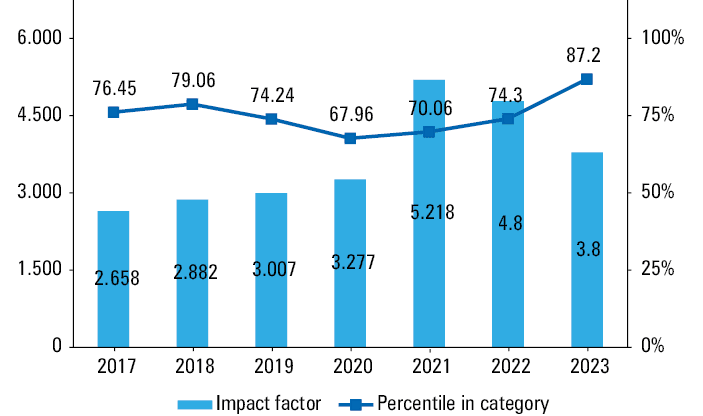
What happened to the IF of Polish Archives of Internal Medicine? As shown in Figure 1, its IF has fallen from 4.8 to 3.8 in 2024, though a stable increase in the last 10 years provides evidence for gradual enhancement of the journal’s position reflected by citations, even if the COVID‑19 papers no longer contributed to our 2‑year IF this year. The Polish journals with the highest 2‑year IF (along with their ranking in their own category) are provided in Table 1. Paradoxically, we are happy against all odds, since quite unexpectedly, Pol Arch Intern Med, the official journal of the Polish Society of Internal Medicine, is again within the first quartile in the Medicine (general) category, which was not the case 2 years ago with the IF of 5.218, given high values of this metric among other journals in this category. Being in the top quartile in our field was always our goal, and we have finally achieved it in 2024. At the same time, taking into account our position among similar journals determined by the IF in our category (Medicine, general and internal), it has been steadily increasing over the last few years (Figure 1). We are currently in the 87th percentile of this category, so we are closest to the first decile of the best journals in history.
Journal | 2023 impact factor | Quartile in the category |
Cellular & Molecular Biology Letters | 9.2 | Q1 |
Oeconomia Copernicana | 7.6 | Q1 |
Biocybernetics and Biomedical Engineering | 5.3 | Q1 |
Equilibrium‑Quarterly Journal of Economics and Economic Policy | 5.0 | Q1 |
Archives of Civil and Mechanical Engineering | 4.4 | Q1 |
Biology of Sport | 4.2 | Q1 |
Polish Archives of Internal Medicine | 3.8 | Q1 |
Studies in Second Language Learning and Teaching | 3.7 | Q1 |
Kardiologia Polska | 3.7 | Q1 |
Pharmacological Reports | 3.6 | Q2 |
Reviews on Advanced Materials Science | 3.6 | Q2 |
Journal of Artificial Intelligence and Soft Computing Research | 3.3 | Q2 |
Archives of Medical Science | 3.0 | Q1 |
Neurologia i Neurochirurgia Polska | 2.9 | Q2 |
Archivum Immunologiae et Therapiae Experimentalis | 2.9 | Q3 |
As editors, we are aware of the fact that the best research is not submitted to Pol Arch Intern Med, but our vision for this journal is to become the platform for solid, methodologically sound, novel findings reported by Polish clinical scientists (usually practicing in our health care system environment with its specific features), to play a vital and transformative role in improving care of our patients, and to present our scientific achievements to the international community of researchers.
We are grateful to the authors who have entrusted us with their research; the most cited papers published in 2021 and 2022 that contributed to our latest IF are listed in Table 2. Since we rely on our reviewers, we also wish to acknowledge their hard work under deadlines in 2023, and the most active supporters of our mission are presented in Table 3.
Title | Authors | Citation | Times cited |
Asthma and comorbidities: recent advances | Mario Cazzola, Paola Rogliani, Josuel Ora, Luigino Calzetta, Gabriella M. Matera | Pol Arch Intern Med. 2022; 132: 16250 | 21 |
Fibrin clot properties in coronary artery disease: new determinants and prognostic markers | Julie B Larsen, Anne‑Mette Hvas | Pol Arch Intern Med. 2021; 131: 16113 | 17 |
Recent advances in the treatment of irritable bowel syndrome | Silvia Bonetto, Sharmila Fagoonee, Edda Battaglia, Mario Grassini, Giorgio M. Saracco, Rinaldo Pellicano | Pol Arch Intern Med. 2021; 131: 709‑715 | 17 |
Hashimoto thyroiditis: an evidence‑based guide to etiology, diagnosis and treatment | Joanna Klubo‑Gwiezdzinska, Leonard Wartofsky | Pol Arch Intern Med. 2022; 132: 16222 | 14 |
Management of SARS‑CoV‑2 infection: recommendations of the Polish Association of Epidemiologists and Infectiologists as of April 26, 2021 | Robert Flisiak, Andrzej Horban, Jerzy Jaroszewicz, Dorota Kozielewicz, Agnieszka Mastalerz‑Migas, Radosław Owczuk, Miłosz Parczewski, Małgorzata Pawłowska, Anna Piekarska, Krzysztof Simon, Krzysztof Tomasiewicz, Dorota Zarebska‑Michaluk | Pol Arch Intern Med. 2021; 131: 487‑496 | 14 |
Monika Bociąga‑Jasik |
Daniel P. Potaczek |
Katarzyna Nabrdalik |
Jacek Bil |
Małgorzata Chlabicz |
Adam D. Durma |
Artur Dziewierz |
Lei Feng |
Magdalena Krajewska‑Włodarczyk |
Lucyna Mastalerz |
Aleksander Siniarski |
We are grateful to the entire team at Medycyna Praktyczna, our publisher since 2007, which has been our partner in ensuring our success. We wish to especially acknowledge remarkable efforts of Katarzyna Toffel, our Managing Editor.
As we look forward to the year ahead, we hope to do our best to enhance our standing in a challenging scholarly market.
ARTICLE INFORMATION