
A 56-year-old patient with malignant hypertension: unrecognized clinical entity revisited


 CC BY-NC-SA 4.0
A 56-year-old patient with malignant hypertension: unrecognized clinical entity revisited
CC BY-NC-SA 4.0
In March 2024, a 56‑year‑old man with no known history of hypertension was referred to the Department of Hypertension of Warsaw Medical University by a primary care physician due to blood pressure (BP) of 240/118 mm Hg. Within a few hours, his BP was reduced to 183/98 mm Hg by orally administered captopril. The patient’s complaints included severe headache, dizziness, and palpitations. He was put on enalapril 10 mg/day, doxazosin 2 mg/day, nitrendipine 10 mg/day, and bisoprolol 5 mg/day. After 5 days, ambulatory BP monitoring showed mean, daytime, and night time BP of 141/78 mm Hg, 151/83 mm Hg, and 122/67 mm Hg, respectively.
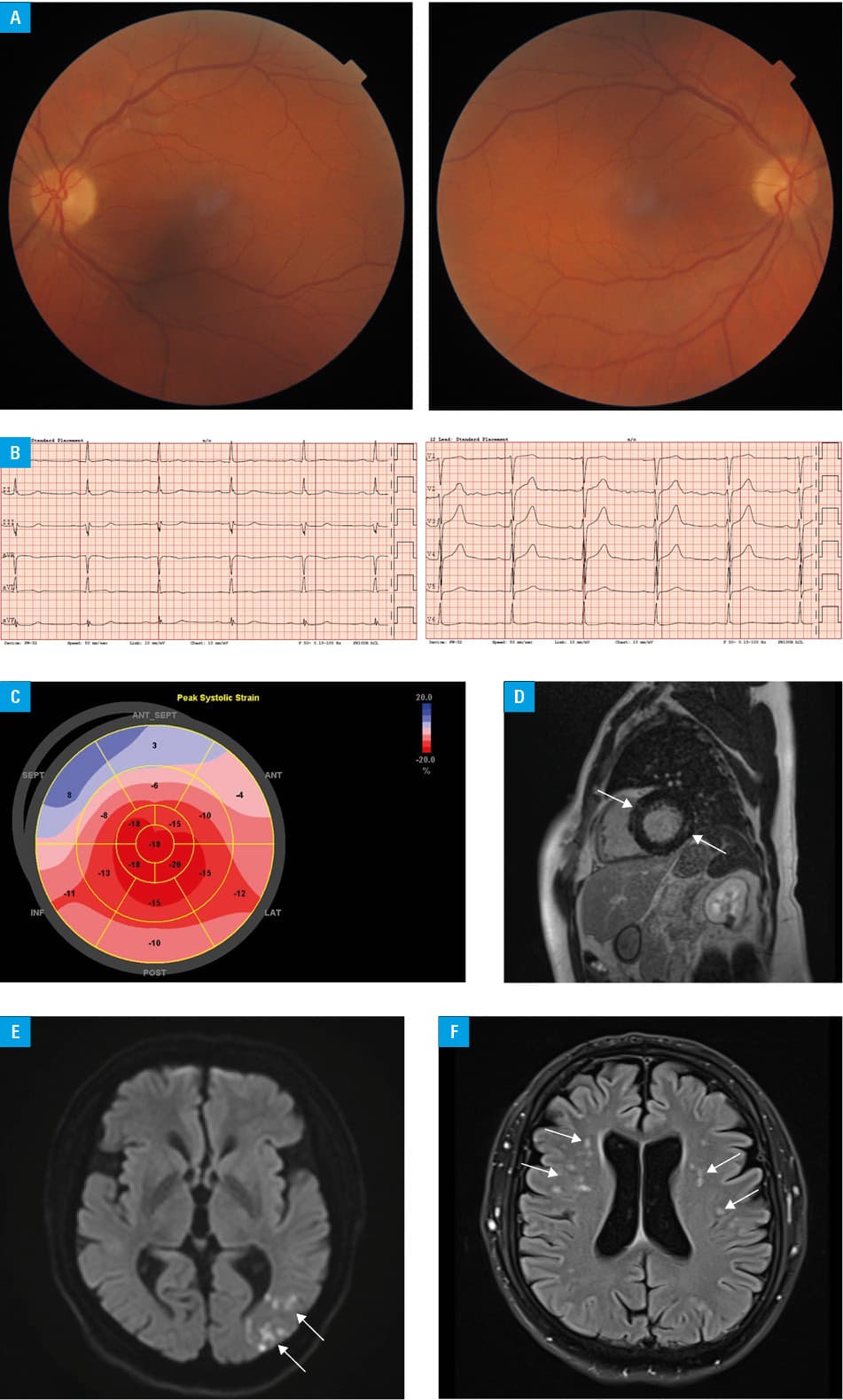
After the patient was stabilized, he was transferred to the Department of Hypertension at the National Institute of Cardiology for further diagnostic workup. On admission, his BP was 136/87 mm Hg and heart rate was 71 bpm. Auscultation of the chest revealed no abnormalities. Fundoscopy demonstrated grade II hypertensive retinopathy (Figure 1A). Optical coherence tomography showed normal thickness of the peripapillar retinal nerve fiber layer and signs of thinning of the ganglion cell complex. On ambulatory BP monitoring, mean, daytime, and night time BP was 136/78 mm Hg, 142/81 mm Hg, and 123/70 mm Hg, respectively. Serum potassium (5.4 mmol/l; reference range [RR], 3.5–5.1 mmol/l) and serum creatinine (1.8 mg/dl; RR, 0.7–1.2 mg/dl) levels were elevated with a decreased glomerular filtration rate (38 ml/min/1.73 m2; RR >60 ml/min/1.73 m2), while albuminuria in 24‑hour urine collection was normal (12.53 mg/24 h; RR <30 mg/24 h). Aldosterone‑to‑renin ratio, serum catecholamines, and other laboratory tests were within normal ranges. Electrocardiogram showed sinus rhythm and left ventricular hypertrophy (LVH; Figure 1B).
Renal Doppler ultrasonography showed normal kidney size, simple cysts in both kidneys, and no stenosis or other abnormalities in renal arteries.
The patient’s past medical history was unremarkable, and he reported a family history of hypertension and stroke in his mother. He was a former smoker and denied substance abuse.
Secondary forms of hypertension were excluded; thus further tests were conducted to look for evidence of target organ damage.
On echocardiographic examination concentric LVH was shown; left ventricular mass index was increased (138 g/m2; RR, 49–115 g/m2) with relative wall thickness of 0.45 (RR ≤0.42). Systolic function assessed by ejection fraction was preserved, whereas function of the longitudinal fibers assessed by speckle tracking showed decreased global longitudinal strain (Figure 1C).
Cardiac magnetic resonance imaging (MRI) revealed LVH (up to 19 mm; RR <12 mm), slightly decreased left and right ventricular systolic function (ejection fraction of 54% and 47%, respectively; RR, 58%–76% and 53%–79%), and focal nonischemic fibrosis (Figure 1D).
Brain MRI showed acute ischemia in the left temporal lobe and in the temporo‑occipital region (Figure 1E), as well as microvascular ischemic lesions in the white matter (Figure 1F).
Carotid ultrasound showed atherosclerotic plaques without stenosis in the common and internal carotid arteries.
Our case confirms that untreated essential hypertension can result in malignant hypertension (MHT), the most severe form of hypertension. Historically, MHT was defined as hypertensive emergency with concomitant presence of severe hypertension and retinopathy.1 However, as shown in our case, patients with MHT may lack severe retinal lesions, which supports the need to change the definition of MHT. According to the updated diagnostic criteria, our patient presents predominantly with target organ damage, including the brain, heart, and kidneys, with no grade III/IV eye involvement.1
Systemic microvascular damage is the pathological hallmark of MHT, affecting especially the retina, brain, heart, and kidneys.2 The exact reason why some patients progress to MHT is not completely understood. Recent reports3 from Europe and the United States indicate that the number of incident cases of MHT is growing. Despite the fact that MHT carries a very high risk of cardiovascular complications and death, the awareness of this entity is still low, and the condition remains poorly recognized among physicians. With effective treatment, the prognosis for MHT patients improves dramatically4; however, they still remain at a high risk of adverse cardiovascular and kidney outcomes.5,6 Nowadays, it is recommended to search for target organ damage in the whole cardiovascular system, brain, and kidneys with the use of modern imaging modalities.
- Mancia G, Kreutz R, Brunström M, et al. 2023 ESH guidelines for the management of arterial hypertension The Task Force for the Management of Arterial Hypertension of the European Society of Hypertension Endorsed by the European Renal Association (ERA) and the International Society of Hypertension (ISH). J Hypertens. 2023; 41: 1874‑2071.
- Boulestreau R, Śpiewak M, Januszewicz A, et al. Malignant hypertension: a systemic cardiovascular disease. J Am Coll Cardiol. 2024; 83: 1688‑1701. | Crossref
- Polgreen LA, Suneja M, Tang F, et al. Increasing trend in admissions for malignant hypertension and hypertensive encephalopathy in the United States. Hypertension. 2015; 65: 1002‑1007. | Crossref
- Shantsila A, Shantsila E, Beevers DG, Lip GYH. Predictors of 5‑year outcomes in malignant phase hypertension: the West Birmingham Malignant Hypertension Registry. J Hypertens. 2017; 35: 2310‑2314. | Crossref
- Rubin S, Cremer A, Boulestreau R, et al. Malignant hypertension: diagnosis, treatment and prognosis with experience from the Bordeaux cohort. J Hypertens. 2019; 37: 316‑324. | Crossref
ARTICLE INFORMATION