


 CC BY 4.0
A 72‑year‑old woman with a history of hypertension and ischemic stroke was admitted to an internal medicine department due to abdominal pain, nausea, and vomiting. Physical examination showed slightly pallid skin, regular heart rhythm at 80 bpm, audible third heart sound, systolic murmur in the third intercostal space on the left side of the chest, vesicular murmur above the lungs, and soft, slightly tender abdomen. Laboratory tests showed severe hyponatremia with sodium levels of 116 mmol/l (reference range, 135–145 mmol/l) and serum osmolality of 238 mOsm/kg H2O (reference range, 275–295 mOsm/kg H2O). The common causes of hyponatremia, such as the use of thiazide diuretics, diarrhea, acute and chronic renal failure, and hypothyroidism, were excluded. Ultrasound of the abdomen and computed tomography scan of the brain did not show any abnormalities. Echocardiography showed enlargement of the left atrium with an additional structure (Figure 1A and 1B). A preliminary diagnosis of left atrial myxoma was made due to the structure’s oval shape, characteristic location, and pedunculation. The patient was referred to a cardiothoracic surgery department for tumor removal after prior correction of sodium levels through supplementation. During surgery with anterior thoracotomy, a mass corresponding to the myxoma was removed alongside a fragment of the interatrial septum, to which it was attached. Histopathologic examination confirmed the diagnosis of a benign myxoma.
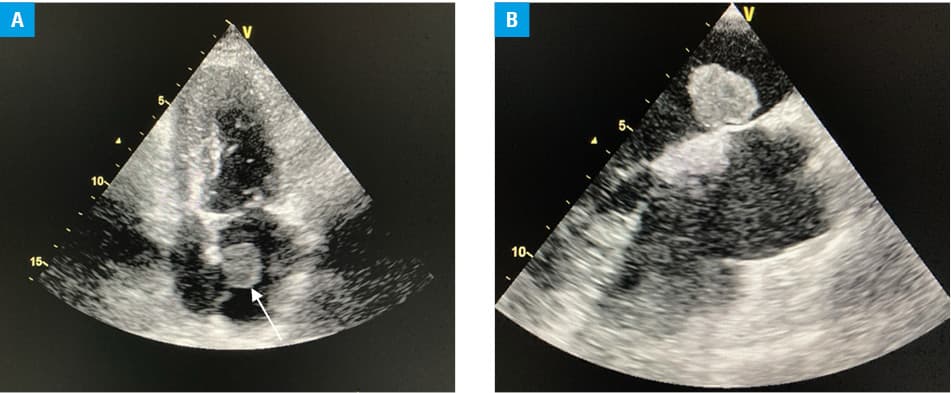
On the second day after the surgery, acute renal failure requiring renal replacement therapy ocurred. The patient also developed recurrence of hyponatremia. In the following days, the sodium levels gradually increased, reaching normal values 35 days after the procedure. Over a 2‑year observation period of serial tests, the sodium levels remained within normal limits.
Myxoma is the most common primary heart tumor, originating from mesenchymal cells of the heart. Most of myxomas have the shape of a pedunculated polyp, often covered with thrombi, with a tendency to fragmentate and embolize.1-3 Thus, it could have been the cause of the previous stroke. Myxomas usually form between the third and sixth decade of life, more commonly in women (70%). Multiple tumors account for 1%–8% of cases, and they can produce cytokines inducing generalized inflammatory reactions. In 10% of cases, there is a familial occurrence (Carney syndrome) with autosomal dominant inheritance.4 The clinical manifestations of myxomas most commonly include dyspnea, syncope, cough, chest pain, heart failure, mitral valve stenosis, generalized inflammatory responses, and thromboembolic complications.
In the presented case, there were no cardiovascular symptoms. The size and location of the tumor did not cause interactions with cardiac structures. Symptoms were caused by severe hyponatremia, which resolved after serum sodium levels were corrected.
So far, only single cases of hyponatremia associated with left atrial myxoma have been described in the literature.5The probable cause of this symptom is oversecretion of atrial natriuretic peptide by the excessively stretched atria due to the presence of the tumor. Transient hyponatremia has also been described after surgery and has been associated with atrial stretch during a surgical procedure or manipulation of the myxoma.
The action of atrial natriuretic peptide and its metabolite urodilatin is multidirectional, leading to diuresis, natriuresis, and, consequently, to hypovolemia and hyponatremia.
The presented case indicates the necessity of performing echocardiography as part of the differential diagnosis of unexplained hyponatremia.
- Griborio‑Guzman AG, Aseyev OI, Shah H, Sadreddini M. Cardiac myxomas: clinical presentation, diagnosis and management. Heart. 2022; 108: 827‑833. | Crossref
- Oktaviono YH, Saputra PBT, Arnindita JN, et al. Clinical characteristics and surgical outcomes of cardiac myxoma: a meta‑analysis of worldwide experience. Eur J Surg Oncol. 2024; 50: 107940. | Crossref
- Mołek‑Dziadosz P, Karcińska A, Dweck MR, et al. A Christmas tree‑shaped atrial myxoma causing transient ischemic attacks. Kardiol Pol. 2023; 81: 290‑291. | Crossref
- Harbeck B, Flitsch J, Kreitschmann‑Andermahr I. Carney complex- why thorough medical history taking is so important ‑ report of three cases and review of the literature. Endocrine. 2023; 80: 20‑28. | Crossref
- Bhat S, Awad WI. Severe hyponatraemia in a patient with a large left atrial myxoma: a case report. Eur Heart J Case Rep. 2022; 6: ytac111. | Crossref
ARTICLE INFORMATION