

 CC BY 4.0
Marfan syndrome (MFS) affects mainly the cardiovascular system, eyes, and skeleton. The diagnosis is based on the revised Ghent criteria.1 The cardinal feature of MFS is dilation of the aortic root, which may lead to life‑threatening complications. In turn, fibromuscular dysplasia (FMD) is defined as an idiopathic, nonatherosclerotic, and noninflammatory segmental arteriopathy. Primarily, it affects women, and commonly involves renal and carotid arteries.2 Contrary to MFS caused by variants in the FBN1 gene,1 there is no single gene associated with FMD.2 Arterial abnormalities, including FMD, aneurysms, and tortuosity, co‑occur frequently in patients with connective tissue disorders.2,3 Little is known about the coexistence of MFS and FMD.4
A 47‑year‑old woman with chronic dissection of the aortic arch and proximal segments of the brachiocephalic, left common carotid and left subclavian arteries, treated for hypertension, was hospitalized locally after fainting during hot weather. Three years earlier, she had undergone supracoronary prosthesis implantation in the acute phase of type A aortic dissection. After extensive evaluation, including chest X‑ray and echocardiogram, no specific cause of fainting was found. However, because of mild bradycardia of 48 bpm, her dose of bisoprolol was tapered from 2.5 mg to 1.25 mg once daily. Doses of telmisartan, hydrochlorothiazide, and acetylsalicylic acid were left unchanged. During the evaluation at our center, the patient was asymptomatic and normotensive. Holter monitoring showed sinus rhythm of 45–145 bpm (mean, 65 bpm) without relevant arrhythmia. Her Marfan systemic score was 5 points due to scoliosis, wrist sign, flat feet, severe myopia, and skin striae, which was not sufficient for the MFS diagnosis. Regarding her family history, the patient’s mother died suddenly at the age of 42. A head‑to‑pelvis computed tomography angiography (CTA) was performed to exclude progression of vascular pathology. It showed a stable image of the dissected aortic arch and its branches. Unexpectedly, it also revealed a “string of beads” pattern characteristic of FMD in both internal carotid arteries (Figure 1A and 1B). No indications for intervention were found. Of note, other vascular beds, including the renal arteries, were not affected by FMD. Next generation sequencing with a TruSight Cardio panel was performed. A novel pathogenic FBN1 gene variant, NM_000138.5:c.5014T>G, p.Cys1672Gly, was found, which, in combination with aortic root disease, allowed for the diagnosis of MFS. Other alterations involving the p.Cys1672 residue have been reported in patients with MFS: p.Cys1672Arg and p.Cys1672Tyr.5 None of them were associated with FMD.
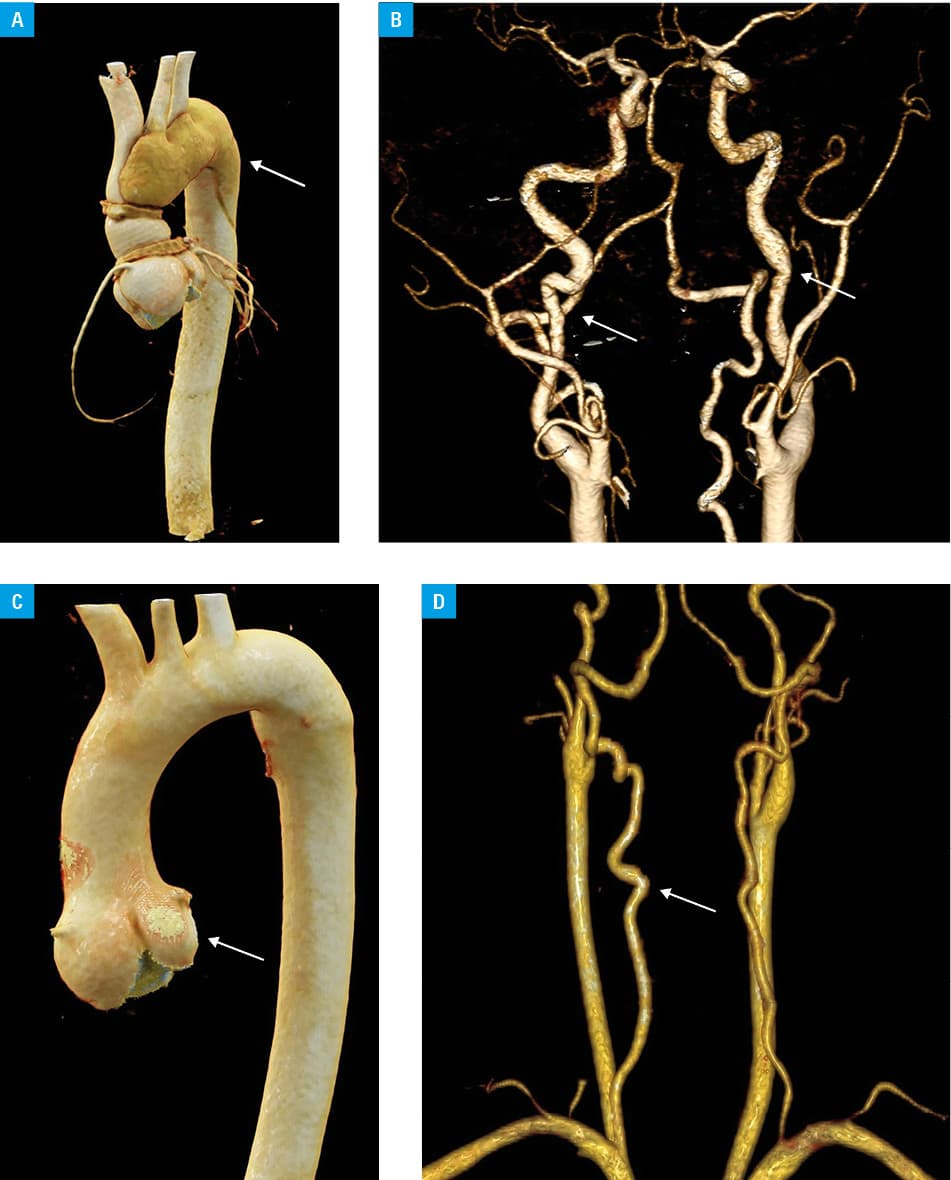
The patient’s 22‑year‑old son was also diagnosed with MFS. His head‑to‑pelvis CTA showed aortic root dilation of 41 mm, tortuosity of the right vertebral artery, and no signs of FMD (Figure 1C and 1D).
To the best of our knowledge, this is the first report of genetically confirmed MFS, complicated by acute aortic dissection and coexisting with FMD in extracranial parts of the internal carotid arteries. As recommended, the patient’s cardiovascular risk factors are well controlled and she is receiving an antiplatelet drug for stroke prevention.2 The lack of FMD features in the patient’s son, a carrier of the FBN1 variant, corresponds well with the fact that FMD affects primarily women.2
- Loeys BL, Dietz HC, Braverman AC, et al. The revised Ghent nosology for the Marfan syndrome. J Med Genet. 2010; 47: 476‑485. | Crossref
- Persu A, Van der Niepen P, Touzé E, et al. Revisiting fibromuscular dysplasia: rationale of the European Fibromuscular Dysplasia Initiative. Hypertension. 2016; 68: 832‑839. | Crossref
- Strzelczyk J, Sobieraj P, Placha G, et al. Multiple intracranial aneurysms and fibromuscular dysplasia of renal arteries in a woman with a variant of the myosin heavy chain 11 gene. Pol Arch Intern Med. 2023; 133: 16424. | Crossref
- Schievink WI, Björnsson J, Piepgras DG. Coexistence of fibromuscular dysplasia and cystic medial necrosis in a patient with Marfan’s syndrome and bilateral carotid artery dissections. Stroke. 1994; 25: 2492‑2496. | Crossref
- Attanasio M, Lapini I, Evangelisti L, et al. FBN1 mutation screening of patients with Marfan syndrome and related disorders: detection of 46 novel FBN1 mutations. Clin Genet. 2008; 74: 39‑46. | Crossref
ARTICLE INFORMATION