
Pelvic venous congestion syndrome resulting from postsurgical inferior vena cava occlusion

 CC BY 4.0
Pelvic venous congestion syndrome resulting from postsurgical inferior vena cava occlusion
CC BY 4.0
Pelvic venous congestion syndrome (PVCS) is a common cause of chronic pelvic pain in young and middle‑aged women. It occurs as a result of both intrinsic and acquired venous abnormalities, such as venous incompetence, valves malfunction or mechanical obstruction.1 In addition, blood flow restriction through the inferior vena cava (IVC), which is the main conduit of venous return from the lower portion of the body, might also lead to PVCS development.2-4 However, data on this condition are very limited in the current literature. We hereby present a case of a young woman with PVCS caused by IVC occlusion after abdominal trauma and surgery.
A 26‑year‑old woman presented to the gynecology department with a suspicion of PVCS. She complained of pain and heaviness in the pelvic region, as well as menorrhagia lasting over 12 months. She had no history of pregnancy, but reported a serious surgical procedure in the abdominal area, as 2 years earlier she underwent laparotomy with open right colectomy and intestinal anastomosis due to a gunshot to the abdomen. Injury to the IVC was reported, but there was no need for vessel ligation. Apart from this, her gynecological examinations were unremarkable. Transvaginal ultrasound showed multiple tortuous and dilated veins in the adnexa with reversed venous flow on color Doppler, suggesting PVCS. Abdominal ultrasound confirmed these findings, showing enlarged ovarian veins (up to 15 mm in diameter) and both renal veins draining into the infrahepatic IVC. The infrarenal IVC was not visualized, but no filling defects or thrombus could be identified. Due to ambiguity of the ultrasonographic findings, the patient was referred for phlebography (Figure 1A) and magnetic resonance imaging (Figure 1B). Both examinations showed complete occlusion of the infrarenal portion of the IVC with massive enlargement of ovarian veins, which functioned as collateral venous drainage from the lower extremities. After multidisciplinary evaluation, the patient was disqualified from endovascular treatment and discharged in a good clinical condition.
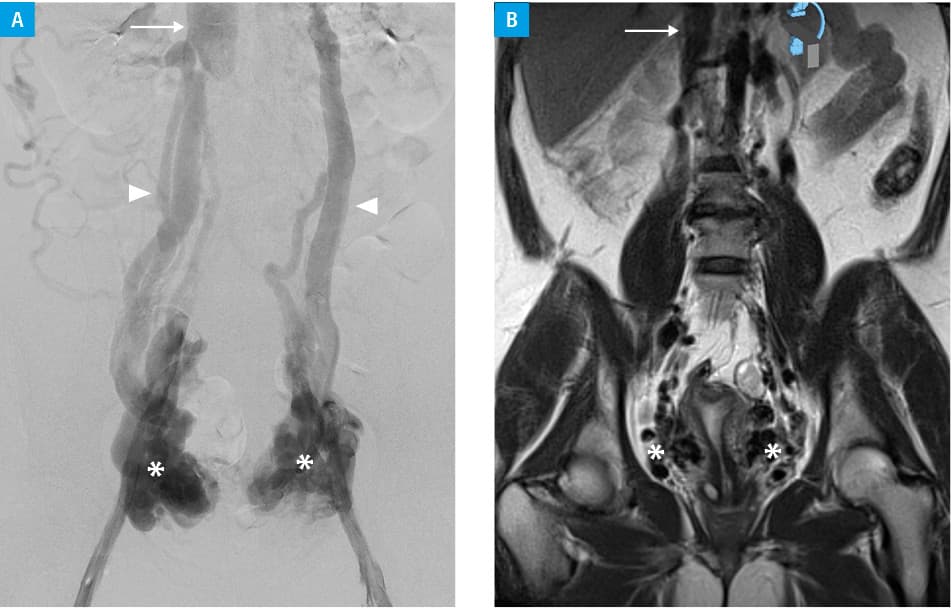
Occlusion or absence of IVC leads to development of collateral venous drainage via gonadal, paravertebral, hemorrhoidal or superficial plexuses.2 Although a few cases of PVCS caused by congenital absence of IVC have been reported, there is no report of PVCS resulting from IVC occlusion or ligation.3,4 In our case, IVC occlusion resulted from the previous injury to the abdomen and the surgical attempt to repair the vessel. In terms of therapeutic options, endovascular embolization is contraindicated in these cases, as the gonadal veins serve as a collateral flow to the central venous system. That is why surgical strategy, including suprarenal IVC bypass, is recommended. It was reported to be an efficacious and feasible treatment for symptomatic patients.5
According to our knowledge, this case is the first one to present PVCS resulting from IVC occlusion, therefore it adds to the research on rare causes of this common condition. It also shows that in the event of IVC occlusion, gonadal veins might serve as a collateral route of venous drainage from the lower extremities, which in this case was a favorable condition.
- Kashef E, Evans E, Patel N, et al. Pelvic venous congestion syndrome: female venous congestive syndromes and endovascular treatment options. CVIR Endovasc. 2023; 6: 25. | Crossref
- Ramanathan T, Michael T, Hughes D, et al. Perinatal inferior vena cava thrombosis and absence of the infrarenal inferior vena cava. J Vasc Surg. 2001; 33: 1097‑1099. | Crossref
- Menezes T, Haider EA, Al‑Douri F, et al. Pelvic congestion syndrome due to agenesis of the infrarenal inferior vena cava. Radiol Case Rep. 2018; 14: 36‑40. | Crossref
- Nichols JL, Gonzalez SC, Bellino PJ, et al. Venous thrombosis and congenital absence of inferior vena cava in a patient with menorrhagia and pelvic pain. J Pediatr Adolesc Gynecol. 2010; 23: 17‑21. | Crossref
- Zhou W, Rosenberg W, Lumsden A, et al. Successful surgical management of pelvic congestion and lower extremity swelling owing to absence of infrarenal inferior vena cava. Vascular. 2005; 13: 358. | Crossref
ARTICLE INFORMATION