
Unusual outcome following transarterial chemoembolization of giant hepatic hemangioma using bleomycin and lipiodol

 CC BY 4.0
Unusual outcome following transarterial chemoembolization of giant hepatic hemangioma using bleomycin and lipiodol
CC BY 4.0
Giant hepatic hemangiomas present a considerable risk of rupture, particularly in patients with large lesions, thereby posing potential life‑threatening consequences.1 Hence, such patients need effective therapeutic interventions. Currently, there are none universally accepted standards for the management of hepatic hemangiomas.
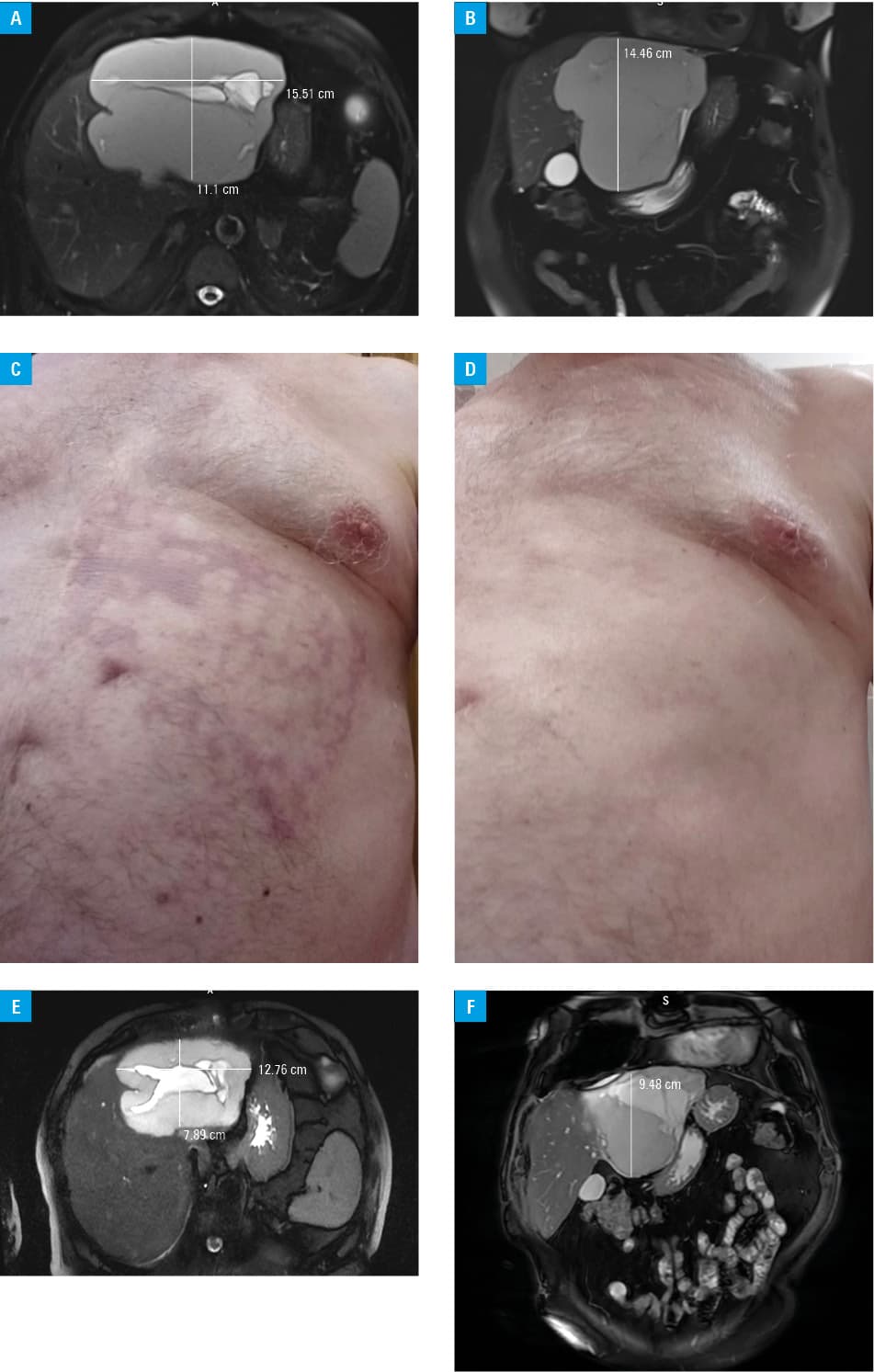
A 74‑year‑old man, diagnosed 20 years earlier with hepatic hemangioma in the left lobe, was advised to observe the lesion without any medical intervention. A follow‑up magnetic resonance imaging (MRI) revealed enlargement of the lesion to 15.5 cm × 11.1 cm × 14.5 cm (Figure 1A and 1B). Based on the examination and growth of the hemangioma, a decision was made to embolize the lesion.
The procedure was performed under local anesthesia with access from the left radial artery using the Seldinger technique. The hepatic hemangioma was embolized with a mixture of 15 IU of bleomycin and 10 ml of lipiodol, injected into the superselectively catheterized left hepatic artery. After the procedure, control angiography was used to evaluate blood stasis of the tumor‑feeding arteries.
The patient developed postprocedural complications, including abnormal taste sensation, abdominal pain in the sternal region, a burning sensation in the esophagus, and bluish‑red vascular patches with an irregular reticular pattern consistent with the tumor’s location (Figure 1C). The patient was prescribed a proton pump inhibitor (omeprazole) and advised to monitor the skin lesions. Both the skin lesions and other ailments disappeared after 2 months without additional interventions (Figure 1D).
Due to its large size, the hemangioma required another embolization, after which its size was reduced, and no complications occurred. The reduction of the lesion size was confirmed on follow‑up MRI performed 6 months after the procedure (Figure 1E and 1F).
Transarterial chemoembolization (TACE) employs chemotherapeutic agents to induce volume reduction by inhibiting neovascularization. The use of bleomycin and lipiodol in chemoembolization interventions for massive hepatic hemangiomas presents a multifaceted therapeutic approach. Due to its cytotoxic properties, bleomycin selectively acts upon neoplastic cells, whereas lipiodol functions as a conduit for drug transfer and promotes vascular embolization. This synergistic mechanism aims to induce tumor regression and relieve symptoms in patients affected by giant hepatic hemangiomas.2,3
TACE utilizing a mixture of bleomycin and lipiodol demonstrates safety, low mortality rates, and infrequent adverse events. Documented complications include liver failure, liver infarction, edema, hemorrhage, hepatic artery dissection, splenic infarction, cholecystitis, and sclerosing cholangitis.2,4 Notably, the complications observed in our patient have not been reported in the literature.
The complications, manifested as gastric complaints and cutaneous lesions, originated from an anatomical variation of the common hepatic artery. This variant gave rise to cutaneous and esophageal branches, which were undetectable on angiography due to considerable dimensions of the hemangioma. Consequently, cutaneous and esophageal feeding arterioles received iatrogenic embolic agent injections.
This case demonstrates the importance of precise visualization of the vascularization of the embolized lesion, considering the anatomical variations and connections between the arteries. Introduction of an embolic agent into a wrong vessel can result in serious, life‑threatening complications.
- Herman P, Costa M, Machado MAC, et al. Management of hepatic hemangiomas: a 14‑year experience. J Gastrointest Surg. 2005; 9: 853‑859. | Crossref
- Kacała A, Dorochowicz M, Patrzałek D, et al. Safety and feasibility of transarterial bleomycin‑lipiodol embolization in patients with giant hepatic hemangiomas. Medicina (Kaunas). 2023; 59: 1358. | Crossref
- Karhunen PJ. Benign hepatic tumours and tumour‑like conditions in men. J. Clin. Pathol.1986; 39: 183‑188. | Crossref
- Özgür Ö, Sindel HT. Giant hepatic hemangioma treatment with transcatheter arterial embolisation and transcatheter arterial chemoembolisation; comparative results. Turk J Med Sci. 2021; 51: 2943‑2950. | Crossref
ARTICLE INFORMATION