
Fournier gangrene with abdominal wall cellulitis probably caused by animal microbiota after insulin injection

 CC BY 4.0
Fournier gangrene with abdominal wall cellulitis probably caused by animal microbiota after insulin injection
CC BY 4.0
Fournier gangrene (FG) is a rare, acute, life‑threatening, necrotizing soft tissue infection of the external genitalia, perineum or perianal region, that rapidly progresses to systemic toxicity, if not treated promptly. The etiology is poorly understood and can often be triggered by a minor inciting event, such as an insect bite or minor trauma.1,2
A 59‑year‑old man with a 20‑year history of insulin‑treated diabetes mellitus (DM), obesity, and chronic hemodialysis (2 years) was admitted to a nephrology department with symptoms of septic shock (elevated levels of inflammatory parameters: C‑reactive protein, 312 mg/dl; reference range [RR] <5 mg/dl; procalcitonin, 13.99 ng/ml; RR <0.5 ng/ml) and hypotension of 80/50 mm Hg. On admission, an inflammatory infiltrate was observed in the lower abdomen, pubic region, and scrotum.
There was a history of abdominal cellulitis (Figure 1A) 4 weeks prior to hospitalization, which was initially treated with oral ciprofloxacin. This antibiotic was changed to cefuroxime (1.5 g intravenously after each hemodialysis session and 250 mg twice daily on nondialysis days) and metronidazole (500 mg orally twice a day) due to increasing lower abdominal pain. No fever was noted at that time. The outpatient treatment lasted for 3 weeks. When the patient was admitted to the hospital, he received 1 dose of meropenem (1 g intravenously) and linezolid (600 mg intravenously) before surgery. This antibiotic treatment was continued in the intensive care unit (ICU), where the patient was qualified for continuous renal replacement therapy, and the doses of antibiotics were increased (meropenem 2 g intravenously 3 times a day and linezolid 600 mg intravenously twice a day). A computed tomography (CT) scan of the abdomen showed 2 spaces of gas in the subcutaneous tissue (84 mm × 89 mm × 110 mm and 69 mm × 126 mm × 114 mm) with dense fluid in one of them reaching the base of the penis. The gas was located in the bladder (Figure 1B and 1C).
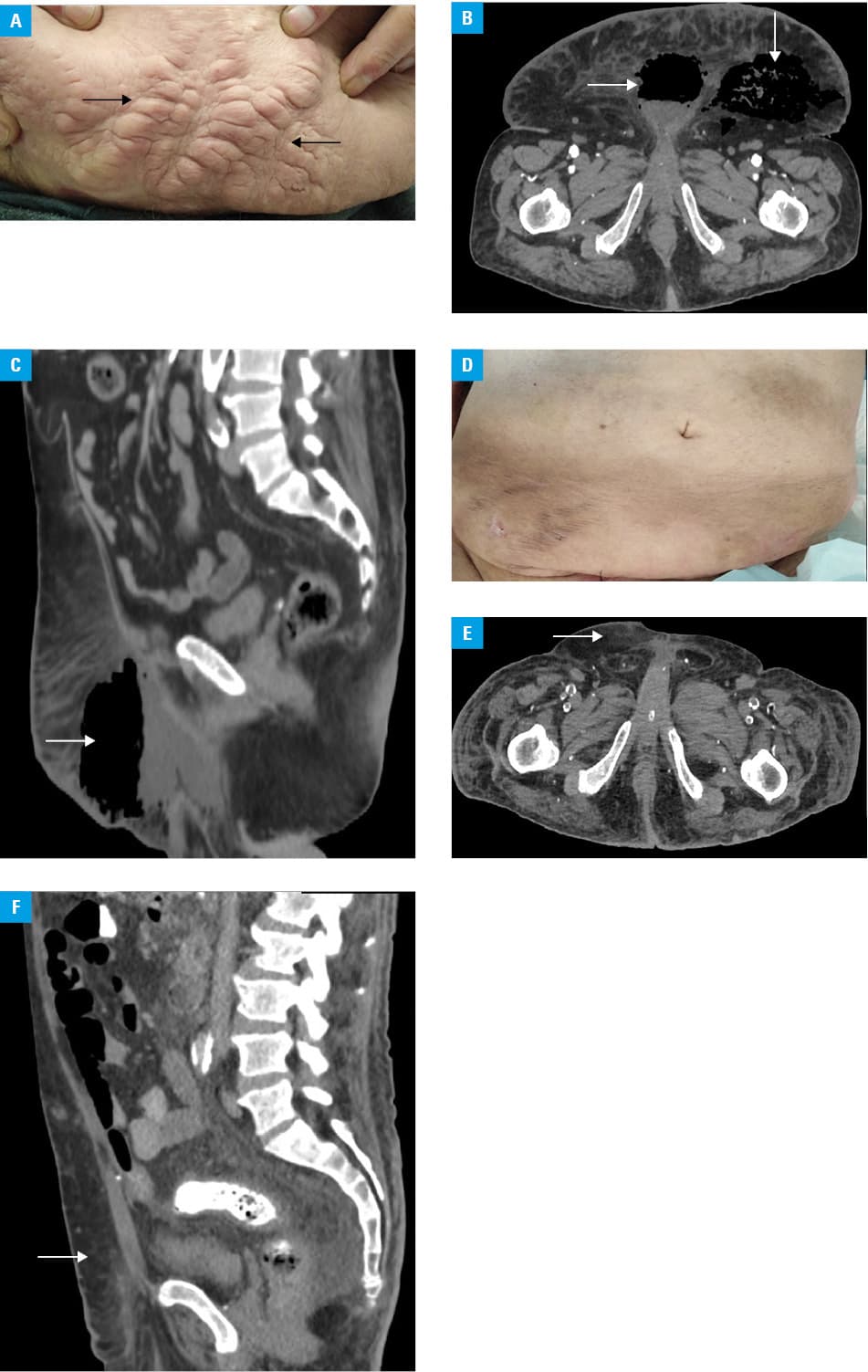
After surgical and urological consultation, peritoneal drainage was performed with removal of the left and middle hypogastric tissue necrosis. Microbiological analysis of the abdomen specimens confirmed the presence of Morganella morgani, Proteus mirabilis, Escherichia coli, Raoultella ornithinolytica, and Klebsiella vriicola. The patient spent 3 months in the ICU, where extensive antibiotic therapy, repeated surgical interventions, continuous veno‑venous hemodiafiltration, and mechanical ventilation through tracheotomy were performed.
Control CT of the abdomen showed healed loss of skin, subcutaneous tissue, and adipose tissue (Figure 1D–1F). Finally, the patient was discharged after 5 months of treatment and rehabilitation. The postoperative history revealed that the patient took care of 10 dogs. He admitted a possible contact with his dogs’ saliva during insulin injection.
The most common cause of FG is polimicrobial flora, which often coexists with DM, and without early surgical treatment usually leads to death.1,2 Raoultella ornithinolytica inhabits natural environments (water, soil), but in humans its reservoir is the gastrointestinal and upper respiratory tract. It usually causes biliary tract infections, pneumonia, and bacteremia in immunocompromised patients.3,4 Klebsiella variicola can colonize different hosts, such as plants, humans, insects, and animals.5 Our patient could have been infected with these bacteria while taking care of the dogs and walking them near a river and a lake. Early recognition combined with aggressive surgical debridement, multidisciplinary team input, and good reconstructive techniques are key factors for survival and good outcomes.
- Auerbach J, Bornstein K, Ramzy M, et al. Fournier gangrene in the emergency department: diagnostic dilemmas, treatments and current perspectives. Open Access Emerg Med. 2020; 12: 353‑364. | Crossref
- Zingaro MD, Boni A, Vermandois JAR, et al. Fournier’s gangrene and intravenous drug abuse: an unusual case report and review of the literature. Open Med. 2019; 14: 694‑710. | Crossref
- Sękowska A. Raoultella spp.-clinical significance, infections and susceptibility to antibiotics. Folia Microbiol. 2017; 62: 221‑227. | Crossref
- Boattini M, Almeida A, Cardoso C, et al. Infections on the rise: Raoultella spp., clinical and microbiological findings from a retrospective study, 2010‑2014. Infect Dis. 2016; 48: 87‑91. | Crossref
- Rodríguez‑Medina N, Barrios‑Camacho H, Duran‑Bedolla J, Garza‑Ramos U. Klebsiella variicola: an emerging pathogen in humans. Emerg Microbes Infect. 2019; 8: 973‑988. | Crossref
ARTICLE INFORMATION