
Heterogeneous and overlapping mechanisms of ischemia and nonobstructive coronary arteries: in-hospital results of the MOSAIC-COR registry
Key words: coronary microcirculation, coronary microcirculatory disease, ischemia and nonobstructive coronary artery disease, physiological assessment, vasospastic angina

 CC BY 4.0
Heterogeneous and overlapping mechanisms of ischemia and nonobstructive coronary arteries: in-hospital results of the MOSAIC-COR registry
CC BY 4.0
Introduction: Ischemia and nonobstructive coronary arteries (INOCA) remains a significant clinical issue. Recent guidelines underscore the importance of comprehensive coronary physiology assessment to make specific diagnoses and implement tailored treatment strategies.
Objectives: Our primary objective was to implement comprehensive invasive diagnostics. The secondary objective was to determine the pathomechanism of INOCA in consecutive adult patients with symptomatic chronic coronary syndrome, noninvasive evidence of myocardial ischemia, and nonobstructive coronary artery disease included in the prospective MOSAIC‑COR registry, and therefore, to define new INOCA subgroups.
Patients and methods: All patients underwent comprehensive coronary physiological assessment, including resting full‑cycle ratio, fractional flow reserve, index of microcirculatory resistance, and coronary flow reserve using a pressure wire and the thermodilution method. Coronary artery reactivity was assessed with acetylcholine in a provocative test.
Results: A total of 173 patients were enrolled (median [interquartile range] age, 66 [58–71] years; 66% women). A high prevalence of typical cardiovascular risk factors was registered. According to physiological assessment, the patients were divided into the following subgroups: epicardial vasospastic angina (EVSA; 19%), microvascular vasospastic angina (MVSA; 19%), coronary microcirculatory disease (CMD; 11%), EVSA+CMD (21%), MVSA+CMD (18%), and noncoronary disorders (12%). The diagnosis of MVSA and MVSA+CMD was more frequent in women (94% vs 76%, respectively).
Conclusions: The patients diagnosed with INOCA in the MOSAIC‑COR registry exhibit significant symptomatology and a high prevalence of typical cardiovascular risk factors. Myocardial ischemia in this population may be generated by various pathomechanisms that may overlap.
Introduction
Patients with chronic coronary syndrome (CCS) and no significant lesions in coronary arteries (ischemia and nonobstructive coronary artery disease [INOCA]) constitute a substantial group, ranging from 30% to 70% of all patients undergoing elective coronary angiography due to angina.1,2 This group of patients has unfavorable prognosis, with a 2.7‑fold higher risk of major adverse cardiovascular events and death than the healthy population.3 Data from large, randomized clinical trials have unequivocally demonstrated that evaluation of coronary circulation should not be accomplished only with visual assessment in resting conditions.4 The current European Society of Cardiology Guidelines on diagnosis and treatment of CCS, published in 2019, emphasize the importance of performing complex coronary physiology assessment.5 Invasive physiological measurements and vasoreactivity provocative tests emerged as essential tools to differentiate between vasospastic angina, microcirculatory angina, overlap of both conditions, or noncardiac disorders.5 According to contemporary literature, identification of heterogeneity in patients with INOCA is pivotal to determine adequate treatment strategies. An appropriate pharmacotherapy may improve outcomes encompassing the severity of angina, quality of life, exertional tolerance and, most importantly, major adverse cardiac and cardiovascular events‑free survival.6 However, limited data are available for each subtype of INOCA, as well as for the prevalence and coexistence of different pathomechanisms of ischemia. A subgroup of patients exhibiting signs and symptoms of vasospasm in a provocative test, but without visual spasm in epicardial vessels requires a more detailed evaluation. Additional data are necessary to investigate INOCA subgroups more precisely, and to enable introduction of an optimal therapy for those patients.
The primary objective of this study was to implement comprehensive invasive diagnostics and determine pathomechanisms of INOCA. The secondary objective was to assess the occurrence of coronary microcirculatory disease (CMD), epicardial vasospastic angina (EVSA), microvascular vasospastic angina (MVSA), and their coexistence in patients with INOCA, which led to re‑arrangement of subgroups. The tertiary objective was to analyze the clinical characteristics of the patients allocated to different phenotypes of INOCA.
Patients and methods
The MOSAIC‑COR (Coronary Microcirculatory Disease and Inflammation in Patients with Chronic Coronary Syndrome And No Significant Coronary Artery Stenosis Study) was conducted as a prospective, observational registry of consecutive adult patients with INOCA. Between July 2020 and July 2023, we enrolled 173 patients with symptomatic CCS, myocardial ischemia confirmed by noninvasive stress tests (myocardial perfusion imaging using single‑photon emission computed tomography and exertion treadmill test), and nonobstructive coronary artery disease. According to the European Society of Cardiology guidelines, INOCA was defined as CCS and nonobstructive coronary arteries (stenosis in epicardial arteries less than 40% diameter or fractional flow reserve [FFR] >0.8 and resting full‑cycle ratio [RFR] >0.89).7-9 We excluded patients with prior coronary revascularization, disease with predicted survival below 1 year, severe valvular pathology, and chronic heart failure with reduced ejection fraction. The study protocol complied with the Declaration of Helsinki and was approved by the institutional ethical committee (304/KBL/OIL/2019). The study is registered at ClinicalTrials.gov (NCT05313919). All patients provided their written informed consent. Physiological measurements were performed with PressureWire X (Abbott Vascular, Santa Clara, California, United States) introduced in the distal part of the epicardial artery. Three consecutive measurements of RFR were taken. Stable hyperemia was induced with a constant intravenous infusion of adenosine at 140 µg/kg/min for a minimum time of 120 seconds.10 FFR was measured in hyperemic conditions. Using the thermodilution method and Coroflow software (Coroventis, Uppsala, Sweden), the index of microcirculatory resistance (IMR) and coronary flow reserve (CFR) were measured.11,12 Coronary artery reactivity was assessed during the provocative test with acetylcholine, administered to the coronary artery in subsequent incremental doses, prepared according to a standardized protocol.13 Clinical symptoms, epicardial spasm on angiography, and ischemic changes on 12‑lead electrocardiogram (ECG) were evaluated during the entire examination.13 A positive result of the provocative test was followed by intracoronary injection of 100 µg of nitroglycerine to cease the generated ischemia. During the invasive diagnostics, comprehensive patient monitoring was provided, including symptom assessment, 12‑lead ECG recording, and direct blood pressure and oxygen saturation measurements. We considered sustained ventricular tachycardia and ventricular fibrillation as severe ventricular arrhythmias. The study adhered to the STROBE criteria for an observational cohort study.
Initially, we categorized the patients into 3 subgroups based on the CorMicA trial definition.14 The first group comprised the patients with microvascular angina (MVA) with abnormal functional assessment, which includes increased IMR (≥25) or decreased CFR (<2) or microvascular spasm (presence of symptoms and ischemic ECG changes, but without identified significant spasm [>90% diameter] in the coronary epicardial artery during the provocative reactivity test). The second group included patients with epicardial vasospastic angina (EVA) characterized by epicardial vasospasm (presence of symptoms and ischemic ECG changes, along with identified significant spasm [>90% diameter] in the coronary epicardial artery during the provocative reactivity test). The third group involved individuals with noncardiac chest pain diagnosed when both the coronary reactivity test and coronary functional assessment yielded normal results.
We then divided the patients into 4 other subgroups. The first of them comprised individuals with CMD characterized by a negative result of the artery reactivity test and abnormal functional assessment, including increased IMR (≥25) or decreased CFR (<2).15,16 The second were the patients with EVSA identified by a normal result of both IMR and CFR and the presence of epicardial vasospasm (presence of symptoms and ischemic ECG changes as well as identified significant spasm [>90% diameter] in the coronary epicardial artery during the provocative reactivity testing)17. The third subgroup comprised the patients with MVSA indicated by a normal result of both IMR and CFR with microvascular spasm (presence of symptoms and ischemic ECG changes but without identified significant spasm [>90% diameter] in the coronary epicardial artery during the provocative reactivity testing)16,17. The last subgroup included individuals without coronary artery disease with both the coronary reactivity test and coronary functional assessment yielding normal results.
Demographic and laboratory data
Demographic data, medical history, laboratory test results, echocardiographic data, and medication data were collected and verified through in‑person interviews and medical records. Body mass index was determined as the ratio of weight (kg) to the height squared (m2). Levels of fasting blood glucose, triglyceride, total cholesterol, low‑density lipoprotein cholesterol, high‑density lipoprotein cholesterol, creatinine, and high‑sensitive C‑reactive protein were measured using an automatic biochemistry analyzer.
Echocardiography
A 2‑dimensional transthoracic echocardiography was conducted by a trained physician (MS or AB), both at baseline and before hospital discharge. All measurements adhered to the recommendations provided by the American Society of Echocardiography and the European Association of Echocardiography.18
Statistical analysis
Quantitative variables were presented as numbers and percentages. For qualitative variables with a normal distribution, mean values with standard deviations were provided, while for variables without a normal distribution, median with interquartile range was used. Normal distribution was determined by the Kolmogorov–Smirnov and the Shapiro–Wilk tests. The χ2 test was employed to compare the qualitative variables, while the Kruskal–Wallis test was used for comparing the continuous variables for more than 2 groups. A P value below 0.05 was assumed significant. The statistical analysis was conducted using SPSS Statistics, version 26 (New York, New York, United States) and R‑Studio, version 8.9 (Boston, Massachusetts, United States) packages.
Results
General characteristics of the patients
Of a total of 173 consecutive patients enrolled, 65% were women. The most prevalent cardiovascular risk factors included overweight / obesity, arterial hypertension, and dyslipidemia. Roughly 70% of the patients had a history of stable angina, classified as the Canadian Cardiovascular Society scale19 grade II–III, while the remaining individuals experienced exertional dyspnea categorized as the New York Heart Association classification grade II–III. All study patients exhibited at least 2 risk factors for cardiovascular diseases. Most patients in the study group had confirmed myocardial ischemia in noninvasive stress tests. Specifically, a positive result of stress electrocardiography was observed in 51 patients (29%), a significant perfusion defect in the radionuclide myocardial perfusion test was registered in 68 patients (39%), and 3 patients (2%) had a positive result of stress echocardiography. The median left ventricular ejection fraction was 60%, and no significant valvular pathologies were detected. Functional assessment, including RFR and FFR, confirmed the absence of significant epicardial artery stenosis.7,8
The size of the subgroups, as defined by the CorMicA criteria, closely resembled those in the CorMicA trial, suggesting that our study population is representative (Figure 1).
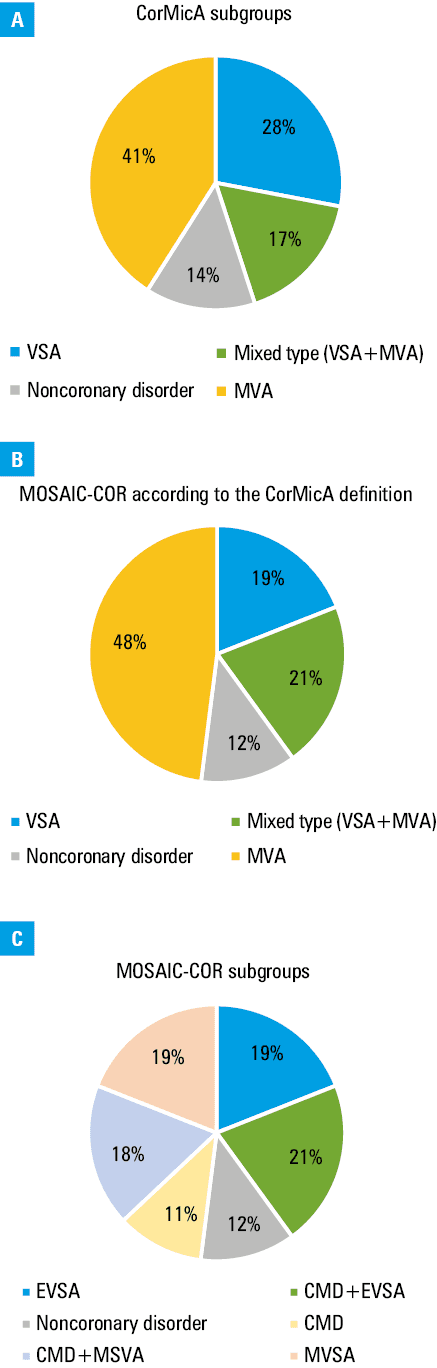
Abbreviations: CMD, coronary microcirculatory disease; EVSA, epicardial vasospastic angina; MVA, microvascular angina; MVSA, microvascular vasospastic angina; VSA, vasospastic angina
Initial subgroup division according to the CorMicA definition
Originally, we divided all patients into 3 subgroups: the MVA, the EVA, and the noncardiac chest pain group. According to this approach, the patients in the noncardiac chest pain group were notably older than those in the other groups (median [interquartile range, IQR], 70 [67–72] vs 66 [58–71] vs 64 [54–70] years; P = 0.036). The proportion of men was the lowest in the MVA group, while in the EVA mixed group, the proportion of sexes was nearly equal. There were differences in the sex proportion for all 3 groups, with 18 (22%), 34 (49%), and 7 (33%) men in the MVA, EVA, and noncardiac group, respectively (P = 0.002). Interestingly, the patients in the MVA and EVA groups exhibited different, mixed pathomechanisms of ischemia. In the MVA group, despite abnormal results of IMR/CRF measurement, 64 patients (77%) displayed microvascular vasospasm during the provocation test. Conversely, in the EVA group, almost 50% of patients had abnormal IMR/CFR results apart from epicardial vasospasm. This observation prompted us to reorganize the subgroups, considering different patterns of ischemia pathomechanisms.14
Baseline description of the patients is presented in Table 1.
Parameter | Overall (n = 173) | MVA (n = 83) | EVA mixed (n = 69) | Noncardiac chest pain (n = 21) | P value |
Quantitative variables are presented as number (percentage), while qualitative variables as median (interquartile range).
SI conversion factors: to convert hemoglobin to g/l, multiply by 10.
Abbreviations: BMI, body mass index; CFR, coronary flow reserve; eGFR, estimated glomerular filtration rate; EVA, epicardial vasospastic angina; Hb, hemoglobin; HbA1c, glycated hemoglobin; hs‑CRP, high‑sensitivity C‑reactive protein; IMR, index of microcirculatory resistance; LDL‑C, low‑density lipoprotein cholesterol; MVA, microvascular angina; PLT, platelet count; WBC, white blood cell count | |||||
Age, y | 66 (58–71) | 66 (58–71) | 64 (54–70) | 70 (67–72) | 0.04 |
Men | 59 (34) | 18 (22) | 34 (49) | 7 (33) | 0.002 |
BMI, kg/m2 | 29.4 (25.8–32.7) | 29.6 (26.6–32.7) | 28.3 (25.1–31.9) | 29.9 (28–34.5) | 0.19 |
Medical history | |||||
Arterial hypertension | 153 (88) | 74 (89) | 58 (84) | 21 (100) | 0.12 |
Dyslipidemia | 156 (90) | 74 (89) | 62 (90) | 20 (95) | 0.88 |
Diabetes | 49 (28) | 26 (31) | 16 (23) | 7 (33) | 0.47 |
Ever smoking | 58 (34) | 27 (33) | 24 (35) | 7 (35) | 0.35 |
Overweight / obesity | 114 (78) | 55 (81) | 46 (74) | 13 (81) | 0.66 |
Hypothyroidism | 47 (27) | 27 (33) | 16 (23) | 4 (19) | 0.32 |
Chronic kidney disease | 11 (6.4) | 6 (7.2) | 4 (5.8) | 1 (4.8) | 0.99 |
Laboratory results | |||||
Hb, g/dl | 13.7 (13–14.6) | 13.5 (13–14.4) | 13.9 (13.3–14.8) | 13.6 (12.9–14.5) | 0.2 |
WBC, 103/µl | 7.4 (6.29–8.61) | 7.5 (6.4–8.6) | 7.3 (6.2–8.7) | 7.3 (6.1–8.4) | 0.88 |
PLT, 103/µl | 238 (206–274) | 242 (211–291) | 237 (202–277) | 222 (185–255) | 0.19 |
hs‑CRP, mg/l | 1.53 (0.9–3) | 1.48 (0.78–2.78) | 1.77 (0.96–3.51) | 1.33 (0.89–2.87) | 0.34 |
LDL‑C, mmol/l | 2.51 (1.92–3.89) | 2.62 (2.02–4.1) | 2.5 (1.9–3.78) | 2.5 (1.9–3.97) | 0.85 |
eGFR, ml/min/1.73 m2 | 77 (65–89) | 80 (64–88) | 78 (68–92) | 70 (58–83) | 0.13 |
HbA1c, % | 5.9 (5.5–6.3) | 6.1 (5.6–6.3) | 5.9 (5.4–6.3) | 5.7 (5.6–6) | 0.57 |
Physiological coronary assessment | |||||
IMR abnormal | 63 (47) | 37 (58) | 24 (42) | 0 | 0.008 |
CFR abnormal | 56 (41) | 28 (45) | 28 (47) | 0 | 0.004 |
Microvascular spasm | 64 (38) | 64 (77) | 0 | 0 | <0.001 |
Epicardial spasm | 67 (40) | 0 | 69 (100) | 0 | <0.001 |
New arrangement of the subgroups based on the MOSAIC‑COR definition
As mentioned above, we distinguished 2 new subgroups. The CMD+EVSA group was characterized by abnormal functional assessment (IMR ≥25 or CFR <2) and the presence of epicardial vasospasm (symptoms and ischemic ECG changes and significant spasm [>90% diameter] in the coronary epicardial artery during the provocative reactivity testing). The patients in the CMD+MVSA group were characterized by abnormal functional assessment (IMR ≥25 or CFR <2) and the presence of microvascular spasm (symptoms and ischemic ECG changes but without significant spasm [>90% diameter] in the coronary epicardial artery during the provocative reactivity testing).
Among the new subgroups, CMD+EVSA was the most prevalent (21%) and CMD was the least common diagnosis (11%). In the CMD+EVSA group, the highest proportion of male patients was observed, whereas in the CMD+MVSA group it was the lowest (56% vs 6%; P <0.001). There were no significant differences in terms of prevalence of typical cardiovascular risk factors between the subgroups. The CMD group had the highest number of patients with chronic kidney disease (CKD) (P = 0.009). Noteworthy, the level of N‑terminal pro–B‑type natriuretic peptide was the highest in the noncardiac pain group, although the difference was not significant. The subgroup size and characteristics are presented in Table 2 and Figure 2.
Parameter | CMD | CMD+EVSA | CMD+MVSA | EVSA | MVSA | Noncoronary disorder | P value | |
Quantitative variables are presented as number (percentage), while qualitative variables as median (interquartile range).
| ||||||||
Patients | 19 (11) | 36 (21) | 32 (18) | 32 (19) | 33 (19) | 21 (12) | – | |
Age, y | 65 (56–72) | 64 (58–71) | 68 (61–72) | 63 (54–67) | 66 (59–69) | 70 (67–72) | 0.08 | |
Men | 8 (42) | 20 (56) | 2 (6) | 14 (44) | 8 (24) | 7 (33) | <0.001 | |
BMI, kg/m2 | 27.9 (26.2–30.1) | 28.1 (25.1–33.7) | 30 (27.6–31.6) | 28.6 (25.1–30.3) | 29.6 (27–34.9) | 29.9 (27–34.4) | 0.37 | |
Medical history | ||||||||
Arterial hypertension | 16 (84) | 30 (83) | 29 (91) | 27 (84) | 30 (91) | 21 (100) | 0.38 | |
Dyslipidemia | 17 (189) | 30 (83) | 29 (91) | 31 (97) | 29 (88) | 20 (95) | 0.53 | |
Diabetes | 6 (32) | 9 (25) | 10 (31) | 7 (22) | 10 (30) | 7 (33) | 0.92 | |
Ever smoking | 9 (47) | 13 [37) | 8 (25) | 10 (31) | 11 (33) | 7 (35) | 0.5 | |
Overweight / obesity | 11 (79) | 23 (74) | 22 (88) | 22 (73) | 23 (77) | 13 (81) | 0.82 | |
Hypothyroidism | 4 (21) | 10 (28) | 9 (28) | 6 (19) | 14 (42) | 4 (19) | 0.27 | |
Chronic kidney disease | 4 (21) | 0 | 2 (6.2) | 4 (12) | 0 | 1 (5) | 0.01 | |
Laboratory results | ||||||||
Hb, g/dl | 13.9 (13.4–14.9) | 14 (13.3–15.2) | 13.5 (12.9–14.3) | 13.7 (13.3–14.7) | 13.4 (13–14.4) | 13.6 (12.9–14.5) | 0.4 | |
WBC, 103/µl | 7.3 (6.3–9.1) | 7.1 (6.1–8.3) | 7.4 (6.4–7.9) | 7.7 (6.3–8.9) | 7.7 (6.4–8.7) | 7.3 (6.1–8.4) | 0.92 | |
PLT, 103/µl | 239 (207–286) | 239 (203–273) | 246 (206–271) | 232 (202–269) | 237 (216–292) | 222 (185–255) | 0.57 | |
hs‑CRP, mg/l | 1.74 (0.96–2.41) | 1.55 (0.78–3.45) | 1.55 (0.8–2.78) | 1.78 (1.03–3.67) | 1.09 (0.75–2.83) | 1.33 (0.89–2.87) | 0.8 | |
LDL‑C, mmol/l | 2.25 (1.89–2.83) | 3.08 (1.88–5.49) | 2.88 (1.81–4.04) | 2.32 (1.9–3.02) | 2.74 (2.31–6.19) | 2.5 (1.9–3.97) | 0.21 | |
eGFR, ml/min/1.73 m2 | 71 (61–89) | 75 (67–90) | 82 (66–89) | 81 (71–93) | 78 (66–88) | 70 (58–83) | 0.41 | |
Physiological coronary assessment | ||||||||
CFR | LAD | 3.1 (1.7–3.9) | 1.9 (1.2–3.4) | 2.1 (1.8–3.2) | 4.1 (3–5.9) | 3.5 (2.8–5.5) | 3.8 (3.1–4.4) | <0.001 |
LCx | 2.9 (2.3–3.8) | 2.5 (1.6–3.3) | 2.2 (1.6–2.7) | 4 (2.7–6.1) | 3.3 (2.6–4.5) | 3.1 (2.3–3.9) | <0.001 | |
IMR | LAD | 29 (18–42) | 17 (11–31) | 23 (15–27) | 16 (11–20) | 14 (11–17) | 15 (12–20) | <0.001 |
LCx | 21 (15–36) | 21 (14–27) | 18 (15–28) | 13 (9–15) | 16 (12–21) | 15 (11–16) | <0.001 | |
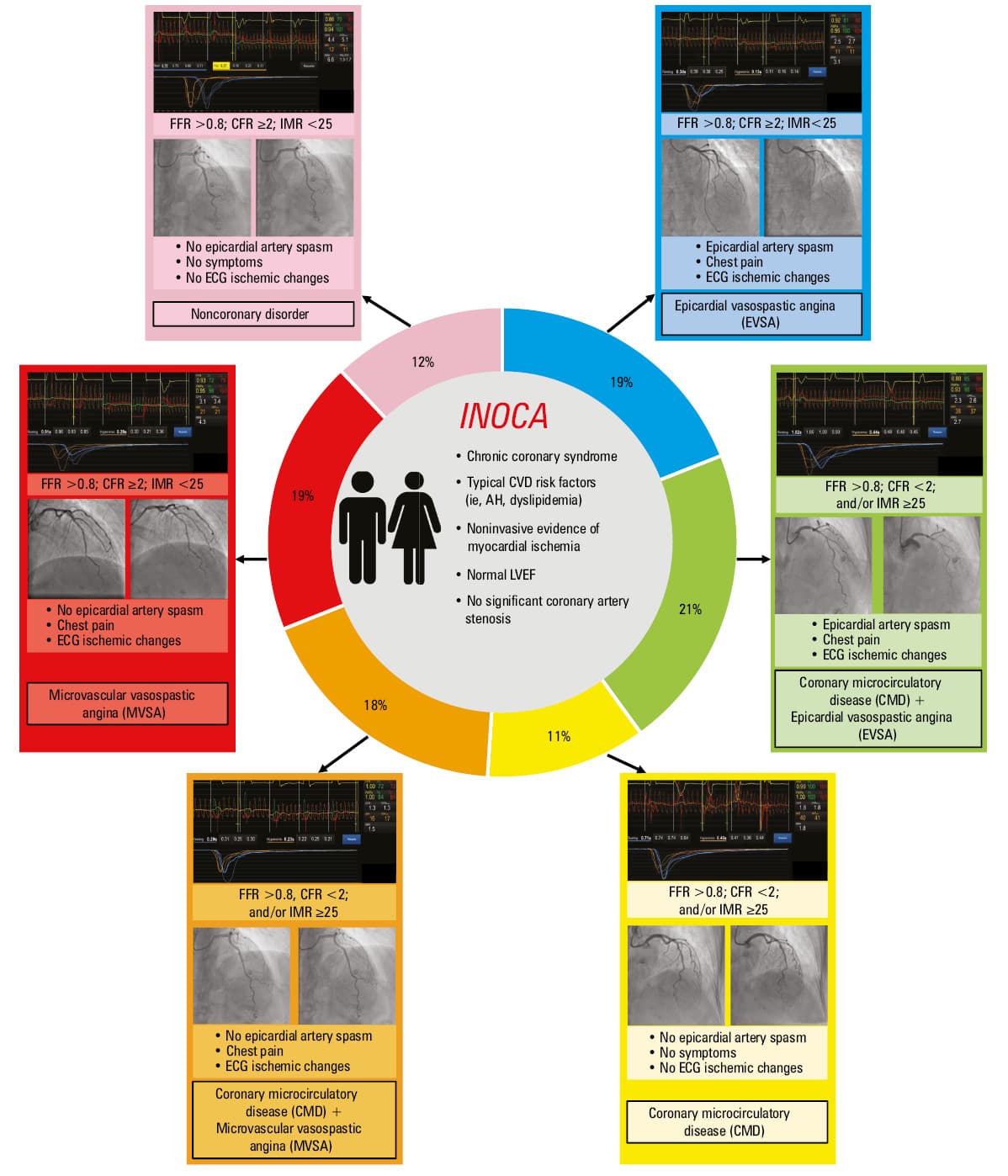
Abbreviations: AH, arterial hypertension; CFR, coronary flow reserve; CVD, cardiovascular disease; ECG, electrocardiogram; FFR, fractional flow reserve; LVEF, left ventricular ejection fraction
Safety of invasive diagnostics
Median (IQR) contrast medium volume used during complex invasive procedure was 140 (120–180) ml. Importantly, no fatal adverse events were observed. During the provocative test with acetylcholine, we recorded episodes of hemodynamically stable paroxysmal atrial fibrillation in 7 patients, which were successfully managed pharmacologically. Additionally, 25 cases of temporary advanced atrioventricular block were observed, which did not require specific treatment. One patient experienced an episode of nonsustained ventricular tachycardia. These data provide additional evidence on safety of the diagnostic algorithm for vasospastic angina. Furthermore, there were 2 cases of coronary artery dissection during physiological measurements with a pressure wire, constituting 1.1% of the entire study group. In these instances, the patients were successfully treated with urgent coronary artery angioplasty.
Discussion
The main findings of this study are that: 1) patients diagnosed with INOCA experience significant symptomatology and exhibit a high prevalence of typical cardiovascular risk factors20-22; 2) there is remarkable heterogeneity among patients suffering from INOCA; and 3) myocardial ischemia with nooobstructive coronary disease is not solely confined to relatively young women, but it affects a broader demographic group, including older patients with a noticeable representation of men. These clinical characteristics, combined with evidence of myocardial ischemia in noninvasive stress tests may initially raise a suspicion of significant coronary artery stenosis. Visualization of morphologically normal coronary arteries underscores the necessity of comprehensive, functional assessment of the coronary circulation.23
Our registry points out remarkable heterogeneity among patients suffering from INOCA. This may result from a disease of coronary microcirculation or microvascular or epicardial vasospasms, and these pathomechanisms often coexist and overlap. Literature reports show that the INOCA group comprises MVA, EVA, and mixed subtypes, with MVA and EVA coexisting.2,14 In our study, the patients with mixed INOCA phenotypes made up virtually 40% of the entire group, emphasizing clinical significance of this phenomenon. However, there are little data on the optimal treatment and pharmacotherapy for the subgroups with mixed pathomechanisms of myocardial ischemia, urging further research.
Interestingly, coexistence of epicardial and microcirculatory vasospasm cannot be ruled out. Unfortunately, there are currently no available methods to explore this phenomenon. New tools, preferably imaging ones, are needed to better understand and diagnose such cases.
In recent studies, CMD was diagnosed based on decreased CFR, while a result of hyperemic microvascular resistance was used to distinguish structural and functional CMD.24,25 However, in our study, we diagnosed CMD relying on the criteria proposed by the European Association of Percutaneous Cardiovascular Interventions Expert Consensus Document on Ischaemia with Non‑Obstructive Coronary Arteries in collaboration with the European Society of Cardiology Working Group on Coronary Pathophysiology and Microcirculation endorsed by the Coronary Vasomotor Disorders International Study Group.1
The results of this study showed that CKD is more often diagnosed in patients with CMD than in other INOCA subgroups. The role of renal microcirculation impairment in the pathogenesis of CKD has been recently reported.26-28 To the best of our knowledge, an association between CKD and the diagnosis of INOCA has not been previously described. However, it is important to acknowledge the relatively small size of the subgroups in our study.
Higher prevalence of INOCA in women is widely postulated in the literature.29-33 There are scarce data on the association between female sex and particular subtypes of INOCA. In our registry, diagnosis of CMD and CMD+MVSA is evidently more common in women.
Safety of the provocative test for vasospastic angina is widely discussed in the literature. Takahashi et al34 provided data confirming safety of this diagnostic procedure. Furthermore, safety of the provocative test with acetylcholine in patients diagnosed with myocardial infarction and nonobstructive coronary arteries (MINOCA) has been proven.35,36 In our registry, approximately 19% of the patients experienced an adverse event during the test with acetylcholine; however, none of these events were life‑threatening, and they were resolved either during the procedure or with hospitalization. On the other hand, Khalid et al37 demonstrated that serious adverse events were associated with the use of a pressure wire during coronary physiology measurements in as many as 27% of patients. We observed 2 cases of coronary artery dissection after physiological assessment with a pressure wire, which resulted in myocardial infarction and required urgent coronary angioplasty. The incidence of coronary artery dissection after the use of a pressure wire in 1.1% of our study patients is consistent with the rate reported in the RIPCORD2 (Does Routine Pressure Wire Assessment Influence Management Strategy at Coronary Angiography for Diagnosis of Chest Pain?) trial.38 New, noninvasive methods for diagnosing INOCA patients need to be developed and validated to enhance the patients’ safety. Recently, the quantitative flow‑ratio–derived index of microcirculatory resistance (QMR) has shown a significant correlation with invasively measured IMR. QMR appears to be a promising method in diagnostics of microcirculation resistance.39,40 Moreover, a new tool for FFR assessment based on coronary computed tomography angiography (CCTA) was described and validated for ambiguous lesion evaluation.41 Hoshino et al42 provided predictors of CMD occurrence analyzed on CCTA.
Nevertheless, noninvasive testing for coronary endothelial dysfunction and vasomotor disorder requires improvement. Ultrasonographic flow‑mediated dilation (FMD) is a validated method for testing of endothelial dysfunction for stratification of cardiovascular risk. However, it is dedicated to peripheral arteries. Results of FMD performed on the brachial arteries are documented in the literature.43-45 The association between FMD in the brachial artery and invasively assessed coronary endothelial dysfunction requires further evaluation.
Limitations
Our study has some limitations that need to be addressed. First, patient enrollment in this registry spanned approximately 3 years as a result of the COVID‑19 pandemic, which substantially affected elective hospital admissions. Second, myocardial ischemia was confirmed through various noninvasive tests, such as electrocardiography treadmill test, stress echocardiography, and radionuclide myocardial perfusion. The study group would have been more representative, had it been assessed using the same method, preferentially a myocardial perfusion assessment test.46-48 Third, the analysis of ischemic changes on ECG recordings during the provocative test with acetylcholine was visual, and a quantitative evaluation with dedicated software might have been more reliable. Finally, the long‑term outcomes and treatment effectiveness were not assessed; however, this was not an aim at this stage of the registry. Follow‑up will be presented in another analysis.
Conclusions
Patients diagnosed with INOCA in the MOSAIC‑COR registry exhibit significant symptomatology and a high prevalence of typical cardiovascular risk factors. Myocardial ischemia in this population may be generated by various, possibly overlapping pathomechanisms. Further investigation is required to evaluate the most effective treatment methods for this group.
- Kunadian V, Chieffo A, Camici PG, et al. An EAPCI expert consensus document on ischaemia with non‑obstructive coronary arteries in collaboration with European Society of Cardiology Working Group on Coronary Pathophysiology & Microcirculation endorsed by Coronary Vasomotor Disorders International Study Group. Eur Heart J. 2020; 41: 3504‑3520.
- Ford TJ, Yii E, Sidik N, et al. Ischemia and no obstructive coronary artery disease: prevalence and correlates of coronary vasomotion disorders. Circ Cardiovasc Interv. 2019; 12: e008126. | Crossref
- Odanovic N, Schwann A, Zhang Z, et al. Long‑term outcomes of patients with ischemia and no obstructive coronary artery disease (INOCA) ‑ a systematic review and meta‑analysis. Eur Heart J. 2023; 44: ehad655.1216. | Crossref
- Tonino PAL, Fearon WF, De Bruyne B, et al. Angiographic versus functional severity of coronary artery stenoses in the FAME study fractional flow reserve versus angiography in multivessel evaluation. J Am Coll Cardiol. 2010; 55: 2816‑2821. | Crossref
- Knuuti J, Wijns W, Saraste A, et al. 2019 ESC Guidelines for the diagnosis and management of chronic coronary syndromes. Eur Heart J. 2020; 41: 407‑477.
ARTICLE INFORMATION