


 CC BY-NC-SA 4.0
Fever of unknown origin (FUO) presents a significant diagnostic challenge due to its diverse etiology, including over 200 possible causes.1 The absence of standardized diagnostic protocol necessitates an individualized approach. The exact cause of FUO remains unidentified in 23.2%–51% of patients.2,3 Neoplasms account for 7%–11.6% of FUO cases.2,3 Angiosarcoma (AS), rare soft tissue sarcoma (<2% of all sarcomas), is characterized by aggressive course and poor prognosis.4
We present a case of an 82‑year‑old man with a 3‑week history of fever and unintentional weight loss. Prior to admission, he received unsuccessful outpatient and inpatient broad‑spectrum antibiotic treatment at a lower‑level referral hospital. During that hospitalization, multiple myeloma was considered as a potential diagnosis, and the patient was referred to our ward for further evaluation. The patient had undergone revascularization of the right external iliac and femoral arteries 8 months before the admission.
On admission, the only significant finding was a palpable tumor in the right iliac fossa, previously assessed by a vascular surgeon as a postprocedural complication. Laboratory tests showed neutrophilia (10.09 × 10³/µl; reference range [RR], 2.2–4.8 × 10³/µl), elevated C‑reactive protein level (174.2 mg/l; RR <5 mg/l) with normal procalcitonin level (0.1 µg/l; RR <0.5 µg/l). Abdominal ultrasound detected a hypoechogenic hypervascular mass (47 mm × 30 mm × 54 mm) surrounding the right external iliac artery (Figure 1A and 1B).
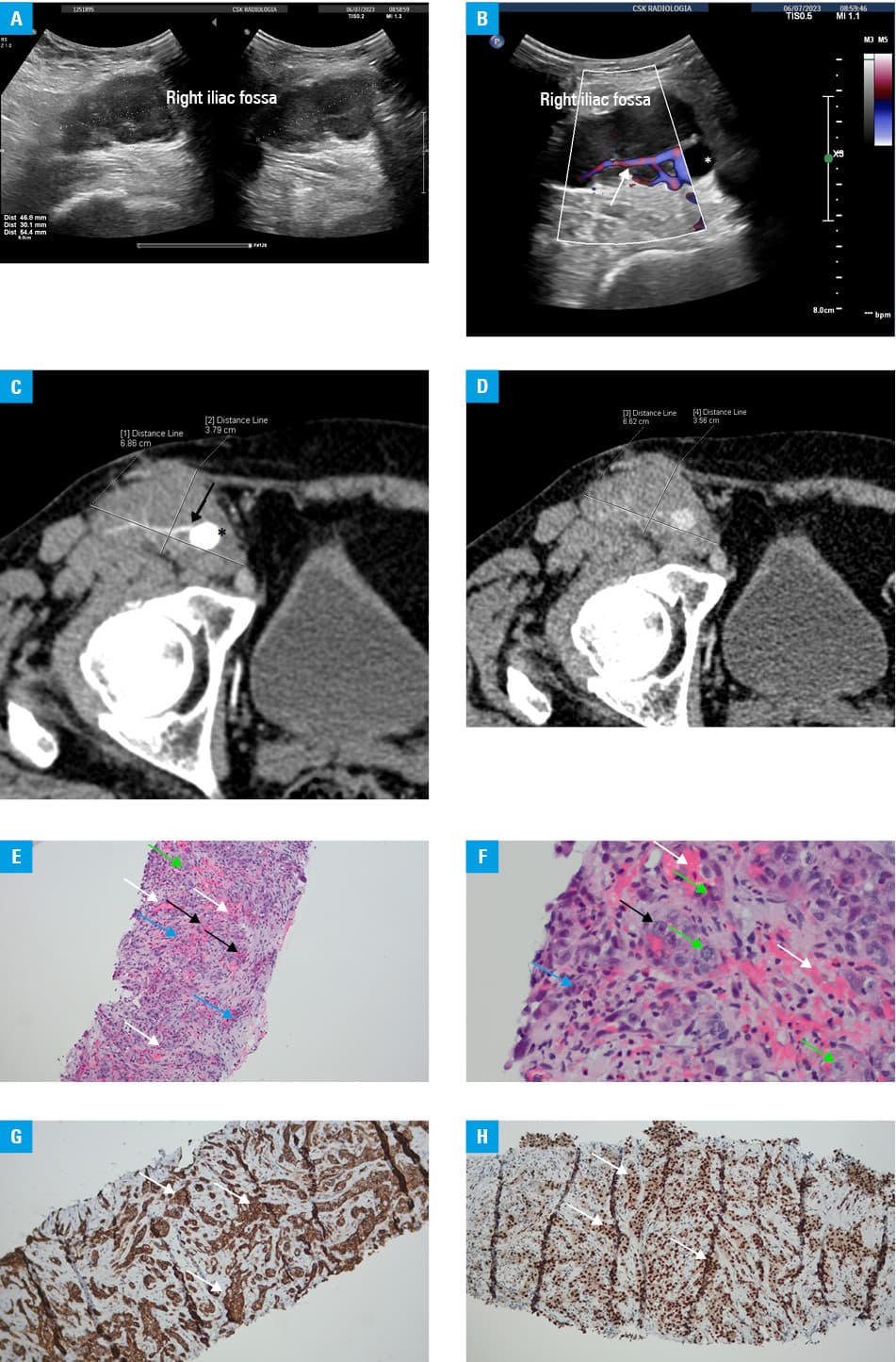
Extensive testing, including blood cultures, hepatitis panel, and autoantibodies, yielded negative results. Therefore, we excluded infectious and noninfectious inflammatory causes, which are responsible for 16%–37.8% and 20.9%–22% of FUO cases, respectively.2,3
Contrast‑enhanced computed tomography (CT) of the thorax, abdomen, and pelvis showed a large (63 mm × 49 mm × 66 mm) hypodense lesion surrounding the right external iliac artery, with few feeding branches seen in the arterial phase, without contrast enhancement typical of malignant tumors, and with slight enhancement in later phases (Figure 1C and 1D, feeding artery diameters are described in Supplementary material, Figure S1A and S1B). Multidisciplinary approach, involving consultation with a vascular surgeon and radiologist, ruled out hematoma, pseudoaneurysm, and abscess as possible diagnoses based on the patient’s clinical presentation and imaging results. Given the uncertain nature of the lesion, a core needle biopsy was performed, revealing AS (Figure 1E–1H) according to the World Health Organization Classification of Soft Tissue and Bone Tumors, 5th Edition.5 The patient was then referred to an oncology center, where he was deemed inoperable and received radiotherapy. Post‑treatment CT showed pulmonary metastases. The patient died within 5 months of the initial AS diagnosis.
This case highlights the diagnostic challenges associated with FUO and emphasizes the importance of considering rare malignancies such as AS. The primary suggestion that the observed lesion was a postprocedural complication and lack of contrast enhancement of the tumor on the CT scan initially excluded the lesion as the cause of fever. This case also suggests a potential link between AS and prior vascular surgery due to the time and localization correlation warranting further research into this phenomenon.
- Cunha BA, Lortholary O, Cunha CB. Fever of unknown origin: a clinical approach. Am J Med. 2015; 128: 1138.e1‑1138.e15. | Crossref
- Bleeker‑Rovers CP, Vos FJ, de Kleijn EMHA, et al. A prospective multicenter study on fever of unknown origin: the yield of a structured diagnostic protocol. Medicine (Baltimore). 2007; 86: 26‑38. | Crossref
- Fusco FM, Pisapia R, Nardiello S, et al. Fever of unknown origin (FUO): which are the factors influencing the final diagnosis? A 2005‑2015 systematic review. BMC Infect Dis. 2019; 19: 653. | Crossref
- May Lee M, Pierobon E, Riva G, et al. Angiosarcoma and vascular surgery: a case report and review of literature. Vasc Endovascular Surg. 2022; 56: 762‑766. | Crossref
- Board WC of TE. Soft tissue and bone tumours. WHO Classification of Tumours, 2020; 1:176‑178
SUPPLEMENTARY MATERIAL
ARTICLE INFORMATION