
Continued regression of cardiac amyloid over the years of sustained complete hematologic remission

 CC BY 4.0
Continued regression of cardiac amyloid over the years of sustained complete hematologic remission
CC BY 4.0
In 2015, a 49‑year‑old man was diagnosed with multiple myeloma (26% of CD138‑positive plasma cells in the bone marrow) and λ amyloid light‑chain (AL) amyloidosis. At diagnosis, he reported severe fatigue and exertional dyspnea (New York Heart Association [NYHA] class 3). Electrocardiography showed sinus rhythm and signs of pseudoinfarction. Laboratory results showed elevated level of N‑terminal pro–B‑type natriuretic peptide (NT‑proBNP) at 2281 pg/ml; reference range [RR], 0–40 pg/ml), as well as creatinine at 1.66 mg/dl (RR, 0.73–1.18 mg/dl), glomerular filtration rate at 42 ml/min/1.73 m2 (RR, 90–120 ml/min/1.73 m²), and albuminuria (no Bence‑Jones protein detected).
Echocardiography revealed left ventricular (LV) hypertrophy, with interventricular septum (IVS) thickness of 18 mm and posterior wall of 16 mm. Both atria were enlarged. Cardiac magnetic resonance (CMR) findings were consistent with extensive myocardial amyloid infiltration, with transmural patchy LV late gadolinium enhancement (LGE), preserved biventricular systolic function, enlargement of both atria, and significant pleural effusion.
The patient received initial hematologic treatment with bortezomib, thalidomide, and dexamethasone, resulting in a partial hematologic response (a difference between the free light‑chain involved and noninvolved decreased by >50% from baseline). In 2016, autologous stem cell transplant (ASCT) was performed, complicated by viral and fungal brain infection, exacerbation of chronic kidney disease with temporary hemodialysis, deep vein thrombosis, and paroxysmal atrial fibrillation. After ASCT, maintenance therapy, initially with bortezomib and dexamethasone, and then with bortezomib alone was administered. Finally, in 2016, a complete hematologic response was achieved, which has been sustained since then. This was followed by a cardiac response in 2020, evidenced by improved exercise tolerance (NYHA, 1/2) and a reduction of NT‑proBNP levels to 185 pg/ml. Improvement of kidney function was also observed.
Despite high‑risk features noted at baseline, including pseudoinfarction and prominent right ventricular (RV) involvement,1,2 serial CMR studies performed in 2017, 2021, and 2022 (Figure 1A–1F) showed an increase of LV ejection fraction (from 56% at baseline to 74%) and atrial size normalization (indirectly suggestive of improved LV diastolic function). RV wall thickness normalized and LV hypertrophy changed from symmetric to asymmetric with normalized inferolateral wall thickness. The 2 most recent CMR studies (2021 and 2022), that is, 5 and 6 years postremission, indicated further reduction of amyloid burden evidenced by a relative decrease of native T1 relaxation time and a marked decrease in myocardial extracellular volume fraction (from 47% to 35%).3,4
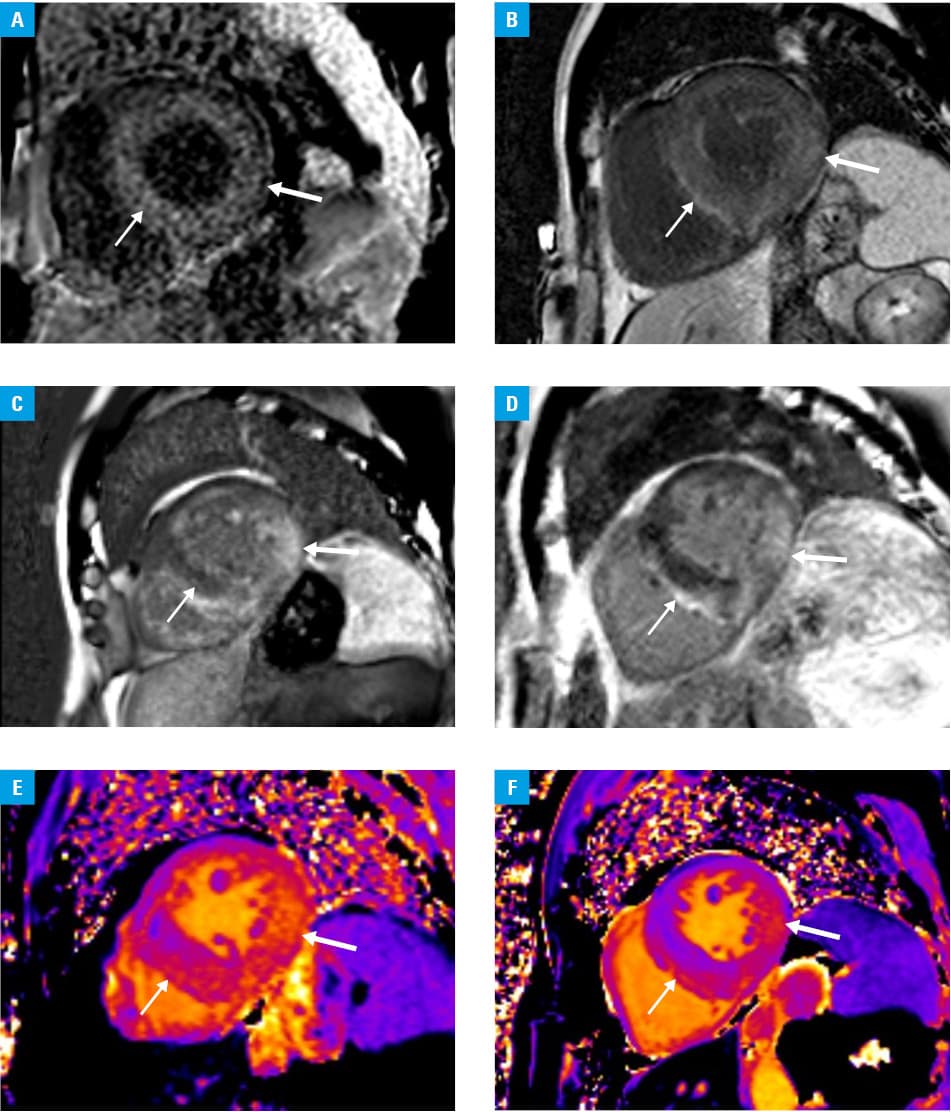
Interestingly, the LGE pattern evolved inconsistently. In comparison with baseline CMR, it disappeared from the RV wall, almost completely regressed from IVS, while it became more prominent in the lateral and inferolateral wall, suggesting replacement fibrosis.5
This case shows that cardiac amyloid burden reduction can be a very slow and heterogeneous process that can continue for years after successful hematologic treatment; however, such cases are rare.5
New drugs acting as antifibril antibodies (birtamimab and CAEL‑101) are being tested in clinical trials, to determine if they can accelerate the process of removing amyloid from tissues and thus improve the prognosis of AL amyloidosis.3
- Zhao L, Li J, Tian Z, Fang Q. Clinical correlates and prognostic values of pseudoinfarction in cardiac light‑chain amyloidosis. J Cardiol. 2016; 68: 426‑430. | Crossref
- Baker KR. Light chain amyloidosis: epidemiology, staging, and prognostication. Methodist DeBakey Cardiovasc J. 2022; 18: 27‑35. | Crossref
- Treibel TA, Fontana M, Maestrini V, et al. Automatic measurement of the myocardial interstitium. JACC: Cardiovascular Imaging. 2016; 9: 54‑63. | Crossref
- Wechalekar AD, Fontana M, Quarta CC, Liedtke M. AL amyloidosis for cardiologists. JACC CardioOncol. 2022; 4: 427‑441. | Crossref
- Martinez‑Naharro A, Patel R, Kotecha T, et al. Cardiovascular magnetic resonance in light‑chain amyloidosis to guide treatment. Eur Heart J. 2022; 43: 4722‑4735. | Crossref
ARTICLE INFORMATION