

 CC BY 4.0
Kikuchi‑Fujimoto disease (KFD) is a self‑limiting histiocytic necrotizing lymphangitis manifested by unilateral cervical lymphadenopathy and nonspecific general symptoms (fever, rash, arthralgia, weight loss). Due to similarity of symptoms, it is necessary to differentiate KFD from lymphoma, systemic lupus erythematosus (SLE), and viral diseases.1-3 However, the misdiagnosis rate is as high as 40%.3
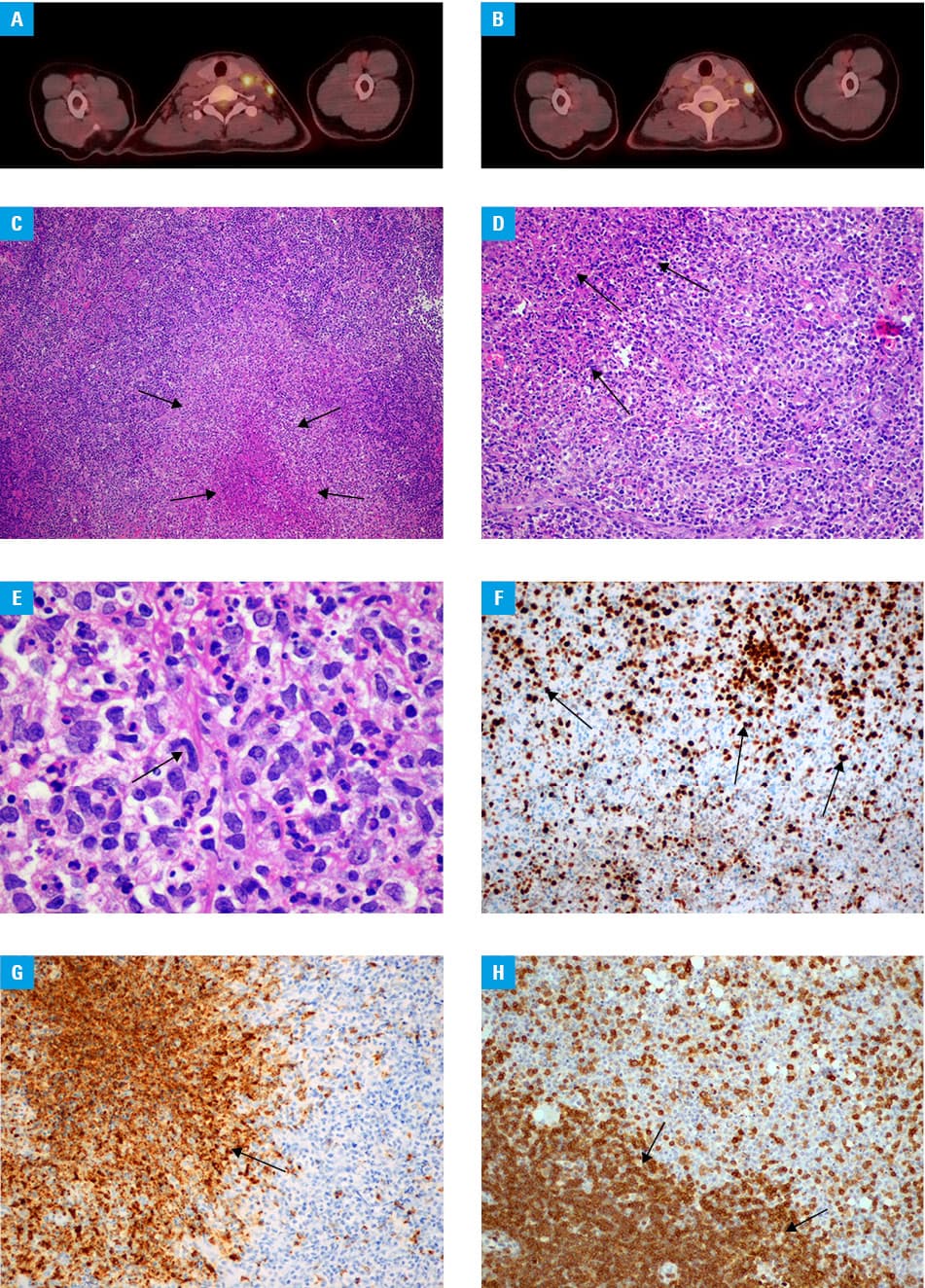
An 18‑year‑old woman, with no addictions or chronic diseases, attended our clinic due to left‑sided cervical lymphadenopathy lasting for a week (January 2023). She reported no fever, weight loss, or fatigue. She had suffered from an upper respiratory tract infection a month earlier, which was not treated pharmacologically. An ambulatory ultrasound examination showed enlarged inferior cervical lymph nodes (up to 24 mm), with obliterated structure and abnormal vascularization of hilum. Laboratory workup showed only abnormal activity of alkaline phosphatase (105 IU/l; reference range, 10–98 IU/l), while the other parameters (peripheral blood count, inflammatory markers, biochemical tests) were within the reference range. They are presented in Supplementary material, Table S1. Serological and molecular tests for an infection with cytomegalovirus, Epstein‑Barr virus, human herpes virus types 6 and 8, parvovirus B‑19, and toxoplasmosis were also negative. Laboratory and clinical evidence ruled out autoimmune disease. A positron emission tomography‑computed tomography (PET/CT) scan revealed metabolically active left‑sided group IV cervical lymph nodes (11 mm × 7 mm, maximum standardized uptake value = 13.2) (Figure 1A–1B). A decision was made to perform excisional biopsy of the lymph node. Histopathologic examination showed a significantly enlarged T‑zone with small T‑cells and multiple areas of necrosis with apoptotic bodies and infiltration of neutrophils, macrophages, small T‑cells, and plasma cells, as well as proliferation of high endothelial vessels, all consistent with a reactionary lymph node enlargement with a predominant reaction in the T‑zone (Figure 1C–1H). The laboratory findings and clinical picture suggested a diagnosis of KFD. No systemic treatment was introduced. Three months later, due to persistent lymphadenopathy, lymph node rebiopsy was scheduled but was eventually withdrawn due to resolution of the symptoms. A follow‑up PET/CT scan (August 2023) showed metabolic and morphological regression of the previously changed lymph nodes.
KFD is a rare disease, affecting mainly young women (mean age, 30 years; range, 6–80 years).4,5 Its etiology remains unknown, although it is primarily suggested to be a reaction to a viral infection or autoimmune factors (patients at an older age often develop autoimmune diseases: SLE, Hashimoto disease, or Sjögren syndrome).4 The most common symptoms of KFD are painful posterior cervical lymphadenopathy, usually 0.5–4 cm (56%–98%) and fever (30%–50%).3 Final diagnosis requires histopathologic examination of the lymph node, revealing characteristic infiltrates of histiocytes with crescentic nuclei (MPO+, CD68+) and small T‑cells (CD3+, CD8+).3-5 The disease resolves spontaneously in up to 95% cases within 1–6 months, with recurrence in 3%–4%.3,5 Nonsteroidal anti‑inflammatory drugs and glucocorticosteroids (prednisone, 1–2 mg/kg) are administered to treat more severe cases. In addition, anakinra (human interleukin‑1 receptor antagonist), hydroxychloroquine (antimalarial), and intravenous immunoglobulin infusions have also been reported to be effective.5 The main aim of our study was to point out that even though KFD is an extremely rare entity, physicians may encounter it in daily practice.
- Wang W, Huang S, Nong L, et al. Clinicopathologic analysis of Kikuchi‑Fujimoto disease and etiologic exploration using metagenomic next‑generation sequencing. Arch Pathol Lab Med. 2023; 147: 767‑773. | Crossref
- Kim HY, Jo HY, Kim SH. Clinical and laboratory characteristics of Kikuchi‑Fujimoto disease according to age. Front Pediatr. 2021; 9: 745506. | Crossref
- Gurung S, Pariyar RS, Karki S, et al. Kikuchi‑Fujimoto disease in a 20‑year‑old female: a case report. Ann Med Surg (Lond). 2023; 85: 1894‑1896. | Crossref
- Perry AM, Choi SM. Kikuchi‑Fujimoto disease: a review. Arch Pathol Lab Med. 2018; 142: 1341‑1346. | Crossref
- Mahajan VK, Sharma V, Sharma N, Rani R. Kikuchi‑Fujimoto disease: a comprehensive review. World J Clin Cases. 2023; 11: 3664‑3679. | Crossref
SUPPLEMENTARY MATERIAL
ARTICLE INFORMATION