
End-stage kidney disease treated with hemodialysis in a patient with Hutchinson–Gilford progeria syndrome

 CC BY 4.0
End-stage kidney disease treated with hemodialysis in a patient with Hutchinson–Gilford progeria syndrome
CC BY 4.0
Hutchinson–Gilford progeria syndrome (HGPS) is an ultrarare, genetically determined disorder, occurring once in every 18 million people, characterized by accelerated aging.1 Symptoms of the syndrome, including growth impairment and severe atherosclerosis, appear in early childhood, leading to drastically shortened lifespan with an average age of death at 14.6 years; however, intellectual deficits are not present.2 Cardiovascular disease (CVD) is the leading cause of death in patients with HGPS.
We present a case of a 24‑year‑old woman diagnosed with HGPS at the age of 2 years and 6 months. At 10 months of age, kidney pyramid calcification was diagnosed on ultrasonography. At the age of 7 years, the patient developed hypertension. At that time she started treatment with lonafarnib at the Children’s Hospital in Boston as part of a clinical trial. Lonafarnib belongs to farnesyltransferase inhibitors, which reduce the synthesis of progerin, an abnormal protein produced due to the HGPS point mutation that is responsible for vascular changes.3 The treatment was continued for 12 years.
Deterioration of kidney function (serum creatinine, 2.15 mg/dl [reference range, 0.55–1.02 mg/dl]; estimated glomerular filtration rate [eGFR] calculated using the Chronic Kidney Disease Epidemiology Collaboration [CKD‑EPI] equation, 32 ml/min/1.73 m2 [reference range >90 ml/min/1.73 m2]; creatinine clearance calculated with the Cockcroft–Gault formula, 9 ml/min; body mass, 13 kg) was first observed at the age of 19, following a 2‑year experimental treatment with everolimus. It has been demonstrated that the combined use of lonafarnib and everolimus reduces progerin expression in individuals with HGPS.4 However, in some patients, everolimus may induce kidney injury.5 Over the subsequent 2 years, a further decrease in kidney function was observed. At the age of 21, the patient required initiation of renal replacement therapy (RRT) with hemodialysis due to end‑stage kidney disease (ESKD) (serum creatinine, 4.05 mg/dl; eGFR by the CKD‑EPI equation, 15 ml/min/1.73 m2; creatinine clearance by the Cockcroft–Gault formula, 3 ml/min; body mass, 13 kg) with overhydration and severe anemia. A tunneled‑cuffed hemodialysis catheter was inserted into the right internal jugular vein (Figure 1A). The hemodialysis schedule involved 3 hemodialysis sessions (12 hours per week); an FX40 dialyzer with an effective surface area of 0.6 m2 and pediatric lines were used. Interdialytic weight gain ranged from 4%–7% of body weight, Kt/V ranged from 1.2 to 1.8. Hypertension, anemia, and secondary hyperparathyroidism were pharmacologically controlled. During RRT an improvement in the patient’s clinical status was observed. Unfortunately, she died after 18 months of hemodialysis therapy due to severe pneumonia at the age of 24.
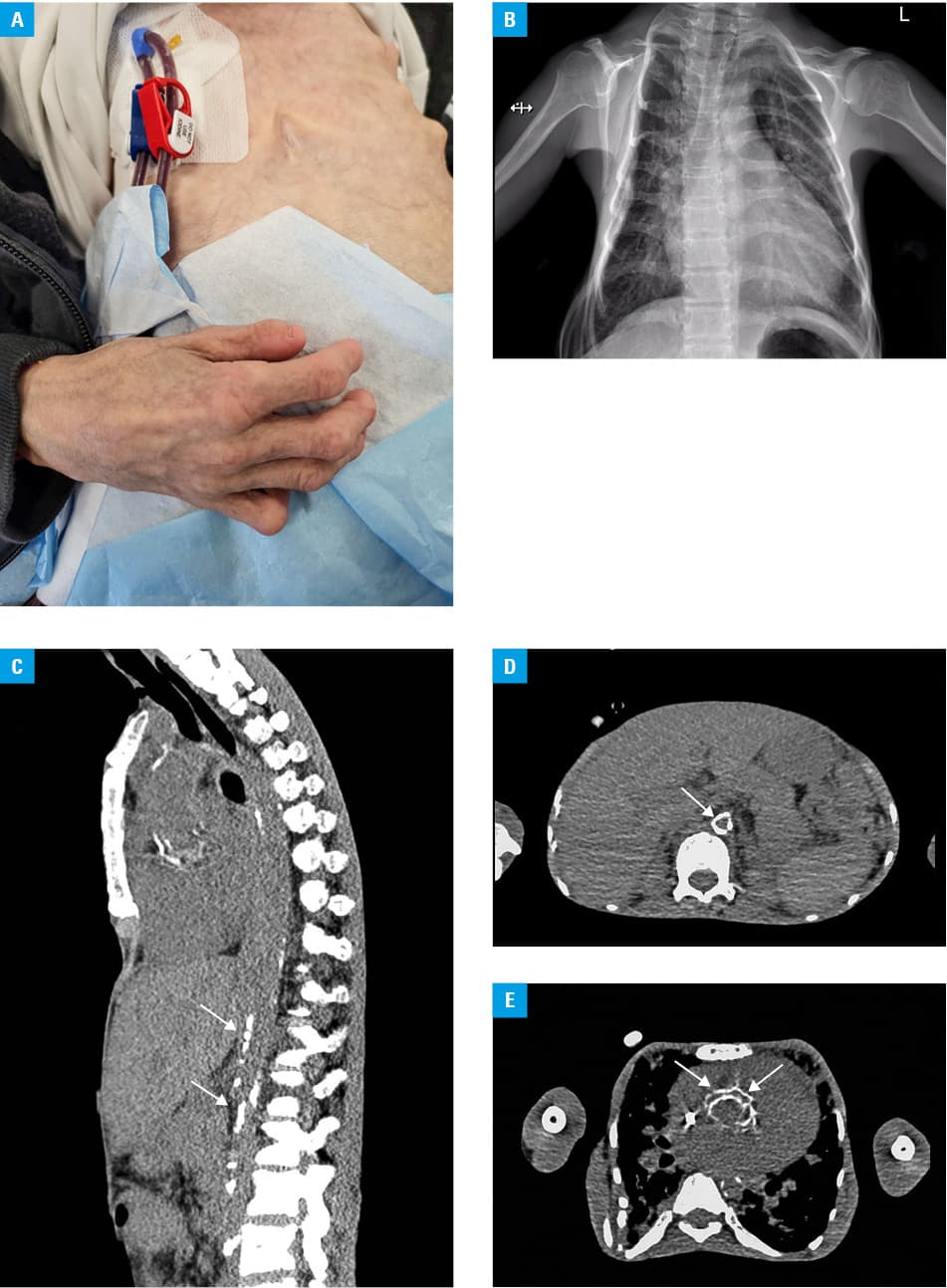
Expected lifespan in individuals with HGPS is drastically shortened due to CVD, which was also the case in our patient (Figure 1B–1E). She also developed ESKD and required RRT with hemodialysis. The cause of ESKD is not clear, but it might involve kidney calcification / nephrocalcinosis, hypertension, and atherosclerosis, along with a potentially nephrotoxic effect of everolimus. To our best knowledge, this is the first report of ESKD treated with hemodialysis in a patient with HGPS. It shows that RRT with hemodialysis can prolong survival in a patient with progeria, despite unfavorable prognosis.
- Gordon LB. PRF by the numbers. The Progeria Research Foundation. https://www.progeriaresearch.org/prf‑by‑the‑numbers/?hilite=PRF+numbers. Accessed June 30, 2024.
- Gordon LB, Shappell H, Massaro J, et al. Association of lonafarnib treatment vs no treatment with mortality rate in patients with Hutchinson‑Gilford progeria syndrome. JAMA. 2018; 319: 1687‑1695. | Crossref
- Gordon LB, Norris W, Hamren S, et al. Plasma progerin in patients with Hutchinson‑Gilford progeria syndrome: immunoassay development and clinical evaluation. Circulation. 2023; 147: 1734‑1744. | Crossref
- Abutaleb NO, Atchison L, Choi L, et al. Lonafarnib and everolimus reduce pathology in iPSC‑derived tissue engineered blood vessel model of Hutchinson‑Gilford progeria syndrome. Sci Rep. 2023; 13: 5032. | Crossref
- Ha SH, Park JH, Jang HR, et al. Increased risk of everolimus‑associated acute kidney injury in cancer patients with impaired kidney function. BMC Cancer. 2014; 14: 906. | Crossref
ARTICLE INFORMATION