

 CC BY 4.0
Significant mitral stenosis (MS) is defined as a mitral valve area (MVA) below 1.5 cm². Invasive treatment is usually indicated when clinical symptoms are present. According to current guidelines, a decision on the intervention should be based on a consultation with a heart team.1 In this work, we describe 2 cases with similar echocardiographic findings managed using different strategies.
A 70‑year‑old man with atrial fibrillation (AF), height of 163 cm, and weight of 70 kg (body surface area [BSA], 1.76 m2), who underwent mitral commissurotomy (MC) in 1979, was admitted to our hospital for cardiac evaluation. He reported shortness of breath on exertion (New York Heart Association functional class III). Chest X‑ray showed significant cardiomegaly (Supplementary material, Figure S1A–S1D). Transthoracic echocardiography (TTE) showed moderate MS with mild regurgitation (mean mitral gradient, 10 mm Hg; MVA index, 0.68 cm2/m2; Figure 1A), accompanied by giant left atrium (LA), defined as an LA diameter above 65 mm (diameter, 100 mm; area, 137 cm2; LA volume, 1001 ml; LA volume index, 541 ml/m2; Figure 1B–1D). TTE also showed enlarged right atrium (area, 51 cm2), with widening of the tricuspid annulus (49 mm), severe tricuspid regurgitation (TR) (proximal isovelocity surface area [PISA], 9 mm; effective regurgitant orifice, 0.46 cm2; TR volume, 47 ml), and elevated right ventricular systolic pressure (62 mm Hg; Supplementary material, Figure S2A and S2B). Other valves and dimensions were within normal range. Further diagnostic workup revealed pancytopenia and stage G3b renal failure. Due to high perioperative risk (EuroScore II, 8.46%), including potential reoperation requiring extracorporeal circulation, cachexia (Clinical Frailty Scale, 5 points), dependence on others for assistance, and pancytopenia, the heart team opted for conservative treatment.
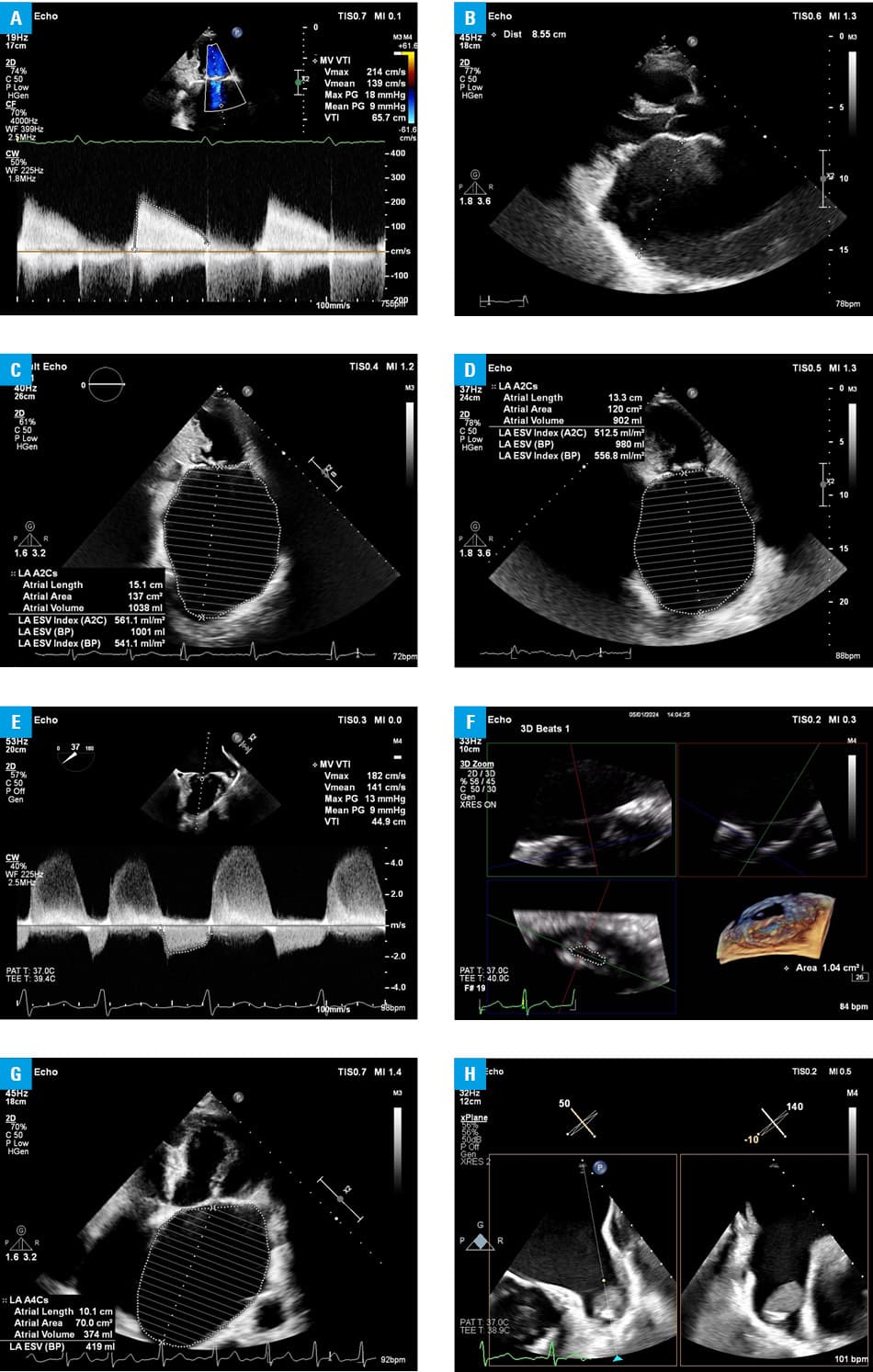
A 66‑year‑old woman with chronic heart failure, AF, previous pulmonary edema, height of 163 cm, and weight of 63 kg (BSA, 1.68 m2) was admitted to our hospital for cardiac diagnostics. TTE demonstrated mixed mitral disease: severe stenosis (mean gradient, 10 mm Hg; MVA index, 0.6–0.83 cm2/m2; Figure 1E and 1F) and moderate regurgitation (PISA, 7 mm; vena contracta, 6 mm), as well as giant LA (diameter, 83 mm; area, 80 cm2; LA volume, 400–500 ml; LA volume index, 250 ml/m2; Figure 1G). Other valves and dimensions were within normal range. Transesophageal echocardiography confirmed severe MS and identified a thrombus in the LA appendage (Figure 1H). The surgical risk was assessed as 1.8% in EuroScore II. After consultation with the heart team, the patient underwent successful MV replacement (mechanical valve, Medtronic ATS 31M; Medtronic, Minneapolis, United States) and LA appendage closure (AtriClip 45; Atricure, Mason, Ohio, United States).
When assessing a patient for intervention, it is important to consider other factors in addition to echocardiographic images. In the above cases, the first patient had comorbidities precluding surgery, contrary to the second patient. For individuals with surgical contraindications, percutaneous MC is an alternative despite its limitations, such as prior commissurotomy, persistent AF, severe pulmonary hypertension, MV calcification, and severe TR. It is also noteworthy that new transcatheter solutions for MS in high‑risk patients are emerging.4,5
- Vahanian A, Beyersdorf F, Praz F, et al. 2021 ESC/EACTS Guidelines for the management of valvular heart disease. Eur Heart J. 2022; 43: 561‑632. | Crossref
- Apostolakis E, Shuhaiber JH. The surgical management of giant left atrium. Eur J Cardiothorac Surg. 2008; 33: 182‑190. | Crossref
- Yang S, Wang C, Zhang B, et al. Clinical effects of surgical left atrial reduction and concomitant mitral valve replacement in patients with giant left atrium. Braz J Cardiovasc Surg. 2023; 38: e20220469. | Crossref
- Xiling Z, Puehler T, Sondergaard L, et al. Transcatheter mitral valve repair or replacement: competitive or complementary? J Clin Med. 2022; 11: 3377. | Crossref
- Scisło P, Rdzanek A, Pietrasik A, et al. The function of the heart after successful transcatheter mitral valve repair due to severe functional regurgitation. Pol Arch Intern Med. 2021; 131: 686‑692. | Crossref
SUPPLEMENTARY MATERIAL
ARTICLE INFORMATION