
IgG4-related disease and antineutrophil cytoplasmic antibody–associated vasculitis overlap syndrome with renal involvement: diagnostic difficulties and treatment strategies

 CC BY 4.0
IgG4-related disease and antineutrophil cytoplasmic antibody–associated vasculitis overlap syndrome with renal involvement: diagnostic difficulties and treatment strategies
CC BY 4.0
Immunoglobulin G4–related disease (IgG4‑RD) is a rare, progressive, immune‑mediated, fibroinflammatory condition. It is recognized as definite when all of the following items are present, probable when items 1 and 2 are found, and possible when items 1 and 3 are present: 1) clinical and radiologic features, that is, enlargement of or a tumor‑like mass in at least 1 of the typical organs (lacrimal and salivary glands, retroperitoneum, pancreas, bile ducts, orbits, kidneys, lungs, aorta, pachymeninges, or thyroid gland); 2) pathologic features, including 2 or more of the following: dense lymphoplasmacytic infiltration, IgG4+/IgG cell ratio greater than or equal to 40% and / or the number of IgG4+ plasma cells greater than or equal to 10 per 1 high‑power field, storiform tissue fibrosis (“cartwheel appearance”) or obliterative phlebitis; 3) serum IgG4 level greater than or equal to 135 mg/dl (50%–70% of cases).1-3
Renal involvement is extremely rare. The most common renal manifestation is tubulointerstitial inflammation with progressive renal failure, nondiabetic proteinuria, and erythrocyturia. Less common symptoms include hypocomplementemia, elevated IgE levels, eosinophilia, and polyclonal hypergammaglobulinemia. Histopathologic changes in the glomeruli are rare, whereas immune deposits in the basement membrane of the tubules are a common finding.3-5
Due to the lack of specificity of IgG4 level elevation, IgG4‑RD mimics a wide range of clinical conditions, such as Sjögren syndrome, sarcoidosis, Castleman disease, infections, neoplasms, lymphomas, and vasculitis. Exclusion criteria for IgG4‑RD are rapid progression, fever, lack of response to glucocorticoids, idiopathic leukopenia or thrombocytopenia, other positive disease‑specific autoantibodies, cryoglobulinemia, suspected malignancy, neutrophilic or granulomatous inflammation, and necrosis.1-5 Most patients with IgG4‑RD present with multiorgan involvement.
We report a case of a 62‑year‑old man with chronic kidney disease (CKD) who was referred to a nephrology department due to sudden progression of renal failure (creatinine, 343 μmol/l; reference range [RR], 62–106 μmol/l). Laboratory workup revealed eosinophilia (0.63 × 10³ cells/μl; RR, 0.04–0.45 × 10³/μl), elevated serum lipase (372 U/l; RR, 13–60 U/l) and amylase levels (330 U/l; RR, 28–100 U/l), erythrocyturia (18.5 cells/μl; RR <13.6 cells/μl), proteinuria (urine protein / creatinine ratio, 57.3 mg/mmol; RR <15 mg/mmol), polyclonal IgG gammopathy (28.9 g/l; RR, 6.38–17 g/l), elevated IgG4 level (6.13 g/l; RR, 0.03–2.01 g/l), and positive myeloperoxidase antibodies (6.5 IU/ml; RR <3.5 IU/ml). Contrast‑enhanced computed tomography (CT), performed for the first time during this hospitalization, showed multiple round, hypodense areas in the renal cortex (Figure 1A) and a small area of diffuse fibrosis in the lung parenchyma. Renal biopsy was performed. Histopathologic examination showed complete sclerosis of one‑third of the glomeruli, a slight increase in the mesangial matrix, hypercellularity, a crescent of cellular‑fibrous cells, extensive fibrosis, and abundant lymphoplasmacytic cell infiltration in the stroma. No deposits were observed (Figure 1B–1F).
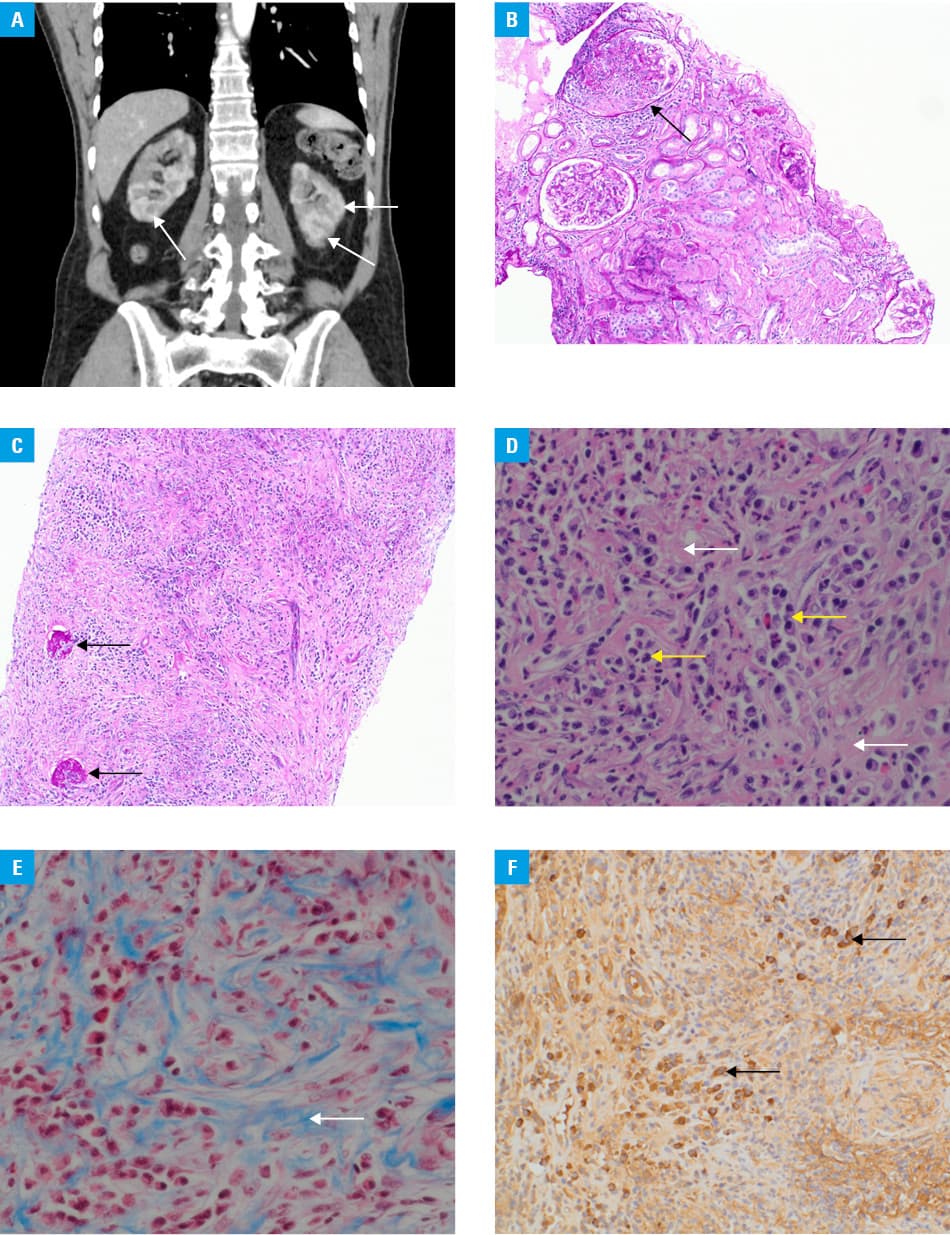
IgG4‑RD and antineutrophil cytoplasmic antibody–associated vasculitis (AAV) overlap syndrome was diagnosed. Given the proven efficacy of corticosteroids and rituximab in both conditions,5 the patient was treated with oral prednisolone 40 mg once daily with dose reduction for 4 months and 2 pulses of 1 g rituximab every 14 days. As a maintenance dose, rituximab 500 mg (4 doses) intravenously every 6 months and a low‑dose oral glucocorticosteroid were administered. At the 3- and 7‑month follow‑up, the patient’s IgG4 levels were within the RR; he presented with stable CKD (creatinine, 281 μmol/l) and an almost complete regression of lung lesions on chest CT.
IgG4‑RD and AAV can overlap. Awareness and accurate diagnosis are important to prevent progression to chronic disease, multiorgan dysfunction, and mortality. A treatment strategy that targets both diseases should be used.3-5
- Biedroń, G, Kosałka J, Gąsior J, et al. Kimura disease and immunoglobulin G4‑related disease: a possible overlap in a patient with severe systemic symptoms. Pol Arch Intern Med. 2019; 129: 125‑126. | Crossref
- Wallace ZS, Naden RP, Chari S, et al. American College of Rheumatology / European League Against Rheumatism IgG4‑Related Disease Classification Criteria Working Group. The 2019 American College of Rheumatology / European League Against Rheumatism classification criteria for IgG4‑related disease. Arthritis Rheumatol. 2020; 72: 7‑19. | Crossref
- Erden A, Bolek EC, Yardimci KG, et al. ANCA‐associated vasculitides and IgG4‐related disease really overlap or not? Int J Rheum Dis. 2019; 22: 1926‑1932. | Crossref
- Perugino CA, Stone JH. IgG4‑related disease: an update on pathophysiology and implications for clinical care. Nat Rev Rheumatol. 2020; 16: 702‑714. | Crossref
- Faz‑Muñoz D, Hinojosa‑Azaola A, Mejía‑Vilet JM, et al. ANCA‑associated vasculitis and IgG4‑related disease overlap syndrome: a case report and literature review. Immunol Res. 2022; 70: 550‑559. | Crossref
ARTICLE INFORMATION