

 CC BY 4.0
The causative agent of amebic dysentery (amebiasis) is the cosmopolitan protozoan Entamoeba histolytica.1 In Poland, cases of the disease are usually imported. The infection occurs via the oral route. A typical clinical manifestation is the intestinal form, characterized by bloody diarrhea. Extraintestinal forms are less common and mainly include organ abscesses, with liver abscesses predominating.2 Treatment of the extraintestinal forms is combined, and encompasses administration of metronidazole (or tinidazole) and paromomycin. In the cases of extensive abscesses, surgical management, such as aspiration or drainage, is necessary.3,4
A previously healthy 41‑year‑old man, who has been travelling with his family for 6 months in south‑east Asia, suddenly developed fever of up to 39 °C, not accompanied by any other symptoms. The consulting physician on the island of Gili Air, Indonesia, empirically recommended cefixime without specifying the diagnosis. As there was no clinical improvement, the patient traveled to the nearby island of Bali, where he was hospitalized. Laboratory workup included leukocytosis (33 × 109/l; with the predominance of neutrophils), along with elevated levels of procalcitonin (1.83 ng/ml; reference range [RR], 0–0.05 ng/ml) and C‑reactive protein (8 mg/l; RR, 0–5 mg/l). Neuroinfection, malaria, and dengue fever were ruled out, and a diagnosis of right‑sided pneumonia with pleural effusion was made (Figure 1A). Treatment included gentamicin, sulbactam, and cefoperazone. Bronchoscopy showed distal stenosis of the right lower bronchus due to external compression. The imaging workup was extended to a computed tomography (CT) scan of the chest, which confirmed the diagnosis of pneumonia with pleural reaction. Despite an absence of abdominal symptoms, abdominal ultrasonography was performed, and a lesion in the liver consistent with an abscess or hematoma was visualized. A subsequent abdominal CT scan confirmed the presence of a 10‑cm abscess of the right lobe of the liver. Stool tests for parasites were negative. Due to the liver abscess with pleural reaction of possible amebic etiology, treatment was modified to metronidazole and cefixime. The patient no longer had a fever; however, he started to experience pain in his right shoulder, requiring morphine administration. After 10 days of hospitalization, he was unexpectedly discharged on an oral antibiotic and analgesic treatment.
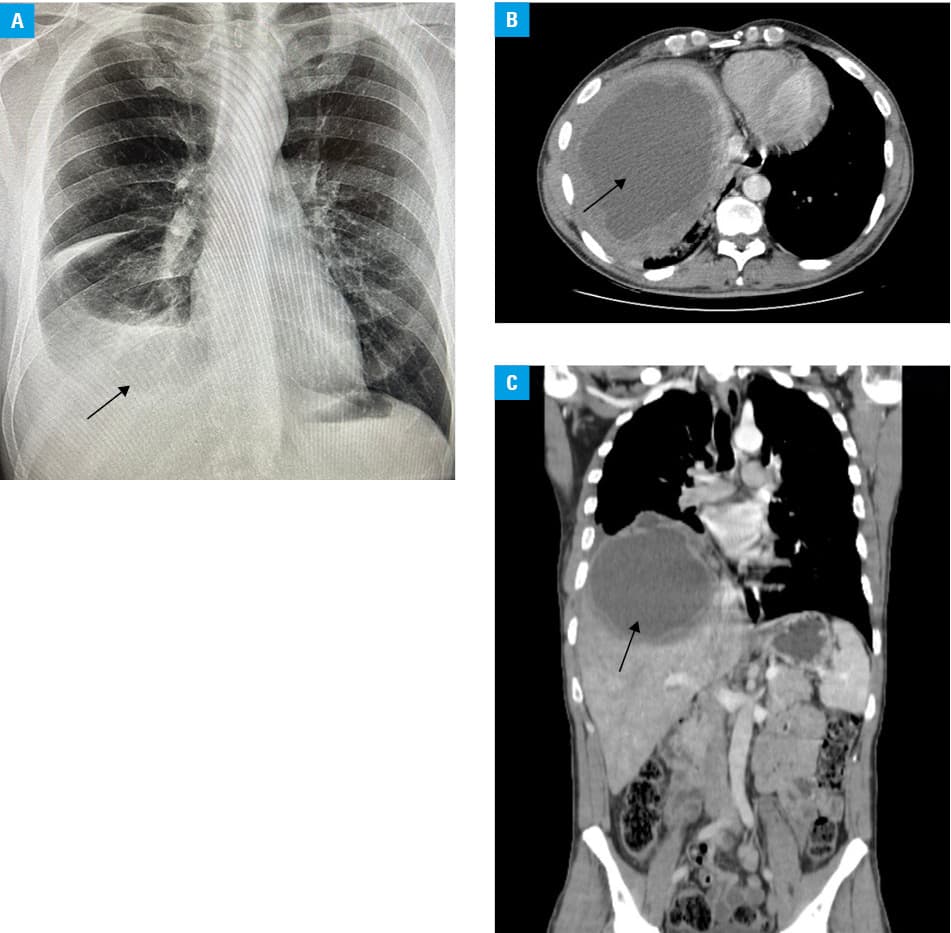
Despite weakness, weight loss of 9 kg (body mass index, 19.81 kg/m2), and shoulder pain, the patient decided to return to Poland. During the flight, he started expectorating purulent sputum. His general condition continued to deteriorate as he traveled by car from Warsaw to Kędzierzyn‑Koźle, where, in the surgical ward, a subsequent CT scan showed a 16‑cm liver abscess with a fistula to the chest (Figure 1B and 1C). The patient underwent surgery involving drainage of the liver abscess. Cultures of the abscess content were sterile, and histopathologic examination showed necrotic masses with purulent infiltration. He was treated with metronidazole with piperacillin‑tazobactam. After 8 days of hospitalization, he was discharged in good condition.
One month after the surgery, he was admitted to the First Department of Infectious Diseases in Wrocław for further diagnostic tests for amebic dysentery. The stool polymerase chain reaction test results for this disease were negative but E. histolytica immunoglobulin G antibodies were positive. Additional treatment with paromomycin was implemented.
On follow‑up imaging and clinical examination performed 9 months after surgical treatment, no changes on the chest or abdominal CT scan were found. The patient felt healthy.
In the differential diagnosis of febrile conditions in individuals travelling to countries with lower sanitary standards, the possibility of E. histolytica infection should always be taken into account, even in the absence of typical intestinal symptoms.5
- Mach T, Wroczyńska A. Amebiasis [in Polish]. https://www.mp.pl/interna/chapter/B16.II.4.24.4.2. Accessed July 18, 2024.
- Sikorska K. Amoebic liver abscess [in Polish]. Hepatologia. 2021; 21: 72‑76.
- Kumanan T, Sujanitha V, Sreeharan N. Amoebic liver abscess: a neglected tropical disease. Lancet Infect Dis. 2020; 20: 160‑162. | Crossref
- Kumar R, Patel R, Priyadarshi RN, et al. Amebic liver abscess: an update. World J Hepatol. 2024; 16: 316‑330. | Crossref
- Kuna A, Grzybek M. Practical approach to a patient with fever who travelled to the tropics. Pol Arch Intern Med. 2024; 134: 16600. | Crossref
ARTICLE INFORMATION