
Initial experiences with combined therapy of anemia with roxadustat and epoetin α in hemodialysis patients: a case series


 CC BY-NC-SA 4.0
Initial experiences with combined therapy of anemia with roxadustat and epoetin α in hemodialysis patients: a case series
CC BY-NC-SA 4.0
Introduction
Anemia is a severe complication of chronic kidney disease (CKD) that is associated with an increased risk of glomerular filtration rate (GFR) decline, hospitalization, and cardiovascular events.1 Although the main mechanism underlying the pathophysiology of anemia of CKD is disruption of oxygen sensing, the whole picture is in fact much more complex, and involves iron utilization defects, decreased red blood cell lifespan, and blood loss associated with dialysis procedures.2 Conventional treatment of anemia of CKD consists in administration of erythropoietin‑stimulating agents (ESAs) together with iron supplementation. However, maintaining stable hemoglobin levels may require increasing ESA doses, which puts patients at a higher risk of cardiovascular complications, while iron supplementation may lead to overdose due to predominance of storage over transportation capacity in the uremic milieu.3
On the other hand, undertreatment of renal anemia is a global problem and a recognized unmet need in CKD patients.4 Furthermore, hemodialysis patients are prone to inflammation, which, according to the DOPPS (Dialysis Outcomes and Practice Patterns Study), affects more than 40% of this population.5 Inflammation makes iron supplementation more problematic, disrupts iron utilization, and hinders an adequate ESA response. Reduced response to ESA treatment in dialysis patients remains a challenge in the management of anemia.6 Roxadustat is a novel choice option in anemia treatment, regarded as an alternative to ESA. The drug is the only oral hypoxia‑inducible factor–prolyl hydroxylase inhibitor (HIF–PHI) approved by the European Medicines Agency for adult patients with CKD, both nondialysis- and dialysis‑dependent.7 Roxadustat is capable of targeting complex mechanisms of anemia of CKD by restoring the oxygen‑sensing pathway and allowing for better iron utilization. This results in satisfactory long‑term sustained hemoglobin control, and could ensure better care for CKD patients.8 Current evidence does not endorse combined therapy utilizing HIF–PHI together with ESA due to a lack of supporting data. Nevertheless, the first published observations in patients treated with peritoneal dialysis (PD) show that such an approach is feasible and most probably safe.9 Here, we report our experience with the administration of roxadustat combined with decreased doses of ESA in hemodialysis patients who did not achieve the recommended hemoglobin level during conventional anemia treatment.
Patients and methods
This is an observational, noninterventional, prospective analysis of 5 patients treated with roxadustat combined with an ESA. Diagnosis and treatment of anemia in our center is carried out in accordance with the current recommendations of the Kidney Disease Improving Global Outcomes (KDIGO) Clinical Practice Guideline for Anemia in CKD and the expert opinion of the Polish Society of Nephrology.10,11 None of the included hemodialysis patients had iron, folic acid, or vitamin B12 deficiency, or experienced bleeding from the gastrointestinal tract. A moderate increase in parathyroid hormone concentration was observed in 2 individuals, and a moderate increase (<30 mg/l) in C‑reactive protein level was noted in 3 patients. ESAs are used with a target hemoglobin level above 10 g/dl (mean dose of epoetin α in our center is 4430 IU/week). Given the potential for side effects, we do not routinely use ESA doses greater than 12 000 IU/week of epoetin α. In the first half of 2023, 7 of 93 individuals treated in our center (7.5%) did not reach a hemoglobin level above 9 g/dl when taking 9000 to 12 000 units of epoetin α per week for a minimum 2 months of ESA therapy. Their erythropoietin resistance index was between 15.1 and 30.6 IU/week/kg/g/dl. ESA hyporesponsiveness was considered based on the diagnostic criterion of a hemoglobin concentration lower than 10 g/dl despite using the maximum dose (9000–12 000 IU/week) of epoetin α for a minimum of 2 months. The patients signed consent for off‑label use after being fully informed that no studies exist on combining ESA with roxadustat and that such a combination had not been used before. They were also informed about the potential risks and benefits. Two of 7 patients did not consent to the proposed treatment. A combination of roxadustat and epoetin α was offered to the remaining 5 patients as a salvage therapy. Before initiation of the combination therapy, 4 individuals did not reach the target hemoglobin concentration for 3 months, while 1 patient was below the therapeutic target for 5 months. Three patients received blood transfusions within 6 months before initiation of the combined treatment. In all 5 patients, epoetin α was administered intravenously in individually determined doses (Supplementary material, Table S1). All participants had their iron metabolism parameters restored in accordance with recommendations.10,11 Two patients received maintenance doses (400 mg/month) of iron isomaltoside. The patients consented to off‑label combined treatment with roxadustat (Evrenzo) and epoetin. Roxadustat was added to the treatment at a dose of 60 mg/week (20 mg thrice weekly), with simultaneous reduction of the ESA dose by 50% in 3 out of 5 patients. In 1 patient, the previous dose of epoetin α was maintained. Roxadustat was administered during the hemodialysis session, ensuring full compliance with the treatment. Hemoglobin concentration was monitored every 2 weeks, and the doses of ESA and roxadustat were adjusted at these intervals to achieve a target hemoglobin level of 10–11 g/dl. For the purposes of this report, treatment effects were analyzed for 24 weeks.
The study was conducted according to the guidelines of the Declaration of Helsinki, and all patients provided written consent to evaluate their scientific data. The study protocol, in conformity with good clinical practice guidelines, was approved by the Ethical Committee at the Medical University of Gdansk (NKBBN/693/2023).
Statistical analysis
We report descriptive results, and the sample size was not determined based on statistical hypothesis testing. Data are presented as percentages for categorical variables and as mean (SD) or median (interquartile range) for continuous variables. The Shapiro–Wilk test was used to determine the distribution of continuous variables. The Wilcoxon signed–rank test or the Friedman analysis of variance (with the Kendall coefficient of concordance) was used to compare 2 or multiple variables, respectively, at individual time points. The Pearson correlation coefficient or Spearman rank correlation coefficient was calculated to measure an association between variables, as appropriate. A 2‑sided P value below 0.05 was considered significant. Statistical analysis was performed using Statistica 13.3 software (TIBCO Software Inc., Palo Alto, California, United States).
Results
All patients achieved the target hemoglobin level above 10 g/dl during the 24 weeks of combined therapy with ESA and HIF–PHI, which was maintained until the end of the follow‑up period. This was achieved by individual patients after 8, 12, 12, 6, and 22 weeks of the treatment, respectively (Supplementary material, Table S1). After 24 weeks of treatment, the median hemoglobin concentration was 10.6 g/dl (Figure 1).
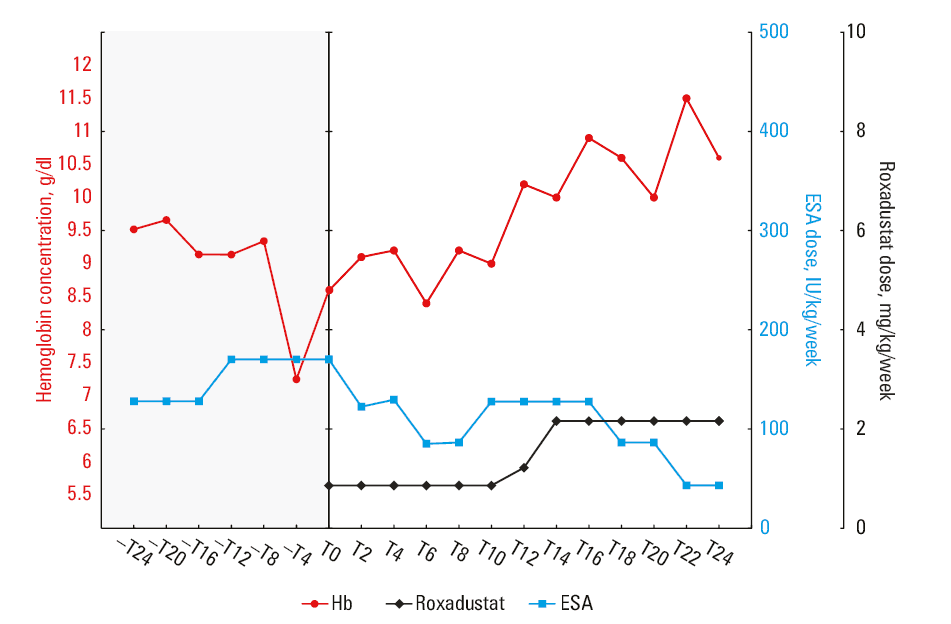
Abbreviations: ESA, erythropoiesis‑stimulating agent; Hb, hemoglobin
Administration of erythropoiesis‑stimulating agent
ESA doses during the 6 months before the inclusion of roxadustat were maintained at the level between 9000 and 12 000 IU/week (129.5 and 244.9 IU/kg/week). At the time of roxadustat therapy initiation, the ESA dose was reduced by 50% in 3 of 5 patients (Patients 1, 2, and 3). In 2 individuals (Patients 4 and 5), the previous dose of epoetin was maintained. Within the first 6 weeks of the combined treatment, 3 patients (Patients 2, 3, and 5) experienced a decline in hemoglobin levels, necessitating ESA dosage adjustment in 1 (Patient 3), and blood transfusions in 2 individuals (Patients 3 and 5). During the subsequent follow‑up period, ESA dosage adjustments were made for 3 patients: at week 4, return to the baseline dose (Patient 3), at week 10, dose increase by 33% (Patient 2); and at week 12, dose increase by 50% (Patient 1). During further treatment, the dosage of ESA was successfully reduced in all patients, with 2 individuals (Patients 1 and 3) discontinuing ESA entirely by week 18 of the follow‑up, and 1 in the last week of observation (Patient 3). In the remaining 2 patients (Patients 4 and 5), ESA dose was reduced relative to the initial dose (Supplementary material, Figure S1). The achieved reduction in ESA dosage was significant (P = 0.02, Supplementary material, Table S2).
Administration of roxadustat
During the follow‑up, the dose of roxadustat was increased to 150 mg/week in 4 individuals (Patients 1, 2, 3, and 4) between the 10th and 14th weeks of observation. One patient (Patient 5) maintained the initial dose. A positive correlation between the dose of roxadustat and hemoglobin level (R = 0.5; P <0.001) and a negative correlation between the dose of ESA and hemoglobin level (R = –0.46; P = 0.002) were observed. The median hemoglobin values as well as epoetin α and roxadustat dosages are shown in Figure 1.
Iron requirement and iron management parameters
During the observation period, there was a significant reduction in the dose of iron used, with 1 individual (Patient 2) who successfully discontinued supplementation. In addition, an increase in transferrin saturation was observed, with a concomitant increase in serum ferritin and transferrin levels; however, only the change in transferrin level was significant (P = 0.02, Supplementary material, Table S2).
Blood transfusion needs
During the 24 weeks of follow‑up, 2 individuals (Patients 3 and 5) required transfusion of red blood cell concentrates (RBCCs); both of them received the transfusion within the first 6 weeks of the study. The need for transfusions was associated with clinically severe infections in hospitalized diabetic patients treated with broad‑spectrum antibiotic therapy (piperacillin with tazobactam). In subsequent weeks, no need for RBCC transfusion was noted in any patient.
Discussion
To date, optimal management of anemia in dialysis patients has not been fully defined. Published data suggest that therapy with roxadustat is associated with many benefits, such as stability of hemoglobin levels. HIF–PHIs are not inferior to conventional ESAs in increasing and maintaining hemoglobin levels in hemodialysis patients, or in reducing the need for transfusion, as compared with placebo.7 Here, we report preliminary results based on off‑label treatment using combined therapy with roxadustat and ESA in hemodialysis patients with ESA hyporesponsiveness and a high comorbidity burden. To our knowledge, this study is the first to successfully evaluate the efficacy and safety of adding roxadustat to the treatment of anemia in ESA‑hyporesponsive patients on hemodialysis. Several studies have reported that ESA hyporesponsiveness is associated with an increased risk of cardiovascualr events and death.12 this is particularly important for patients treated with high doses of ESAs.13 Roxadustat was shown to be noninferior to ESAs (epoetin α or darbepoetin) for cardiovascular safety in dialysis patients in a pooled analysis of phase 3 clinical trials.14 The concept of combined therapy is not entirely new. Dai et al9 reported on successful addition of roxadustat to ESA in 9 PD patients, with both a 100% cumulative responsive rate and maintenance rate of hemoglobin level above 11 g/dl. However, that study had some flaws in the design, as the difference in roxadustat doses between 2 groups was insubstantial (120 vs 100 mg per week), and hemoglobin values were already in the target before the treatment initiation (mean, 10.5–10.8 g/dl). The target hemoglobin level was reached by all patients at week 16.9 In our study, the hemoglobin target was set at above 10 g/dl, and a 100% cumulative responsive rate was reached at week 22. Although both groups of patients were hyporesponsive to the previous, conventional therapy of anemia, they were profoundly diverse. Apart from different modalities of kidney replacement therapy (hemodialysis vs PD), our study group had a disproportionately higher comorbidity burden than the individuals included in the study by Dai et al.9 Nevertheless, the main outcomes of the combined treatment were unexpectedly concurrent in both studies. Namely, addition of roxadustat effectively increased hemoglobin levels and allowed for a substantial decrease in the epoetin dose. Also, no drug‑related adverse events were observed in either study.
Similarly to other studies in hemodialysis patients, we observed a significant increase in transferrin level and a decrease in the dose of intravenous iron during the treatment. A possible driver of roxadustat’s effect on transferrin may be the presence of a hypoxia regulatory element in the transferrin gene.15 The reduced use of intravenous iron in our study might be due to increased iron availability and utilization. It has been reported that HIF–PHI therapy may reduce the need for iron supplementation,14 and provide better efficacy in coexisting inflammation with a decrease in mean hepcidin values.16 However, the available evidence does not conclusively prove the theory that the use of HIF–PHI reduces the need for iron supplementation in dialysis‑dependent patients. On the other hand, trials published to date were not designed to address these questions, and iron was administered according to trial protocols that varied widely.7 There is also no definitive evidence that HIF–PHIs are more effective than ESA in treating anemia in dialysis‑dependent patients with inflammation. However, some studies indicate that they are effective in lowering hepcidin levels in this group. Hepcidin concentration was shown to decrease in patients receiving roxadustat, as compared with the baseline, in all CKD populations, and the decrease may be greater with roxadustat than with ESA or placebo.17 These considerations, together with the half‑life of roxadustat in CKD patients (which is about 15 hours) make this agent a highly attractive option for hemodialysis patients. On the other hand, it is important to be aware of the possible limitations of such therapy in terms of potential polypharmacy and drug‑drug interactions, the risk of enhancing tumor growth, retinopathy, cyst growth in autosomal dominant polycystic kidney disease, and also difficulties in monitoring adherence.7
Of note, pairing HIF–PHI therapy with epoetin α did not prevent an initial decrease in hemoglobin levels. This effect seems a common consequence of the switch from ESA to roxadustat therapy. Based on existing evidence, we anticipated such a possibility and were reluctant to discontinue epoetin α in patients with initially low concentration of hemoglobin. Eventually, we were able to discontinue ESA in 50% of the cases, but a gradual approach seems advocated, especially in patients with an increased comorbidity index. Based on our experience, several reasons may support the decision to introduce combined therapy with HIF–PHI and ESA. The effects of roxadustat on erythropoiesis differ from the mechanism of action of ESA, which opens the potential for a synergistic effect of the combined therapy. As iron transport directly to bone marrow may possibly be improved, the erythropoiesis initiated by ESA therapy in the bone marrow could be completed. Further, roxadustat improves cellular receptivity to ESA and increases endogenous erythropoietin production, so its action more closely resembles physiology.18 By improving cellular receptivity to ESA, HIF–PHI may also increase the response to simultaneously administered ESA. The abovementioned factors may allow for a substantial reduction of ESA dosage. Given the U‑shaped or J‑shaped relationship between the ESA dose and adverse event rates in CKD patients,19 this may translate into better patient prognosis.20 Also, during initial combined therapy, the doses of roxadustat could be lower than or within the lower range of the doses recommended in the summary of product characteristics, which undeniably decreases the risk of dose‑dependent side effects of each medication. Finally, our approach may have some economic impact, lowering the costs of treatment, as compared with full‑dose monotherapy.
The main limitation of our study is its modest sample size and observational design. These limitations entail a risk of statistical analysis errors, so the results should be interpreted with caution. We need to stress that our intention was not to popularize off‑label treatment but to present our real‑life data to help future studies build on our experience.
Conclusions
We showed the feasibility, short‑term safety, and efficacy of combined treatment with roxadustat and ESA in hemodialysis patients with prior ESA hyporesponsiveness. The long‑term benefits and risks of combined therapy remain largely unknown. Randomized control studies on such an approach are needed before our promising preliminary observations could be further advocated.
- Michalopoulos SN, Gauthier‑Loiselle M, Aigbogun MS, et al. Patient and care partner burden in ckd patients with and without anemia: a US‑based survey. Kidney Med. 2022; 4: 100439. | Crossref
- Babitt JL, Lin HY. Mechanisms of anemia in CKD. J Am Soc Nephrol. 2012; 23: 1631‑1634. | Crossref
- Del Vecchio L, Minutolo R. ESA, iron therapy and new drugs: are there new perspectives in the treatment of anaemia? J Clin Med. 2021; 10: 839. | Crossref
- Wong MMY, Tu C, Li Y, et al. Anemia and iron deficiency among chronic kidney disease Stages 3‑5ND patients in the Chronic Kidney Disease Outcomes and Practice Patterns Study: often unmeasured, variably treated. Clin Kidney J. 2020; 13: 613‑624. | Crossref
- Karaboyas A, Morgenstern H, Fleischer NL, et al. Inflammation and erythropoiesis‑stimulating agent response in hemodialysis patients: a self‑matched longitudinal study of anemia management in the Dialysis Outcomes and Practice Patterns Study (DOPPS). Kidney Med. 2020; 2: 286‑296. | Crossref
SUPPLEMENTARY MATERIAL
ARTICLE INFORMATION