
Primary adrenal insufficiency and hypogonadotropic hypogonadism associated with NR0B1 (DAX1) gene nonsense mutation (p.Gln155*) in a patient with empty sellae syndrome

 CC BY 4.0
Primary adrenal insufficiency and hypogonadotropic hypogonadism associated with NR0B1 (DAX1) gene nonsense mutation (p.Gln155*) in a patient with empty sellae syndrome
CC BY 4.0
Primary adrenal insufficiency (PAI) is a rare condition with a highly variable prevalence globally. The highest prevalence (up to 20 cases per 100 000 inhabitants) has been reported in Scandinavia.1 In each case of PAI, the etiology should be determined, as it has a considerable impact on the disease course and treatment. The age of PAI onset may facilitate establishing the cause of the disease. Among newborns, congenital adrenal hyperplasia is by far the most prevalent cause of PAI; however, genetic causes also usually manifest at that age. We report a case of a patient with PAI and hypogonadotropic hypogonadism (HH) associated with a novel NR0B1 (DAX1) genetic variant (c.463C>T) and empty sellae syndrome.
A 31‑year‑old man was admitted to a tertiary referral center due to PAI and HH. On admission, he presented with erectile dysfunction, sparse body hair, and hyperpigmentation of the skin. Shortly after birth, the patient was diagnosed with PAI, and treatment with hydrocortisone and fludrocortisone was initiated. At that time, based on the urine steroid profile (gas chromatography–mass spectrometry), congenital adrenal hyperplasia was excluded. The patient failed to initiate puberty, and was subsequently treated with prasterone, which was later switched to testosterone. He ceased the androgen supplementation during the COVID‑19 pandemic for a few years.
On admission, the patient was on 20 mg of hydrocortisone and 0.1 mg of fludrocortisone daily. Laboratory workup revealed decreased concentrations of cortisol, aldosterone, and adrenal androgens paired with elevated concentrations of adrenocorticotropic hormone. Concentrations of follicle‑stimulating hormone, luteinizing hormone, and testosterone were below the reference range (Supplementary material, Table S1).
Magnetic resonance imaging (MRI) of the pituitary gland showed empty sellae syndrome (Figure 1A). Abdominal computed tomography yielded an image of bilateral adrenal atrophy (Figure 1B). Scrotal ultrasound examination showed prepubertal size of the testicles (left, 1.7 ml; right, 1.3 ml), decreased echogenicity, multiple microcalcifications, and decreased blood flow; no focal lesions were visualized. In contrast to the presented case, there are usually no morphological changes on pituitary MRI in patients with NR0B1 (DAX1) mutations, despite impaired gonadotroph function.
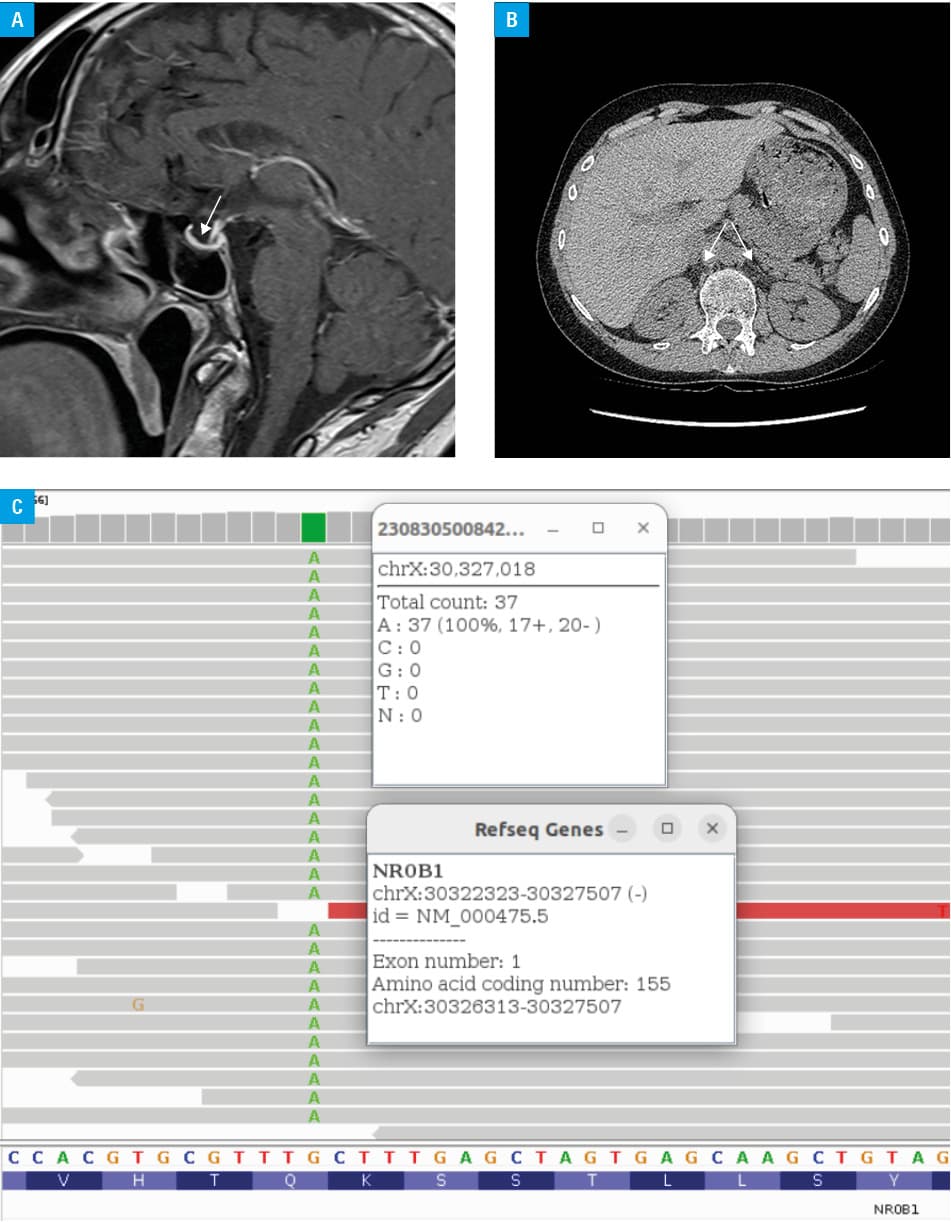
A whole‑exome sequencing test was performed using the next generation sequencing method. The sequences of the enriched DNA regions were read on a NovaSeq6000 sequencer (Illumina, San Diego, California, United States) with a read length of 2 × 101 nucleotides. A hemizygous cytosine‑to‑thymine substitution at nucleotide 463 (NM_000 475: c.463C>T) resulting in a nonsense mutation (p.Gln155*) in the NR0B1 gene was identified (Figure 1C).
The NR0B1 gene, located on the short arm of the X chromosome (Xp21), encodes a nuclear receptor subfamily 0 group B member 1 (NR0B1), and is also referred to as dosage‑sensitive sex reversal adrenal hypoplasia congenita critical region on the X chromosome, gene 1 (DAX1). NR0B1 is expressed primarily in embryonic stem cells, the ventromedial hypothalamus, pituitary gonadotropic cells, and steroidogenic tissues.2 Typically, mutations in the NR0B1 gene prevent the adrenal cortex from developing beyond the fetal stage, resulting in infantile‑onset PAI and adrenal hypoplasia.3 To date, more than 300 individuals and families with PAI associated with the loss of NR0B1 have been reported worldwide, albeit this number may be underestimated due to a low frequency of molecular testing.4
NR0B1 mutations do not affect the early stages of gonadal development, although the affected men usually develop HH, mainly due to a lack of pituitary response to gonadotropin‑releasing hormone pulses.4,5
The presented case underlines the need to include testing for NR0B1 mutations in the diagnostics of men with PAI and HH, even if the symptoms develop later in life. Identification of the cause of PAI has direct implications for the clinical course, treatment, and genetic counseling.
- Olafsson AS, Sigurjonsdottir HA. Increasing prevalence of Addison disease: results from a nationwide study. Endocr Pract. 2016; 22: 30‑35. | Crossref
- Jadhav U, Harris RM, Jameson JL. Hypogonadotropic hypogonadism in subjects with DAX1 mutations. Mol Cell Endocrinol. 2011; 346: 65. | Crossref
- Reutens AT, Achermann JC, Ito M, et al. Clinical and functional effects of mutations in the DAX‑1 gene in patients with adrenal hypoplasia congenita. J Clin Endocrinol Metab. 1999; 84: 504‑511. | Crossref
- Buonocore F, Achermann JC. Primary adrenal insufficiency: new genetic causes and their long‑term consequences. Clin Endocrinol (Oxf). 2020; 92: 11‑20. | Crossref
- Ponikwicka‑Tyszko D, Kotula‑Balak M, Jarzabek K, et al. The DAX1 mutation in a patient with hypogonadotropic hypogonadism and adrenal hypoplasia congenita causes functional disruption of induction of spermatogenesis. J Assist Reprod Genet. 2012; 29: 811. | Crossref
SUPPLEMENTARY MATERIAL
ARTICLE INFORMATION