

 CC BY 4.0
Adrenal tumors are common in the elderly and occur in up to 10% of people over 65 years of age. While most tumors are adenomas, malignant tumors are diagnosed in 5%–8% of patients with adrenal lesions. They represent mainly metastases, pheochromocytoma, and adrenocortical carcinoma (ACC), while primary adrenal lymphomas and sarcomas are extremely rare. Adrenal tumors are more frequent in patients with congenital adrenal hyperplasia.1-3 In any patient with an adrenal mass, 2 key questions need to be answered: whether it is potentially malignant and whether it is hormonally active.
A 70‑year‑old woman was referred to an endocrinology department due to bilateral adrenal lesions reported on high‑resolution computed tomography (CT). The lesion in the right adrenal gland measured 44 mm × 33 mm × 36 mm and 20 Hounsfield units, and the thickened left adrenal gland contained several nodules measuring 26 mm × 16 mm, 22 mm × 14 mm and 14 mm × 1 mm, below 10 Hounsfield units, suggestive of lipid‑rich adenomas. The patient reported a history of hirsutism for several years, fluctuating body weight, well‑controlled hypertension, back and hip pain, and sudden hot flashes accompanied by excessive sweating and palpitations. On physical examination, excessive hair on the chin and over the upper lip, facial flushing, medium‑filled supraclavicular fossa, and central obesity were noted. The results of hormonal workup (Supplementary material, Table S1) suggested hypercortisolemia with abnormal 1 mg dexamethasone test, and decreased adrenocorticotropic hormone and elevated evening cortisol levels.
Due to high density of the right adrenal gland lesion on unenhanced CT scan, suggestive of its malignant potential, magnetic resonance imaging was performed (Figure 1A and 1B). A solid lesion in the right adrenal gland, hyperintense on T2‑weighted sequences, with no chemical shift, was suggestive of metastasis / ACC / pheochromocytoma. A chemical shift of 67% in the left adrenal gland led to a diagnosis of lipid‑rich adenoma.
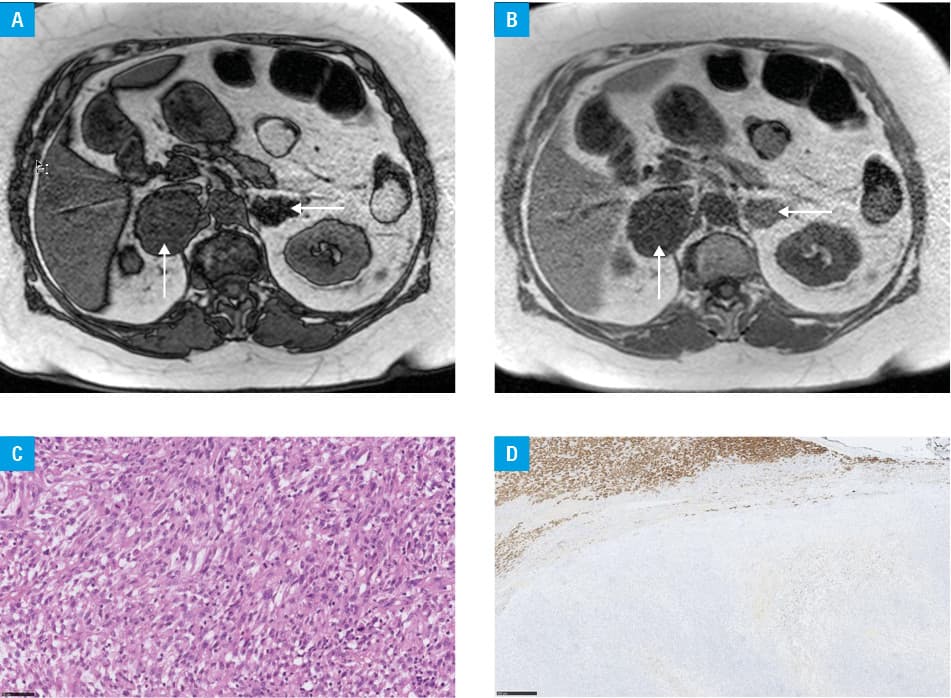
The patient was referred for right‑sided laparoscopic adrenalectomy due to a suspicion of hormonally active ACC. As the tumor was fused with the inferior vena cava from the lateral and posterior sides, and it could not be mobilized, conversion was performed. After surgery, supplementation with hydrocortisone was started at a dose of 10 mg/day.
Unexpectedly, histopathologic examination (Figure 1C and 1D) revealed undifferentiated spindle cell sarcoma G3 (pT2 N0 LVI0 PNI0 R1). These are exceedingly rare tumors with a very limited number of cases reported worldwide. The literature lacks data on patient management and prognosis.4 The patient currently awaits radiotherapy.
Three months after adrenalectomy the patient was in a good general condition, and reported no symptoms of adrenal insufficiency. The results of hormonal workup (Supplementary material, Table S2) enabled a diagnosis of mild autonomous cortisol secretion in a patient with left adrenal adenoma and hydrocortisone supplementation was discontinued. A follow‑up CT scan showed no regrowth or metastatic lesions. A dual energy X‑ray absorptiometry scan showed osteoporosis, a common complication of mild autonomous cortisol secretion, and treatment with oral bisphosphonate was started.
Our case underscores the importance of a detailed diagnostics of adrenal tumors. To the best of our knowledge, this is the second reported case of adrenal spindle cell sarcoma.5
- Sahlander F, Patrova J, Mannheimer B, et al. Congenital adrenal hyperplasia in patients with adrenal tumors: a population‑based case‑control study. J Endocrinol Invest. 2023; 46: 559‑565. | Crossref
- Leszczyńska D, Tuszyńska‑Meissner A, Ciebiera M, et al. Giant uterine fibroid and adrenal tumor in a patient who ceased congenital adrenal hyperplasia treatment. Pol Arch Intern Med. 2023; 133: 16587. | Crossref
- Chang L, Yu D, Wang F. 17α-hydroxylase deficiency associated with adrenal myelolipoma. Pol Arch Intern Med. 2023; 133: 16369. | Crossref
- Feng L, Wang M, Yibulayin F, et al. Spindle cell sarcoma: a SEER population‑based analysis. Sci Rep. 2018; 8: 5024. | Crossref
- Ozaal AMOM, Rajendra S. Pleomorphic spindle cell sarcoma of the adrenal gland: an extremely rare cause of a large abdominal mass and a challenging diagnosis. J Surg Case Rep. 2022; 2022: rjac049. | Crossref
SUPPLEMENTARY MATERIAL
ARTICLE INFORMATION