
Finding logic in biologics: different outcomes in inflammatory bowel disease–associated pyoderma gangrenosum

 CC BY 4.0
Finding logic in biologics: different outcomes in inflammatory bowel disease–associated pyoderma gangrenosum
CC BY 4.0
Pyoderma gangrenosum (PG) is a rare autoimmune dermatosis considered to be one of the possible cutaneous extraintestinal manifestations of inflammatory bowel diseases (IBD). PG exhibits a rapid progression, recurrence, and resistance to treatment. However, biological therapies represent a promising shift in the management of this condition.
We present 4 patients with IBD‑associated PG. The first 2 patients (a woman aged 35 years and a man aged 59 years), both diagnosed with ulcerative colitis, developed PG several months after IBD diagnosis. Dermatologic examination showed necrotic nodules with central ulcerations localized on the nose and arm (Figure 1A–1D), as well as the chest (the man) and lower extremity (the woman). Colonoscopy demonstrated active inflammation in both patients. Treatment with tumor necrosis factor α (TNF-α) inhibitor infliximab resulted in skin lesion remission in both patients, leaving characteristic cribriform scars. The other 2 patients (women aged 64 and 27 years) were diagnosed with Crohn disease. Both underwent multiple surgeries resulting in stomas and were treated with infliximab; however, severe anaphylaxis ensued. Consequently, the biological agent was switched to adalimumab (anti–TNF-α antibody) in the older woman, who simultaneously developed peristomal PG. Colonoscopy confirmed progression of the disease with active ulcerations. Due to a lack of efficacy and detection of anti‑adalimumab antibodies, treatment was changed to ustekinumab (anti‑interleukin‑12/23 antibody). PG remained active despite treatment with all 3 biologics. The younger patient was switched to adalimumab and, after the fourth dose, developed PG on her lower extremities and is currently treated with vedolizumab, dapsone, and glucocorticosteroid pulses with satisfactory results (Figure 1E–1H). At the time of PG onset, the patient reported worsening symptoms; however, colonoscopy demonstrated stable disease with only a few small erosions. Topical steroids were administered simultaneously to all patients, alongside proper wound management.
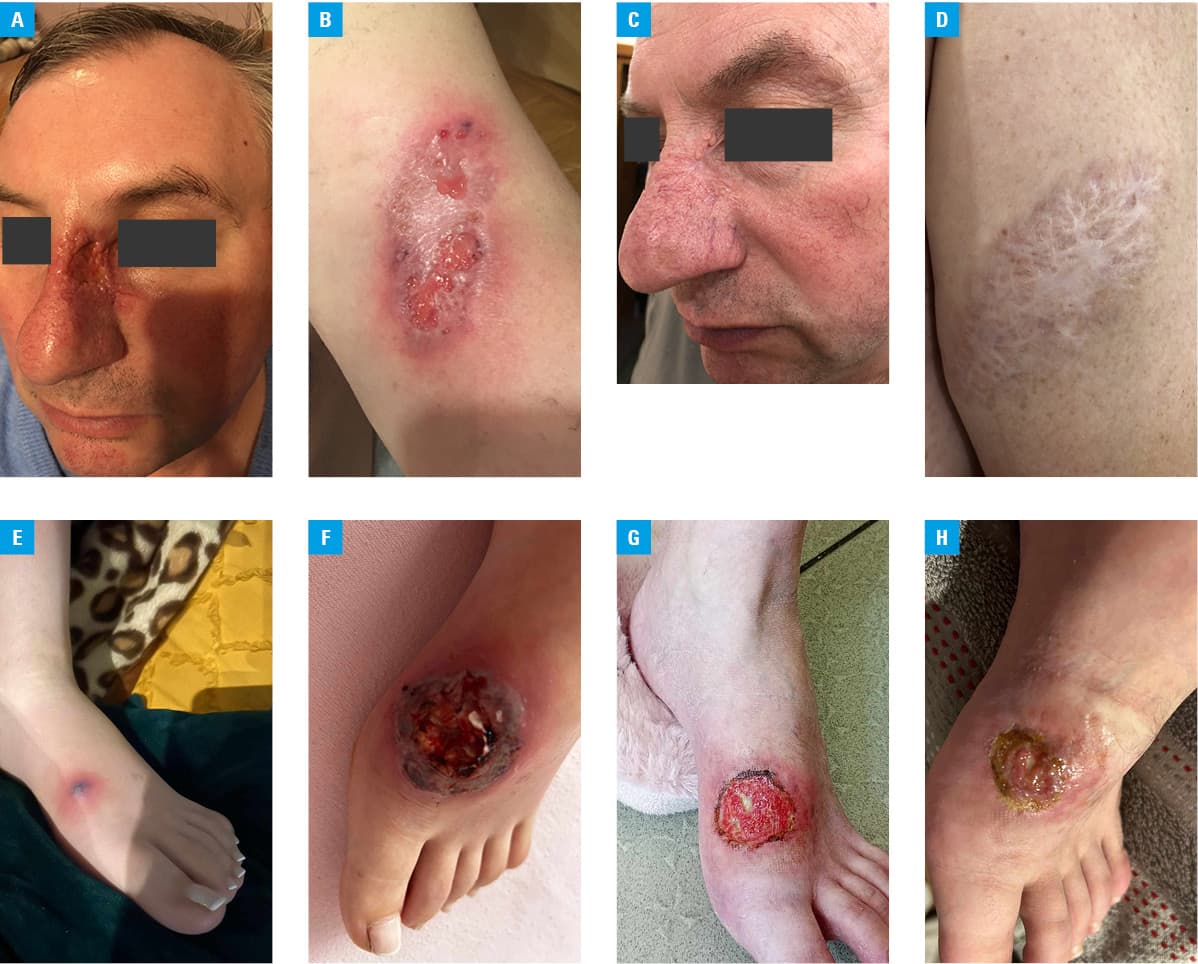
PG incidence ranges from 0.4%–2.6% of patients with IBD.1 While mild PG may resolve with topical therapy, systemic immunosuppressive agents such as cyclosporine, prednisone, mycophenolate mofetil, dapsone, or biologics are often necessary. However, due to potential adverse effects and a recurrence risk of up to 30% in patients treated with steroids and cyclosporine, ongoing evaluation of the efficacy of various biological agents in PG treatment is warranted.2 To date, TNF-α inhibitors, particularly infliximab, have been extensively studied and have shown promising results, establishing them as the first‑line biological treatment for PG.3,4 Although adalimumab, with a similar mechanism of action, generally yields satisfactory results, infliximab often achieves complete resolution of skin lesions.5 This corresponds with the findings observed in the described cases, wherein rapid resolution of PG occurred in 2 out of 3 instances following administration of infliximab. In situations where therapy with these antibodies is not feasible (eg, due to anaphylactic reactions or antibody detection), patients may be transitioned to alternative medications such as ustekinumab, vedolizumab, or Janus kinase inhibitors. Although the available data are limited, these alternatives have also demonstrated efficacy in PG treatment, typically resulting in partial and satisfactory responses.4
PG poses a huge treatment challenge, and in the era of biological therapies, it is essential to discern which agent to utilize. While most available data favor infliximab as the first‑line therapy, other agents may also be considered based on emerging evidence on their efficacy.
- States V, O’Brien S, Rai JP, et al. Pyoderma gangrenosum in inflammatory bowel disease: a systematic review and meta‑analysis. Dig Dis Sci. 2020; 65: 2675‑2685. | Crossref
- Maverakis E, Marzano AV, Le ST, et al. Pyoderma gangrenosum. Nat Rev Dis Primers. 2020; 6: 81. | Crossref
- Brooklyn TN. Infliximab for the treatment of pyoderma gangrenosum: a randomised, double blind, placebo controlled trial. Gut. 2006; 55: 505‑509. | Crossref
- McKenzie F, Cash D, Gupta A, et al. Biologic and small‑molecule medications in the management of pyoderma gangrenosum. J Dermatolog Treat. 2019; 30: 264‑276. | Crossref
- Yamasaki K, Yamanaka K, Zhao Y, et al. Adalimumab in Japanese patients with active ulcers of pyoderma gangrenosum: final analysis of a 52‐week phase 3 open‐label study. J Dermatol. 2022; 49: 479‑487. | Crossref
ARTICLE INFORMATION