
Neuropsychiatric adverse events in tenofovir disoproxil fumarate– and tenofovir alafenamide–based HIV therapy and prophylaxis: a systematic review and meta‑analysis
Key words: antiretroviral therapy, HIV, neuropsychiatric adverse events, pre-exposure prophylaxis, tenofovir


 CC BY-NC-SA 4.0
Neuropsychiatric adverse events in tenofovir disoproxil fumarate– and tenofovir alafenamide–based HIV therapy and prophylaxis: a systematic review and meta‑analysis
CC BY-NC-SA 4.0
Introduction: Tenofovir is integral to antiretroviral therapy (ART) and pre‑exposure prophylaxis (PrEP) for HIV; however, neuropsychiatric adverse events (NPAEs) associated with its use have not been systematically investigated.
Objectives: This systematic review aimed to characterize common NPAEs occurring during tenofovir‑based ART and PrEP, and to assess the specific role of tenofovir in their emergence.
Patients and methods: Four literature databases and 3 trial registries were searched up to December 31, 2023 for randomized controlled trials reporting NPAEs in treatment‑naive adults receiving tenofovir‑based ART or PrEP. Meta‑analyses were conducted to compare tenofovir (with / without emtricitabine) with placebo and tenofovir alafenamide–based with tenofovir disoproxil fumarate–based regimens.
Results: A total of 69 trials (62 on ART, 7 on PrEP) including 29 340 patients on tenofovir‑based therapies identified headache, dizziness, insomnia, and depression as common NPAEs, especially in HIV studies. Meta‑analyses of tenofovir (with / without emtricitabine) vs placebo only indicated an increased risk of dizziness (odds ratio [OR], 1.32; 95% CI, 1.09–1.59; P = 0.004). Comparisons between tenofovir alafenamide and disoproxil fumarate did not show significant differences in NPAE risks, although sensitivity analyses suggested a higher risk of headache with tenofovir alafenamide in HIV studies (OR, 1.24; 95% CI, 1.01–1.52; P = 0.04).
Conclusions: Common occurrence of NPAEs in tenofovir‑based HIV multidrug regimens highlights the need to screen HIV patients for neuropsychiatric complications. The lack of effect of tenofovir, as compared with placebo, for most analyzable NPAEs suggests its favorable safety profile. However, a possible increase in the dizziness risk on tenofovir, and a potentially elevated risk of headache on tenofovir alafenamide– as compared with tenofovir disoproxil fumarate–based regimens in HIV therapy merit further investigation.
What's new?
This is the first systematic review and meta‑analysis investigating the spectrum of neuropsychiatric adverse events (NPAEs) in individuals exposed to tenofovir‑based antiretroviral therapy (ART) and pre‑exposure prophylaxis in randomized controlled trials. NPAEs, including headache, dizziness, insomnia, and depression, occur relatively frequently in tenofovir‑based ART. However, most NPAEs are not directly related to tenofovir use, with dizziness being a possible exception. Additionally, tenofovir alafenamide may entail a higher risk of headache than tenofovir disoproxil fumarate in ART regimens.
Introduction
With early initiation and adherence to antiretroviral therapy (ART), the life expectancy of people living with HIV (PLWH) is approaching that of the general population.1 However, PLWH still face challenges in terms of neuropsychiatric health. This may be due to the prolonged central nervous system exposure to viral toxins, a life‑long treatment with a combination of various (potentially neurotoxic) antiretrovirals, general age‑related diseases, and polypharmacy.2 As neuropsychiatric comorbidities and / or adverse events (AEs) reduce adherence to ART,2-5 it is important to have a comprehensive understanding of potential neuropsychiatric sequalae of antiretroviral agents.
The nucleotide reverse transcriptase inhibitor tenofovir disoproxil fumarate is an essential component of most ARTs. It acts as a prodrug of tenofovir and is typically used alongside emtricitabine. Previous studies have highlighted bone and renal toxicities as significant AEs associated with the use of tenofovir disoproxil fumarate, with renal complications occasionally leading to Fanconi syndrome.6,7 However, neuropsychiatric sequelae of tenofovir disoproxil fumarate have rarely been explored; although some in vitro evidence suggests that it may have direct neurotoxic effects.8,9 Despite these findings, the actual impact on neuropsychiatric health may be mitigated by low penetration of tenofovir into the brain, which inherently limits its potential neurotoxic effects in vivo.10 To date, only 1 narrative review has curated a selection of case reports and trials documenting neuropsychiatric AEs (NPAEs) in regimens based on tenofovir disoproxil fumarate.11
Tenofovir alafenamide, another prodrug of tenofovir, is metabolized intracellularly, resulting in lower plasma concentrations and reduced nephrotoxicity, as compared with tenofovir disoproxil fumarate.12 Previous meta‑analyses indicated noninferiority of tenofovir alafenamide to tenofovir disoproxil fumarate in terms of efficacy, general safety, and tolerability;13 however, its use may be associated with dyslipidemia.6 Tenofovir alafenamide–based regimens have not been closely scrutinized for their neuropsychiatric safety. Although it has been suggested that the higher intracellular concentrations of tenofovir during treatment with tenofovir alafenamide–based regimens may potentially lead to increased neurotoxicity,14 this hypothesis remains speculative and is not directly supported by direct evidence of enhanced brain penetration.
Beyond ART, tenofovir plays a vital role as a key component of HIV pre‑exposure prophylaxis (PrEP), which, similarly to ART, is a long‑term therapy.15 The specific role of tenofovir in the emergence of NPAEs is challenging to establish in ART regimens due to its combination with other agents. In contrasts, PrEP studies often involve tenofovir alone or combined with only emtricitabine, providing a unique opportunity to assess specific risks of tenofovir more directly. Additionally, unlike ART studies, some PrEP trials are placebo‑controlled, allowing for direct comparisons against a placebo.
The pivotal role of tenofovir in HIV prevention and management necessitates a thorough investigation of its potential neurotoxic effects. However, despite its widespread use, the potential neuropsychiatric impact of tenofovir has not yet been the focus of systematic examination. This systematic review aimed to build upon existing research on the general safety of tenofovir‑based therapies by 1) exploring the spectrum and frequencies of common NPAEs in treatment‑naive patients on tenofovir‑based ART and PrEP; 2) assessing whether tenofovir itself is associated with an elevated risk of NPAEs by conducting meta‑analytical comparisons with placebo; and 3) examining whether the risks of individual NPAEs differ between tenofovir disoproxil fumarate and tenofovir alafenamide.
Patients and methods
This systematic review and meta‑analysis was performed in accordance with the updated Preferred Reporting Items for Systematic Reviews and Meta‑analyses (PRISMA) guidelines.16 The protocol was registered with PROSPERO (CRD42020162861). A systematic search was conducted in 4 literature databases (PubMed, Embase, Web of Science, and Cochrane Central Register of Controlled Trials) and 3 trial registries (ClinicalTrials.gov, EU Clinical Trials Register, and Clinical Study Data Request) from respective database inception to December 31, 2023 (search algorithms are presented in Supplementary material, Table S1). For trials with missing or incomplete NPAE data, we contacted the principal authors or study sponsors to request the necessary information.
Selection criteria and study outcomes
A detailed overview of inclusion and exclusion criteria is provided in Supplementary material, Table S2. Briefly, we included blinded and open‑label randomized controlled trials (RCTs) that compared tenofovir alafenamide– or tenofovir disoproxil fumarate–based ART or PrEP with any pharmacological control, including placebo. As we were interested in the consequences of long‑term medication, trials with a minimum duration of 2 months were eligible. To avoid preselection bias due to tolerability and to reduce heterogeneity, only trials involving therapy‑naive adults were included. Our prespecified outcomes of interest were types of NPAEs and the number of affected patients.
Data extraction and quality assessment
The identified records were screened and assessed for eligibility by 2 independent reviewers (MG, MSS). Extracted data included publication details, study design and duration, sample characteristics, treatment characteristics, and types and number of NPAEs. In the case of multiple reports on a single trial, data were collected from the record with the most complete AE report. Data from different dosing arms within the same study were pooled. A previously published checklist17 was used to rate the quality of AE measurement and reporting. Two reviewers (MG, MSS) independently performed a quality assessment for all included trials using the revised Cochrane risk‑of‑bias tool for randomized trials (RoB 2).18 Any disagreements were resolved through a discussion with a third reviewer (TGR).
Qualitative analysis
The aim of the qualitative analysis was to identify common NPAEs occurring in patients on tenofovir‑based regimens. Types of NPAEs were defined a priori through a discussion between neurologists, psychiatrists, and clinical pharmacologists. The prespecified list of NPAEs was open to extension based on additional symptoms reported in trials and deemed relevant by our interdisciplinary team (Supplementary material, Table S3). Symptoms were clustered if they 1) were synonymous or could be grouped under a single umbrella term, and 2) did not occur within the same study arm. Incidences of NPAEs were aggregated within and across treatment regimens, and NPAEs with at least 50 occurrences in HIV trials were regarded as common. In addition to evaluating the frequency of common NPAEs, data on the relationship between treatment duration and NPAE emergence, as well as withdrawals due to NPAEs, were sought.
Statistical analysis
The quantitative analysis was structured around 2 key comparisons. The first one concerned tenofovir’s effect: meta‑analyses were conducted to compare NPAE outcomes of tenofovir use (alone or with emtricitabine) against a placebo. The inclusion of emtricitabine reflected the clinical practice that tenofovir was rarely used as monotherapy. The second comparison was focused on identifying differences between tenofovir disoproxil fumarate and tenofovir alafenamide: we analyzed studies that included both a tenofovir alafenamide–based intervention and a tenofovir disoproxil fumarate–based comparator to assess potential differences in the risk of NPAEs between the tenofovir prodrugs.
We included both open‑label and blinded studies across indications (ART, PrEP). Meta‑analyses were performed if 3 or more studies reported NPAEs using the same term with at least 10 cumulative events in every treatment group. Analyses were conducted using Review Manager 5.4 (Cochrane Collaboration, London, United Kingdom).19 We calculated odds ratios (ORs) with 95% CIs using a random‑effects model due to expected heterogeneity in the study population and design. We used a P value of <0.05 to determine statistical significance. Due to the exploratory nature of our study, P values were not adjusted for multiple comparisons. Heterogeneity in the effect sizes was assessed using the I² statistic.
We planned 3 sensitivity analyses for both comparisons: 1) exclusion of studies with the highest weight, 2) exclusion of studies with a high risk of bias, and 3) leave‑one‑out analyses. In addition, for the comparison of tenofovir (with / without emtricitabine) vs placebo, an additional sensitivity analysis was performed: 4) restriction to studies utilizing tenofovir as monotherapy. Three sensitivity analyses were intended to be performed for the comparison between tenofovir disoproxil fumarate and tenofovir alafenamide: 5) exclusion of open‑label studies, 6) restriction to studies that administered the same concomitant medication in both tenofovir arms, and 7) restriction to HIV studies.
Ethics
Ethical approval and patient consent were not required for this systematic review, as all data were extracted from previously conducted studies and could not be attributed to individual participants.
Results
Search results
Following duplicate exclusion, a total of 8058 records were identified in our search (Supplementary material, Figure S1). After screening titles and abstracts, we assessed 1186 full‑text papers for eligibility. Ultimately, 69 RCTs (62 on ART and 7 on PrEP) were included in the qualitative analysis. Four trials were unpublished, with data reported only on trial registries. Additional data were obtained from authors in 6 cases.
Characteristics of eligible studies on antiretroviral therapy in the qualitative synthesis
The 62 included ART studies involved 23 016 patients on tenofovir‑based therapy: tenofovir alafenamide in 11 studies with 2997 patients, and tenofovir disoproxil fumarate in 57 studies with 20 219 patients. Of these, 34 studies were double‑blind and 28 were open‑label. One study involved HIV and hepatitis B–coinfected patients. The reported mean age ranged from 26 to 41.6 years. Women accounted for only 19% of the study population; however, 2 studies exclusively enrolled women. The main characteristics of all included ART trials are summarized in Supplementary material, Table S4.
Across all ART trials, 27 individual therapeutic agents were employed in 29 tenofovir‑based combinations. Tenofovir alafenamide was only combined with emtricitabine and protease inhibitors, integrase strand transfer inhibitors, or, in 1 case, a capsid inhibitor. Tenofovir disoproxil fumarate was combined with either other nucleoside reverse transcriptase inhibitors or non‑nucleoside reverse transcriptase inhibitors.
Characteristics of eligible studies on pre‑exposure prophylaxis in the qualitative synthesis
We included 7 trials focused on PrEP, investigating tenofovir disoproxil fumarate either as monotherapy or with emtricitabine in 6324 patients. One study also analyzed tenofovir alafenamide with emtricitabine in 2694 patients. Women accounted for 43% of the study population across all PrEP studies. The mean age was reported in only 2 studies (23.5 and 36 years, respectively). A detailed overview of the PrEP trials is presented in Supplementary material, Table S5.
Quality assessment and bias rating
Of the ART studies, only 9 detailed the AE assessment methods. Although data from trial registries or original investigators were used to augment the AE reports, only a quarter of the ART trials had complete AE data without preselection for frequency. Bias risk in the blinded ART trials was generally low, except for studies involving efavirenz, which entailed a higher risk due to potential unblinding from characteristic NPAEs (Supplementary material, Figure S2). Open‑label studies were generally assessed to have a high risk of bias (Supplementary material, Figure S3).
Among the PrEP studies, only 1 provided information on the AE collection method. Complete AE reporting was limited to 2 studies. Four of the 7 studies were judged to have a moderate or high risk of bias, primarily attributed to open‑label designs or inadequate details on the randomization process (Supplementary material, Figures S4 and S5).
Qualitative analysis
More than 200 NPAEs were reported across all tenofovir‑based treatment arms, but only 13 occurred in more than 50 patients each (Supplementary material, Table S6). The most frequent neurologic events were headache (3071 affected of 21 608 exposed patients), dizziness (2242 of 17 633), somnolence (305 of 7597), vertigo (110 of 3776), paresthesia (92 of 3976), and peripheral neuropathy (80 of 3437). The most frequent psychiatric events were insomnia (1476 of 16 399), depression (1229 of 16 085), abnormal dreams (847 of 8577), anxiety (679 of 11 105), decreased appetite (249 of 7214), sleep disorders (143 of 4625), and nightmares (87 of 3351). Notably, efavirenz‑containing treatment groups accounted for a large number of cases across most of these events.
The spectrum of reported NPAEs during PrEP was narrower, and relative frequencies for most observed events were numerically lower. Dizziness, headache, insomnia, and depression were the only NPAEs with aggregated relative frequencies of at least 2% across all reviewed studies (Supplementary material, Table S7).
The relationship between treatment duration and NPAE frequency was rarely explored in the included studies. One PrEP study comparing tenofovir disoproxil fumarate with placebo reported monthly dizziness rates over 24 months, with the highest incidence in the first month of therapy.20 Furthermore, some ART studies provided data for different observation periods. For example, a study comparing 2 tenofovir disoproxil fumarate regimens found most new cases of headache and depression emerging at weeks 1–48, though new cases continued to appear during follow‑up.21,22
Twenty‑five studies providing complete reports of AEs leading to withdrawal were used to calculate the rate of withdrawals due to NPAEs. In the ART studies, dizziness and depression were the most common neurologic and psychiatric AEs leading to withdrawal, with 11 and 13 cases, respectively, out of 675 and 415 patients experiencing these NPAEs. In the PrEP studies, only isolated cases of withdrawal were reported (Supplementary material, Table S8).
Meta‑analyses of tenofovir vs placebo
Five double‑blind RCTs using tenofovir disoproxil fumarate for PrEP met the criteria for inclusion in the meta‑analysis. Of these, 3 used tenofovir disoproxil fumarate alone, whereas emtricitabine was added in 2 trials. Meta‑analyses were possible for 4 neuropsychiatric symptoms (Figure 1). Analyses for headache (OR, 0.96; 95% CI, 0.85–1.09; P = 0.56), anxiety (OR, 0.73; 95% CI, 0.41–1.31; P = 0.3), and insomnia (OR, 0.93; 95% CI, 0.75–1.16; P = 0.1) yielded no differences between tenofovir disoproxil fumarate–based PrEP and placebo. However, a higher risk for dizziness (OR, 1.32; 95% CI, 1.09–1.59; P = 0.004) was observed in the tenofovir disoproxil fumarate group. Heterogeneity was only detected for anxiety, where it was low (I2 = 11%).23 These results were mostly supported by our sensitivity analyses (Supplementary material, Table S9). Notably, when the analyses were limited to studies using tenofovir disoproxil fumarate as monotherapy, the observed effects on dizziness diminished to a nonsignificant trend (OR, 1.29; 95% CI, 0.98–1.68; P = 0.06).
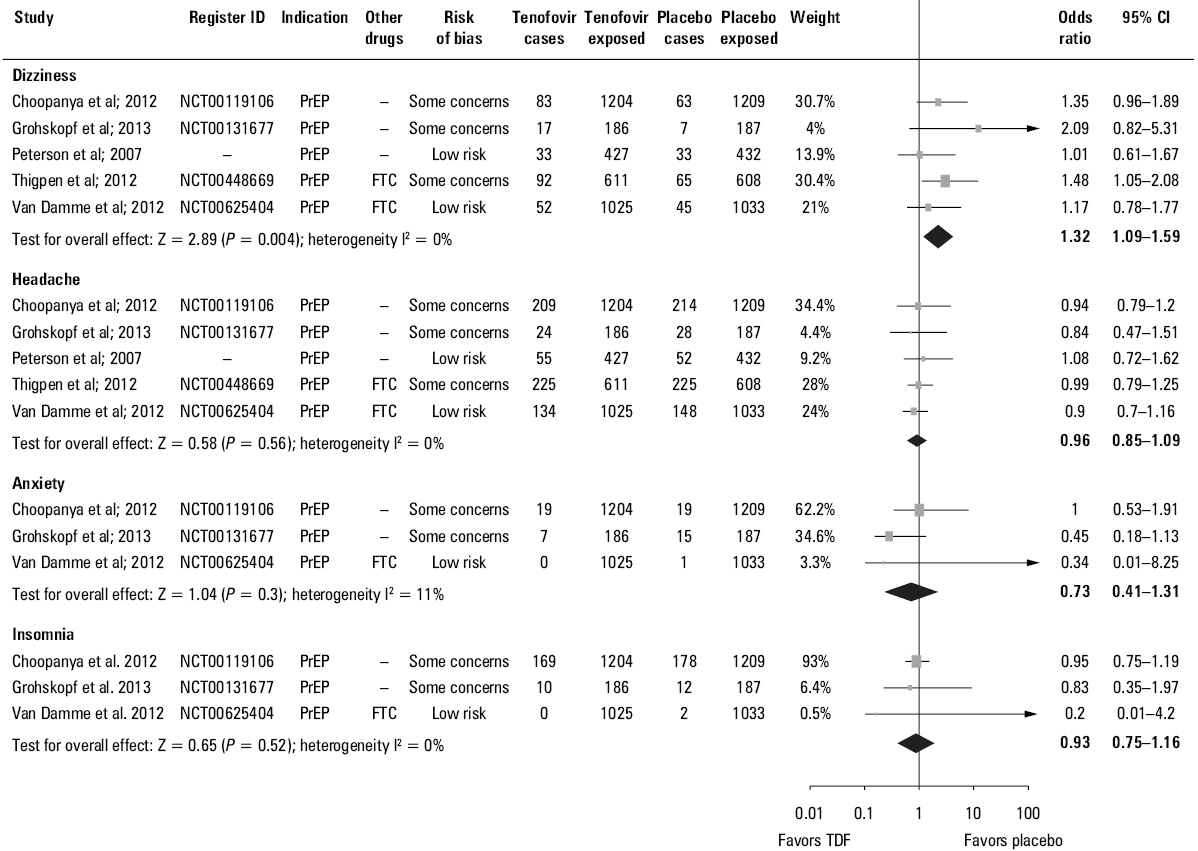
Abbreviations: FTC, emtricitabine; TDF, tenofovir disoproxil fumarate
Meta‑analyses of tenofovir disoproxil fumarate– vs tenofovir alafenamide–based regimens
Six double‑blind studies on ART and 1 on PrEP were eligible for a comparison of the tenofovir prodrugs. Meta‑analyses were possible for dizziness (OR, 0.87; 95% CI, 0.6–1.24; P = 0.43), headache (OR, 1.1; 95% CI, 0.95–1.27; P = 0.19), anxiety (OR, 1; 95% CI, 0.671.5; P = 0.99), depression (OR, 1.25; 95% CI, 0.91–1.72; P = 0.18), and insomnia (OR, 1.27; 95% CI, 0.96–1.68; P = 0.1) (Figure 2). None of the comparisons yielded significant differences between tenofovir alafenamide and tenofovir disoproxil fumarate. Heterogeneity was absent for all symptoms (I2 = 0%) except for anxiety, where it was low (I2 = 21%).23 Sensitivity analyses were mostly unremarkable, except for that involving headache (Supplementary material, Table S10). After exclusion of the single PrEP study, a higher headache risk associated with tenofovir alafenamide–based therapies was observed (OR, 1.24; 95% CI, 1.01–1.52; P = 0.04; I2 = 0%). This study was excluded from 3 sensitivity analyses: exclusion of the study with the highest weight, leave‑one‑out, and restriction to HIV therapy studies.
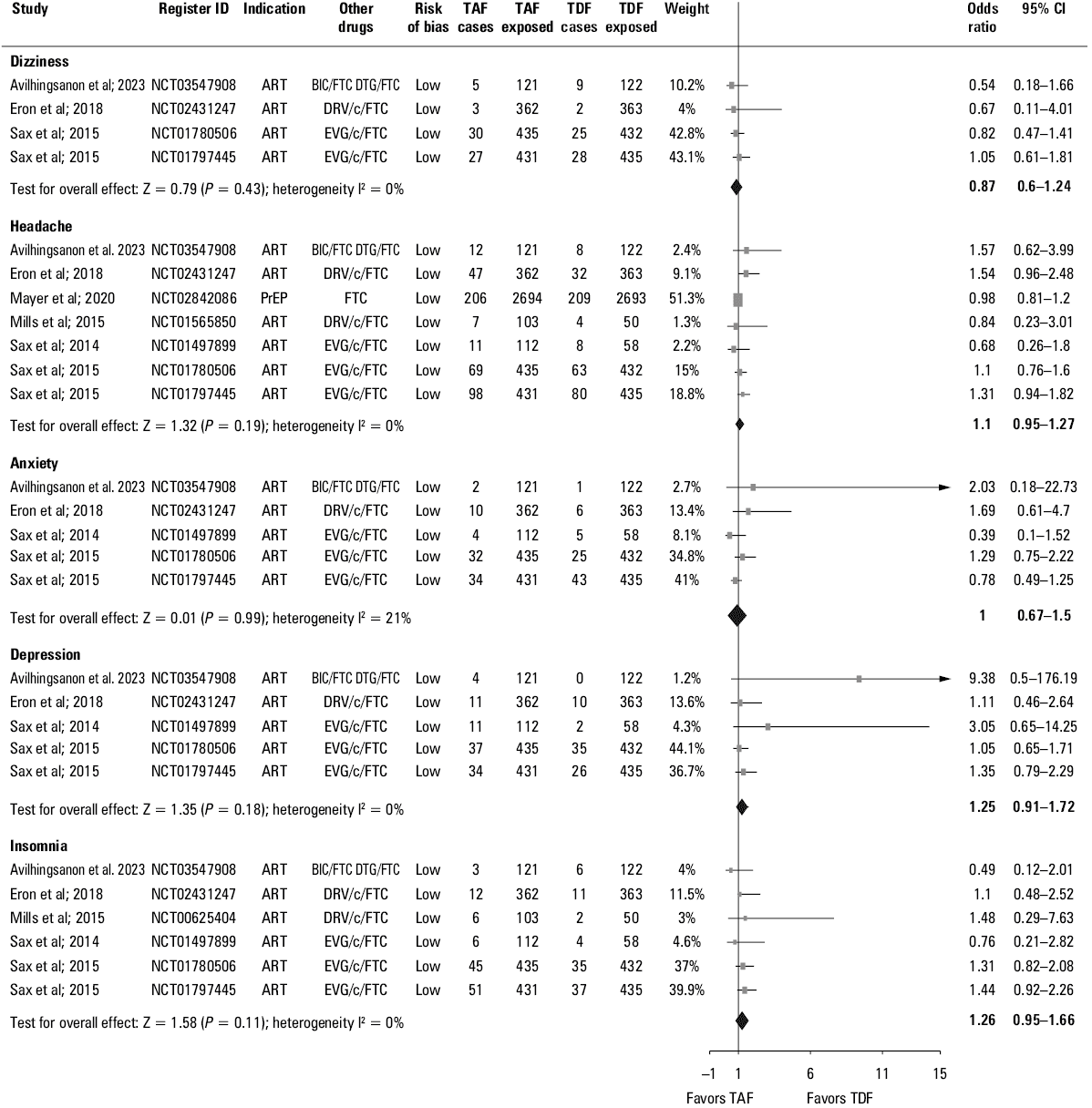
Abbreviations: ART, antiretroviral therapy; BIC, bictegravir; c, cobicistat; DRV, darunavir; DTG, dolutegravir; EVG, elvitegravir; TAF, tenofovir alafenamide; others, see Figure 1
Discussion
This systematic review and meta‑analysis is the first to extensively evaluate NPAEs in tenofovir‑based ART and PrEP. By analyzing data from 62 RCTs, we found that patients on tenofovir‑based ART experienced a heterogeneous spectrum of NPAEs, with headache, dizziness, insomnia, depression, and anxiety being the most common with both tenofovir disoproxil fumarate– and tenofovir alafenamide–based regimens. In the context of PrEP, most NPAEs were less frequently reported. Although data on the relationship between treatment duration and the emergence of NPAEs were limited, the number of newly afflicted patients seemed to decrease with time. Additionally, despite their common occurrence, NPAEs were rarely reported as a reason for withdrawal of tenofovir‑based therapy.
A pooled analysis of data from trials on tenofovir disoproxil fumarate (with or without emtricitabine) vs placebo in PrEP settings identified a higher risk of dizziness associated with tenofovir regimens but no significant effect on other NPAEs. Meta‑analyses comparing tenofovir disoproxil fumarate– vs tenofovir alafenamide–based therapies in ART and PrEP found no significant risk difference for any of the evaluated NPAEs. However, some sensitivity analyses suggested a potentially higher risk of headache with tenofovir alafenamide–based ART.
Most ART studies employed tenofovir disoproxil fumarate–based regimens, with various combination partners as potentially contributing to NPAEs. Regimens containing efavirenz accounted for a large fraction of NPAEs, reflecting the well‑known neuropsychiatric sequalae of efavirenz.24-26 Tenofovir alafenamide–based ART involved fewer combinations, notably excluding efavirenz. Consequently, the spectrum and incidence of NPAEs were smaller than with tenofovir disoproxil fumarate–based ART.
As compared with ART, fewer NPAEs were observed during tenofovir‑based PrEP, both in terms of variety and frequency. The higher rates of NPAEs in ART could partly be due to the higher general prevalence of neuropsychiatric conditions among PLWH,27 potentially exacerbating the reported incidence of such events. However, a more compelling explanation lies in the configurations of tenofovir‑based therapies: PrEP trials used tenofovir as either monotherapy or with emtricitabine only, while ART studies used complex regimens, incorporating various antiretroviral agents. Supporting this, the lack of significant differences observed for most NPAEs between tenofovir disoproxil fumarate (with or without emtricitabine) and placebo in the PrEP trials suggests that tenofovir itself has no significant potential for causing most NPAEs. Dizziness was the only event occurring more frequently in the patients receiving tenofovir regimens than those on placebo in the PrEP studies. This effect was noted in the pooled analysis of tenofovir disoproxil fumarate alone and with emtricitabine but was reduced to a trend when only monotherapy was analyzed, possibly due to reduced statistical power. Dizziness, although often classified as a neurological symptom, has a multifaceted etiology, including vestibular and cardiovascular factors.28 Its occurrence does not necessarily imply a central nervous system origin, given the lack of association between tenofovir and other NPAEs. While the increased incidence of dizziness in the tenofovir PrEP studies warrants attention, it should not be prematurely attributed to direct neurotoxic effects of the drug without further evidence.
Meta‑analytical comparisons of tenofovir alafenamide– and tenofovir disoproxil fumarate–based treatments across ART and PrEP studies revealed no significant overall differences. However, 3 sensitivity analyses—all of which effectively narrowed the focus to ART studies—suggested an increased risk of headache with tenofovir alafenamide. Previous meta‑analyses have explored the safety profiles of the tenofovir prodrugs in ART regimens among both treatment‑naive and treatment‑experienced patients, occasionally highlighting individual AEs, including neuropsychiatric ones, such as insomnia and headache. While the frequency of insomnia showed no significant difference between tenofovir alafenamide– and tenofovir disoproxil fumarate–based treatments in the treatment‑naive patients,13 a different pattern emerged for headache: analysis of data from a mixed cohort of treatment‑naive and treatment‑experienced patients indicated that those treated with tenofovir alafenamide experienced headache more frequently than those on tenofovir disoproxil fumarate–based regimens.29 Similarly, a study involving patients switching from tenofovir disoproxil fumarate to tenofovir alafenamide also reported increased rates of headache after treatment change.30 Furthermore, a recent meta‑analysis focusing on treatment‑naive individuals showed a trend toward a greater incidence of headache among individuals on tenofovir alafenamide than in those receiving tenofovir disoproxil fumarate.13 Our analysis expanded on the latter study by incorporating 2 additional trials31,32 and extending the follow‑up periods for 2 studies,33 thereby reinforcing the suggestion that tenofovir alafenamide–based ART may carry a higher risk of headache. However, this finding cannot be generalized across different indications, as the single included PrEP study showed nearly identical headache rates in the treatments,32 indicating that the risk profile for headache may vary by treatment setting. In addition, while headache is usually considered a central nervous system symptom in the context of AEs, we must reiterate our caution against hastily attributing such symptoms solely to the central nervous system. As with dizziness, the etiology of headache is multifactorial.34 This assertion is further supported by the absence of a similar pattern for other neuropsychiatric AEs, such as dizziness, anxiety, depression, and insomnia.
Limitations
Importantly, to our best knowledge, specific NPAEs other than headache and insomnia have not been investigated in previous meta‑analyses of tenofovir alafenamide– vs tenofovir disoproxil fumarate–based regimens. Considering the increasing significance of tenofovir alafenamide in ART, as well as its role in PrEP, our finding of noninferiority to tenofovir disoproxil fumarate regarding most NPAEs represents an important contribution to an understanding of its risk profile.15,35
Several limitations must be considered when interpreting the results of our study. First, to reduce possible investigator bias, we extracted the number of all AEs vs only drug‑related AEs, meaning that some observed events may not be causally related to the treatment. This is especially true in the ART studies, where the high prevalence of neuropsychiatric conditions in PLWH27 may have led to an overestimation of the effect of tenofovir‑based therapies on neuropsychiatric health and contributed to the higher numbers and frequencies of NPAEs, as compared with the PrEP trials.
Second, due to incomplete AE reporting in most included studies, the total number of reported cases may not represent the actual numbers for some NPAEs. Frequency thresholds for AE reporting present in most studies omitted rarer events, and many records were excluded due to missing, preselected, or grouped AE data. We tried to correct this by contacting the investigators but obtained additional data for only 6 trials.
Third, our study employed stringent inclusion criteria, specifically focusing on treatment‑naive patients. This methodological choice serves as both a strength and a limitation of our meta‑analyses. In contrast to a previous meta‑analysis that compared the general safety of tenofovir disoproxil fumarate– vs tenofovir alafenamide–based therapies, which incorporated studies including treatment‑experienced patients,36 our targeted approach on treatment‑naive patients was adopted to reduce potential biases associated with preselection for tolerability. This strategy aimed to improve homogeneity, while recognizing the trade‑off of potentially diminishing statistical power. Notably, this criterion also prompted our decision not to include studies focusing on the treatment of hepatitis B, which otherwise would have been valuable for both the comparison of tenofovir vs placebo and the comparison of the tenofovir prodrugs. Treatment‑naivety is rarely a prerequisite in hepatitis B trials, as most studies allow both treatment‑naive and treatment‑experienced patients.37,38
Fourth, we pooled data on AEs reported up to different time points of observation and study duration for the meta‑analyses. This approach ensured inclusion of the most complete datasets available at the expense of introducing additional heterogeneity.
Finally, our decision to compare tenofovir alafenamide with tenofovir disoproxil fumarate stemmed from the hypothesis that higher intracellular tenofovir concentrations, potentially achieved with tenofovir alafenamide, might increase neurotoxicity.39 To date, there has been no direct comparison of neuronal concentrations of tenofovir between these prodrugs. However, a single small study assessed tenofovir concentrations in cerebrospinal fluid (CSF) and plasma before and after switching from tenofovir disoproxil fumarate to tenofovir alafenamide in ART patients, using the CSF / plasma concentration ratio as a surrogate marker of brain penetration. The authors found that this ratio increased after the switch, suggesting enhanced brain penetration.40 However, the small sample size and reliance on an indirect method to estimate brain penetration limit the generalizability of these findings. Without direct evidence comparing neuronal uptake, the question of increased neurotoxicity with tenofovir alafenamide remains open. Given its growing use, a thorough investigation into potential risks is warranted. Our analysis contributes to this exploration, emphasizing the need for cautious interpretation and further research to elucidate the neuropsychiatric safety profile of tenofovir alafenamide.
Conclusions
This study demonstrated that several types of NPAEs are common in tenofovir‑based ART. In the PrEP trials, where tenofovir was used alone or with emtricitabine, the spectrum and frequency of NPAEs were generally lower. The higher risk in the ART studies may reflect both the increased vulnerability of PLWH to NPAEs and the effects of other drugs included in ART regimens. Although NPAEs rarely led to therapy withdrawal in RCTs on tenofovir‑based therapy, such symptoms can impair adherence in real‑world settings,3-5 underscoring the need to monitor these events. The European AIDS Clinical Society (EACS) guidelines recommend assessing depression and anxiety through leading questions,41 and we suggest expanding this list to include other common neuropsychiatric symptoms. The EACS guidelines also provide algorithms for managing neuropsychiatric symptoms. Importantly, if a causal link to ART is likely, switching regimens is warranted; otherwise, general guidelines (eg, for headache, depression) should be followed.41 Among NPAEs, dizziness may be the only symptom directly attributed to tenofovir. Tenofovir alafenamide is noninferior to its predecessor regarding NPAE rates, except for a potentially higher risk of headache in the ART patients, which warrants further investigation.
- May MT, Gompels M, Delpech V, et al. Impact on life expectancy of HIV‑1 positive individuals of CD4+ cell count and viral load response to antiretroviral therapy. AIDS. 2014; 28: 1193‑1202. | Crossref
- Yuan NY, Kaul M. Beneficial and adverse effects of cART affect neurocognitive function in HIV‑1 infection: balancing viral suppression against neuronal stress and injury. J Neuroimmune Pharmacol. 2021; 16: 90‑112. | Crossref
- DiMatteo MR, Lepper HS, Croghan TW. Depression is a risk factor for noncompliance with medical treatment: meta‑analysis of the effects of anxiety and depression on patient adherence. Arch Intern Med. 2000; 160: 2101‑2107. | Crossref
- Angelino AF, Treisman GJ. Issues in co‑morbid severe mental illnesses in HIV infected individuals. Int Rev Psychiatry. 2008; 20: 95‑101. | Crossref
- O’Brien ME, Clark RA, Besch CL, et al. Patterns and correlates of discontinuation of the initial HAART regimen in an urban outpatient cohort. J Acquir Immune Defic Syndr. 2003; 34: 407‑414. | Crossref
SUPPLEMENTARY MATERIAL
ARTICLE INFORMATION