
A diagnostic challenge: unraveling a parotid gland tumor in a patient with medullary thyroid carcinoma


 CC BY-NC-SA 4.0
A diagnostic challenge: unraveling a parotid gland tumor in a patient with medullary thyroid carcinoma
CC BY-NC-SA 4.0
A 65‑year‑old man with a history of total thyroidectomy, bilateral neck lymph node dissection, and radiotherapy for medullary carcinoma of the left thyroid lobe presented with a painless left parotid tumor detected incidentally over 6 months ago. Physical examination showed a 1.5‑cm mass in the left preauricular area without facial nerve palsy. Laboratory tests showed an elevated calcitonin level of 1137 pg/ml (reference range for men ≤110 pg/ml) but were otherwise normal. Although ultrasound‑guided fine‑needle biopsy (FNB) showed no cancerous cells, the diagnosis remained uncertain. Magnetic resonance imaging showed an enhancing 16 mm × 12 mm nodule in the left parotid gland with no abnormal enhancement in the thyroidectomy bed (Figure 1A and 1B). Superficial parotidectomy was performed, leading to a final diagnosis of nodular oncocytic hyperplasia (NOH). The postsurgical calcitonin level was 1017 pg/ml. Histologically, the tumor was a solid, well‑defined nodule measuring 2 cm × 1.3 cm × 1.7 cm. Microscopically, it contained large cells with abundant clear cytoplasm and round, regular nuclei arranged in solid and trabecular patterns separated by thin fibrovascular stroma, positive for antimitochondrial antibodies (Figure 1C and 1D).
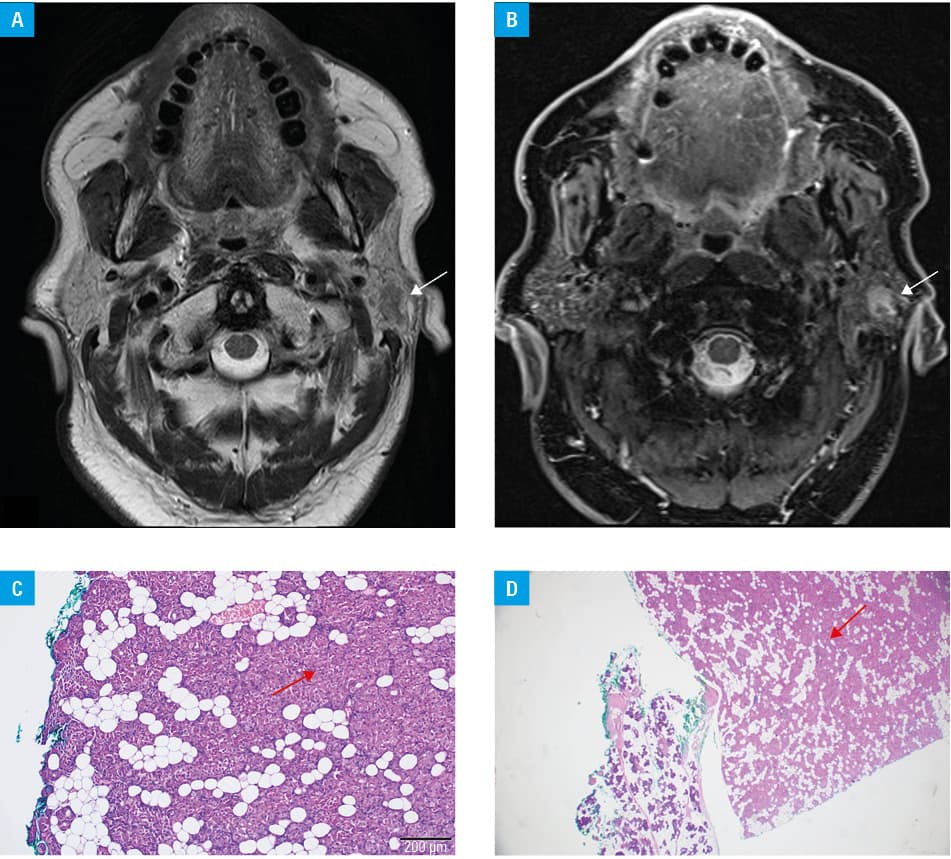
NOH is an extremely rare, benign condition primarily affecting women in their sixth to eighth decade, accounting for less than 1% of all salivary gland tumors, usually located in the parotid gland.1 Histologically, NOH presents as multiple nonencapsulated nodules of oncocytic cells interspersed with normal tissue.1 The World Health Organization classification of salivary gland neoplasms includes other oncocytic entities, such as oncocytoma and oncocytic carcinoma.2 Unlike NOH, oncocytoma is a solitary tumor, commonly affecting the major salivary glands in patients over 70 years of age, while oncocytic carcinoma is a rare salivary malignancy characterized by infiltrative growth and the absence of a connective tissue capsule.2 Although NOH is benign with no predisposition to malignancy, surgery may be required to rule out differential diagnoses, especially when FNB results are inconclusive. In this case, surgery was performed to exclude the possibility of a metastatic lymph node from medullary thyroid carcinoma, given the uncertain FNB results. NOH should be differentiated from the oncocytic variant of medullary thyroid carcinoma, which although exceptionally rare, may mimic other oncocytic lesions, earning its name as a “great mimicker.”3 Additionally, although rare, metastases to the salivary glands account for 3.2%–10% of all salivary gland tumors.4 A rapid growth of a parotid mass, coupled with a distinct histopathological pattern, is indicative of a metastatic diagnosis, unlike the slow‑growing nature of NOH. NOH must be distinguished from other oncocytic lesions, such as salivary duct carcinoma, which shows cribriform or papillary patterns, nuclear pleomorphism, and necrotic background absent in NOH.5 Warthin tumor, another condition with oncocytic features, can be differentiated by its lymphoid component, mucus, and necrotic background, which are absent in NOH.5 This case highlights NOH, a benign but rare condition that may mimic other oncocytic lesions, sometimes necessitating surgical intervention to rule out malignancy.
- Hung C‑J, Liu Y‑H, Liao J‑B. Nodular oncocytic hyperplasia of bilateral parotid glands with parapharyngeal space extension. Ear Nose Throat J. 2022; 101: 392‑396. | Crossref
- Skálová A, Hyrcza MD, Leivo I. Update from the 5th Edition of the World Health Organization classification of head and neck tumors: salivary glands. Head Neck Pathol. 2022; 16: 40‑53. | Crossref
- Sams SB, Tompkins KD, Mayson S, et al. Oncocytic variant of medullary thyroid carcinoma; a rare tumor with numerous diagnostic mimics by fine needle aspiration. Diagn Cytopathol. 2017; 45: 1148‑1152. | Crossref
- Wu ZH, Ge MH, Cao J, et al. Parotid metastases from thyroid carcinomas. Int J Clin Exp Pathol. 2017; 10: 10467‑10474.
- Özakkoyunlu Hasçiçek S, Tunçel D, Ünsal Ö, et al. Oncocytic lesions of salivary glands with morphological and immunohistochemical findings. Sisli Etfal Hastan Tip Bul. 2020; 54: 88‑93.
ARTICLE INFORMATION