
Differences in cardiovascular outcomes between men and women with acute pancreatitis
Key words: acute pancreatitis, cardiovascular outcomes, cohort study, sex difference, win ratio


 CC BY-NC-SA 4.0
Differences in cardiovascular outcomes between men and women with acute pancreatitis
CC BY-NC-SA 4.0
Introduction: The risk of cardiovascular disease increases in patients with acute pancreatitis (AP). However, it remains unknown whether this increase varies between sexes.
Objectives: Our aim was to assess sex differences in cardiovascular outcomes in AP patients during long‑term follow‑up.
Patients and methods: The participants were recruited from the United Kingdom Biobank, which is a population‑based cohort study consisting of 502 368 individuals aged 40–69 years old. Cardiovascular outcomes were defined as major cardiovascular and cerebrovascular adverse events (MACCEs), encompassing all‑cause death, myocardial infarction, and stroke. We compared sex difference in MACCE incidence using incidence rate per 1000 person‑years. The association between sex and MACCE risk was assessed using the Cox proportional hazards models and win ratio method, adjusted for demographic, lifestyle, metabolic factors, and medication use.
Results: A total of 1371 participants with AP were included, 42.5% were men. Over the median (interquartile range) follow‑up of 13.9 (13–14.7) years, 226 MACCEs occurred. The incidence rate of MACCE was 16.44 for men and 9.8 for women. The multivariate Cox regression analysis indicated a higher risk of MACCEs in men than in women (hazard ratio [HR], 1.8; 95% CI, 1.36–2.38). Adjusted HR for all‑cause mortality, myocardial infarction, and stroke were 1.49, 2.75, and 1.67, respectively. The adjusted win ratio by inverse probability of treatment weighting was 0.55 (P <0.001), suggesting a worse outcome in men.
Conclusions: Men experienced more adverse cardiovascular outcomes than women in long follow‑up after AP, suggesting a need for sex‑specific management strategies in AP patients.
What's new?
This study highlights significant sex differences in cardiovascular outcomes among patients with acute pancreatitis (AP). Using data from the United Kingdom Biobank, we found that men have a substantially higher risk of major adverse cardiovascular and cerebrovascular events than women in long‑term follow‑up. Our findings show that men with AP are at a greater risk for myocardial infarction and all‑cause mortality, suggesting a need for sex‑specific management strategies. These insights emphasize the importance of personalized approaches to managing cardiovascular risk in AP patients, potentially improving long‑term outcomes. Future research should focus on understanding the underlying mechanisms driving these sex differences and developing targeted interventions.
Introduction
Acute pancreatitis (AP) is one of the most common gastrointestinal diseases requiring hospitalization.1 The occurrence of AP can be attributed to several modifiable risk factors, including gallstones, alcohol abuse, high triglyceride level, smoking, and obesity.2 Among those, 2 the most common etiological factors are alcohol abuse and gallstones.
Studies have found that the inflammatory process associated with AP impacts other organ systems, including the cardiovascular system, to a various degree and duration.3 The American Heart Association has identified 7 modifiable risk factors that can lead to cardiovascular diseases (CVDs): hypertension, diabetes, high cholesterol level, smoking, insufficient physical activity, high body mass index (BMI), and poor diet. Certain risk factors, such as obesity, hypertriglyceridemia, and metabolic syndrome are shared between CVD and AP patients. In addition, alcohol abuse is one of the most common causes of AP. It may also induce decreased myocardial contractility, hypertension, arrhythmias, and nonischemic dilated cardiomyopathy.
Studies have found that the mentioned risk factors differ with sex. For instance, the prevalence of hypertriglyceridemia is higher in men than in women.4 The European Prospective Investigation into Cancer and Nutrition has shown that the risk of diabetes is higher in men than women.5 Metabolic syndrome increases with age in a sex‑specific manner: while slightly more frequent in men below 50 years old, its distribution reverses beyond the age of 50.6 Moreover, men with obesity are at a 64% higher risk of coronary artery disease than women, which is believed to be associated with an increase in diabetes and abdominal obesity.7 Furthermore, obesity could induce a reduction in estrogen levels in premenopausal women, reversing their protective effects against CVDs.8 Therefore, it can be concluded that sex differences in the abovementioned risk factors could impact cardiovascular outcomes differently in men and women with AP.
Although there is a lot of evidence linking AP with an increased risk of developing CVD,9 sex‑specific disease characteristics and associations between cardiovascular outcomes and AP have received limited attention. In this study, data from the United Kingdom (UK) Biobank were used to investigate sex differences in the incidence of major adverse cardiovascular and cerebrovascular events (MACCEs) among patients with AP. The aim of the study was to assess whether there are sex differences in cardiovascular outcomes among AP patients during long‑term follow‑up to limit the impact of sex disparities in cardiovascular care and long‑term cardiovascular outcomes.
Patients and methods
Study design and participants
The UK Biobank is a prospective cohort study that recruited 502 368 individuals aged 40–69 years from 22 assessment centers between 2006 and 2010. The baseline assessment comprised of a touchscreen questionnaire, a face‑to‑face interview, a range of physical measurements, and collection of biological samples (blood, urine, and saliva).
Our study included the participants who reported AP at baseline. AP was identified using the International Classification of Diseases 10th Revision (ICD‑10) codes K85.0, K85.1, K85.2, K85.3, K85.8, and K85.9, as well as ICD‑9 code 5770. The excluding criteria were concomitant chronic pancreatitis and MACCE prior to baseline.
Covariates
Information on age and sex was obtained from self‑reported baseline characteristics. Ethnicity was also self‑reported by the participants and categorized as white, Asian, black, or other. The educational attainment was gauged by the age at which the participants left full‑time education. For those who only reported a degree or qualification status, an equivalent age at completion of the education was determined. Income levels were calculated from average total household income before tax and grouped into level 1 (less than 18 000 GBP), level 2 (18 000 to 30 999 GBP), level 3 (31 000 to 51 999 GBP), and level 4 (over 52 000 GBP). Employment was categorized as employed / self‑employed or retired / unemployed. The Townsend deprivation index was calculated immediately before the participant joined the UK Biobank to assess the impact of socioeconomic factors on health outcomes. Physical activity was defined by the International Physical Activity Questionnaire as low, moderate, or high. Diet was classified as healthy or unhealthy, which was evaluated using a more recent definition of the ideal intake of dietary components for cardiovascular health.10 If the participants achieved the intake goal, they were considered to have an adequate intake of the diet component. Adequate intake of at least half of all diet components was considered as a healthy diet, less than half was considered an unhealthy diet (field identifiers and serving sizes used per diet component in the UK Biobank are provided in Supplementary material, Table S1). Smoking and drinking status were self‑reported and categorized as never, former, or current. BMI was obtained from physical measurements, which included height and weight measured at the initial visit to the assessment center. The presence or absence of hypertension, dyslipidemia, and diabetes were self‑reported at baseline, and were categorized as yes or no. Information on medication for high cholesterol level, high blood pressure, and diabetes was obtained from the “Health and medical history” section of the touchscreen questionnaire initially completed at the assessment center. More detailed information on covariates was provided in the Supplementary material, Table S1.
Cardiovascular outcomes and follow‑up
The primary outcome of this study was MACCE, defined as a composite of all‑cause death, myocardial infarction (MI), and stroke. The secondary outcomes included all‑cause death, MI, and stroke. The date of the earliest reported MI or stroke for a participant was algorithmically defined by the UK Biobank, as it was linked to relevant hospital inpatient records (Hospital Episode Statistics for England, Morbidity Records for Scotland). Date of death was acquired from death register dataset (National Health Service [NHS] Digital, NHS Central Register, and National Records). For all participants, follow‑up started at inclusion in the UK Biobank and ended either when MI, stroke, or all‑cause death occurred or on the study’s conclusion on March 30, 2023, whichever occurred first.
Statistical analysis
To present the baseline data, mean (SD) was used for continuous variables, and counts and percentages were used for categorical variables. To address the missing data, we applied multiple imputation with chained equations to impute the missing values, and conducted ten imputations (baseline demographic comparison in the imputation cohort, nonimputation cohort, and excluded cohort was shown in Supplementary material, Table S2). The median (interquartile range [IQR]) follow‑up time was calculated using the reverse Kaplan–Meier method. Crude incidence rate (IR) per 1000 person‑years was calculated with the Poisson regression and associated 95% CIs using the exact Poisson method. Cumulative rates for MACCE and its components according to sex were exhibited on the Kaplan–Meier curve, and differences between the 2 groups were compared by the log‑rank tests.
We used the Cox proportional hazards regression models to assess the sex differences in cardiovascular outcomes, the hazard ratios (HRs) and 95% CIs, followed by separate analyses with MACCE components of all‑cause death, MI, and stroke. In the sequentially‑adjusted Cox proportional hazards models, we adjusted all covariates step by step. Model 1 included only sex; model 2 included age, ethnicity, education level, income levels, employment status, and the Townsend deprivation index, and was further adjusted on the basis of model 1; in model 3, physical activity, diet quality, smoking status, and drinking status were further adjusted on the basis of model 2; in model 4, BMI, hypertension, dyslipidemia, and diabetes were further adjusted on the basis of model 3; and in model 5 (fully‑adjusted model), medications including antihypertensive, lipid‑lowering, and hypoglycemic drugs were further adjusted on the basis of model 4. Female sex was used as the reference group in all models. The Schoenfeld residuals were used to assess the proportional hazard assumption, and no violation was found. The interaction between sex and age was evaluated in model 5.
Considering that the primary outcome of this study was a composite end point, the results for the outcome were further analyzed with the win ratio method, and the inverse probability of treatment weighting (IPTW) was used to adjust for confounding and selection bias at baseline,11 including sex, age, ethnicity, education level, income levels, employment status, the Townsend deprivation index, physical activity, diet quality, smoking status, drinking status, BMI, hypertension, dyslipidemia, diabetes, and medication. Notably, both inverse probability weighted average treatment effect (IPW‑ATE) and stabilized IPTW (SIPTW)-ATE, were similarly adjusted for the aforementioned indicators. Every male patient was compared with every female patient during a shared follow‑up time defined as the minimum of their follow‑up times. The pairs were classified as winners for men if all‑cause death during follow‑up occurred first in women, and losers if all‑cause death occurred first in men. If both participants in a pair completed or exited the study before all‑cause death, they were classified according to who experienced MI first in a hierarchical order. If those completed or exited the study before MI, they were classified according to who experienced stroke first. A pair was tied if a decision could not be made on whether it was a winner or a loser. The win ratio was defined as the total number of winner pairs divided by the total number of loser pairs. Therefore, the benefit of male sex is provided by a win ratio above 1. The 95% CIs were estimated for the win ratio effect measures. To facilitate the comparison of the estimates provided by the win ratio with those of the HR, the HR as 1/HR and respective 95% CIs are also reported. 1/HR represents the rate of events in the female group vs the rate in the male group, whereby a 1/HR above 1 indicates a higher event rate in the female group than in the male group (ie, a benefit for the men).
Several sensitivity analyses were conducted to test the robustness of our findings. First, we only included participants with no missing values. Then, within this subset, the individuals were stratified into either single or recurrent AP cohort, based on the frequency of AP episodes, facilitating a renewed examination of the correlation between sex and MACCE. All statistical analyses were performed using R project version 4.2.3 (R Foundation for Statistical Computing, Vienna, Austria). A 2‑sided P value below 0.05 was considered significant.
Ethics
The UK North West Multi‑Centre Research Ethics Committee approved the UK Biobank (11/NW/0382). All participants provided their written informed consent for the questionnaire and collection of biological data. This research was conducted under UK Biobank application number 152047.
Results
Characteristics of the study participants
Of the 1963 participants diagnosed with AP at baseline, 485 were excluded due to coexisting chronic pancreatitis, and 108 due to a history of MACCE. This left a total of 1371 participants for final analyses. Figure 1 shows the flowchart of the study sample selection.
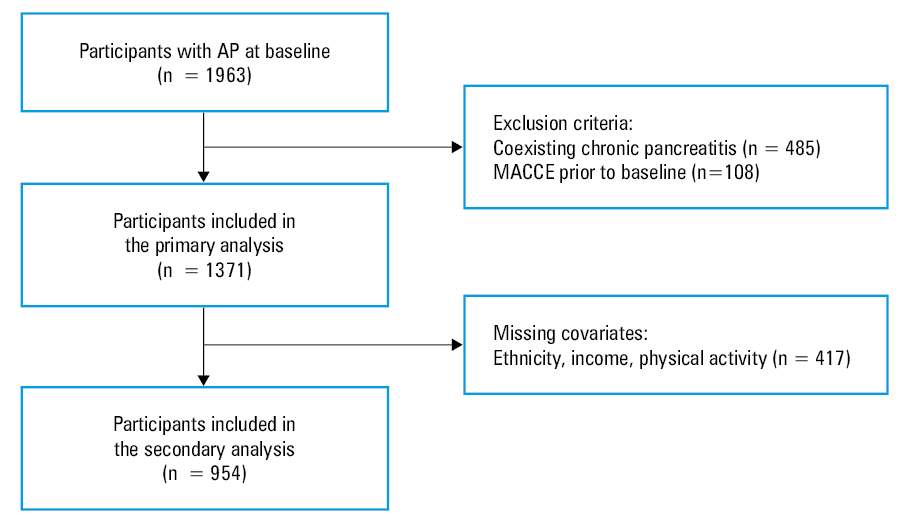
Abbreviations: AP, acute pancreatitis; MACCE, major cardiovascular and cerebrovascular adverse event
Mean (SD) age of the study participants at baseline was 59 (7.3) years, 788 were women (57.5%) and 583 were men (42.5%). Age distribution did not differ between sexes (P = 0.06). The baseline characteristics of the sample according to sex are provided in Table 1. In general, men achieved higher educational level, had higher income, and higher employment rate. Men also demonstrated reduced BMI, increased blood pressure, and a higher prevalence of current smokers and current drinkers. Additionally, a higher percentage of men than women had hypertension, dyslipidemia or diabetes, and were taking antihypertensive, lipid‑lowering, and hypoglycemic drugs.
Characteristics | Men (n = 583) | Women (n = 788) | P value | ||
Data are presented as number and percentage unless stated otherwise.
a Adequate intake of at least half of all diet components was considered a healthy diet, less than half was considered an unhealthy diet.
Abbreviations: BMI, body mass index | |||||
Demographic characteristics | |||||
Age, mean (SD), y | 58.5 (7.5) | 59.3 (7.1) | 0.06 | ||
Ethnicity | White | 564 (96.7) | 766 (97.2) | 0.92 | |
Asian | 10 (1.7) | 11 (1.4) | |||
Black | 5 (0.9) | 5 (0.6) | |||
Other | 4 (0.7) | 6 (0.8) | |||
Age at leaving full‑time education, mean (SD), y | 17.4 (2.9) | 17 (2.6) | 0.004 | ||
Income level | <18 000 GBP | 179 (30.7) | 329 (41.8) | <0.001 | |
8000–30 999 GBP | 139 (23.8) | 222 (28.2) | |||
31 000–52 000 GBP | 135 (23.2) | 142 (18) | |||
>52 000 GBP | 130 (22.3) | 95 (12.1) | |||
Employment status | Paid employment or self‑employment | 295 (50.6) | 328 (41.6) | 0.001 | |
Retired or unemployed | 288 (49.4) | 460 (58.4) | |||
Townsend deprivation index, mean (SD) | –1 (3.2) | –1.2 (3.1) | 0.35 | ||
Lifestyle characteristics | |||||
Diet qualitya | Unhealthy | 505 (86.6) | 683 (86.7) | 0.99 | |
Healthy | 78 (13.4) | 105 (13.3) | |||
Physical activity | Low | 143 (24.5) | 190 (24.1) | 0.85 | |
Moderate | 211 (36.2) | 297 (37.7) | |||
High | 229 (39.3) | 301 (38.2) | |||
Smoking status | Never | 245 (42) | 474 (60.2) | <0.001 | |
Previous | 249 (42.7) | 248 (31.5) | |||
Current | 89 (15.3) | 66 (8.4) | |||
Alcohol consumption status | Never | 18 (3.1) | 72 (9.1) | <0.001 | |
Previous | 81 (13.9) | 63 (8) | |||
Current | 484 (83) | 653 (82.9) | |||
Metabolic characteristics | |||||
BMI, kg/m2, mean (SD) | 28.7 (4.5) | 29.8 (5.9) | <0.001 | ||
Diastolic blood pressure, mm Hg, mean (SD) | 84.3 (9.9) | 81.6 (10.9) | <0.001 | ||
Systolic blood pressure, mm Hg, mean (SD) | 141.4 (17) | 138.4 (21) | 0.003 | ||
Hypertension | No | 353 (60.5) | 496 (62.9) | 0.4 | |
Yes | 230 (39.5) | 292 (37.1) | |||
Dyslipidemia | No | 424 (72.7) | 633 (80.3) | 0.001 | |
Yes | 159 (27.3) | 155 (19.7) | |||
Diabetes | No | 481 (82.5) | 724 (91.9) | <0.001 | |
Yes | 102 (17.5) | 64 (8.1) | |||
Medication | |||||
Antihypertensive drugs | No | 406 (69.6) | 561 (71.2) | 0.57 | |
Yes | 177 (30.4) | 227 (28.8) | |||
Lipid‑lowering drugs | No | 418 (71.7) | 612 (77.7) | 0.01 | |
Yes | 165 (28.3) | 176 (22.3) | |||
Hypoglycemic drugs | No | 550 (94.3) | 770 (97.7) | 0.002 | |
Yes | 33 (5.7) | 18 (2.3) | |||
Sex differences in incidence rates of cardiovascular outcomes
Over a median (IQR) follow‑up duration of 13.9 (13–14.7) years, encompassing 18 030.9 person‑years, 226 cases of MACCE occurred in 1371 individuals, including 122 in men (IR, 16.44; 95% CI, 13.77–19.64) and 104 in women (IR, 9.8; 95% CI, 8.09–11.88) (Table 2). The IR for all‑cause death was significantly higher in men than in women (11.39; 95% CI, 9.24–14.04 vs 7.59; 95% CI, 6.11–9.42). IR of MI and stroke was also greater in men (4.68; 95% CI, 3.41–6.43 vs 2.05; 95% CI, 1.36–3.08 and 2.42; 95% CI, 1.56–3.75 vs 1.33; 95% CI, 0.8–2.2, respectively; Table 2). For women as controls, the IR ratio for MACCE, all‑cause death, MI, and stroke was 1.68, 1.5, 2.29, and 1.82, respectively. Even after stratifying the population by age (<60 years old and ≥60 years old), IR for MACCE and its components was still higher for men in both age groups (Supplementary material, Table S3).
Outcome | Men | Women | IRRb (95% CI) | P value | ||||
No. of events / No. at risk | Person‑years | IRa (95% CI) | No. of events / No. at risk | Person‑years | IRa (95% CI) | |||
a IR calculated per 1000 person‑years
b IRR calculated with women as the reference
Abbreviations: IR, incidence rate; IRR, incidence rate ratio; others, see Figure 1 | ||||||||
MACCE | 122/583 | 7418.83 | 16.44 (13.77–19.64) | 104/788 | 10 612.06 | 9.8 (8.09–11.88) | 1.68 (1.29–2.18) | <0.001 |
All‑cause death | 88/583 | 7723.97 | 11.39 (9.24–14.04) | 82/788 | 10 805.57 | 7.59 (6.11–9.42) | 1.5 (1.11–2.03) | 0.008 |
Myocardial infarction | 38/583 | 8117.31 | 4.68 (3.41–6.43) | 23/788 | 11 244.56 | 2.05 (1.36–3.08) | 2.29 (1.37–3.9) | 0.002 |
Stroke | 20/583 | 8263.15 | 2.42 (1.56–3.75) | 15/788 | 11 284.33 | 1.33 (0.8–2.2) | 1.82 (0.94–3.62) | 0.08 |
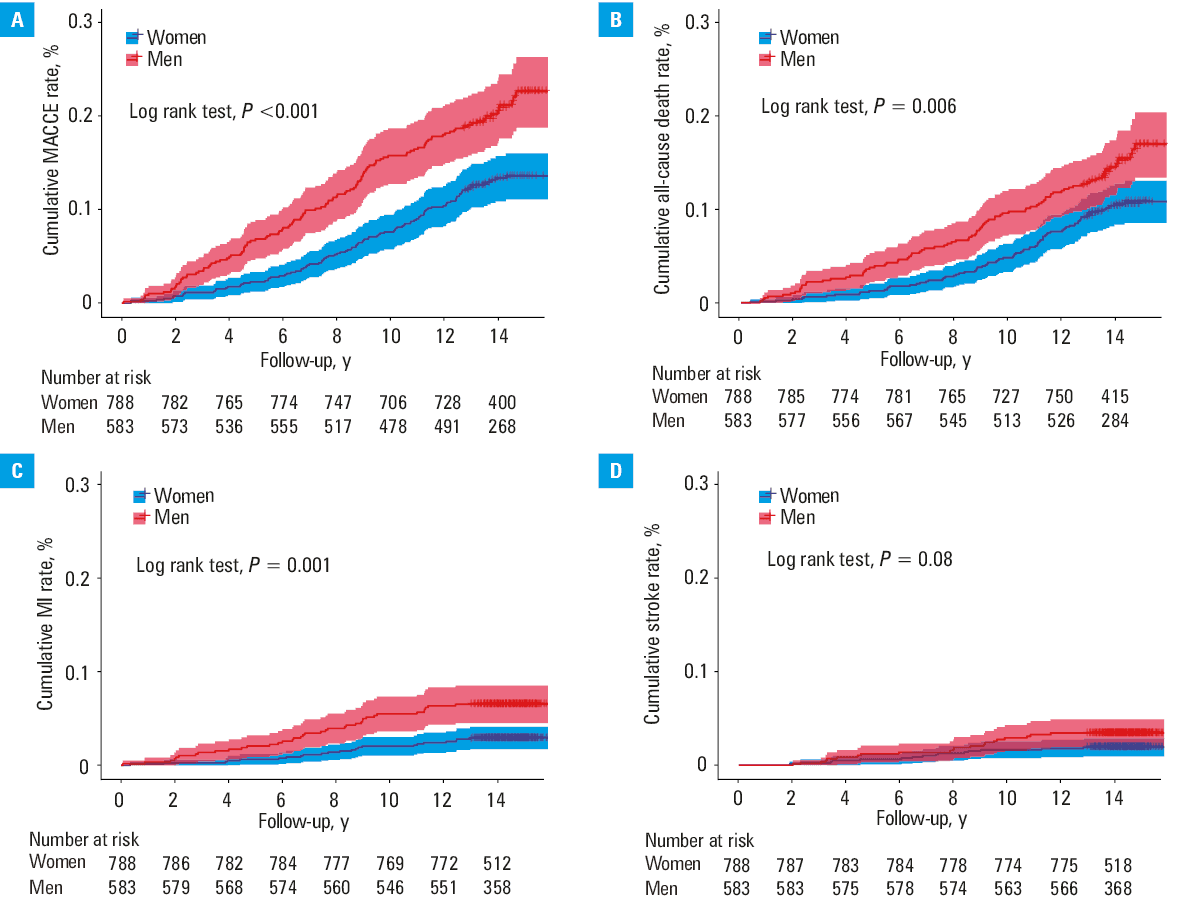
The Kaplan–Meier survival curves showed the cumulative risk of MACCE and its components in men and women. The log‑rank test demonstrated significantly higher long‑term rates of cumulative MACCE, all‑cause death, and MI in men (Figure 2). After stratification according to age, the Kaplan–Meier curves showed the same results (Supplementary material, Figure S1).
Risk for men in multivariate models
The Cox regression analysis adjusting for multiple variables consistently demonstrated that men were at a significantly increased risk for MACCE (HR, 1.8; 95% CI, 1.36–2.38), all‑cause mortality (HR, 1.49; 95% CI, 1.08–2.06), and MI (HR, 2.75; 95% CI, 1.57–4.81; Figure 3). However, the risk of stroke did not show significant sex‑dependent differences (HR, 1.67; 95% CI, 0.79–3.52).
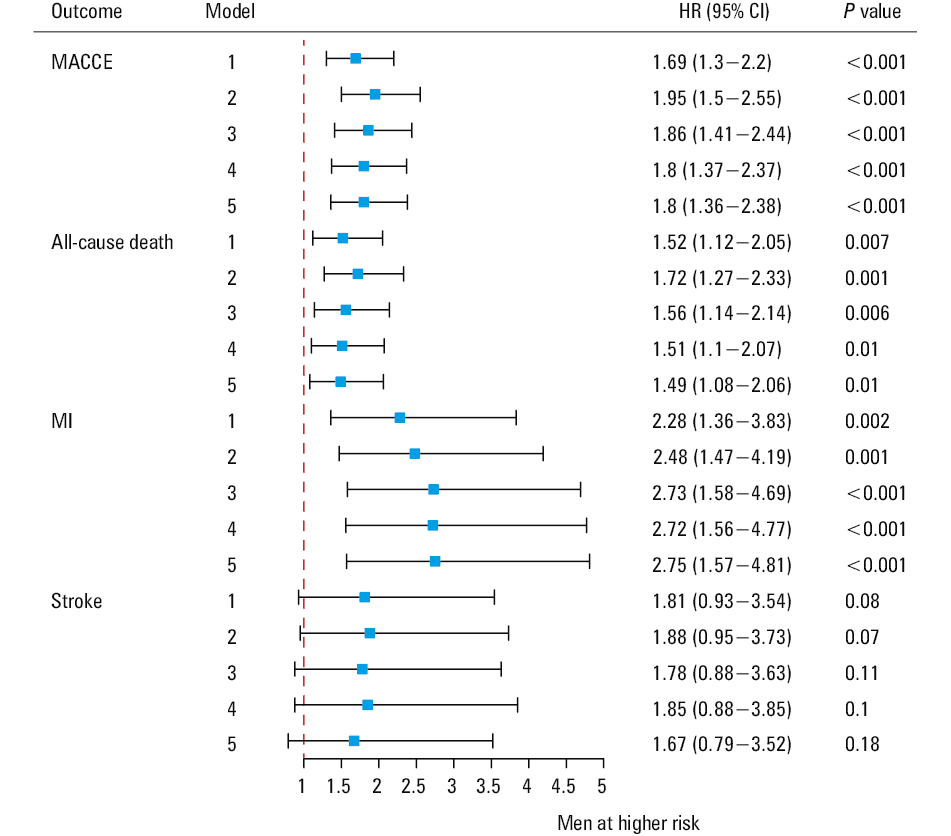
The HR for sex differences for MACCE and all‑cause mortality increased after adjusting for demographic characteristics, and then dropped after adjusting for lifestyle and metabolic factors and medication. For MI, the HR for sex difference rose after addition of demographic characteristics, lifestyle factors, and metabolic factors, and it reached its maximum value after addition of medication. The same trend was observed for stroke, but no significant sex difference was found after step‑by‑step adjustment (Figure 3). Additionally, no significant interaction between age and sex was observed in the fully‑adjusted model (Supplementary material, Table S4).
Win ratio for the analysis of the primary composite outcome
The summary statistics of the baseline characteristics of patients by pre- and post‑IPTW adjustment are presented in Supplementary material, Table S5. To better assess the homogeneity of baseline characteristics before and after IPTW adjustment, the standardized mean difference in each of the baseline covariates was calculated (Supplementary material, Figure S2).
Table 3 displays the unadjusted and adjusted win ratio statistics for analyses of the composite outcome of AP patients by sex. The unadjusted win ratio was 0.61 (95% CI, 0.47–0.8; P <0.001), the IPTW‑adjusted win ratio from the IPTW‑ATE and SIPTW‑ATE was 0.55 (95% CI, 0.42–0.72; P <0.001). The IPTW‑adjusted win ratio closely aligned with the results of the adjusted Cox models regarding the point estimate, interval estimate of 1/HR, and P value.
Method | Win ratio analysisa | Cox model analysis | ||||
WR | 95% CI | P value | 1/HR | 95% CI | P value | |
a Win ratio is calculated as the number of wins for men divided by the number of wins for women among all possible pairs between men and women. Win ratio exceeding 1 reflects a better outcome.
Abbreviations: ATE, average treatment effect; HR, hazard ratio; IPTW, inverse probability of treatment weighting; SIPTW, stabilized inverse probability of treatment weighting; WR, win ratio | ||||||
Unadjusted | 0.61 | 0.47–0.8 | <0.001 | 0.59 | 0.45–0.77 | <0.001 |
IPTW‑ATE | 0.55 | 0.42–0.72 | <0.001 | 0.56 | 0.42–0.74 | <0.001 |
SIPTW‑ATE | 0.55 | 0.42–0.72 | <0.001 | 0.56 | 0.42–0.74 | <0.001 |
Sensitivity analyses
As a sensitivity analysis, we assessed the sex‑depending risk for all outcomes in the population without missing values (Supplementary material, Table S6), and the results remained essentially unchanged (Supplementary material, Tables S7 and S8). Then, we stratified the whole cohort into single and recurrent AP cohorts, and the results were still consistent with our primary outcome (Supplementary material, Tables S9–S11).
Discussion
This large‑scale, population‑based prospective cohort study, showed that over an extended period after the onset of AP, men had a significantly higher risk of MACCE than women. This was observed for all‑cause death and MI. These findings were consistent in the sensitivity analysis, which was restricted to participants with single AP. Collectively, although previous studies suggested that cardiovascular outcomes are a concern for patients with AP, these observations emphasize a poorer prognosis for men with a history of AP. This underlines an urgent need for improved and evidence‑based sex‑dependent management strategies for AP patients.
To our knowledge, this study is the first to report the long‑term cardiovascular outcomes of AP patients adjusted for sex. Its main finding is the causal relationship between AP and MACCE. The contribution of AP to the causal pathway of cardiovascular disorders is undeniable, particularly in combination with other risk factors, such as hypertension, dyslipidemia, and diabetes. In addition, alcohol consumption, a common cause of AP, promotes cardiovascular disease. Multiple studies have clarified the association between AP and cardiovascular disorders. First, AP is an acute inflammation of the pancreas. During AP, the inflammatory cytokines, such as tumor necrosis factor α, transforming growth factor β, interleukin (IL)-1, IL‑6, IL‑10, and chemokine monocyte chemoattractant protein‑1 may be released into and distributed by the circulation.12 This can promote a systemic inflammatory response, negatively affecting 1 or more organ systems to a varying degree.13 The cardiovascular system may also be affected and this may manifest as atherosclerosis, arrhythmia, and pericardial disorder.14 Second, systemic inflammation can induce endothelial dysfunction, which plays an important role in regulating vascular homeostasis. Another inflammatory disease, rheumatoid arthritis, has been confirmed to significantly increase the risk of CVD due to impaired vascular function.15 Inflammation can also cause clotting. Multiple intravascular thrombi were found in pathological tissue after AP,16 and levels of fibrinogen and D‑dimer (a marker of fibrinolysis activation) were also raised, with an overall increase in platelet count. This further increases the risk of MI or stroke in AP patients. Third, AP is also known to be associated with hemodynamic dysfunction, which is caused by reduced circulating volume, due to increased capillary permeability. Large vessel complications in AP tend to occur at the advanced stages of the disease, ranging from arterial spasm to pseudoaneurysm.17 In animal models of AP,18 there is usually a noticeable decrease in mean arterial pressure, cardiac index, and central venous pressure. We assumed that such changes can also play an important role in development of CVDs in humans, and may affect the long‑term incidence of MACCE.
The higher incidence of MACCE in men can be attributed to multiple factors, including biological differences, lifestyle habits, social pressure, and medical interventions. From a physiological perspective, the protective effects of estrogen in women during their reproductive years likely contribute to their lower cardiovascular risk. Lifestyle factors, such as higher rates of smoking and alcohol consumption, as well as dietary habits favoring high‑fat, high‑cholesterol, and calorie‑dense foods, are also more common among men. Additionally, men often face greater social and work‑related pressure, which can lead to physiological responses that increase the cardiovascular burden. Lastly, men may exhibit lower treatment adherence and underutilize medical resources, potentially contributing to poor disease control and increased risk of cardiovascular events.
A previous large‑scale cohort study19 found that patients with AP were at a 1.24‑fold higher risk of acute coronary syndrome (ACS) than those without AP. Meanwhile, the risk of 3 subcategories of ACS (ST‑segment elevation MI, non–ST‑segment elevation MI, and unstable angina) in the AP cohort was also greater than in the control cohort. Upon stratifying the cohort by sex, it was found that the relative risk of ACS was higher in the AP than the control cohort for both sexes. However, the study did not compare the risk of ACS in men and women, and only assessed cardiovascular outcomes of ACS. In contrast, the end point event in our study included all‑cause death, MI, and stroke, thereby providing a more comprehensive assessment of the cardiovascular burden of AP patients.
Another similar large‑scale cohort study9 reported that the risk of stroke, MI, and mortality was significantly higher in diabetic participants with AP history than those without AP at 9‑year follow‑up. The study also showed that the adjusted HR (95% CI) for the risk of stroke, MI, and mortality was 1.534 (1.342–1.753), 1.998 (1.733–2.303), and 2.353 (2.2–2.515), respectively. However, the study did not compare the sex‑dependent risk of CVD in patients with AP. Moreover, it compared the incidence of stroke, MI, and mortality separately, and did not use MACCE as the primary end point. MACCE, as a composite of MI, stroke, and all‑cause death, more comprehensively reflects the cardiovascular prognostic burden in patients with AP. In addition, the study neither excluded the chronic pancreatitis (CP) patients, nor treated CP as a confounding factor, making it difficult to assess causality. Our work involved a specific cohort of patients with AP but no CP, and evaluated long‑term data on MACCE incidence.
Some limitations of our study should be acknowledged. Firstly, information on the etiology and severity of AP was unavailable, which may potentially affect the cardiovascular outcomes. Secondly, participants with AP are more likely to have abnormal glucose metabolism and develop type 3c diabetes. Diabetes is an important factor in the interplay between AP and MACCE. It was difficult to identify such participants, which is an inherent limitation of the UK Biobank. However, we adjusted for baseline diabetes in the multivariate models. Thirdly, we did not assess the influence of other diseases, such as chronic kidney disease, chronic obstructive pulmonary disease, or peripheral artery disease that might affect the relationship between AP and cardiovascular diseases. The strength of our study is that we presented the sex‑dependent risk of MACCE in AP patients adjusted for important confounding variables over long‑term follow‑up. We have also conducted the adjusted win ratio analysis, taking into account clinical importance of composite events, and provided robust evidence on the sex difference for the primary outcome.
Conclusions
In this large cohort study of the UK participants with long‑term follow‑up, we found a higher risk of MACCE, all‑cause death, and MI in men than women. Further investigations are necessary to better understand the mechanisms behind this increased risk in men, and further actions are required to prevent and manage cardiovascular risk in the male population.
- Lu Y, Qiu M, Pan S, et al. Comparison of an interpretable extreme gradient boosting model and an artificial neural network model for prediction of severe acute pancreatitis. Pol Arch Intern Med. 2024; 134: 16700. | Crossref
- Yadav D, Lowenfels AB. Trends in the epidemiology of the first attack of acute pancreatitis: a systematic review. Pancreas. 2006; 33: 323‑330. | Crossref
- Bexelius TS, Ljung R, Mattsson F, Lagergren J. Cardiovascular disease and risk of acute pancreatitis in a population‑based study. Pancreas. 2013; 42: 1011‑1015. | Crossref
- Hernandez P, Passi N, Modarressi T, et al. Clinical management of hypertriglyceridemia in the prevention of cardiovascular disease and pancreatitis. Curr Atheroscler Rep. 2021; 23: 72. | Crossref
- InterAct Consortium, Langenberg C, Sharp S, et al. Design and cohort description of the InterAct Project: an examination of the interaction of genetic and lifestyle factors on the incidence of type 2 diabetes in the EPIC Study. Diabetologia. 2011; 54: 2272‑2282. | Crossref
SUPPLEMENTARY MATERIAL
ARTICLE INFORMATION