


 CC BY-NC-SA 4.0
In patients with lung cancer, imaging tests to evaluate progression may reveal lesions in unexpected locations. When lesions are found within the ventricles, a differential diagnosis must include the possibility of myxoma, sarcoma, vegetation, and thromboembolism, as well as intraventricular metastasis, which is extremely rare. We report a patient with a metastatic lesion incidentally detected in the right ventricle (RV) on 18F‑fluorodeoxyglucose‑positron emission tomography / computed tomography (18FDG‑PET/CT) and transthoracic echocardiography.
A 65‑year‑old man presented with a 3‑week history of cough, but no general fatigue or dyspnea. He had no comorbidities except for hypertension and benign prostatic hyperplasia. His body temperature was 36.4 °C, and no heart murmur was audible. The heart rate was 78 bpm with no irregularities, and blood pressure was 142/80 mm Hg. Laboratory results, including creatinine and liver enzymes, were also unremarkable. Chest CT showed a 48‑mm‑diameter mass in the left lung (Figure 1A). Although noncontrast CT was indistinct (Figure 1B), contrast‑enhanced CT showed a spectacular filling defect in the RV, encompassing great majority of the cavity (Figure 1C). An electrocardiogram showed normal findings. PET/CT revealed 18FDG uptake in a mass in the heart (Figure 1D and 1E). Transthoracic echocardiography identified a 60 mm × 25 mm mass in the RV near the tricuspid valve, with mobile base and the apex fixed to the ventricular wall (Figure 1F). RV contraction was preserved at the base but it was reduced from the mid to apex. Ejection fraction was 64%. On a bronchoscopy specimen, the tumor had highly atypical cells and was positive for pancytokeratin but negative for S‑100, thyroid transcription factor 1, hepatic nuclear factor 4α, and p40, leading to a diagnosis of poorly differentiated non‑small cell lung cancer. The patient was treated with immune checkpoint inhibitors (ICIs), nivolumab and ipilimumab. This treatment resulted in shrinkage of the primary tumor and metastatic lesions, including that in the RV (Figure 1G). No recurrence has been observed to date, 17 months after the initiation of treatment.
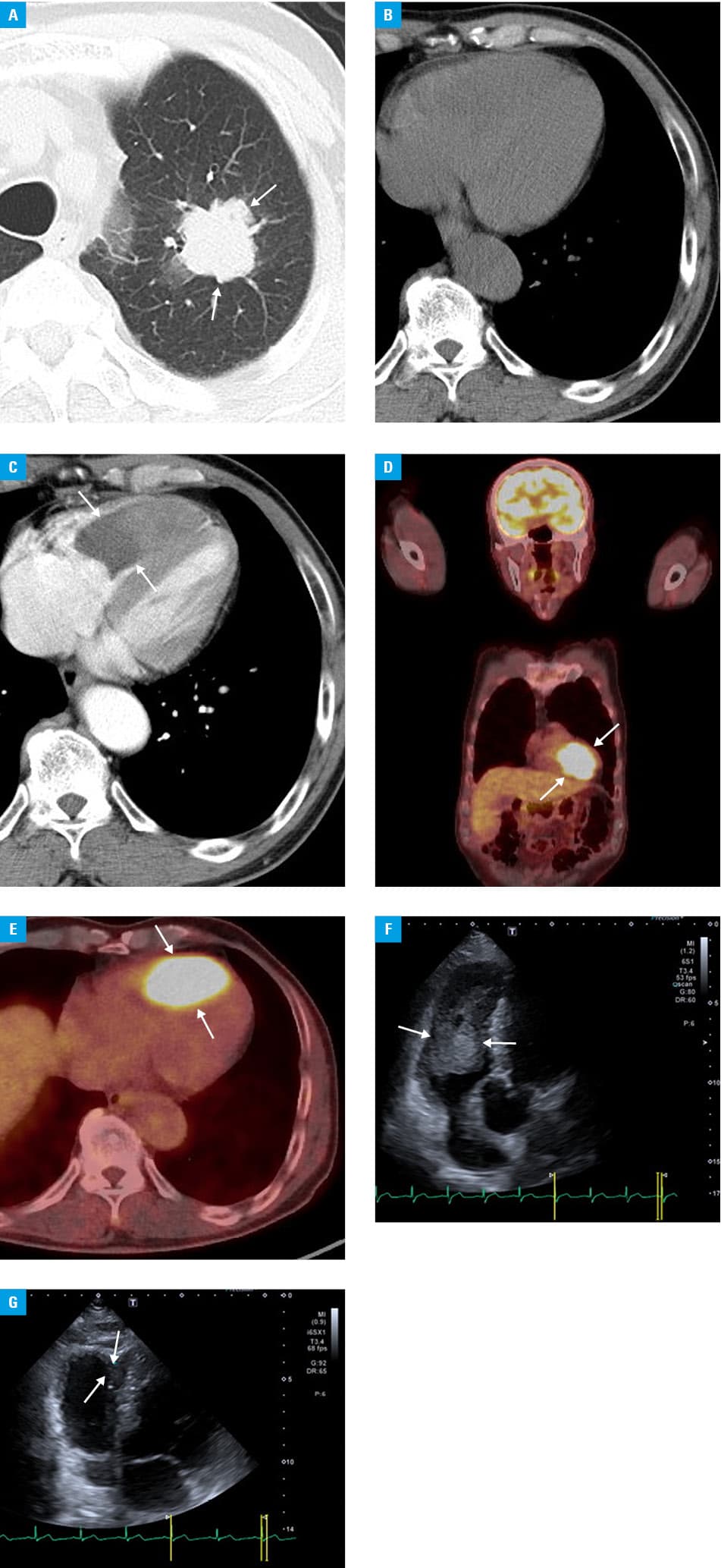
Intraventricular space‑occupying lesions, such as thromboembolism and intraventricular metastasis, can be recognized as filling defects on contrast‑enhanced CT, but are difficult to detect without contrast enhancement. Although transthoracic echocardiography can confirm the presence of these intraventricular lesions, accurate differential diagnosis of these 2 lesions is difficult. On the other hand, 18FDG‑PET/CT makes it possible to distinguish them by examining the presence or absence of 18FDG uptake by the intraventricular lesions. However, 18FDG uptake is usually observed in the left ventricular wall, and unless attention is paid to the difference in shape, it may be overlooked as uptake in the left ventricular wall. In this patient and in previously reported cases,1-3 transthoracic echocardiography and 18FDG‑PET/CT provided useful information regarding the diagnosis and response of intraventricular metastasis. Successful responses to treatment with ICI monotherapy have been reported for patients with intraventricular metastasis.4,5 Our patient showed a good response to combined nivolumab and ipilimumab therapy. Even for lung cancer patients with intraventricular metastases, ICI‑containing treatment might be an efficacious option.
- Orcurto MV, Delaloye AB, Letovanec I, et al. Detection of an asymptomatic right‑ventricle cardiac metastasis from a small‑cell lung cancer by F‑18‑FDG PET/CT. J Thorac Oncol. 2009; 4: 127‑130. | Crossref
- Tagliabue L, Manfrinato G, Luciani A. An unusual case of myocardial localization of non‑small cell lung cancer metastasis: a case report and review of literature. Indian J Nucl Med. 2017; 32: 208‑210. | Crossref
- Ya’qoub L, Payne K, Parikh S, Enriquez J. A right ventricular mass in a patient with squamous cell lung cancer: a case report and review of literature. Cureus. 2018; 10: e2261. | Crossref
- Tang X, Zhou W, Huang D, et al. Anti‑PD‑1 therapy ‑ a potential treatment for myocardial metastasis from nasopharyngeal carcinoma: a case report. Front Immunol. 2021; 12: 688682. | Crossref
- Bilani N, Elson L, Martinez F, et al. A multimodal approach to evaluate for cardiac metastasis in a case of non‑small cell lung cancer. Case Rep Oncol. 2020; 13: 212‑218. | Crossref
ARTICLE INFORMATION