
Rare transthyretin gene variants (p.Ala45Thr, p.Val91Ala, p.Phe53Cys, p.Ala101Val, p.Glu109Lys, and p.Phe53Leu): diagnostic pitfalls and clinical characteristics of Polish patients with transthyretin cardiac amyloidosis
Key words: cardiac amyloidosis, hereditary transthyretin amyloidosis, transthyretin, transthyretin amyloidosis, transthyretin gene

 CC BY 4.0
Rare transthyretin gene variants (p.Ala45Thr, p.Val91Ala, p.Phe53Cys, p.Ala101Val, p.Glu109Lys, and p.Phe53Leu): diagnostic pitfalls and clinical characteristics of Polish patients with transthyretin cardiac amyloidosis
CC BY 4.0
Introduction: The knowledge about clinical features of Polish patients with hereditary type of transthyretin cardiac amyloidosis (hATTR‐CA) is scant.
Objectives: Our aim was to present rare transthyretin (TTR) gene variants and diagnostic difficulties in patients with hATTR‐CA.
Patients and methods: In the years 2018–2024, 252 consecutive patients with suspected CA were evaluated, including blood tests, standard 12‑lead electrocardiography, transthoracic echocardiography and 99mtechnetium-3,3‑diphosphono‑1,2‑propanodicarboxylic acid ([99mTc]Tc‑DPD) scintigraphy. The TTR gene sequencing was performed, if mandatory.
Results: hATTR‑CA was confirmed in 14 patients (including 1 woman). Most of them had pathogenic or likely pathogenic TTR gene variants, which are highly uncommon in the hereditary transthyretin amyloidosis population: p.Ala45Thr, p.Val91Ala, p.Phe53Cys, p.Ala101Val, p.Glu109Lys, and p.Phe53Leu. Of note, the patients with p.Ala101Val and p.Phe53Cys variants had inconclusive [99mTc]Tc‑DPD scintigraphy results, which may be due to low sensitivity of [99mTc]Tc‑DPD bone scintigraphy to these variants. Cardiac biomarkers did not reflect the intensity of cardiac uptake on [99mTc]Tc‑DPD bone scintigraphy, as 2 patients with intense cardiac uptake of the tracer had normal or borderline levels of high‑sensitivity cardiac troponin T and N‑terminal pro–B‑type natriuretic peptide. During follow‑up, 4 patients died, and 2 underwent combined heart and liver transplantation.
Conclusions: This study broadens our knowledge regarding genotype‑phenotype correlations of specific TTR variants, widens the spectrum of identified TTR variants in the Polish population, and shows limited value of [99mTc]Tc‑DPD scintigraphy in some patients with hATTR‑CA. In the cases with strong suspicion of ATTR‑CA and inconclusive [99mTc]Tc‑DPD scintigraphy results, genetic testing should be considered.
What's new?
We report on clinical features of Polish patients with hereditary transthyretin amyloidosis diagnosed with very rare transthyretin variants: p.Ala45Thr, p.Val91Ala, p.Phe53Cys, p.Ala101Val, p.Glu109Lys, and p.Phe53Leu. We described diagnostic pitfalls in transthyretin cardiac amyloidosis that may lead to a serious delay in establishing the diagnosis, such as low sensitivity of 99mtechnetium-3,3‑diphosphono‑1,2‑propanodicarboxylic acid scintigraphy in some specific cases and normal level of cardiac biomarkers in patients with intense cardiac uptake on scintigraphy. Our experience underscores the importance of both caution and awareness of the limitations of diagnostic tools, especially in cases that require going beyond the established diagnostic scheme.
Introduction
In recent years, the prognosis of patients with transthyretin cardiac amyloidosis (ATTR‑CA) has improved significantly. With technetium‑based scintigraphy and a noninvasive diagnostic algorithm proposed by Gillmore et al,1 the diagnostic process has become much less complicated. The presence of intense cardiac uptake on bone scintigraphy using 99mtechnetium‑3,3‑diphosphono‑1,2‑propanodicarboxylic acid ([99mTc]Tc‑DPD) in the absence of monoclonal gammopathy greatly facilitates the diagnosis of ATTR‑CA. Bone scintigraphy with [99mTc]Tc‑DPD has proven to be a useful and reliable technique, which makes histologic diagnosis redundant in the majority of patients. In addition, the advent of new therapies that effectively slow the progression of ATTR‑CA further improves patient prognosis and quality of life.
Considering the fact that ATTR‑CA treatment is more effective in the early stages of the disease, and that some variants in the transthyretin (TTR) gene are responsible for rapidly progressive heart failure (HF), timing of the diagnosis is crucial. Despite advances in the diagnostics of ATTR‑CA and the emergence of new management guidelines, the diagnosis of ATTR‑CA remains challenging in some cases.2-4 Diagnostic difficulties result mainly from exceptions to established diagnostic rules, heterogeneity of ATTR, and still insufficient knowledge of the pathophysiology of the disease. The presence of essential red flags increases alertness to ATTR‑CA, but has limited sensitivity and specificity. We have become accustomed to the high diagnostic accuracy of [99mTc]Tc‑DPD bone scintigraphy, almost forgetting its limitations and the fact that an absence of myocardial uptake of the radiopharmaceutical does not always rule out ATTR‑CA.5 For some specific TTR variants, for example, p.Val50Met, p.Phe84Leu, or p.Ser97Tyr, [99mTc]Tc‑DPD bone scintigraphy has very low sensitivity, and the precise mechanism of bone tracer uptake in amyloidosis remains unexplained.5,6 On the other hand, there are patients with intense cardiac uptake on bone scintigraphy without clinical signs or clinical suspicion of cardiomyopathy, which are usually necessary to trigger the diagnostic procedure.5
The aim of this study was to present the clinical features of Polish patients with pathogenic TTR variants diagnosed at our center, as well as to describe difficulties and pitfalls in their diagnostic process. Our experience underscores the importance of both caution and awareness of the limitations of diagnostic tools, especially in the cases that require going beyond the established diagnostic scheme.
Patients and methods
Between August 2018 and May 2024, 252 consecutive patients with suspected CA were routinely evaluated at the National Institute of Cardiology, Warsaw, Poland, including their medical history, physical examination, blood tests, standard 12‑lead electrocardiography (ECG), transthoracic echocardiography, and [99mTc]Tc‑DPD bone scintigraphy. The suspicion of CA was raised in patients with left ventricular (LV) wall thickness of at least 12 mm and at least 1 red flag or clinical scenario, as described in detail previously.2-4 Some of the patients had been previously diagnosed with ATTR and referred to our center for further evaluation or confirmation of the diagnosis. Blood tests included N‑terminal pro–B‑type natriuretic peptide (NT‑proBNP) and high‑sensitivity cardiac troponin T (hs‑cTnT) measurements, as well as free light‑chain testing and immunofixation of serum and urine to exclude light‑chain amyloidosis. The TTR gene sequencing was offered to patients with high myocardial uptake of [99mTc]Tc‑DPD, patients who had first‑degree relatives with hereditary ATTR (hATTR), and individuals with inconclusive results. Genetic analysis was carried out using various platforms available over time. Most patients underwent genetic testing in a local laboratory of the National Institute of Cardiology. Genomic DNA was isolated from whole peripheral blood by standard techniques. The entire coding regions of the TTR gene together with splice sites were sequenced with the Sanger method using a 3130 × L genetic analyzer (Life Technologies, Foster City, California, United States) and the Big Dye Terminator v1.1 Cycle Sequencing Kit (Life Technologies), according to the manufacturer’s instructions. For chromatogram analysis, Variant Reporter 1.1 (Life Technologies) was used.
Statistical analysis
All statistical analyses were performed using MedCalc 12.1.4.0 software (MedCalc, Mariakerke, Belgium). After checking for normal distribution with the Shapiro–Wilk test, continuous variables were compared using either the t test or the Mann–Whitney test, as appropriate. The normally distributed continuous variables were shown as mean (SD), and non‑parametrically distributed variables were shown as median (interquartile range [IQR]). Categorical variables were expressed as frequency (percentage) of patients and were compared using the χ2 test or the Fisher exact test. A 2‑sided P value below 0.05 was considered significant.
Survival was defined as time from the first admission to our center to time of death (medical records or reports from relatives) or time to the last follow‑up (personal contact or telephone call).
Ethics
The study included consecutive patients diagnosed with hATTR‑CA. Informed written consent was obtained from each participant. The study complied with the Declaration of Helsinki, and was approved by the Institutional Ethics Committee of the National Institute of Cardiology (IK‑NPIA‑0021‑4/1762/2019).
Results
Of the 252 patients, 56 (22.2%) were diagnosed with ATTR‑CA. A TTR analysis was performed in 48 of 56 patients (85.7%). Fourteen individuals (including 1 woman) were diagnosed with hATTR‑CA, 34 patients were diagnosed with wild‑type ATTR (wtATTR), and the remaining 8 patients refused genetic testing, 6 of whom were over 80 years old at the time of diagnosis (Figure 1). Most of the patients with hATTR‑CA had highly uncommon TTR gene variants: p.Ala45Thr, p.Val91Ala, p.Phe53Cys, p.Ala101Val, p.Glu109Lys, and p.Phe53Leu (Tables 1 and 2). The remaining 4 patients had the p.Val50Met TTR variant. All patients except those with the p.Glu109Lys TTR variant were unrelated. The patient with the p.Val91Ala TTR variant and 1 of the patients with the p.Val50Met TTR variant had a family history of hATTR. Eleven patients (78.6%) with hATTR‑CA presented with mixed phenotype and suffered also from peripheral polyneuropathy.
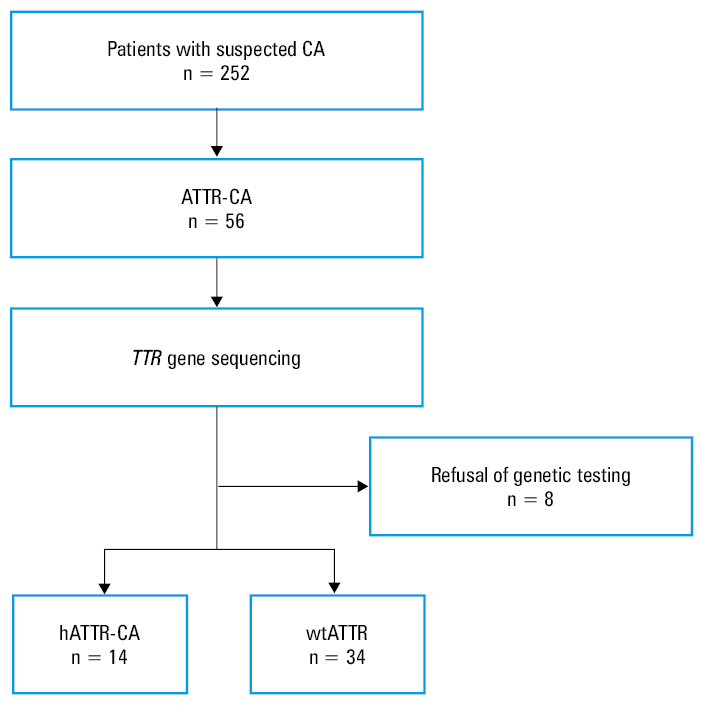
Abbreviations: ATTR‑CA, transthyretin cardiac amyloidosis; h, hereditary; TTR, transthyretin; wt, wild‑type
Parameters | Patients | |||||||||||||
1 | 2 | 3 | 4 | 5a | 6a | 7 | 8 | 9 | 10 | 11 | 12 | 13 | 14 | |
a Patients 5 and 6 are relatives.
b At the time of follow‑up or death
c [99mTc]Tc‑DPD scintigraphy was performed after heart and liver transplantation, there was exceptionally increased tracer uptake in the skeletal muscles and abdominal cavity.
Abbreviations: AVB, atrioventricular block; AF, atrial fibrillation; ECG, electrocardiogram; E/e’ ratio, the ratio of the transmitral early peak velocity (E) estimated by pulsed wave Doppler over the early mitral annulus velocity (e’); HF, heart failure; hs‑cTnT, high‑sensitivity cardiac troponin T; LBBB, left bundle branch block; LVEF, left ventricular ejection fraction; LVH, left ventricular hypertrophy; MACE, major adverse cardiac events; MWT, maximal wall thickness; NIVCD, nonspecific intraventricular conduction delay; nsVT, nonsustained ventricular tachycardia; NT‑proBNP, N‑terminal pro–B‑type natriuretic peptide; NYHA, New York Heart Association; RBBB, right bundle branch block; SR, sinus rhythm; SVT, supraventricular tachycardia; SCD, sudden cardiac death; [99mTc]Tc‑DPD, 99mtechnetium‑3,3‑diphosphono‑1,2‑propanodicarboxylic acid; others, see Figure 1 | ||||||||||||||
TTR variant | p.Ala45Thr | p.Val91Ala | p.Phe53Cys | p.Ala101Val | p.Glu109Lys | p.Glu109Lys | p.Phe53Leu | p.Phe53Leu | p.Phe53Leu | p.Phe53Leu | p.Val50Met | p.Val50Met | p.Val50Met | p.Val50Met |
Age at onset, y | 42 | 36 | 46 | 52 | 57 | 50 | 48 | 57 | 58 | 45 | 59 | 58 | 67 | 46 |
NYHA class | II | I | I | II | III | II | I | I | IV | II | II | II | II | II |
ECG | SR, nsVT | SR | SR, 1st degree AVB, RBBB, nsVT | SR | SR, 2nd degree AVB type I, NIVCD, paroxysmal AF | AF, NIVCD, nsVT | SR, SVT | SR, RBBB SVT, nsVT | SR, 1st degree AVB, NIVCD, SVT, paroxysmal AF | SR, 1st degree AVB, NIVCD, nsVT | SR, 1st degree AVB, intermittent LBBB, SVT, nsVT | SR, SVT | SR, NIVCD | SR, SVT, LVH |
Low QRS voltage | + | – | – | – | – | + | + | – | – | + | – | – | – | – |
Pseudoinfarct pattern | + | – | – | + | + | + | – | + | + | + | + | + | + | – |
NT‑proBNP, pg/ml | 1308 | 10 | 273 | 1250 | 2340 | 6594 | 925 | 1199 | 9903 | 1049 | 2330 | 704 | 383 | 8 |
hs‑cTnT, ng/l | 65 | 7 | 52 | 96 | 50 | 66 | 28 | 98 | 180 | 51 | 38 | 22 | 33 | 17 |
MWT, mm | 18 | 12 | 19 | 15 | 23 | 18 | 16 | 20 | 21 | 18 | 19 | 25 | 17 | 13 |
LVEF, % | 50 | 60 | 65 | 70 | 45 | 25 | 40 | 40 | 45 | 55 | 60 | 65 | 60 | 65 |
E/e’ | 15 | 8 | 8 | 9 | 27 | 16 | 9 | 10 | 28 | 15 | 17 | 11 | 11 | 7 |
Polyneuropathy, Coutinho stageb | – | I | I | I | II | I | I | II | – | III | II/III | II | III | I |
Carpal tunnel syndrome | – | – | – | – | – | + | – | + | – | + | + | – | – | + |
Perugini grading on [99mTc]Tc‑DPD scintigraphy | 3 | 3 | 1 | 0 | 3 | 3 | 0c | 3 | 3 | 3 | 3 | 3 | 3 | 2 |
MACE / outcome | First stroke at 42, second at 46; death at 47 | Alive | Alive | Alive | Combined heart and liver transplantation at 58; death at 62 | Hospitalization for heart failure; alive | Combined heart and liver transplantation at 51; alive | SCD at 59 | Death at 64 due to HF | Alive | Alive | Alive | Alive | Alive |
Survival, mo | 6 | 20 | 6 | 13 | 62 | 4 | 96 | 27 | 12 | 64 | 44 | 44 | 18 | 6 |
TTR variant (NM_000371.4) | Protein change | ACMG classification18 | ClinVar classification19 | Allele frequency20 | Number of patients in the study | Zygosity |
Abbreviations: ACMG, American College of Medical Genetics and Genomics; others, see Figure 1 | ||||||
c.133G>A | p.Ala45Thr | Likely pathogenic | Pathogenic | Not reported | 1 | Heterozygous |
c.272T>C | p.Val91Ala | Pathogenic | Pathogenic / likely pathogenic | Not reported | 1 | Heterozygous |
c.158T>G | p.Phe53Cys | Pathogenic | Not reported | Not reported | 1 | Heterozygous |
c.302C>T | p.Ala101Val | Likely pathogenic | Conflicting classifications of pathogenicity (pathogenic, likely pathogenic, uncertain significance) | 6.195e‑7 | 1 | Homozygous |
c.325G>A | p.Glu109Lys | Pathogenic | Pathogenic / likely pathogenic | 6.195e‑7 | 2 | Heterozygous |
c.157T>C | p.Phe53Leu | Pathogenic | Pathogenic | Not reported | 4 | Heterozygous |
c.148G>A | p.Val50Met | Pathogenic | Pathogenic | 0.00005700 | 4 | Heterozygous |
Typically, the patients diagnosed with hATTR‑CA were younger than those with wtATTR (P <0.001), and had a lower burden of comorbidities. None of the patients in the hATTR‑CA group had arterial hypertension, while in the wtATTR group it was present in 67.6% of the participants (P <0.001). Atrial fibrillation was also more frequently observed in the wtATTR group (P = 0.003). Carpal tunnel syndrome was observed in both groups with the same frequency (P = 0.59).
There was no significant difference between the groups in terms of ECG findings characteristic of CA, such as pseudoinfarct pattern or low QRS voltage (Table 3). Only 4 patients (28.6%) with hATTR‑CA had low QRS voltage in limb leads. Pseudoinfarct pattern in precordial leads was present in 10 individuals (71.4%) with hATTR‑CA. Features of LV hypertrophy on ECG were present extremely rarely: in 1 patient with hATTR‑CA and 5 with wtATTR.
Parameter | hATTR (n = 14) | wtATTR (n = 34) | P value | |
Data are presented as mean (SD) or median (interquartile range) unless indicated otherwise.
| ||||
Age at diagnosis, y | 56 (37–69) | 76.5 (63–86) | <0.001 | |
BMI, kg/m2 | 23.5 (16–28) | 25 (21–34) | 0.12 | |
NYHA functional class, n (%) | I | 4 (28.6) | 3 (8.8) | 0.09 |
II | 8 (57.1) | 24 (70.6) | ||
III | 1 (7.1) | 7 (20.6) | ||
IV | 1 (7.1) | 0 | ||
Coronary artery disease, n (%) | 5 (35.7) | 18 (52.9) | 0.28 | |
Arterial hypertension, n (%) | 0 | 23 (67.6) | <0.001 | |
Diabetes mellitus, n (%) | 1 (7.1) | 11 (32.3) | 0.08 | |
Carpal tunnel syndrome, n (%) | 5 (35.7) | 15 (44.1) | 0.59 | |
AF, n (%) | 3 (21.4) | 24 (70.5) | 0.003 | |
AVB (of any degree), n (%) | 5 (35.7) | 16 (47.05) | 0.47 | |
LBBB, n (%) | 1 (7.1) | 4 (11.8) | >0.99 | |
RBBB, n (%) | 2 (14.3) | 8 (23.5) | 0.7 | |
LVH on ECG, n (%) | 1 (7.1%) | 5 (14.7) | 0.65 | |
Low QRS voltage, n (%) | 4 (28.6) | 7 (27.9) | 0.71 | |
Pseudoinfarct pattern, n (%) | 10 (71.4) | 18 (52.9) | 0.24 | |
MWT, mm | 18.1 (3.5) | 20.5 (3.6) | 0.04 | |
Posterior wall thickness, mm | 14.4 (3.4) | 17.1 (3.1) | 0.01 | |
LA dimension, mm | 41.5 (39–46) | 47 (43–52.2) | 0.004 | |
LVEDd, mm | 45.2 (5.8) | 45.5 (5.8) | 0.86 | |
E/e’ ratio | 11 (8.6–16) | 16 (13–18) | 0.07 | |
LVEF, % | 53.2 (12.8) | 51.3 (11.9) | 0.36 | |
TAPSE, mm | 19.2 (4.1) | 16.4 (4) | 0.04 | |
NT‑proBNP, pg/ml | 1124 (383–2330) | 2687 (1472–3896) | 0.008 | |
hs‑cTnT, ng/l | 50.5 (28–66) | 50.6 (34–75) | 0.62 | |
Echocardiography showed increased thickness of LV wall in all patients. The maximal wall thickness varied markedly among the patients, from mildly to massively increased, and was higher in the patients with wtATTR (P = 0.045). Similarly, posterior wall thickness was greater in the wtATTR group (P = 0.01). The dimension of the left atrium was also greater in the patients with wtATTR (P = 0.004), which is consistent with more frequently observed atrial fibrillation in this group. Most of the patients had preserved LV ejection fraction (LVEF). There was no significant difference between the groups in terms of LVEF and diastolic dysfunction (E/e’ ratio). The patients with wtATTR had lower tricuspid annular plane systolic excursion value than those in the hATTR‑CA group (P = 0.04).
Serum NT‑proBNP levels were higher in the wtATTR group than in the patients with hATTR‑CA (P = 0.008). In the hATTR‑CA group, baseline laboratory workup showed increased levels of hs‑cTnT in all but 1 patient. With the exception of 2 patients, all participants with hATTR‑CA had elevated NT‑proBNP levels.
Clinical characteristics of the patients with p.Ala45Thr, p.Val91Ala, p.Phe53Cys, and p.Ala101Val TTR variants
The clinical data of the patients with hATTR‑CA are shown in Table 1. The patient with the p.Ala45Val TTR variant was diagnosed with ATTR‑CA at the age of 46 years. His first symptoms occurred 4 years earlier in the form of multiple transient ischemic attacks and 2 episodes of acute ischemic strokes. Due to recurrent hematuria, the patient was diagnosed urologically: histopathological examination revealed amyloid deposits in the urinary bladder. ECG, echocardiography, and cardiac biomarker levels suggested CA (Table 1). Bone scintigraphy with [99mTc]Tc‑DPD showed intense cardiac uptake corresponding to the Perugini grade 3. The patient died shortly after ATTR‑CA diagnosis.
The patient with the p.Val91Ala TTR variant was previously followed‑up as an identified carrier of the TTR variant, and was referred to our center for ATTR‑CA evaluation after developing transthyretin familial amyloid polyneuropathy (ATTR‑FAP). In addition to polyneuropathy, the patient also had prominent visual symptoms associated with opacities of the vitreous body. He underwent vitrectomy. Other than that, he was asymptomatic, with no overt symptoms of HF. Although he had normal levels of cardiac biomarkers, normal ECG, borderline LV wall thickness (12 mm), preserved LVEF (60%), and global longitudinal strain of –19.6%, bone scintigraphy with [99mTc]Tc‑DPD showed intense cardiac uptake corresponding to Perugini grade 3.
The patient with the extremely rare p.Phe53Cys TTR variant was diagnosed with ATTR‑CA at the age of 47 years. A year earlier, symptoms of polyneuropathy appeared. The patient had red flags for ATTR‑CA: abnormalities on ECG, significantly increased LV wall thickness and hs‑cTnT level, and mildly elevated NT‑proBNP level (Table 1). Bone scintigraphy with [99mTc]Tc‑DPD showed cardiac uptake corresponding to Perugini grade 1. Light‑chain amyloidosis was excluded.
The woman with the homozygous p.Ala101Val TTR variant was diagnosed with ATTR‑CA at the age of 55 years. For the past 3 years, she had suffered from recurrent syncope, hypotension, diarrhea, and weight loss. Based on ECG, echocardiography, cardiac biomarker levels, and the clinical course of the disease, a strong suspicion of CA was raised (Table 1). Serious difficulties were encountered in establishing the patient’s diagnosis. Bone scintigraphy with [99mTc]Tc‑DPD showed no cardiac uptake. The immunohistochemistry result was inconclusive due to the presence of only scant amyloid deposits in the biopsied tissue. A trepanobiopsy ruled out light‑chain amyloidosis. Due to the inconclusive results, the TTR gene sequencing was performed. The result of the genetic test confirmed hATTR. Neurological diagnostics revealed sensorimotor‑autonomic polyneuropathy of stage I. After a year, bone scintigraphy with [99mTc]Tc‑DPD was repeated, which again showed no cardiac uptake. The concentration of cardiac biomarkers was elevated, but to the same level as a year ago.
Follow‑up of patients with hereditary transthyretin cardiac amyloidosis
The outcomes of patients with hATTR‑CA are presented in Table 1. The median follow‑up was 19 (6–44) months for all patients. From 2019, consecutive patients (8 of 14 patients with hATTR‑CA) were treated with tafamidis in a compassionate use program. The program was closed to new patients in October 2023. During follow‑up, 4 patients died. The main cause of death was advanced HF or sudden cardiac death. Two patients underwent combined heart and liver transplantation: the patient 5 with the p.Glu109Lys TTR variant, who died 4 years after the surgery, and the patient 7 with the p.Phe53Leu TTR variant who has been alive at 58‑month follow‑up. Laboratory examination during follow‑up showed no significant differences in serum hs‑cTnT and NT‑proBNP levels as compared to baseline values (P = 0.36 and P = 0.31, respectively).
Discussion
The study presents clinical characteristics of patients with TTR variants: p.Ala45Thr, p.Val91Ala, p.Phe53Cys, p.Ala101Val, p.Glu109Lys, and p.Phe53Leu, which are very rare in the hATTR population. Previous reports on the p.Ala45Thr TTR variant described patients of Chinese and Japanese origin with leptomeningeal amyloidosis. Interestingly, no association of this variant with ATTR‑CA or urinary bladder amyloidosis has been previously reported.7-10 In the case of the p.Phe53Cys TTR variant, only 1 patient with the same variant and surprisingly also of Polish origin has been described so far. The previously reported patient was a woman with vitreous opacities, cardiomyopathy, mild sensory neuropathy, and kidney disease, who underwent liver transplant.11 The p.Val91Ala TTR variant was previously described in families from several different countries including Poland. Visual symptoms were reported in all families, sometimes preceding severe ATTR‑FAP; however, no marked cardiomyopathy was observed.12 The p.Ala101Val TTR variant is unusually rare. To date, only a few patients with this variant have been presented, including 2 from our center.13 A more detailed description of Polish patients with the p.Glu109Lys and p.Phe53Leu TTR variants has been published previously, including information on previous literature reports on these variants.13,14
In our study, cardiac biomarkers, hs‑cTnT and NT‑proBNP, did not reflect the intensity of cardiac uptake on [99mTc]Tc‑DPD bone scintigraphy. Two patients with normal or borderline serum levels of the cardiac biomarkers already had high cardiac uptake of the tracer (patient 2 with the p.Val91Ala TTR variant and Perugini grade 3 and patient 14 with the p.Val50Met TTR variant and Perugini grade 2). The lack of association between cardiac biomarker levels and the Perugini grading was mentioned in previous reports, which also indicated that NT‑proBNP and hs‑cTnT are significant prognostic factors in ATTR‑CA, whereas stratification by the Perugini grade has no prognostic significance.15,16 However, from a diagnostic point of view, the absence of such red flags as elevated levels of cardiac biomarkers may lead to a serious delay in the initiation of clinical investigation to confirm or rule out ATTR‑CA. It is therefore worth noting that transthyretin cardiomyopathy may occur in patients with normal or borderline levels of hs‑cTnT and NT‑proBNP.
On the other hand, the normotensive patient with elevated serum levels of cardiac biomarkers, especially hs‑cTnT, had only mild cardiac uptake (patient 3 with the p.Phe53Cys TTR variant and Perugini grade 1) despite increased myocardial thickness, strongly suggestive of cardiac infiltration with amyloid deposits. In the case of patient 3 with the p.Phe53Cys TTR variant and patient 4 with the p.Ala101Val TTR variant, it was hypothesized that mild or no cardiac uptake may be due to low sensitivity of [99mTc]Tc‑DPD bone scintigraphy to these rare variants, similarly to what has been reported for several other TTR variants.5,6 Another explanation for the low sensitivity of bone scintigraphy in these cases is an early stage of the disease, which is inconsistent with other results. The previously reported woman with the p.Phe53Cys TTR variant was diagnosed based on tissue biopsy, so it is currently impossible to find out whether p.Phe53Cys belongs to the group of variants for which [99mTc]Tc‑DPD bone scintigraphy has very low sensitivity.11 As for the p.Ala101Val TTR variant, 1 patient of Polish descent with a homozygous p.Ala101Val TTR variant and ATTR‑CA has been recently reported to have no myocardial uptake on technetium pyrophosphate ([99mTc]Tc‑PYP) bone scintigraphy (Perugini grade 0). In the same study, another patient with a heterozygous p.Ala101Val TTR variant was described with positive [99mTc]Tc‑PYP bone scintigraphy (Perugini grade 3).17 These findings and our observations suggest that sensitivity of [99mTc]Tc‑DPD and [99mTc]Tc‑PYP bone scintigraphy in detecting the homozygous p.Ala101Val TTR variant is extremely low. According to the literature, homozygous patients may develop more severe manifestations of the disease and present symptoms earlier than heterozygous individuals.17 However, the mechanism by which scintigraphy remains positive in heterozygous patients with the p.Ala101Val TTR variant and negative in homozygous patients remains unclear. Current guidelines3 recommend genetic testing in patients with confirmed ATTR to differentiate between hATTR and wtATTR. However, in the patients with a strong suspicion of ATTR, especially in a population where the TTR variants with low sensitivity on bone scintigraphy occur, TTR gene analysis should be considered, even if the [99mTc]Tc‑DPD scintigraphy result is negative or inconclusive.
Limitations
Our results are based on a single‑center observation. The clinical characteristics of the patients 5, 7, 8, and 10 have been described previously.13 Since they underwent scintigraphy with [99mTc]Tc‑DPD, they were included in the current study so as not to compromise the methodology. We believe that information about their current status provided additional value to the study.
Conclusions
This study broadens our knowledge on the phenotypic picture of specific rare TTR variants. Diagnostic pitfalls, such as normal levels of cardiac biomarkers or low sensitivity of [99mTc]Tc‑DPD scintigraphy in some specific TTR variants, may lead to a serious delay in establishing the diagnosis of ATTR‑CA. Therefore, it is sometimes necessary to go beyond the current recommendations. In the cases with strong suspicion of ATTR‑CA, the diagnostic pathway with [99mTc]Tc‑DPD bone scintigraphy should by initiated even in the absence of some essential red flags. Moreover, the TTR gene analysis should be considered in patients without confirmed ATTR‑CA, as this may contribute to an earlier diagnosis.
- Gillmore, JD, Maurer MS, Falk RH, et al. Nonbiopsy diagnosis of cardiac transthyretin amyloidosis. 2016; 14: 2404‑2412. | Crossref
- Rapezzi C, Lorenzini M, Longhi S, et al. Cardiac amyloidosis: the great pretender. Heart Fail Rev. 2015; 20: 117‑124. | Crossref
- Garcia‑Pavia P, Rapezzi C, Adler Y, et al. Diagnosis and treatment of cardiac amyloidosis: a position statement of the ESC Working Group on Myocardial and Pericardial Diseases. Eur Heart J. 2021; 42: 1554‑1568. | Crossref
- Grzybowski J, Podolec P, Holcman K, et al. Diagnosis and treatment of transthyretin amyloidosis cardiomyopathy: a position statement of the Polish Cardiac Society. Kardiol Pol. 2023; 81: 1167‑1185. | Crossref
- Saro R, Pavan D, Porcari A, et al. Lights and shadows of clinical applications of cardiac scintigraphy with bone tracers in suspected amyloidosis. J Clin Med. 2023; 12: 7605. | Crossref
ARTICLE INFORMATION