
Misfortune never comes singly: an unusual case of a patient with type 1 diabetes mellitus and widespread cardiac fibrosis with restrictive phenotype, mitral stenosis, and postcapillary pulmonary hypertension

 CC BY 4.0
Misfortune never comes singly: an unusual case of a patient with type 1 diabetes mellitus and widespread cardiac fibrosis with restrictive phenotype, mitral stenosis, and postcapillary pulmonary hypertension
CC BY 4.0
Diabetes mellitus (DM) often manifests itself through cardiomyopathic phenotypes, which are classified as restrictive or dilative.1 The autoimmune etiology of type 1 DM (T1DM) and insulin therapy–related sequels may determine the cardiovascular presentation.2
A 34‑year‑old man with a 20‑year history of T1DM and without prior cardiovascular events was hospitalized due to progressive exercise intolerance (New York Heart Association class III) over 8 months. His body mass index was 20 kg/m2. Diastolic murmur at the apex was detected on auscultation. Laboratory workup showed increased markers of inflammation (C‑reactive protein, 31 mg/l; reference range [RR] <5 mg/l) and heart failure (N‑terminal pro–B‑type natriuretic peptide [NT‑proBNP], 4399 pg/ml; RR <125 pg/l) , with mildly elevated troponin T levels (0.024 ng/ml; RR <0.014 ng/ml). Despite insulin therapy, the patient’s glycemic control was suboptimal (glycated hemoglobin A1c, 8%), while estimated glomerular filtration rate was normal.
Electrocardiography showed sinus rhythm of 92 bpm, right axis deviation, and right ventricular (RV) hypertrophy. Transthoracic echocardiography depicted severe mitral stenosis (maximum pressure, 46 mm Hg; mean pressure, 27 mm Hg; mitral valve area, 0.6 cm2) with unusually significant thickening involving not only the mitral valve but also the mitral‑aortic curtain and papillary muscles (Figure 1A and 1B). Compression of the small‑sized left ventricle (LV) with a D‑shape sign and LV hypertrophy (intraventricular septum [IVS], 13 mm; posterior wall, 16 mm), normal LV ejection fraction (55%), and impaired global longitudinal strain (–8.7%) were observed. Simultaneously, “right heart domination,” with right atrial enlargement, RV hypertrophy, severe tricuspid regurgitation with RV systolic pressure of 100 mm Hg, and pericardial effusion were found.
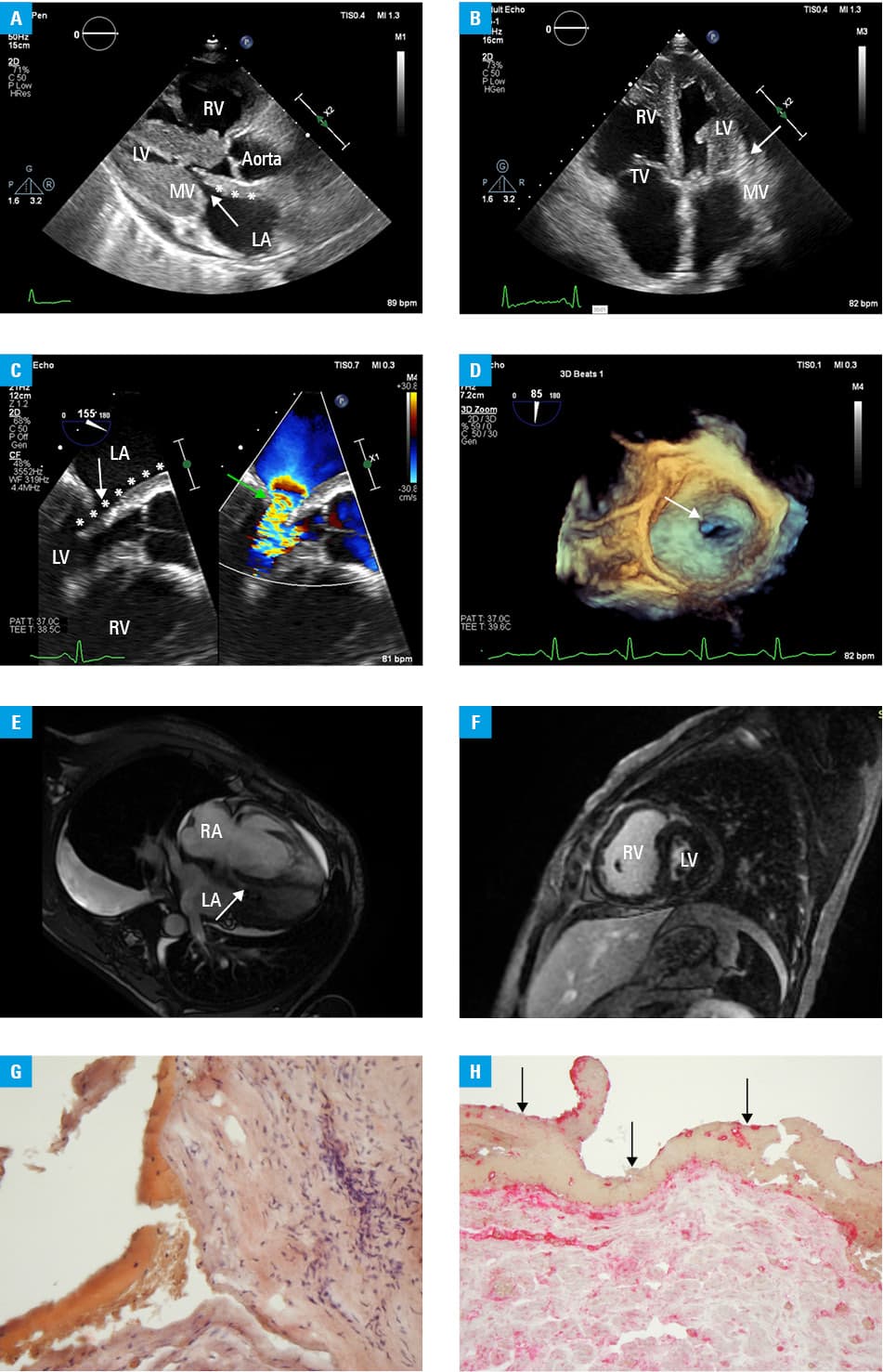
Transesophageal echocardiography confirmed the presence of an atypical layer of tissue covering the left atrium (Figure 1C), along with mitral apparatus with mitral valve stenosis (Figure 1C and 1D), and a thrombus in the left atrial appendage, despite optimal anticoagulation.
Laboratory test results showed normal blood smear and negative antinuclear and anticentromere antibodies. No monoclonal gammopathy was found, and Fabry disease was ruled out.
Cardiac magnetic resonance imaging showed no resting LV perfusion defects, but minor defects in the thickened RV wall and LV papillary muscles were detected, along with atypical thickening and fibrosis. Late gadolinium enhancement was seen in the LV IVS, inferior wall, and RV wall. RV dilation and a D‑shaped septum were noted (Figure 1E and 1F).
Based on cardiac computed tomography findings, coronary artery disease was excluded. Right heart catheterization confirmed severe postcapillary pulmonary hypertension (PH; mean pulmonary arterial pressure, 57 mm Hg; pulmonary capillary wedge pressure, 18 mm Hg; cardiac index, 2.6 l/min).
99mTechnetium 3,3‑diphosphono‑1,2‑propanodicarboxylic acid scintigraphy showed Perugini grade 1, excluding transthyretin‑related cardiac amyloidosis. Endomyocardial biopsy showed no amyloid deposits but confirmed the presence of diffuse endomyocardial fibrosis (Figure 1G and 1H).
Pharmacotherapy was implemented, including insulin therapy (multiple daily injections), diuretics, and anticoagulation. Sildenafil administration led to clinical improvement and resulted in NT‑proBNP level reduction (from 4399 pg/ml to 1619 pg/ml). The patient was referred for high‑risk mitral valve surgery; however, he experienced sudden cardiac death a week after discharge.
This case aligns with the restrictive phenotype of diabetic cardiomyopathy, alongside fibrotic, infiltrative etiology confirmed on myocardial biopsy, which is an unprecedented combination. Such a clinical picture suggests a high T‑cell infiltration in T1DM, causing widespread cardiac fibrosis and dysfunction.3 Diagnosis involved a comprehensive workup to exclude other conditions, such as coronary artery disease, Fabry disease, and amyloidosis.2
Despite all efforts, the patient’s prognosis remained poor. Treatment options for restrictive diabetic cardiomyopathy and postcapillary PH are limited. Mitral stenosis met the criteria for intervention, but the presence of thrombus was a contraindication to balloon valvuloplasty and necessitated high‑risk mitral valve surgery.
The value of this case lies in the unusual clinical course of the disease. Also, it is interesting in the context of the current data on metformin and sodium‑glucose cotransporter‑2 inhibitors. These drugs promote autophagic influx, which may explain their effect on alleviating cellular stress and ameliorating the course of experimental diabetic cardiomyopathy.4 As such, they may be a milestone in heart protection in patients with DM.
- Ministrini S, Andreozzi F, Montecucco F, et al. Neutrophil degranulation biomarkers characterize restrictive echocardiographic pattern with diastolic dysfunction in patients with diabetes. Eur J Clin Invest. 2021; 51: e13640. | Crossref
- Seferović PM, Paulus WJ. Clinical diabetic cardiomyopathy: a two‑faced disease with restrictive and dilated phenotypes. Eur Heart J. 2015; 36: 1718‑1727. | Crossref
- Tan Y, Zhang Z, Zheng C, et al. Mechanisms of diabetic cardiomyopathy and potential therapeutic strategies: preclinical and clinical evidence. Nat Rev Cardiol. 2020; 17: 585‑607. | Crossref
- Packer M. Autophagy‑dependent and -independent modulation of oxidative and organellar stress in the diabetic heart by glucose‑lowering drugs. Cardiovasc Diabetol. 2020; 19: 62. | Crossref
ARTICLE INFORMATION