

 CC BY 4.0
A 70‑year‑old white woman was admitted to our hospital due to dyspnea (New York Heart Association class III) and easy fatigue. The patient medical history included arterial hypertension, hyperlipidemia, supraventricular cardiac arrhythmias, chronic coronary syndrome, and chronic heart failure with reduced ejection fraction (HFrEF). Physical examination revealed no abnormalities upon admission. Laboratory investigations disclosed elevated level of N‑terminal pro–B‑type natriuretic peptide (3480 pg/ml; reference range [RR], 0–125 pg/ml), low‑density lipoprotein cholesterol (2.35 mmol/l; value recommended based on the risk profile <1.4 mmol/l), and absolute iron deficiency (ferritin, 30.8 µg/l; values indicating absolute iron deficiency <100 μg/l).
Transthoracic echocardiography showed left ventricular (LV) hypertrophy, most pronounced in the interventricular septum (maximum wall thickness, 21 mm; Figure 1A and 1B), reduced LVEF (32% on 3‑dimensional [3D] echocardiography), akinesia of the basal segments and hypokinesia of the middle segments of the interventricular septum and the inferior wall. Global longitudinal strain was reduced (–6.9%; RR <–18%) with the apical sparing strain pattern (Figure 1C). Right ventricular (RV) systolic function was decreased (fractional area change 20%; RR, 35%–63% and RVEF on 3D, 21.5%; RR >45%). No systolic anterior motion or narrowing of the LV outflow tract was observed.
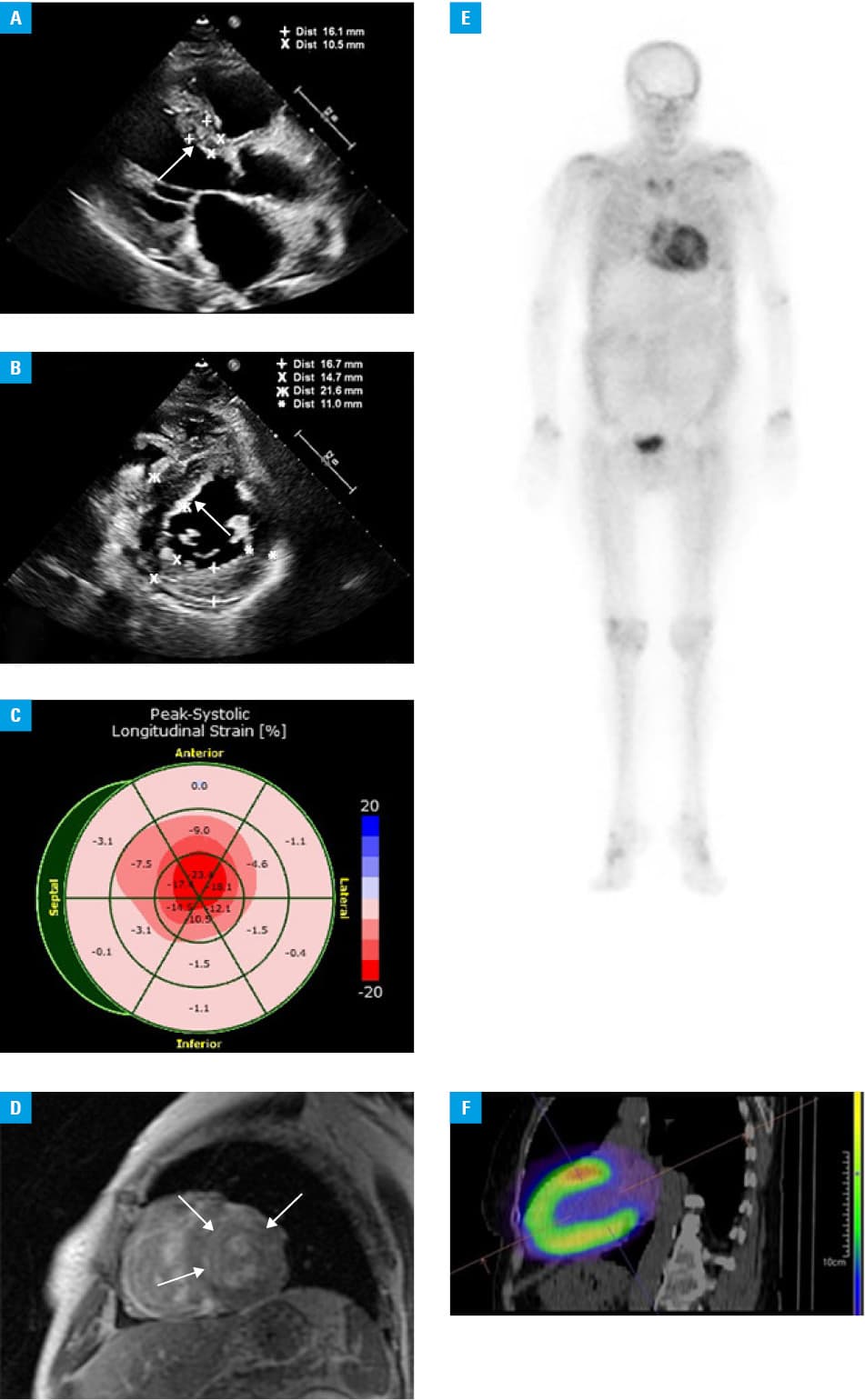
Cardiac magnetic resonance imaging (MRI) confirmed hypokinesia of the LV with LVEF of 33% and hypertrophy of the interventricular septum. Due to the muscle heterogeneity, there were difficulties in selecting optimal acquisition parameters on MRI, pointing to amyloidosis as a possible diagnosis (Figure 1D). Myocardial scintigraphy revealed cardiac uptake (Perugini grade 3), which may correspond to cardiac amyloidosis (Figure 1E and 1F).
On serum immunofixation, monoclonal immunoglobulin G-λ was detected, and the second stage of immunofixation was negative. No Bence‑Jones protein was found in urine. Adipose tissue biopsy was performed, as consulted by a hematologist, and the result ruled out amyloid light‑chain amyloidosis. The patient was diagnosed with transthyretin amyloid cardiomyopathy (ATTR‑CM) with concomitant monoclonal gammopathy of undetermined significance. Genetic testing did not reveal mutations in the transthyretin gene (wild‑type amyloidosis). The patient was qualified for targeted therapy with tafamidis through an early access to medicines scheme. Additionally, she was treated with doxycycline and tauroursodeoxycholic acid. Iron deficiency was supplemented with ferric carboxymaltose at a dose of 500 mg intravenously.
ATTR is a rare cause of cardiomyopathy in which protein deposits accumulate in the extracellular matrix of the heart.1 A diagnose is difficult and requires multimodal imaging, including echocardiography, MRI and radioisotope imaging, as well as laboratory and genetic tests. Tafamidis is the only available drug registered for the ATTR‑CM treatment. It stabilizes transthyretin molecules preventing their disintegration into monomers.2 Disease‑modifying therapy with tafamidis improves the quality of life, delays the onset of HF symptoms, prevents HF hospitalizations, and improves prognosis.3 Experimental studies showed that doxycycline and tauroursodeoxycholic acid are effective in degrading transthyretin deposits and can slow down the amyloidosis progression.4 However, this has not been confirmed in clinical trials. To reduce symptoms, improve quality of life, and reduce the risk of HF hospitalization in patients with HFrEF and iron deficiency, intravenous iron supplementation is recommended.5
- Susuł M, Petkow‑Dimitrow P, Rajtar‑Salwa R. Genetically confirmed transthyretin amyloidosis primarily diagnosed as hypertrophic cardiomyopathy. Pol Arch Intern Med. 2022; 132: 16163. | Crossref
- Garcia‑Pavia P, Rapezzi C, Adler Y, et al. Diagnosis and treatment of cardiac amyloidosis: a position statement of the ESC Working Group on Myocardial and Pericardial Diseases. Eur Heart J. 2021; 42: 1554‑1568. | Crossref
- Grzybowski J, Podolec P, Holcman K, et al. Diagnosis and treatment of transthyretin amyloidosis cardiomyopathy: a position statement of the Polish Cardiac Society. Kardiol Pol. 2023; 81: 1167‑1185. | Crossref
- Obici L, Cortese A, Lozza A, et al. Doxycycline plus tauroursodeoxycholic acid for transthyretin amyloidosis: a phase II study. Amyloid. 2012; 19: 34‑36. | Crossref
- McDonagh TA, Metra M, Adamo M, et al. 2023 Focused Update of the 2021 ESC Guidelines for the diagnosis and treatment of acute and chronic heart failure developed by the task force for the diagnosis and treatment of acute and chronic heart failure of the European Society of Cardiology (ESC) with the special contribution of the Heart Failure Association (HFA) of the ESC. Eur Heart J. 2023; 44: 3627‑3639.
ARTICLE INFORMATION