
Association between standardized management algorithm and outcomes of patients undergoing high-risk percutaneous coronary interventions included in the IMPELLA-PL registry
Key words: high-risk percutaneous coronary interventions, Impella, mechanical circulatory support

 CC BY 4.0
Association between standardized management algorithm and outcomes of patients undergoing high-risk percutaneous coronary interventions included in the IMPELLA-PL registry
CC BY 4.0
Introduction: Impella CP is a percutaneous left ventricular assist device used in selected patients undergoing high‑risk percutaneous coronary interventions (HR‑PCIs). To improve outcomes of Impella‑supported HR‑PCI, institutional Impella programs have been developed.
Objectives: We evaluated the association between the use of a standardized periprocedural management algorithm and outcomes of patients undergoing HR‑PCI included in the national IMPELLA‑PL registry.
Patients and methods: Consecutive patients undergoing HR‑PCI supported with Impella CP (n = 253), enrolled in the IMPELLA‑PL registry between January 2014 and December 2021, were retrospectively divided into those fulfilling (n = 77) and not fulfilling (n = 176) the criteria of a standardized management algorithm, as proposed in the Roadmap Towards an Institutional Impella Program for HR‑PCI (ROAD TIP).
Results: Implementation of the standardized management algorithm allowed for selection of patients at a higher baseline risk, manifested by higher prevalence of acute coronary syndrome (P = 0.001), higher EuroScore (P = 0.02), and greater coronary artery disease complexity (P = 0.003). It also allowed for performing more complex PCI procedures, including a higher proportion of left main PCIs (P = 0.005), bifurcation PCIs (P <0.001), and use of calcium modification techniques (P = 0.02), more frequent Impella implantation before PCI (P = 0.002), and a higher proportion of ultrasound‑guided punctures (P <0.001). Despite higher baseline risk and greater procedural complexity, 12‑month outcomes of the patients treated according to the ROAD TIP algorithm were comparable to those of the individuals not fulfilling the algorithm criteria, who had a more favorable risk profile and underwent less complex procedures. In low‑volume centers, 12‑month mortality was lower in the standardized management group (P = 0.047), whereas in high‑volume centers, it was comparable between the groups.
Conclusions: Implementation of a dedicated management algorithm might improve outcomes of Impella‑assisted HR‑PCI, especially in low‑volume centers.
What's new?
We evaluated the relationship between the use of a standardized management algorithm previously proposed by our group (Roadmap Towards an Institutional Impella Program for High‑Risk Percutaneous Coronary Intervention [ROAD TIP]) and outcomes of patients undergoing revascularization supported with the Impella pump and included in the national IMPELLA‑PL registry. The patients treated according to the ROAD TIP algorithm had a higher‑risk profile and underwent more complex procedures, as compared with the individuals who did not fulfil the algorithm criteria; however, 12‑month mortality was comparable in both groups. In the centers where less than 10 Impella‑assisted procedures had been performed, the 12‑month mortality was lower in the standardized than in the nonstandardized management group. The use of a dedicated algorithm might improve results of Impella‑supported revascularization, particularly in low‑volume centers.
Introduction
A growing number of patients with coronary artery disease (CAD), including those with multivessel disease, left main (LM) disease, disease of the last patent conduit, and severe left ventricular (LV) dysfunction, require high‑risk percutaneous coronary intervention (HR‑PCI) procedures using short‑term mechanical circulatory support (MCS).1 Impella CP (Abiomed, Danvers, Massachusetts, United States) is a percutaneous ventricular assist device (pVAD) that provides hemodynamic support by continuously pumping the blood from the LV into the ascending aorta.2 More specifically, it facilitates blood flow during systole, offering physiological and effective LV support. It decreases LV end‑diastolic pressure, which is relevant during periprocedural ischemia. It also allows for maintaining systemic antegrade coronary flow, which is crucial in patients with decreased cardiac output due to severe LV dysfunction. Preliminary evidence from clinical trials and registries has demonstrated the superiority of Impella over other MCS devices in patients undergoing HR‑PCI.3-5 According to the European Association of Percutaneous Coronary Interventions (EAPCI) and the American College of Cardiology (ACC), elective use of Impella during HR‑PCI procedures should be considered to prevent hemodynamic compromise in selected high‑risk patients.6,7
In light of the differences in clinical practice between Europe and the United States (US) and the challenges related to conducting large, randomized trials of hemodynamic support in patients undergoing HR‑PCI, national registries are a valuable scientific basis for evaluating the impact of MCS devices on patient prognosis, and for developing new recommendations pertaining to this population. To date, 5 registries that specifically focus on the use of Impella to support HR‑PCI have been launched: the Impella Italian (IMP‑IT) registry, the German registry, and the IMPELLA‑PL registry in Europe, the Catheter‑Based Ventricular Assist Devices (cVAD) registry in the US, and the J‑PCI registry in Japan.8-12 The results of all these registries have consistently shown that 12‑month mortality rates in patients undergoing protected HR‑PCI with Impella are acceptable (15%–18%), despite the relatively high proportion of systemic and device‑related periprocedural complications (20%–25%).
To further improve clinical outcomes of Impella‑supported HR‑PCI procedures, algorithms and institutional Impella programs have been developed.13-15 Recently, we proposed a Roadmap Towards an Institutional Impella Program for HR‑PCI (ROAD TIP algorithm),16 where we identified 4 management steps that are crucial to ensure high‑quality care of patients undergoing Impella‑assisted HR‑PCI: patient selection, procedure preparation, PCI, and postprocedural care. These steps have been suggested based on the recent expert consensus statements proposed by the EAPCI, ACC, and the Asian Pacific Society of Cardiology,13,14,17,18 as well as our experiences gathered during implementation of the Impella technology in Poland between 2014 and 2022.19 However, the effect of the ROAD TIP algorithm implementation on patient outcomes has not been investigated. To address this knowledge gap, we retrospectively compared characteristics and outcomes of patients included in the IMPELLA‑PL registry who were and were not treated according to the standardized management algorithm.
Patients and methods
Design
IMPELLA‑PL was a national, multicenter, retrospective registry launched under the auspices of the Association of Cardiovascular Interventions of the Polish Cardiac Society and coordinated by the First Department of Medical University of Warsaw. The study did not require the consent of the Bioethical Committee of the Medical University of Warsaw due to its retrospective character. The rationale and design of the IMPELLA‑PL registry were published previously.11 The HR‑PCI cohort consisted of hemodynamically stable patients with severe CAD referred for elective or urgent Impella‑assisted HR‑PCI by the local heart team. Data regarding HR‑PCI patient selection, procedure preparation, PCI trajectory, and postprocedural care were collected retrospectively in the form of dedicated, password‑protected, web‑based electronic case reports.
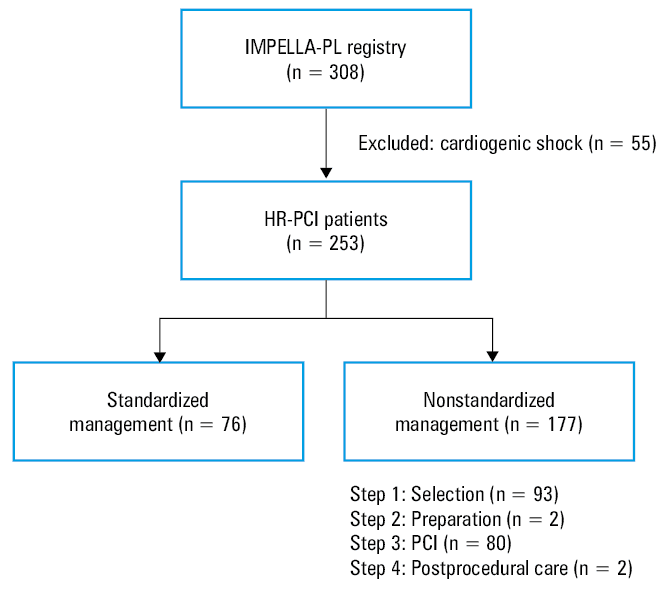
The HR‑PCI patients were retrospectively divided into 2 groups: those treated according to the standardized management algorithm and those who did not fulfil the algorithm criteria (Figure 1). The standardized management was defined as fulfilment of all periprocedural steps according to the ROAD TIP algorithm, including 1) optimal patient selection: at least 3 high‑risk indications and no contraindications; 2) optimal preparation: preprocedural vascular access imaging and heart team discussion; 3) optimal PCI: ultrasound‑guided puncture or contralateral angiography via an additional safety access, along with successful revascularization of all preplanned lesions; and 4) optimal postprocedural care: patient monitoring in the cardiac intensive care unit according to the standardized algorithm (pump and hemodynamic monitoring once per hour, laboratory tests and echocardiography once daily) (Table 1). Nonstandardized management was defined as failure to fulfil at least 1 of the above‑listed criteria.
Abbreviations: HR‑PCI, high‑risk percutaneous coronary intervention
Abbreviations: ACS, acute coronary syndrome; AMI, acute myocardial infarction; AR, aortic regurgitation; AS, aortic stenosis; CAD, coronary artery disease; CTO, chronic total occlusion; HCM, hypertrophic cardiomyopathy; LVEF, left ventricular ejection fraction; others, see Figure 1 | |
Step 1: Patient selection | |
Indications (at least 3 required) | Risk of hemodynamic instability
|
Patient characteristics
| |
Coronary anatomy
| |
Procedural characteristics
| |
Contraindications | Aorta
|
Left ventricle
| |
General
| |
Step 2: Preparation | Vascular access imaging
|
Heart team discussion
| |
Step 3: PCI | Large‑bore access
|
Step 4: Postprocedural care | If Impella not removed in the catheterization laboratory
|
The study end points included 1) in‑hospital mortality, 2) in‑hospital major adverse cardiovascular events (MACEs; need for cardiosurgical intervention, exacerbation of heart failure [HF], acute myocardial infarction [MI], acute kidney injury [AKI], inflammatory complications, severe bleeding complications as per the operator’s judgement), 3) device‑related complications (access site bleeding, limb ischemia, need for an endovascular or surgical intervention, hemolysis, aortic injury), and 4) 12‑month outcomes, including mortality and MACE after discharge (rehospitalization for HF, acute MI, need for urgent repeated revascularization, stroke, LV assist device [LVAD] implantation, heart transplant). The prespecified end point definitions have been published previously.11
Statistical analysis
Statistical analysis was performed using the IBM SPSS Statistics package, version 24.0 (IBM Corp., Armonk, New York, United States). Categorical variables were reported as numbers and percentages, and were compared using the χ2 test or Fisher exact test. Continuous variables were expressed as mean (SD) or median (interquartile range), and were compared using the t test or Mann–Whitney test, depending on the distribution, as verified with the Shapiro–Wilk test. For continuous variables referring to patient characteristics with more than 2 categories, the P value was calculated separately for each category, without adjustment for multiple comparisons. The Kaplan–Meier analysis and the log rank test were used to compare 12‑month mortality. The mortality predictors with a P value below 0.1 in the univariable analysis were included in the final multivariable model in both groups. The results of univariable and multivariable regression analyses are reported as odds ratios and 95% CIs. All analyses were conducted by an independent statistician in a blinded manner. Statistical tests were 2‑sided, with a significance level of 0.05.
Results
Among the 253 HR‑PCI patients included in the IMPELLA‑PL registry, 76 individuals (30%) were treated according to the standardized management algorithm and 177 (70%) were not. No patients were lost to follow‑up. The reasons for not fulfilling the criteria for standardized management included suboptimal patient selection (n = 93 [53%]), suboptimal preparation (n = 2 [1%]), suboptimal PCI trajectory (n = 80 [45%]), and suboptimal postprocedural care (n = 2 [1%]) (Table 1; Figure 1).
Patient and procedural characteristics
Clinical and procedural characteristics of both groups are presented in Table 2. There were no differences regarding baseline characteristics. The mean (SD) patient age was 72.1 (10.1) years and 69.9 (9.6) years, respectively, in the standardized and nonstandardized management groups, and a majority of patients in both groups were men (86.8% vs 87.6%, respectively). The patients managed according to the standardized algorithm group underwent HR‑PCI more often in the setting of acute coronary syndrome (ACS) than chronic coronary syndrome (P <0.001), and had a higher median EuroScore than the nonstandardized management group (P = 0.02). Over 75% of patients in both groups had concomitant hypertension and dyslipidemia, nearly 50% had diabetes mellitus, and approximately 40% had chronic kidney disease (CKD). A history of stroke or transient ischemic attack was more frequent in the standardized than the nonstandardized management group (P = 0.02). About 50% of patients in both groups had a history of MI, about 30% previously underwent PCI, and about 10% previously underwent coronary artery bypass grafting (CABG). Laboratory parameters and echocardiographic characteristics were comparable in both groups, with the median LV ejection fraction (LVEF) of 29% and 26%, respectively, in the standardized and nonstandardized management groups.
Parameter | Standardized management group (n = 76) | Nonstandardized management group (n = 177) | P value | ||
SI conversion factors: to convert hemoglobin to g/l, multiply by 10; creatinine to μmol/l, by 88.4; CRP to nmol/l, by 9.524; NT‑proBNP to ng/l, by 1; troponin to μg/l, by 1.
Abbreviations: BMI, body mass index; CABG, coronary artery bypass graft; COPD, chronic obstructive pulmonary disease; CRT, cardiac resynchronization therapy; CRP, C‑reactive protein; CX, circumflex artery; ECMO, extracorporeal membrane oxygenation; EF, ejection fraction; HF, heart failure; IABP, intra‑aortic balloon pump; ICED, implantable cardiac electronic device; ICD, implantable cardioverter‑defibrillator; ICU, intensive care unit; IVUS, intravascular ultrasound; IQR, interquartile range; IVL, intravascular lithotripsy; LA, left atrium; LAD, left anterior descending artery; LM, left main coronary artery; LVEDD, left ventricular end‑diastolic diameter; NSTEMI, non–ST‑segment elevation myocardial infarction; NT‑proBNP, N‑terminal pro–B‑type natriuretic peptide; OCT, optical coherence tomography; PAD, peripheral arterial disease; PEA, pulseless electrical activity; RCA, right coronary artery; RV, right ventricle; STEMI, ST‑segment elevation myocardial infarction; TIA, transient ischemic attack; VF, ventricular fibrillation; VT, ventricular tachycardia; others, see Figure 1 and Table 1 | |||||
Baseline characteristics | |||||
Age, y, mean (SD) | 72.1 (10.1) | 69.9 (9.6) | 0.11 | ||
Men, n (%) | 66 (86.8) | 155 (87.6) | 0.87 | ||
BMI, kg/m2, median (IQR) | 27.7 (25.2–29.6) | 27.1 (23.9–30.8) | 0.45 | ||
Clinical presentation, n (%) | |||||
Acute coronary syndrome | Overall | 53 (69.7) | 81 (45.8) | 0.001 | |
STEMI | 2 (2.6) | 4 (2.3) | 0.59 | ||
NSTEMI | 40 (52.6) | 67 (37.9) | 0.03 | ||
Unstable angina | 11 (14.5) | 9 (5.1) | 0.01 | ||
Chronic coronary syndrome | 22 (29) | 89 (50.3) | 0.001 | ||
Risk factors | |||||
Hypertension, n (%) | 58 (76.3) | 140 (79.1) | 0.62 | ||
Dyslipidemia, n (%) | 59 (77.6) | 139 (78.5) | 0.87 | ||
Diabetes mellitus, n (%) | 37 (48.7) | 82 (46.3) | 0.73 | ||
Prior myocardial infarction, n (%) | 35 (46.1) | 96 (54.2) | 0.37 | ||
Prior PCI, n (%) | 24 (31.6) | 68 (38.4) | 0.3 | ||
Prior CABG, n (%) | 5 (6.6) | 20 (11.3) | 0.25 | ||
Atrial fibrillation, n (%) | 24 (31.6) | 51 (28.9) | 0.66 | ||
Chronic HF, n (%) | 75 (98.7) | 174 (98.3) | 0.82 | ||
Prior stroke or TIA, n (%) | 16 (21.1) | 20 (11.3) | 0.02 | ||
Chronic kidney disease, n (%) | 29 (38.2) | 64 (36.2) | 0.76 | ||
Dialysis, n (%) | 2 (2.6) | 2 (1.1) | 0.38 | ||
Mehran Risk Score, points, median (IQR) | 11 (8–14) | 10 (7–14) | 0.66 | ||
COPD, n (%) | 6 (7.9) | 21 (11.9) | 0.35 | ||
PAD, n (%) | 28 (36.8) | 48 (27.1) | 0.12 | ||
EuroScore, %, median (IQR) | 6.8 (3.5–10.6) | 4.5 (2.5–8.5) | 0.01 | ||
Cardiac arrest prior to admission, n (%) | 2 (2.6) | 7 (4) | 0.6 | ||
ICED, n (%) | Overall | 13 (17.1) | 28 (15.8) | 0.8 | |
Pacemaker | 1 (1.3) | 9 (5.1) | 0.19 | ||
ICD | 6 (7.9) | 22 (12.4) | 0.29 | ||
CRT | 4 (5.3) | 8 (4.5) | 0.9 | ||
Laboratory parameters | |||||
Hemoglobin, g/dl, median (IQR) | 13.2 (11.8–14.2) | 13.1 (11.8–14.3) | 0.77 | ||
Platelets, × 109/l, median (IQR) | 218 (169.5–287.5) | 210 (170–256) | 0.5 | ||
Creatinine, mg/dl, median (IQR) | 1 (0.9–1.3) | 1.1 (1–1.4) | 0.18 | ||
CRP, mg/l, median (IQR) | 10.2 (2.3–24.1) | 5.3 (2.4–20.3) | 0.35 | ||
NT‑proBNP, pg/ml, median (IQR) | 4952 (2117–9718) | 3785 (1673–9181) | 0.42 | ||
Troponin, ng/ml, median (IQR) | 0.51 (0.12–3.57) | 0.24 (0.03–2.34) | 0.09 | ||
pH, mean (SD) | 7.42 (0.12) | 7.41 (0.07) | 0.67 | ||
Lactate, mmol/l, median (IQR) | 1.75 (1.23–2.65) | 1.7 (1.35–14.2) | 0.4 | ||
Echocardiographic characteristics | |||||
LVEDD, mm, mean (SD) | 58.4 (9) | 60.8 (8.8) | 0.07 | ||
LVEF, %, median (IQR) | 29 (20–38) | 26 (20–35) | 0.44 | ||
RV dysfunction, n (%) | 14 (18.4) | 32 (18.1) | 0.79 | ||
Mitral regurgitation grade 3 or 4, n (%) | 13 (17.1) | 30 (16.9) | 0.98 | ||
Tricuspid regurgitation grade 3 or 4, n (%) | 12 (15.8) | 24 (13.6) | 0.89 | ||
Severe aortic stenosis, n (%) | 0 | 2 (1.1) | 0.32 | ||
Angiographic characteristics | |||||
Vessels with significant stenosis, n, median (IQR) | 4 (3–4) | 3 (3–4) | 0.03 | ||
Severe calcifications, n (%) | 55 (72.4) | 87 (49.2) | <0.001 | ||
CTO, n (%) | 48 (63.2) | 89 (50.3) | 0.06 | ||
In‑stent restenosis, n (%) | 7 (9.2) | 10 (5.6) | 0.3 | ||
In‑stent thrombosis, n (%) | 1 (1.3) | 0 | 0.13 | ||
Extent of the disease, n (%) | Single‑vessel | 0 | 1 (0.6) | 0.9 | |
Multivessel (except for LM) | 17 (22.4) | 45 (25.4) | 0.6 | ||
Multivessel (including LM) | 59 (77.6) | 103 (58.2) | 0.003 | ||
Missing data | 0 | 28 (15.8) | – | ||
Syntax score, points, mean (SD) | 42.5 (20) | 44.3 (18.4) | 0.51 | ||
Procedural characteristics | |||||
Vascular access for PCI, n (%) | Radial artery | 38 (48.7) | 66 (37.3) | 0.06 | |
Femoral artery | 38 (48.7) | 111 (62.7) | 0.06 | ||
Brachial artery | 2 (2.6) | 5 (2.8) | 0.93 | ||
PCI via Impella sheath, n (%) | 13 (17.1) | 32 (18.1) | 0.85 | ||
Vessel treated, n (%) | LM | 62 (81.6) | 113 (63.8) | 0.005 | |
LAD | 62 (81.6) | 137 (77.4) | 0.46 | ||
CX | 49 (64.5) | 92 (52) | 0.07 | ||
RCA | 12 (15.8) | 36 (20.3) | 0.4 | ||
Intravascular imaging, n (%) | Overall | 46 (60.5) | 60 (33.9) | <0.001 | |
IVUS | 44 (57.9) | 60 (33.9) | <0.001 | ||
OCT | 2 (2.6) | 0 | 0.03 | ||
Functional assessment, n (%) | 2 (2.6) | 7 (4) | 0.6 | ||
Rotational atherectomy and / or IVL, n (%) | 37 (48.7) | 59 (33.3) | 0.02 | ||
Bifurcation PCI, n (%) | Overall | 63 (82.9) | 100 (56.5) | <0.001 | |
Use of the 2‑stent technique | 39 (51.3) | 39 (22) | 0.004 | ||
CTO PCI, n (%) | 12 (15.8) | 14 (7.9) | 0.06 | ||
Contrast volume, ml, median (IQR) | 240 (170–326) | 250 (180–350) | 0.3 | ||
Radiation dose, mGy, median (IQR) | 1631 (860–2638) | 1680 (795–2533) | 0.76 | ||
Procedural success, n (%) | 56 (73.7) | 154 (87) | 0.003 | ||
Impella characteristics | |||||
Use of Impella CP, n (%) | 76 (100) | 177 (100) | – | ||
Timing of Impella placement, n (%) | Before PCI | 71 (93.4) | 136 (76.8) | 0.002 | |
During PCI | 5 (6.6) | 39 (22) | 0.003 | ||
After PCI | 0 | 0 | – | ||
Impella removal in a catheterization laboratory, n (%) | 72 (94.7) | 165 (93.2) | 0.65 | ||
Time of implantation, min, median (IQR) | 25 (15.3–36.8) | 26 (15–40) | 0.4 | ||
Duration of support, h, median (IQR) | 2.3 (2–60) | 3.5 (2–90) | 0.16 | ||
Vascular access for Impella, n (%) | |||||
Femoral artery | 64 (84.3) | 173 (97.7) | <0.001 | ||
Subclavian artery | 11 (14.5) | 3 (1.7) | <0.001 | ||
Ultrasound‑guided puncture | 47 (61.8) | 24 (13.6) | <0.001 | ||
Surgical access | 23 (30.3) | 15 (8.5) | <0.001 | ||
Other forms of cardiopulmonary support | |||||
Ccatecholamines, n (%) | 18 (23.7) | 29 (16.4) | 0.17 | ||
Levosimendan, n (%) | 7 (9.2) | 6 (3.4) | 0.15 | ||
Mechanical ventilation, n (%) | 4 (5.3) | 6 (3.4) | 0.48 | ||
Renal replacement therapy, n (%) | 2 (2.6) | 2 (1.1) | 0.34 | ||
ECMO, n (%) | 2 (2.6) | 4 (2.3) | 0.86 | ||
IABP, n (%) | 2 (2.6) | 3 (1.7) | 0.62 | ||
ICU stay, d, median (IQR) | 4 (2–11) | 3 (2–7) | 0.07 | ||
Hospital stay, d, median (IQR) | 14 (10–20.8) | 11 (7–18) | 0.003 | ||
Regarding angiographic characteristics, the patients managed according to the standardized algorithm had more vessels with significant stenosis, defined as more than 50% stenosis in the LM or more than 70% stenosis in a major coronary vessel (>2.5 mm) on coronary angiography, or 30% to 70% stenosis with fractional flow reserve lower than or equal to 0.8 (P = 0.03). Also, they had more severe calcifications (P <0.001) and presented more often with multivessel disease, including LM disease (P = 0.003). The standardized management group more often underwent LM PCI (P = 0.005), with the procedure guided by intravascular imaging (P <0.001). The proportion of bifurcation PCIs was also higher in the standardized management group (P <0.001), with more frequent use of the 2‑stent technique (P = 0.004). The procedural success rate (revascularization of all preplanned lesions) was lower in the standardized than in the nonstandardized management group (P = 0.003).
All patients were treated with Impella CP, and all received the support either before or during PCI. In the standardized management group, the device was implanted more often before PCI (P = 0.002). Femoral access was less common (P <0.001), whereas subclavian access (P <0.001) and ultrasound‑guided puncture were more common (P <0.001) in these patients, as compared with the nonstandardized management group.
The need for additional cardiopulmonary support, including catecholamines, levosimendan, mechanical ventilation, extracorporeal membrane oxygenation (ECMO), and intra‑aortic balloon pump (IABP), as well as the need for renal replacement therapy were comparable between the groups. The patients managed according to the standardized algorithm group were hospitalized for a longer time than those who did not fulfil the algorithm criteria (P = 0.003). There were no significant differences between the groups with respect to pharmacotherapy at discharge.
Outcomes
In‑hospital and 12‑month outcomes of both groups are presented in Table 3. The in‑hospital mortality rate was comparable between the groups (10.5% vs 7.3%, respectively, in the standardized and nonstandardized management groups). The proportion of patients with in‑hospital MACEs was higher in the standardized than the nonstandardized management group (48.7% vs 27.1%; P <0.001), which was mostly driven by more inflammatory complications (27.6% vs 7.9%; P <0.001). The proportion of device‑related complications, including access site bleeding, limb ischemia, need for endovascular or surgical intervention, hemolysis, and aortic injury, was similar in both groups.
Parameter | Standardized management group (n = 76) | Nonstandardized management group (n = 177) | P value | ||
In‑hospital outcomes, n (%) | |||||
Mortality | 8 (10.5) | 13 (7.3) | 0.4 | ||
Need for cardiosurgical intervention | 0 | 1 (0.6) | 0.51 | ||
Exacerbation of HF | 6 (7.9) | 6 (3.4) | 0.25 | ||
Acute myocardial infarction | 5 (6.6) | 6 (3.4) | 0.25 | ||
Acute kidney injury | 13 (17.1) | 19 (10.7) | 0.16 | ||
Inflammatory complications | 21 (27.6) | 14 (7.9) | <0.001 | ||
Major bleeding | 14 (18.4) | 20 (11.3) | 0.13 | ||
Device‑related complications, n (%) | |||||
Access site bleeding | 10 (13.2) | 26 (14.7) | 0.75 | ||
Limb ischemia | 3 (3.9) | 3 (1.7) | 0.28 | ||
Endovascular intervention | 2 (2.6) | 6 (3.4) | 0.75 | ||
Surgical intervention | 2 (2.6) | 6 (3.4) | 0.75 | ||
Hemolysis | 1 (1.3) | 3 (1.7) | 0.83 | ||
Aortic injury | 0 | 1 (0.6) | 0.51 | ||
12‑month outcomes, n (%) | |||||
Mortality after discharge | 5 (6.6) | 20 (11.3) | 0.25 | ||
MACE after discharge | Overall | 12 (15.8) | 20 (11.3) | 0.41 | |
Rehospitalization for HF | 8 (10.5) | 17 (9.6) | 0.82 | ||
Myocardial infarction | 0 | 3 (1.7) | 0.25 | ||
Repeat revascularization | Overall | 2 (2.6) | 6 (3.4) | 0.75 | |
PCI | 2 (2.6) | 6 (3.4) | 0.84 | ||
CABG | 0 | 0 | 1 | ||
Stroke | 1 (1.3) | 3 (1.7) | 0.83 | ||
LVAD implantation | 0 | 1 (0.6) | 0.51 | ||
Heart transplant | 1 (1.3) | 2 (1.1) | 0.9 | ||
Total mortality, n (%) | 13 (17.1) | 33 (18.6) | 0.77 | ||
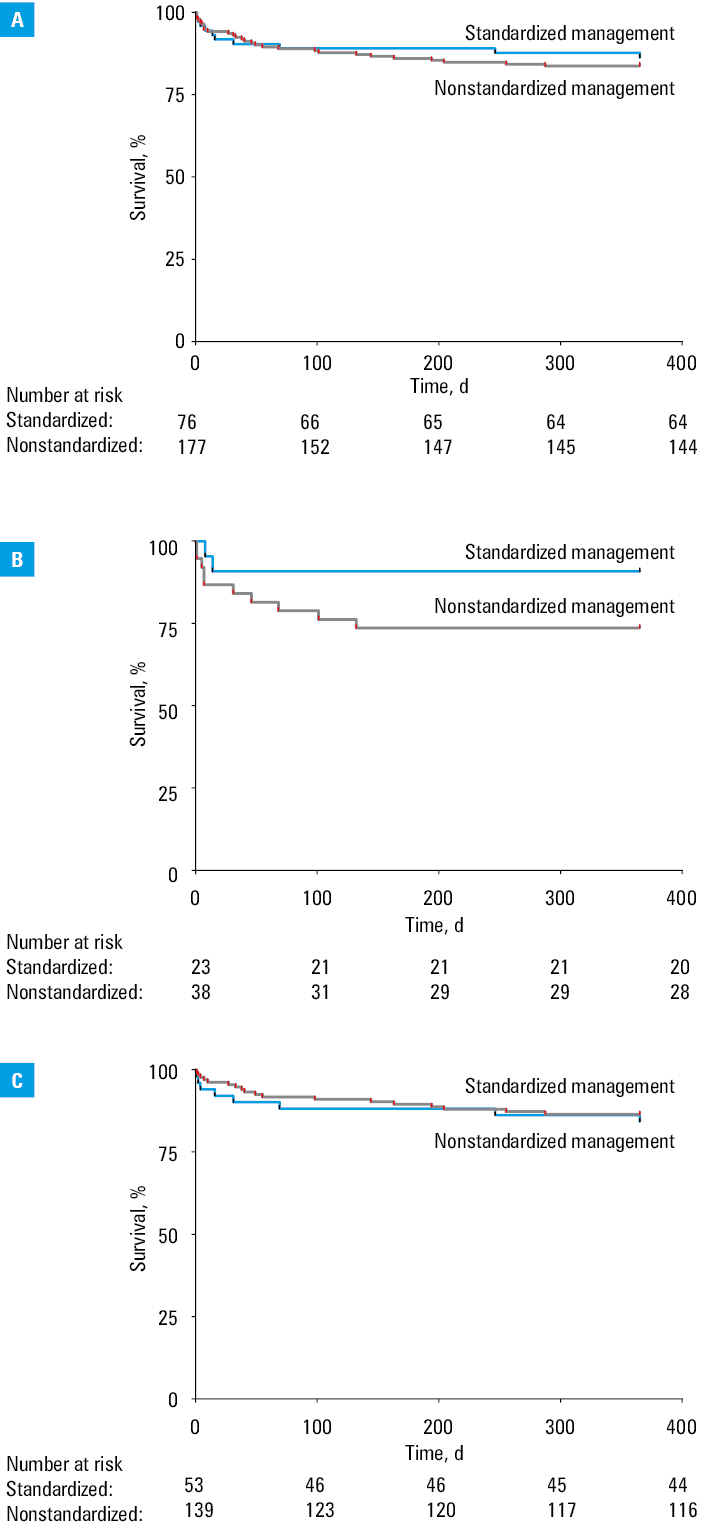
Mortality after discharge was nominally lower in the standardized than the nonstandardized management group (6.6% vs 11.3%) but the difference did not reach statistical significance. The overall 12‑month mortality in both groups was also comparable (hazard ratio [HR], 0.84; 95% CI, 0.42–1.69; P = 0.24; Figure 2A). In a subgroup analysis according to reasons for not fulfilling the criteria for standardized management, there were no differences in 12‑month mortality among the patients who did not receive standardized treatment due to suboptimal patient selection (n = 93) and suboptimal PCI trajectory (n = 80). The subgroups not fulfilling the criteria of optimal patient preparation (n = 2) and postprocedural care (n = 2) were not included in the subanalysis due to a small number of patients.
In the standardized management group, 12 patients (15.8%) experienced 12 MACEs during the 12‑month follow‑up, including 8 rehospitalizations for HF, 2 repeated revascularizations, 1 stroke, and 1 heart transplant. In the nonstandardized management group, 20 patients (11.3%) experienced 32 MACEs, including 17 rehospitalizations for HF, 3 MIs, 6 repeated revascularizations, 3 strokes, 2 heart transplants, and 1 LVAD implantation.
Since the adoption of standardized algorithms is associated with increasing procedure volume and team experience,15 we also compared the 12‑month mortality outcomes in low- and high‑volume centers participating in the IMPELLA‑PL registry. The high‑volume centers were defined as centers that performed 10 or more Impella‑assisted HR‑PCI procedures over the study period. The ROAD TIP algorithm was used in 23 out of 61 procedures performed in the low‑volume centers (38%) and 53 out of 192 procedures in the high‑volume centers (28%) (P = 0.13). In the low‑volume centers, the 12‑month mortality rate was lower in the standardized than in the nonstandardized management group (HR, 0.39; 95% CI, 0.13–0.96; P = 0.047; Figure 2B), whereas in the high‑volume centers, it was comparable between both groups (HR, 1.21; 95% CI, 0.51–2.86; P = 0.65; Figure 2C). There were no differences in mortality, regardless of the reason for the lack of the nonstandardized management (Supplementary material, Figure S1).
The results of univariable analysis identifying independent predictors of 12‑month mortality in the standardized and nonstandardized management groups are presented in Supplementary material, Tables S1 and S2, respectively, and the results of multivariable analysis are shown in Table 4. In the standardized management group, age, prior CABG, LVEF, number of vessels with significant stenosis, and Impella removal in the catheterization laboratory were associated with 12‑month mortality (P ≤0.08 for all). However, in multivariable analysis, none of the above parameters turned out to be an independent predictor of 12‑month mortality, with borderline significance for the number of vessels with significant stenosis (P = 0.05). In the nonstandardized management group, dyslipidemia, prior MI, atrial fibrillation, CKD, right ventricular dysfunction, in‑stent restenosis, contrast volume, radiation dose, Impella removal in the catheterization laboratory, and the use of catecholamines were associated with 12‑month mortality (P ≤0.09 for all) in univariable analysis. Of those, prior MI, atrial fibrillation, and CKD were identified as independent predictors of 12‑month mortality (P ≤0.03 for all) in multivariable analysis.
Variable | Univariable analysis | Multivariable analysis | ||||
OR | 95% CI | P value | OR | 95% CI | P value | |
Standardized management group (n = 76) | ||||||
Age, y | 0.94 | 0.89–1 | 0.06 | 0.95 | 0.88–1.03 | 0.24 |
Prior CABG | 8.18 | 1.22–54.77 | 0.03 | 10.74 | 0.78–146.27 | 0.08 |
LVEF, % | 0.95 | 0.89–1.01 | 0.08 | 0.97 | 0.9–1.03 | 0.31 |
Vessels with significant stenosis, n | 2.29 | 1.06–4.99 | 0.035 | 2.57 | 0.99–6.65 | 0.05 |
Impella removal in a catheterization laboratory | 0.09 | 0.01–1.17 | 0.07 | 0.11 | 0.01–1.59 | 0.11 |
Nonstandardized management group (n = 177) | ||||||
Dyslipidemia | 0.46 | 0.2–1.07 | 0.07 | 0.81 | 0.24–2.68 | 0.73 |
Prior myocardial infarction | 0.47 | 0.22–1.02 | 0.06 | 0.23 | 0.07–0.79 | 0.02 |
Atrial fibrillation | 2.93 | 1.34–6.41 | 0.007 | 4.52 | 1.49–13.65 | 0.008 |
Chronic kidney disease | 2.58 | 1.18–5.52 | 0.017 | 3.29 | 1.11–9.76 | 0.03 |
RV dysfunction | 2.35 | 0.95–5.79 | 0.06 | 1.89 | 0.56–6.37 | 0.31 |
In‑stent restenosis | 3.17 | 0.84–11.96 | 0.09 | 4.76 | 0.66–34.41 | 0.12 |
Contrast volume, ml | 1.03 | 1.01–1.06 | 0.019 | 1 | 0.99–1.01 | 0.22 |
Radiation dose, mGy | 1 | 1–1.01 | 0.06 | 1 | 0.99–1.01 | 0.57 |
Impella removal in a catheterization laboratory | 0.09 | 0.03–0.32 | <0.001 | 0.24 | 0.03–1.82 | 0.17 |
Use of catecholamines | 3.5 | 1.46–8.41 | 0.005 | 2.79 | 0.62–12.66 | 0.18 |
Discussion
Main findings
We evaluated the association between the implementation of a standardized periprocedural management algorithm (ROAD TIP) and outcomes of patients undergoing HR‑PCI who were enrolled in the IMPELLA‑PL registry. The main finding of our study is that the patients treated with Impella according to the standardized algorithm had a higher‑risk profile at baseline, underwent more complex PCI procedures, and more often experienced in‑hospital complications, as compared with the patients not fulfilling the standardized algorithm criteria, who were generally at a lower risk and underwent less complex procedures. The 12‑month outcomes were comparable between the groups.
Perspective
Over the past decade, the use of pVADs to provide hemodynamic support during HR‑PCI has rapidly expanded, despite a lack of sufficient evidence from large‑scale randomized trials. According to the EAPCI, Impella is the only pVAD that may be considered in highly selected patients undergoing HR‑PCI in the case of acceptable femoral access, whereas IABP and veno‑arterial ECMO (VA‑ECMO) should not be used in this setting.13 Data supporting the efficacy and safety of Impella in HR‑PCI come from the PROTECT studies and large‑scale registries, with hitherto no head‑to‑head comparison against other pVADs. The prospective, multicenter PROTECT I trial20 (n = 20) demonstrated that Impella 2.5 can be successfully used during HR‑PCI, providing robust hemodynamic support. In the per protocol analysis of the randomized PROTECT II trial,5 the patients treated with Impella 2.5 (n = 226) experienced fewer MACEs than the individuals treated with IABP (n = 226; P = 0.048). In the prospective, single‑arm PROTECT III trial,21 HR‑PCI patients supported with Impella 2.5 or CP (n = 504) demonstrated more complete revascularization, lower rates of bleeding complications, and improved 90‑day clinical outcomes, as compared with the historic cohort of PROTECT II patients with severely depressed LVEF (mean, ca. 23%). In other studies, the use of Impella was associated with over 75% lower risk of post‑PCI AKI than expected from current risk models, and lower risk of AKI, as compared with the use of VA‑ECMO, suggesting that Impella might be a protective strategy against AKI during HR‑PCI.22,23
In line with clinical trial findings, retrospective analyses of data from multicenter national registries, including the IMP‑IT, German registry, IMPELLA‑PL, and cVAD registry,8,9,12 confirmed acceptable clinical outcomes of Impella in HR‑PCI. However, some authors have questioned these benefits. For example, in a retrospective study of 1680 patients, Khalid et al24 found that HR‑PCI could be successfully performed without a pVAD in 98.2% of patients, with lower mortality and fewer complications at 30‑day follow‑up than reported for Impella‑assisted HR‑PCI (mortality, 1.6%; AKI, 4.6%; stroke, 0.2%; major bleeding, 1.1%). The ongoing randomized PROTECT IV trial, which aims to compare Impella 2.5 or CP vs no support or bailout IABP in patients with complex CAD and reduced LVEF undergoing HR‑PCI (n = 1252) over a 3‑year follow‑up, will help identify patients that may truly benefit from the use of Impella during a percutaneous revascularization procedure. Meanwhile, identification of patients who truly benefit from pVAD support remains problematic.
Previous studies consistently showed that a standardized multidisciplinary team approach improves outcomes in patients treated with Impella in the setting of cardiogenic shock.25-27 However, similar data are not yet available for HR‑PCI. Our results indicate that the standardized management algorithm allowed for 1) selection of patients at a higher baseline risk, including those with ACS, more comorbidities, and more complex CAD (multivessel disease, LM artery involvement, and severe calcifications); 2) performing more complex PCI procedures with a lower procedural success rate, including a higher proportion of LM PCIs, bifurcation PCIs, and use of calcium modification techniques; 3) more frequent Impella implantation before than during PCI; 4) more careful vascular access management, with a higher proportion of ultrasound‑guided punctures and more frequent choice of alternative access (subclavian access, surgical access). Despite a higher baseline risk, greater PCI complexity with subsequent lower procedural success, and more frequent in‑hospital complications, the patients treated according to the standardized algorithm had comparable 12‑month outcomes to those not fulfilling the algorithm criteria, who were at a lower baseline risk and underwent less complex procedures. The higher proportion of inflammatory complications in the standardized algorithm group, defined as confirmed infection treated with antimicrobial agents, might be due to more frequent use of surgical access, and might explain the longer hospital stay.
Importantly, we found an association between the use of a standardized management algorithm and 12‑month mortality depending on the volume of performed HR‑PCI procedures. In the low‑volume centers (<10 Impella‑assisted interventions), 12‑month mortality was lower in the standardized than in the nonstandardized management group, whereas in the high‑volume centers, it was comparable between the groups. This observation confirms the presence of a learning curve in the setting of Impella‑supported HR‑PCI, as previously shown in a prespecified subanalysis of the PROTECT II study.28 Hence, standardized management algorithms seem especially beneficial in low‑volume centers, with a balanced, integrated, team approach being the path toward optimal patient care. However, given the observational and retrospective design, our findings are hypothesis‑generating and should be confirmed in prospective studies.
Limitations
Our study has several limitations. First, the ROAD TIP algorithm has been proposed in the year 2023, whereas the patient inclusion period for the IMPELLA‑PL registry ended in 2022. Hence, we could not prospectively validate the algorithm in the IMPELLA‑PL registry, but only retrospectively evaluate the association between the use of the standardized periprocedural management algorithm and HR‑PCI outcomes. A comparison of the characteristics and outcomes of patients before and after the introduction of the algorithm would be more reliable and remains to be performed. Second, the algorithm was proposed based on the recent expert consensus statements13,14,17,18 and our experiences. However, a machine learning approach might improve identification of the management steps crucial for patient qualification for Impella‑assisted HR‑PCI and detection of independent predictors of mortality.29 Third, since this was a registry‑based study, it was limited by the availability of complete medical history data. In addition, the outcome events were adjudicated by local committees in every participating hospital, but there was no independent event adjudication committee. Thus, both baseline characteristics and data regarding end points might be prone to under- or overreporting bias, despite prespecified definitions. Fourth, in the current study, Impella was implanted and removed during the same procedure in over 90% of patients, which reflects the overall clinical stability of this cohort. Hence, the results cannot be extrapolated to less stable HR‑PCI patients. Finally, since different end point definitions were used in different national Impella registries, comparisons of our results with data from other registries should be interpreted with caution.
Conclusions
The patients treated according to the standardized algorithm were characterized by a higher‑risk profile and greater procedural complexity than the individuals not fulfilling the algorithm criteria, who were at a lower baseline risk and underwent less complex procedures; however, the 12‑month outcomes were comparable between the groups. A comparison of patient outcomes before and after implementation of the dedicated management algorithm is required to confirm our findings.
- Rihal CS, Naidu SS, Givertz MM, et al. 2015 SCAI/ACC/HFSA/STS Clinical expert consensus statement on the use of percutaneous mechanical circulatory support devices in cardiovascular care: endorsed by the American Heart Association, the Cardiological Society of India, and Sociedad Latino Americana de Cardiologia Intervencionista; Affirmation of Value by the Canadian Association of Interventional Cardiology‑Association Canadienne de Cardiologie d’intervention. J Am Coll Cardiol. 2015; 65: 2140‑2141. | Crossref
- Zein R, Patel C, Mercado‑Alamo A, et al. A review of the Impella devices. Interv Cardiol. 2022; 17: e05. | Crossref
- Dangas GD, Kini AS, Sharma SK, et al. Impact of hemodynamic support with Impella 2.5 versus intra‑aortic balloon pump on prognostically important clinical outcomes in patients undergoing high‑risk percutaneous coronary intervention (from the PROTECT II randomized trial). Am J Cardiol. 2014; 113: 222‑228. | Crossref
- Lansky AJ, Tirziu D, Moses JW, et al. Impella versus intra‑aortic balloon pump for high‑risk PCI: a propensity‑adjusted large‑scale claims dataset analysis. Am J Cardiol. 2022; 185: 29‑36. | Crossref
- O’Neill WW, Kleiman NS, Moses J, et al. A prospective, randomized clinical trial of hemodynamic support with Impella 2.5 versus intra‑aortic balloon pump in patients undergoing high‑risk percutaneous coronary intervention: the PROTECT II study. Circulation. 2012; 126: 1717‑1727. | Crossref
SUPPLEMENTARY MATERIAL
ARTICLE INFORMATION