
Prognostic significance of anti-gliadin and anti-F-actin immunoglobulin A antibodies in primary sclerosing cholangitis
Key words: anti-gliadin antibody, anti-F-actin antibody, outcome, primary sclerosing cholangitis

 CC BY 4.0
Prognostic significance of anti-gliadin and anti-F-actin immunoglobulin A antibodies in primary sclerosing cholangitis
CC BY 4.0
Introduction: Primary sclerosing cholangitis (PSC) is a biliary disorder associated with a high risk of end‑stage liver disease and cholangiocarcinoma (CCA). Currently, prediction of unfavorable outcomes is hindered by a lack of valuable prognostic biomarkers.
Objectives: The aim of the study was to assess the prevalence of autoantibodies in PSC and define their potential use as the predictors of the disease progress and CCA in a large, prospective cohort of PSC patients.
Patients and methods: Enzyme‑linked immunosorbent assay was applied for detection of serum immunoglobulin (Ig) A anti‑gliadin antibodies at a concentration equal to or above 30 U and anti‑F‑actin antibodies at a concentration equal to or above 20 U in 624 patients with PSC and 305 healthy controls. Poor PSC outcomes were defined as liver transplantation or / and liver disease‑related death, that is, transplantation‑free survival, and CCA.
Results: Anti‑gliadin and anti‑F‑actin IgA antibodies were more frequent in the PSC patients than in the healthy controls (P <0.001 for both). The autoantibodies were associated with laboratory indices of the liver disease severity, including the model of end‑stage liver disease score, and anti‑F‑actin was associated with cirrhosis (P <0.001). During a median (interquartile range) follow‑up of 18.5 (8–33) months, 17.2% patients were transplanted, 4.6% died due to their liver disease, and 5.2% were diagnosed with CCA. Associations between anti‑F‑actin and anti‑gliadin and a shorter transplantation‑free survival (P <0.001 for both) were found. In the multivariable Cox proportional hazards regression analysis anti‑gliadin was an independent predictor of poor survival. No association between the analyzed antibodies and the incidence of CCA was detected.
Conclusions: Anti‑gliadin and anti‑F‑actin IgA identify the subgroup of PSC patients with a more severe disease and at a risk of shortened transplantation‑free survival.
What's new?
Primary sclerosing cholangitis (PSC) remains an unpredictable liver condition associated with a high risk of biliary cancer and cirrhosis. In this study, involving a large, prospective Polish cohort of patients with PSC, we evaluated 2 autoantibodies, anti‑gliadin and anti‑F‑actin, as biomarkers of the disease severity and poor outcome. We showed that both antibodies identified patient populations with a distinct, more severe clinical picture, and were independent predictors of poor survival. We believe that our work will contribute to improved management of patients with PSC and promote development of novel predictive models of outcome.
Introduction
Primary sclerosing cholangitis (PSC) is a chronic, progressive cholestatic liver disease, which affects predominantly young to middle‑aged adults. It is characterized by fibro‑inflammatory changes in the biliary tract, which may lead to cholestasis and liver injury, resulting in biliary infections, liver fibrosis, and eventually end‑stage liver disease.1 Moreover, PSC often coexists with other autoimmune diseases,2 with the strongest association with inflammatory bowel diseases (IBDs), which is the hallmark of PSC.3 Ulcerative colitis occurs in about 70%–90% of the patients with PSC, the coincidence with Crohn disease is much rarer. Current pharmacotherapy fails to prevent the disease progression and life‑threatening complications; therefore, liver transplantation remains the only curative treatment for a significant proportion of patients.4 However, the risk of recurrence in post‑transplant setting is almost 30%.5 Finally, the disease is associated with about 600‑fold greater risk of developing cholangiocarcinoma (CCA) than in the general population, and its lifetime incidence in PSC may reach 10%–20%.6 Biliary cancer often develops in asymptomatic patients a few years after initial PSC diagnosis or can be the first manifestation of the disease.7 In consequence, many malignancy cases are primary inoperative cancers at the time of diagnosis and the patients have disastrous prognosis, as the cancer responds weakly to chemotherapy.
For these reasons, one of the most important goals for clinicians providing care for patients with PSC is to carefully stratify the risk of both liver cirrhosis and CCA development. Patients with a greater risk of these adverse outcomes may benefit from more strict surveillance and even early liver transplantation. Unfortunately, no proven prognostic indicators for an unfavorable disease outcome are currently known, posing a significant challenge for the disease management. To date, biochemical indicators of cholestasis, for example, alkaline phosphatase or the nonspecific model of end‑stage liver disease (MELD), are primarily used for risk stratification or as clinical trial end points. Cancer surveillance is usually limited to radiological imaging and serum markers.8 The widely used tumor marker carbohydrate antigen 19.9 (Ca19.9) lacks sensitivity and specificity. Except for biliary cancer, common causes of increased level of Ca19.9 may be bacterial cholangitis or even non‑neoplastic dominant stricture of the bile duct. Magnetic resonance imaging is a modality of choice in the detection of malignant strictures and liver tumor mass. However, it is often impossible to differentiate on imaging malignant duct changes from multiple benign strictures typical of a natural course of PSC. All these make an early detection of CCA extremely challenging. Moreover, no risk factors and related biomarkers have yet been identified that could aid the risk prediction of the cancer before it develops. Therefore, novel prediction markers are urgently needed for the risk stratification of a progressive disease course and cancer surveillance.
Recently, anti‑gliadin and anti‑F‑actin immunoglobulin (Ig) A autoantibodies, previously described in patients with celiac disease, have been also found in patients with PSC.9 Intriguingly, Tornai et al10 showed in a small group of patients with PSC that these antibodies were associated with unfavorable outcome. Due to a limited number of included patients, a large‑scale cohort study is needed to verify these findings. Moreover, no data exist assessing the relationship between anti‑F‑actin and anti‑gliadin IgA and the risk of CCA in patients with PSC.
In this study we aimed to investigate the prevalence and clinical significance of anti‑gliadin IgA and F‑actin IgA antibodies in a large, prospective cohort of PSC patients, and to estimate their potential value as predictors of progressive disease course and poor outcome, including liver cirrhosis, transplantation‑free survival, and CCA.
Patients and methods
Study design and patients
This cohort study included a prospective group of white patients with PSC from a local registry. The registry is an electronic, protected database hold by the Pomeranian Medical University in Szczecin, Poland. It was created in 2009 and includes all consecutive patients with established diagnosis of PSC, treated at 2 medical university centers in Poland (Medical University of Warsaw and Pomeranian Medical University in Szczecin). In each patient, a diagnosis of PSC was established according to the European Association for the Study of the Liver Guidelines,4 that is, cholestatic liver injury with typical appearance of bile ducts on imaging after excluding other causes of cholangiopathies. The study included also patients with autoimmune hepatitis syndrome, which was confirmed with serological and liver biopsy examination.4 All patients were screened clinically and endoscopically for concomitant IBD. A diagnosis of liver cirrhosis was confirmed by either histology or imaging techniques (computed tomography or liver elastography). From the entire registry, we included into this study all nontransplanted adult PSC patients who had no other concomitant liver diseases that could impact the study measures, such as alcoholic liver disease or viral hepatitis. The study groups did not contain patients with recurrent PSC after liver transplantation.
Demographic, clinical, and laboratory data on each patient were collected at entry and on regular follow‑up appointments or at hospital admissions. To assess the severity of liver disease, MELD score was calculated according to the mathematical formula, which takes into account the following laboratory parameters: international normalized ratio, serum creatinine, and bilirubin. The score ranged from 6 to 40, with higher values indicating worse liver function. Moreover, blood samples were collected at inclusion, and they were stored in a local biobank at –80 oC. To define factors correlated with the outcome, dates of specific liver‑related events, that is liver transplantation or liver disease‑related death, as well as the occurrence of CCA, were documented during the observation. A diagnosis of CCA was confirmed with imaging techniques, brush cytology, or postoperative tissue samples.
Follow‑up time was the time until outcome event or the last contact with the patient during outpatient follow‑up visits and inpatient stays. In our centers, a follow‑up visit is usually scheduled every 6 months, unless the patient condition requires more strict medical supervision. Follow‑up was terminated if there was no further record available or the censored outcome occurred.
To compare the prevalence of the analyzed antibodies in the patients and the healthy population, 305 volunteers without any chronic liver disease, matched for sex and age, and residing in the same regions of Poland as the study participants, were also included.
Serological analysis
Anti‑gliadin and F‑actin IgA antibodies were tested in serum samples collected at enrolment, using QUANTA Lite enzyme‑linked immunosorbent assays (Werfen, San Diego, California, United States). The assays were performed according to the manufacturer’s instructions and the cutoff values for seropositivity were at least 20 U for anti‑F‑actin IgA and at least 30 U for anti‑gliadin IgA.
Statistical analysis
Descriptive statistical methods were used to analyze the study and control groups. Categorical data were described using the number of observations and relative frequencies. Distributions of continuous variables were inspected visually on histograms and were identified as non‑normal. Therefore, continuous variables were reported as median values with corresponding interquartile ranges (IQRs). The antibody seropositivity was analyzed in the context of laboratory indicators of liver disease severity, presence of liver cirrhosis, and outcome measures (ie, liver transplantation‑free survival and the occurrence of CCA) documented in the follow‑up period. The Mann–Whitney test was applied to calculate the differences between the subgroups. Prevalence comparison in the subgroup analysis was performed using the 2‑tailed Fisher exact test, and odds ratios were calculated. The adverse disease outcomes assessed in the follow‑up period were liver transplantation‑free survival (ie, liver transplantation or liver disease‑related death) and the occurrence of CCA. To estimate associations between antibody seropositivity and the analyzed outcomes measures, risk ratios were calculated. The Kaplan–Meier analysis was applied to determine associations between the antibodies and adverse disease outcomes. Differences in the observed survival were assessed with the log‑rank test. To identify independent variables for the risk prediction of the outcome events, multivariable Cox proportional hazards regression was performed, including clinical and laboratory parameters with significant associations in the univariable part of the analysis. The calculations were performed and graphs were plotted using Stata 18.0 software (StataCorp LLC, College Station, Texas, United States). P values below 0.05 were considered significant.
Ethics
Written informed consent was obtained from each patient included in the registry for the use of collected data in the study aimed on identification of molecular mechanisms and predictive factors in their disease. All patients were anonymized by allocating an individual number. The study was performed following the principles of good clinical practice and in accordance with the ethical guidelines of the 1975 Declaration of Helsinki (6th revision, 2008). The study protocol was approved by local Institutional Review Board committees at both study sites (Warsaw Medical University and Pomeranian Medical University in Szczecin, Poland) (KB/58/A/2016 and BN‑001/43/06).
Results
Study population and outcome
A total of 624 patients with PSC were enrolled between 2010 and 2022. During a median (IQR) follow‑up of 18.5 (8–33) months, 108 patients (17.2%) were transplanted, 29 (4.6%) died due to liver failure, and CCA was diagnosed in 33 individuals (5.2%). Detailed demographic data of the study participants are summarized in Table 1.
Variable | Study group (n = 624) | Control group (n = 305) | P value |
Data are presented as numbers (percentage) or median (interquartile range).
SI conversion factors: to convert ALT, ALP, AST, and GGT to μkat/l, multiply by 0.0167; ALB to g/l, by 10; hemoglobin to g/l, by 10.
Abbreviations: AIH, autoimmune hepatitis; ALB, albumin; ALP, alkaline phosphatase; ALT, alanine aminotransferase; AST, aspartate aminotransferase; BIL, total bilirubin; GGT, γ-glutamyl transferase; Hb, hemoglobin; IBD, inflammatory bowel disease; INR, international normalized ratio; MELD, model of end‑stage liver disease; PLT, platelets | |||
Age, y | 32 (26–40) | 32 (27–39) | 0.35 |
Men | 407 (65.2) | 201 (65.9) | 0.62 |
Disease duration, y | 3 (0–6) | – | |
AIH variant | 116 (18.5) | – | |
Cirrhosis | 138 (22.1) | – | |
IBD | 415 (66.5) | – | |
Hb, g/dl | 13.8 (12.3–15.1) | – | |
PLT, 103/µl | 245.5 (187.5–306.5) | – | |
ALP, IU/l | 228 (128–396) | – | |
GGT, IU/l | 177 (82.5–333.5) | – | |
BIL, mg/dl | 0.9 (0.5–2) | – | |
ALT, IU/l | 72 (39–122) | – | |
AST, IU/l | 56 (33–97) | – | |
INR | 1 (0.95–1.1) | – | |
ALB, g/dl | 4.4 (3.9–4.7) | – | |
MELD, points | 8 (6.4–10.6) | – | |
Prevalence of antibodies in the study group and healthy controls
In the study group, median (IQR) values for anti‑gliadin IgA and anti‑F‑actin IgA were higher than in the control group and reached 11.4 (7.6–21.7) IU/l vs 7.4 (3.9–14.2) IU/l (P <0.001) and 10.7 (7.3–15.4) IU/l vs 6.8 (5–8.8) IU/l (P <0.001), respectively. Seropositivity rates for both antibodies were higher in the PSC patients than in the healthy controls and amounted to 91 (14.6%) vs 14 (4.6%) for anti‑gliadin IgA (odds ratio [OR], 3.55; 95% CI, 1.97–6.88; P <0.001), and 75 (12%) vs 9 (2.95%) for anti‑F‑actin IgA (OR, 4.5; 95% CI, 2.2–10.36; P <0.001).
Association between antibody seropositivity and indicators of the disease severity in the primary sclerosing cholangitis group
In the study group, both examined autoantibodies were associated with poor liver function and MELD score (Table 2). Moreover, anti‑F‑actin IgA, but not anti‑gliadin IgA, was associated with the presence of liver cirrhosis (OR, 4.63; 95% CI, 2.71–7.88; P <0.001 and OR, 1.32; 95% CI, 0.76–2.25; P = 0.28; respectively).
Variable | Anti‑gliadin IgA | Anti‑F‑actin IgA | |||||
Positive (n = 91; 14.6%) | Negative (n = 549; 88%) | P value | Positive (n = 75; 12%) | Negative (n = 533; 85.4%) | P value | ||
Data are presented as median and interquartile range unless indicated otherwise.
P value <0.05 was deemed significant in the Mann–Whitney test.
Abbreviations: Ig, immunoglobulin; others, see Table 1 | |||||||
Age, y | 32 (26–40) | 34 (25–43) | 0.33 | 32 (25–39) | 36 (27–48) | 0.01 | |
Disease duration, y | 3 (1–6) | 3 (0–6) | 0.92 | 3 (0–6) | 4 (1–7) | 0.21 | |
AIH variant, n (%) | Yes | 98 (18.4) | 18 (19.8) | 0.77 | 100 (18.25) | 16 (21.3) | 0.53 |
No | 435 (81.6) | 73 (80.2) | 448 (81.75) | 59 (78.7) | |||
IBD, n (%) | Yes | 357 (69.7) | 55 (61.1) | 0.11 | 362 (68.4) | 49 (68.1) | 0.95 |
No | 155 (30.3) | 35 (38.9) | 167 (31.6) | 23 (31.9) | |||
PLT, 103/µl | 246 (192–304) | 241 (137–310) | 0.35 | 249 (197–306) | 203 (112–297) | 0.002 | |
Hb, g/dl | 13.9 (12.4–15.1) | 13.3 (11.4–14.5) | 0.002 | 14.1 (12.5–15.2) | 12.4 (11–13.5) | <0.001 | |
BIL, mg/dl | 0.8 (0.5–1.8) | 1.4 (0.6–2.6) | 0.002 | 0.8 (0.5–1.6) | 1.9 (0.9–4.1) | <0.001 | |
ALP, IU/l | 220 (123–386) | 285 (169–434) | 0.01 | 220 (124–383) | 309 (180–431) | 0.009 | |
GGT, IU/l | 172 (80–337) | 200 (108–329) | 0.25 | 173 (81–329) | 191 (87–392) | 0.58 | |
ALT, IU/l | 70 (37–123) | 80 (45–125) | 0.32 | 72 (37–128) | 78 (52–107) | 0.55 | |
AST, IU/l | 53 (32–91) | 75 (38–107) | 0.006 | 53 (32–94) | 78 (46–113) | <0.001 | |
ALB, g/dl | 4.4 (4–4.7) | 4 (3.6–4.4) | <0.001 | 4.4 (4–4.7) | 3.7 (3.1–4.4) | <0.001 | |
INR | 1.05 (1–1.1) | 1 (0.9–1.1) | 0.007 | 1 (0.9–1.1) | 1.1 (1–1.2) | <0.001 | |
MELD, points | 7.1 (6.4–9.7) | 8.5 (6.4–11.8) | 0.002 | 7 (6.4–9.3) | 10.3 (7.5–14.8) | 0.001 | |
Association between the presence of antibodies and transplantation‑free survival
In order to evaluate the relationship between the autoantibody status and the poor outcome, risk ratios (RRs) were calculated, and survival analysis was performed. RRs indicated associations between anti‑F‑actin and anti‑gliadin IgA antibodies, and higher risk of liver‑related death or transplantation (RR, 2.56; 95% CI, 1.9–3.5; P <0.001 and RR, 1.95; 95% CI, 1.4–2.7; P <0.001, respectively).
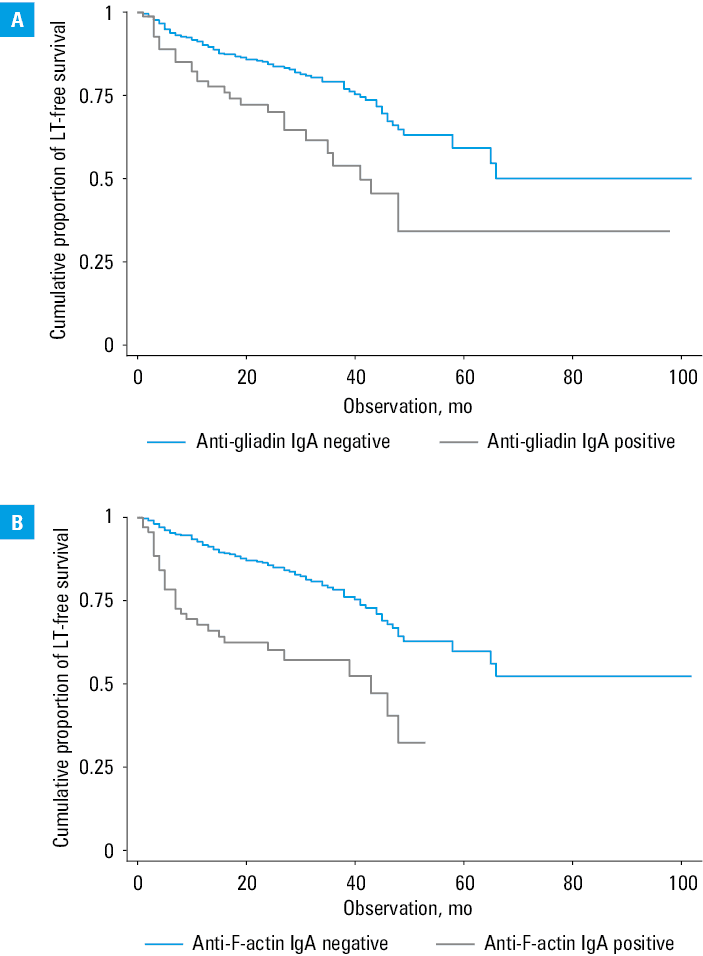
The Kaplan–Meier curves followed by the log‑rank test demonstrated that positive anti‑F‑actin and anti‑gliadin IgA antibodies were associated with a shorter transplantation‑free survival (median [IQR] survival, 13 [5–28] vs 20 [8–33] months; P <0.001 and 14 [7–28] vs 20 [8–33] months; P <0.001, respectively; Figure 1).
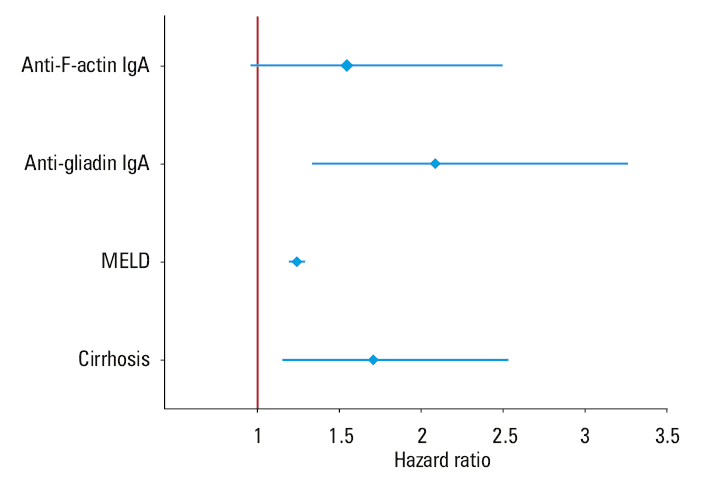
To identify independent variables for the risk prediction of poor outcome, a multivariable Cox regression analysis was performed. In the first step, significant variables were identified in the univariable part of the analysis (Table 3). In this analysis, positive anti‑F‑actin and anti‑gliadin IgA were significant predictors of poor liver transplantation‑free survival. In the second step, significant parameters were included in the multivariable Cox proportional hazards regression analysis. In the model, anti‑gliadin IgA, but not anti‑F‑actin IgA, remained an independent predictor of poor survival (Figure 2).
Variable | Hazard ratio (95% CI) | P value |
Anti‑F‑actin IgA (positive) | 3.06 (2.03–4.62) | <0.001 |
Anti‑gliadin IgA (positive) | 2.12 (1.4–3.2) | <0.001 |
Presence of cirrhosis | 3.48 (2.44–4.95) | <0.001 |
MELD score (points) | 1.25 (1.21–1.29) | <0.001 |
Men | 1.23 (0.84–1.8) | 0.29 |
Age, y | 1.01 (0.99–1.02) | 0.39 |
Disease duration, y | 0.99 (0.96–1.04) | 0.84 |
Association between the presence of antibodies and cholangiocarcinoma
There was no association between the risk of CCA and the analyzed antibodies (anti‑F‑actin IgA: RR, 1.4; 95% CI, 0.5–3.55; P = 0.47 and anti‑gliadin IgA: RR, 0.19; 95% CI, 0.03–1.41; P = 0.07). The univariable Cox proportional hazards analysis did not show any relationship between antibody positivity and the occurrence of CCA (anti‑F‑actin IgA: hazard ratio [HR], 0.39; 95% CI, 0.05–2.9; P = 0.36 and anti‑gliadin IgA: HR, 0.27; 95% CI, 0.06–1.17; P = 0.08).
Discussion
To address the unmet clinical need for the improvement of risk stratification in PSC, in this study we investigated the prevalence and clinical importance of anti‑gliadin and anti‑F‑actin IgA in a large prospective cohort of PSC patients. We found increased seropositivity of both analyzed antibodies in the PSC patients, as compared with healthy controls. In our cohort, anti‑gliadin IgA was present in 14% and anti‑F‑actin IgA in 12% of cases. These findings accord with those of previous reports, in which the prevalence of both antibodies in patients with PSC ranged between 9% and 28% and was significantly higher than in healthy individuals.9,10
In our cohort, the presence of the analyzed antibodies correlated with laboratory indices of the severe disease course, that is, liver cirrhosis and shortened transplantation‑free survival. Our findings support the results of Tornai et al10 who also found an association between anti‑gliadin and anti‑F‑actin autoantibodies and poor liver transplantation‑free survival in a group of PSC patients. Moreover, in our study, both antibodies correlated with MELD score, which is the most commonly used noninvasive tool for outcome prediction in patients with chronic liver diseases.11 Further, anti‑gliadin IgA remained the only independent predictor of poor survival, even after adjusting for MELD score and the presence of liver cirrhosis. These results differ to some extent from those obtained by Tornai et al.10 In their cohort, both anti‑gliadin and anti‑F‑actin IgA were significant predictors of transplantation‑free survival in the univariable analysis and after adjusting for the presence of cirrhosis. However, when adjusting for the Mayo risk score, the significant association was lost in the case of anti‑gliadin IgA positivity.10 This discrepancy may be related to differences in the study group characteristics and / or statistical approach. Nevertheless, in our opinion, all these findings demonstrate a strong evidence for the value of the novel antibodies as biomarkers of progressive disease phenotype and independent predictors of shortened liver transplantation‑free survival. Based on these results, we hypothesize that new or modified prognostic models incorporating antibody status could be developed in a larger multicenter study to improve risk stratification in these patients.
We also analyzed the association between the occurrence of CCA and the antibody seropositivity, as biliary cancer is one of the most fatal and unpredictable complications of the disease. However, we failed to find any association between IgA type anti‑gliadin and anti‑F‑actin and the risk of CCA in our cohort. This finding should be interpreted with caution. On the one hand, it may be the result of a distinct pathophysiological pathway of the developing biliary tract cancer. On the other hand, the relatively short observation period and low cancer incidence may be other causes of the lack of association between CCA and the analyzed antibodies. However, most CCA cases are diagnosed within the 2 first years after initial PSC diagnosis, and CCA incidence in our cohort is comparable to other observational long‑term studies. Further multicenter studies are needed to clarify this issue.
Our study is a purely clinical observation, but we believe that its results can contribute to the knowledge on the role of autoimmunity in PSC. Although PSC has not been considered a typical autoimmune liver disease, as the disease does not respond to steroid or immunosuppressive therapy, it is believed that, along with genetic and environmental factors, autoimmune pathways are involved in PSC pathogenesis.12,13 One argument in favor of this claim is its very high coincidence with IBDs, which are diseases with well‑proven autoimmune background.1 Moreover, several autoantibodies can be detected in the serum of affected patients. However, antineutrophil cytoplasmic or antinuclear antibodies, commonly detected in patients with PSC, do not correlate with the disease activity, have no predictive value, and seem not to play a pathogenic role.14 In contrast to these “classical” antibodies, recent reports provide novel insights into humoral autoimmunity in PSC. Our previous study in 2 independent cohorts of patients with PSC indicated remarkable prevalence of anti‑glycoprotein 2 and anti‑serine proteinase 3 antibodies in these patients, and identified seropositivity as a predictor of more severe disease phenotype, shorter survival, and finally CCA.15 Interestingly, both antibodies are directed against intestine‑derived autoantigenic targets and have been primarily described in patients with IBD.16-18 This link suggests involvement of immunological pathways within the gut‑liver axis in the development of biliary disease.19
Both anti‑gliadin and anti‑F‑actin can also be linked with the gut mucosal autoimmunity. Firstly, the antibody directed against gliadin is produced after exposure of this dietary protein to the mucosal immune system and for decades it has been considered a typical serological marker for celiac disease.20 Secondly, autoantibody against the cytoskeleton protein F‑actin can be found in patients with celiac disease21 and its level correlates with the extent of duodenal villi damage.22 Subsequent studies have showed that these antibodies are not specific to celiac disease and can be present in other conditions, especially those involving the liver. Anti‑F‑actin antibody is highly prevalent in autoimmune hepatitis, and the protein itself was identified as a specific target of the smooth muscle cell antibodies.23 Other investigations showed that significant number of patients with chronic liver diseases can be also anti‑gliadin seropositive. Sjöberg et al9 found the antibody in patients with various liver diseases. Among them, the patients with PSC showed the highest antibody prevalence (24%). Notably, all patients with liver disease included in the study were negative for anti‑endomysium antibody and had no celiac disease.9 Moreover, Reiberger et al24 reported that the frequency of anti‑gliadin in patients with liver cirrhosis was as high as 60%, and the antibody correlated with objective measures of portal hypertension.
Considering the above findings, it can be speculated that formation of gut‑derived antibodies in patients with liver diseases may be the consequence of a nonspecific immune reaction against dietary or intestinal peptides. This may occur after their exposure in the mucosal immune system due to the gut barrier damage and pathologic intestinal permeability. In this context, both autoantibodies may be regarded as markers of the gut barrier failure. Whether the same phenomenon is present in PSC and plays any pathogenic role, especially in patients without liver cirrhosis, is a controversial issue. On the one hand, previous studies failed to identify intestinal permeability in these patients, as assessed by the sucrose‑lactulose‑mannitol test.25 On the other hand, in a study by Tornai et al,10 anti‑F‑actin levels correlated with serum markers of intestinal fatty acid‑binding protein and various antimicrobial antibodies, which are biomarkers of the gut barrier failure. Another argument for the importance of the gut mucosal autoimmunity in patients with PSC is the fact, that all autoantibodies showing clinical significance in PSC are IgA subclass antibodies. Firstly, the prevalence of IgA antibodies against gliadin, F‑actin, glycoprotein 2, and serine proteinase 3 is much higher than the corresponding IgG reactivities.9,10,15,26 Moreover, Tornai et al27 showed that the majority of detected anti‑gliadin antibodies in PSC consisted of the secretory dimeric IgA as a result of retro‑transport from mucosal surface into the systemic circulation. We believe our study provides a supportive evidence on the role of a loss of mucosal tolerance to gut‑derived proteins resulting in the production of IgA reactive autoantibodies.
We acknowledge some limitations of our study. First, the study cohort is restricted to Polish patients from the local registry. As the registry does not contain some variables that could be potential confounders, such as smoking habit or body weight, our analysis has not been adjusted for these data. Moreover, the low occurrence of biliary malignancy in the follow‑up period hindered the power of association and risk stratification analyses. For these reasons, especially in the context of CCA, studies with longer follow‑up period and / or inclusion of an external validation cohort are necessary to confirm or refute our findings. Finally, due to purely observational design of our study, it is impossible to draw any conclusion of causality. Our analysis did not include experimental methods that could provide a direct explanation of the increased risk for the disease progression in the presence of the analyzed antibodies. Whether the antibody positivity is linked with pathophysiology or is rather the consequence of a more advanced liver disease is not completely clear. We believe our results may prompt further experimental studies that would answer these questions.
Despite some limitations, our study provides several important conclusions. To the best of our knowledge, it is the first report on a large prospective cohort of patients with PSC evaluating the clinical significance of IgA antibodies against F‑actin and gliadin in this liver disease. We indicated that the presence of the antibodies identified a subgroup of patients at a risk of a more aggressive disease course and shortened liver transplantation‑free survival. Our findings demonstrated the value of the analyzed antibodies as prediction markers of the progressive disease phenotype and unfavorable outcome. We suggest that the presented results open the door for further multicenter studies aiming at the inclusion of analyzed factors into existing or novel predictive and precision medicine models.28 This could improve the risk stratification in patients with PSC and facilitate clinical decision making and performing clinical trials.
Finally, our results, together with previous findings, provide new evidence on the involvement of the gut‑liver axis and the loss of mucosal tolerance in the natural course of PSC. We believe that despite observational design of the study, our results provide a strong rationale for future studies on this phenomenon in the experimental setting.
- Dyson JK, Beuers U, Jones DEJ, et al. Primary sclerosing cholangitis. Lancet. 2018; 391: 2547‑2559. | Crossref
- Janik MK, Wunsch E, Milkiewicz P. Variants of autoimmune liver diseases: how to diagnose and treat them? Pol Arch Intern Med. 2023; 133: 16408. | Crossref
- Weismuller TJ, Trivedi PJ, Bergquist A, et al. Patient age, sex, and inflammatory bowel disease phenotype associate with course of primary sclerosing cholangitis. Gastroenterology. 2017; 152: 1975‑1984.e8.
- European Association for the Study of the Liver. EASL Clinical Practice Guidelines on sclerosing cholangitis. J Hepatol. 2022; 77: 761‑806. | Crossref
- Alabraba E, Nightingale P, Gunson B, et al. A re‑evaluation of the risk factors for the recurrence of primary sclerosing cholangitis in liver allografts. Liver Transpl. 2009; 15: 330‑340. | Crossref
ARTICLE INFORMATION