
Safety, efficacy, and changing trends in endoscopic ablation for dysplastic Barrett esophagus in Poland: a long-term multicenter retrospective analysis
Key words: Barrett esophagus, coagulation, esophageal neoplasms, patient safety, radiofrequency ablation

 CC BY 4.0
Safety, efficacy, and changing trends in endoscopic ablation for dysplastic Barrett esophagus in Poland: a long-term multicenter retrospective analysis
CC BY 4.0
Introduction: Endoscopic ablation is the mainstay of treatment for dysplastic Barrett esophagus (BE), of which radiofrequency ablation (RFA) and argon plasma coagulation (APC) are the most widely available options.
Objectives: We aimed to analyze the safety and outcomes of endoscopic ablation for BE at the Polish centers offering this procedure.
Patients and methods: We retrospectively analyzed data from 3 high‑volume endoscopy centers between 2002 and 2024. We included adult patients with confirmed BE who received at least 1 ablation session with either conventional / hybrid APC (APC/h‑APC) or RFA, followed by at least 1 endoscopic follow‑up. The outcomes included the rate of complete remission of intestinal metaplasia (CR‑IM) and dysplasia (CR‑D), and adverse event (AE) rate. Risk factors for treatment failure were analyzed using a multivariable logistic regression model.
Results: We analyzed data from 191 patients, of which 160 were included (mean [SD] age, 59.4 [10.8] years; 79.4% men). The overall CR‑IM and CR‑D rates were 80% and 93.8%, respectively. We reported 49 minor AEs (30.6%), and 9 major AEs (5.6%), including 7 esophageal strictures (4.4%). In the early 2000s, APC was the only available ablation modality. However, since 2008, it has been gradually replaced by RFA. Notably, RFA was used for more severe BE cases and carried a higher risk of failed treatment than APC/h‑APC (odds ratio [OR], 7.48; P = 0.001). Other risk factors for treatment failure included the BE length (OR, 1.3; P = 0.002) and diabetes (OR, 7.48; P <0.001).
Conclusions: Endoscopic ablation for BE is safely and effectively provided in Poland at a few expert centers. Patients with diabetes and long‑segment BE are at an increased risk for treatment failure.
What's new?
Endoscopic ablation is an established treatment modality for dysplastic Barrett esophagus (BE), offered at a few expert endoscopic centers in Poland. That treatment is safe and effective, with a major adverse event rate of approximately 5% and a dysplasia eradication rate of over 90%. As of 2002, conventional argon plasma coagulation (APC) was the only available treatment option, but since 2008 it has been gradually replaced by radiofrequency ablation (RFA), and most recently, the hybrid‑APC (h‑APC) method has also become available. Additionally, over the past 2 decades, we have seen more severe BE cases requiring ablation, especially in older patients and those with more advanced baseline BE grades. The growing volume and severity of Barrett disease in Polish centers may reflect a broader trend of rising incidence in the region, potentially constituting a new health care challenge. Treatment centers should recognize potential risk factors for failed treatment, such as RFA use (vs APC/h‑APC), diabetes, and the length of BE segment.
Introduction
Barrett esophagus (BE), a precursor lesion to esophageal adenocarcinoma (EAC), is characterized by the replacement of squamous epithelium in the distal esophagus with metaplastic columnar‑type epithelium containing intestinal metaplasia (IM).1,2 It has been postulated that BE affects approximately 1% of the general population worldwide,3 and the common risk factors include gastroesophageal reflux disease, age (>50 years old), male sex, central obesity, and Caucasian ethnicity.4,5 The development of EAC is sequential and includes several premalignant stages, from nondysplastic BE through low‑grade dysplasia (LGD) and high‑grade dysplasia (HGD), eventually leading to adenocarcinoma.6 EAC remains the dominant histologic type of esophageal cancer in the Western world7 and is characterized by the most rapidly rising incidence rate among all solid tumors within recent decades.8 While squamous cell carcinoma of the esophagus has been the leading subtype of esophageal cancer in Poland, one may anticipate a switch toward the dominant prevalence of EAC in the relatively near future, due to a continuous shift toward a more Western lifestyle, eating habits, and therefore growing incidence of obesity within the population.9
Endoscopic treatment of BE‑related neoplasia, consisting of endoscopic resection of visible lesions followed by ablation of the residual flat BE, remains an established approach to eradicating BE and preventing its further progression to EAC.10-12 Within the available ablation modalities, argon plasma coagulation (APC) and endoscopic radiofrequency ablation (RFA) remain the mainstay treatment options. In recent years, a modification of APC combined with submucosal injection (hybrid‑APC [h‑APC]) has become available and increasingly utilized.13
In Poland, access to endoscopic ablation remains limited, and only a few expert centers offer such treatment. Moderate awareness of the epidemiological threat posed by BE within the medical community and the lack of reimbursement for ablative treatment within the Polish health care system may have contributed to this limited availability.
With this in mind, we performed a retrospective multicenter study to analyze the safety and outcomes of ablative treatment for dysplastic BE within representative Polish centers with an established practice of providing endoscopic treatment for BE.
Patients and methods
Study design
We conducted a retrospective multicenter study including 3 geographically distinct, high‑volume endoscopy centers in Poland (National Institute of Oncology in Warsaw [NIO], H‑T. Centrum Medyczne in Tychy [HTC], and Jagiellonian University Hospital in Kraków [UHK]). All the centers employ experienced endoscopy specialists and have proper support infrastructure. Patients were identified through the Polish Barrett’s Esophagus Registry,14 and within individual clinical and endoscopic databases in each participating center. Any available follow‑up information was included. The analyzed data timeframe spanned from June 2002 to March 2024.
Patients
We included all consecutive adult patients undergoing endoscopic ablation with either APC, h‑APC, or RFA for curative eradication of BE with at least 1 endoscopic follow‑up after treatment completion. The indications for ablation, in line with the European guidelines,10,12,15 included: 1) LGD without a visible lesion, confirmed on at least 2 separate endoscopies; 2) HGD without a visible lesion (on high‑definition endoscopy within the expert center); 3) complementary treatment after endoscopic resection of a visible lesion containing any degree of dysplasia or EAC.
Patients after noncurative endoscopic resection (submucosal invasion [≥T1b sm2], lymphatic / vascular invasion, poorly differentiated tumor [G3]), with ongoing treatment at the time of the analysis, and lost to follow‑up were excluded from the analysis.
Outcomes
The main outcomes included complete remission of intestinal metaplasia (CR‑IM), and complete remission of dysplasia (CR‑D), which were defined as the absence of any visible BE segment and negative biopsies for IM and dysplasia from a normal‑looking Z‑line on at least 1 endoscopy after treatment completion, respectively. Treatment failure was defined as persistent IM or any degree of dysplasia at the end of treatment (failure to achieve CR‑IM/D). Relapse was defined as recurrent IM or dysplasia at any time point after achieving CR‑IM.
Secondary outcomes included the occurrence of adverse events (AEs). AE severity was graded into 5 different classes according to the AGREE classification.16 For simplicity, grade I AEs were considered minor AEs, and defined as any AE deviating from the standard postprocedural course that could be handled with simple pharmacologic treatment (eg, antiemetics, antipyretics, analgesics, and electrolytes), without the need for endoscopic or surgical interventions. A typical example of minor AE was postprocedural chest pain. AEs of grade II and higher were considered major AEs. These were defined as AEs requiring treatment with drugs other than those allowed for grade I AE, need for blood / blood product transfusion, hospital admission for over 24 hours, and any endoscopic, radiologic, or surgical intervention. A typical example of the major AE was esophageal stricture requiring endoscopic dilatation.
Ablation procedures
Before each ablation, the patients underwent dedicated high‑quality endoscopy with documentation of the BE segment using the Prague C&M criteria (since their introduction in 2004).17 Any visible lesion would be assessed for eligibility for endoscopic treatment and removed through endoscopic mucosal resection (EMR) or endoscopic submucosal dissection (ESD), as appropriate.10,18
All ablation procedures were typically performed under conscious sedation or general anesthesia based on preference and local practice of each center. The conventional APC method was applied following the previously described protocol.19 Ablation with h‑APC was typically performed after a prior injection of saline (0.9% sodium chloride) followed by ablation with a power setting of 50–60 W (VIO 300D electrosurgery system with pulsed APC2; Erbe Elektromedizin, Tübingen, Germany). The treatment was carried out in either longitudinal or circumferential strips until visible coagulation. Lastly, RFA was applied with focal ablation catheters (Barrx‑60, Barrx‑90, Barrx‑ULTRA, Medtronic, Minneapolis, Minnesota, United States), typically for treatment of short noncircumferential BE segments (<3 cm). For long, circumferential BE segments, balloon‑type ablation devices were used (Barrx‑360, Barrx‑Express, Medtronic). The treatment course of each method is illustrated in Figure 1.
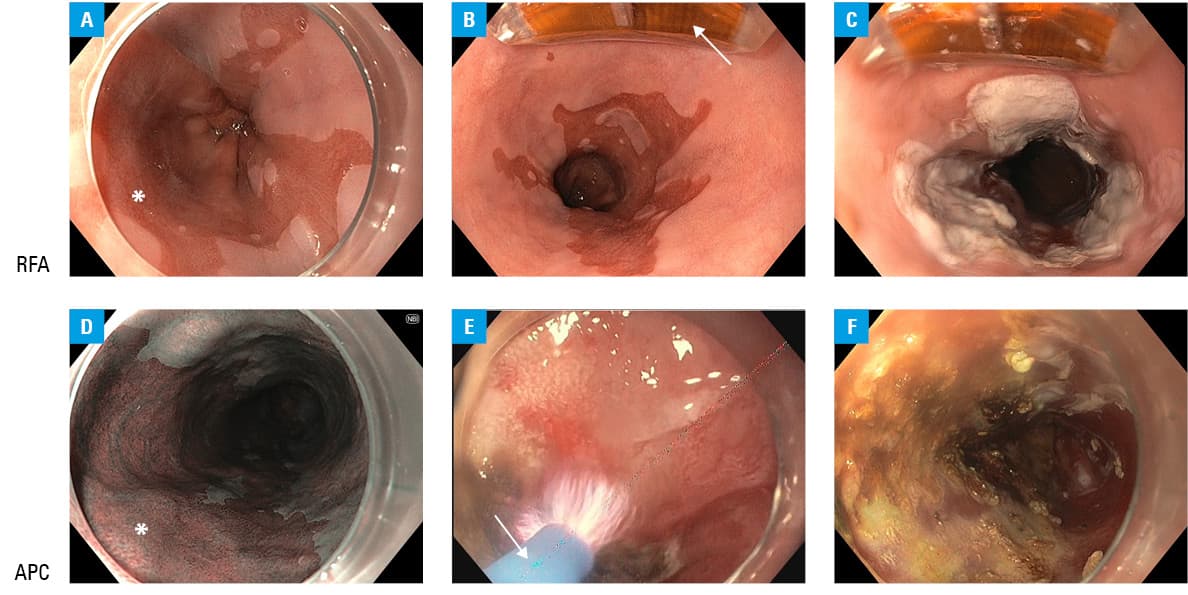
In the case of an uncomplicated course of treatment, the patients were discharged home on the day of the procedure. If required, subsequent treatment sessions were provided every 3 months. The postprocedural care (with some variations between centers) included a liquid diet for the first 24 hours, followed by a gradual introduction of a soft diet and a normal diet at the patients’ discretion. All patients were prescribed high‑dose proton pump inhibitors with additional H2-receptor antagonists for 3 months. After treatment completion, follow‑up endoscopies included systematic biopsies from the neo‑Z‑line during the first assessment 6 to 12 months post‑treatment.
Statistical analysis
Quantitative variables were described as means with SD, and medians with interquartile ranges (IQRs), where appropriate. Categorical variables were presented as counts and percentages of the cohort. The differences in patient characteristics and treatment outcomes were calculated using the χ2 test, one‑way analysis of variance, and Kruskal–Wallis rank sum test, where appropriate. We used a binomial linear multivariable logistic regression model to identify the risk factors for treatment failure. Clinical factors for the model included patient age, sex, length of BE segment, diabetes, presence of hiatus hernia, previous resection for a visible lesion, initial BE grade (LGD vs HGD vs EAC), treatment period (before vs after 2014), and ablation method (RFA vs APC/h‑APC). We reported the odds ratios (ORs) and 95% CIs.
The follow‑up time was calculated as the time between the first ablation procedure and the last available endoscopic follow‑up or relapse of any BE grade. We calculated and compared the relapse‑free times for APC/h‑APC and RFA using the Kaplan–Meier function, and the log‑rank test, respectively. Relapse rates were calculated as the difference in the proportional event rates during follow‑up. For all analyses, a P value below 0.05 was considered significant. We performed all analyses using R software version 3.4.3 (R Foundation for Statistical Computing, Vienna, Austria).
Ethics
Written informed consent was obtained from all patients before each endoscopic ablation and any surveillance procedure. Due to the noninterventional retrospective nature of this analysis, a separate Bioethics Committee approval for this study was deemed unnecessary.
Results
Cohort characteristics
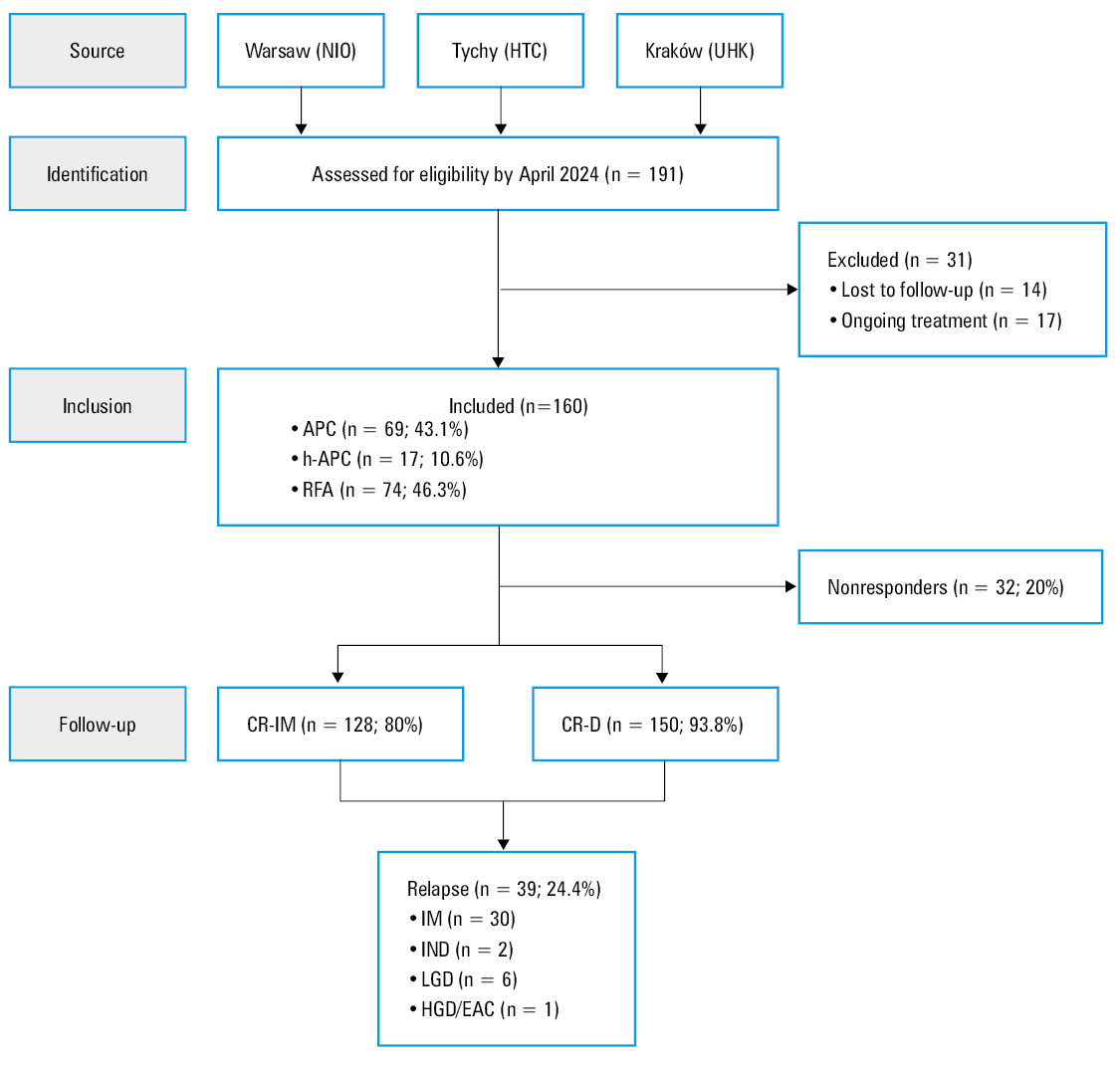
Overall, we analyzed data from 191 patients, of which 31 were excluded due to lack of follow‑up (n = 14) and ongoing treatment at the time of the analysis (n = 17), as shown in the study flowchart (Figure 2). Eventually, 160 patients were included in the analysis. Their mean (SD) age was 59.4 (10.8) years, and 79.4% were men (n = 127). Most patients were overweight / obese (body mass index [BMI] ≥25 kg/m2; 77.5%), and had a long segment BE (≥3 cm; n = 103; 64.4%). According to the Prague classification, the median BE length was C1M3 (IQR‑C, 1–4 cm; IQR‑M, 2–6 cm). Twenty‑six patients (16.3%) had undergone previous endoscopic resection for a visible lesion (21 EMRs, 5 ESDs). Altogether, baseline BE grades included 127 LGD (79.4%), 24 HGD (15%), and 9 pT1 adenocarcinomas (5.6%). The summary of patient characteristics is presented in Table 1.
Parameter | Patients (n = 160) | |
Data are presented as number (percentage) or median (interquartile range) unless indicated otherwise.
a BMI available in 71 patients (44.4%), data missing for 89 patients
| ||
Age, y, mean (SD) | 59.4 (10.8) | |
Men | 127 (79.4) | |
Weight, kg, mean (SD) | 85.9 (17.1) | |
BMIa, kg/m2 | 28 (25.7–30.7) | |
Diabetes | 15 (9.4) | |
Hiatal hernia | 122 (76.3) | |
BE segment length, cm | Circumferential | 1 (1–4) |
Maximum | 3 (2–6) | |
Baseline BE grade | Low‑grade dysplasia | 127 (79.4) |
High‑grade dysplasia | 24 (15) | |
Adenocarcinoma (pT1) | 9 (5.6) | |
Pre‑RFA treatment | Endoscopic mucosectomy | 21 (13.1) |
Endoscopic submucosal dissection | 5 (3.1) | |
When comparing the data from the centers, we noticed several marked differences in the cohort characteristics between the NIO and the other units (HTC, UHK). For example, the NIO patients were generally older (mean age of 61.4 years) and had more advanced disease at presentation. Namely, advanced neoplasia (HGD/EAC) was present in 27% of the NIO patients at baseline, and 2.7% and 12.5% of the HTC and UHK ones, respectively (P <0.001). Additionally, nearly a quarter of the NIO patients had previous endoscopic resection for a visible lesion (n = 26; 22.6%), whereafter ablation was indicated as complementary treatment. Individual cohort characteristics are summarized in Supplementary material, Table S1.
Trends in endoscopic ablation throughout time
On a procedural level, we analyzed 120 RFA, 140 APC, and 32 h‑APC procedures. Conventional APC was the first and the only available treatment modality within selected Polish centers at the beginning of the early 2000s. RFA became available in 2008, and has since gradually replaced the APC method. Consequently, between 2015 and 2022, RFA was the primary option used for BE ablation. However, following its introduction in 2022, h‑APC has been a feasible addition to the spectrum of ablation therapy, and during the last 2 years of our analysis (2023 and 2024) it comprised around half of the procedures. The changing trends in ablation therapy are illustrated in Figure 3.
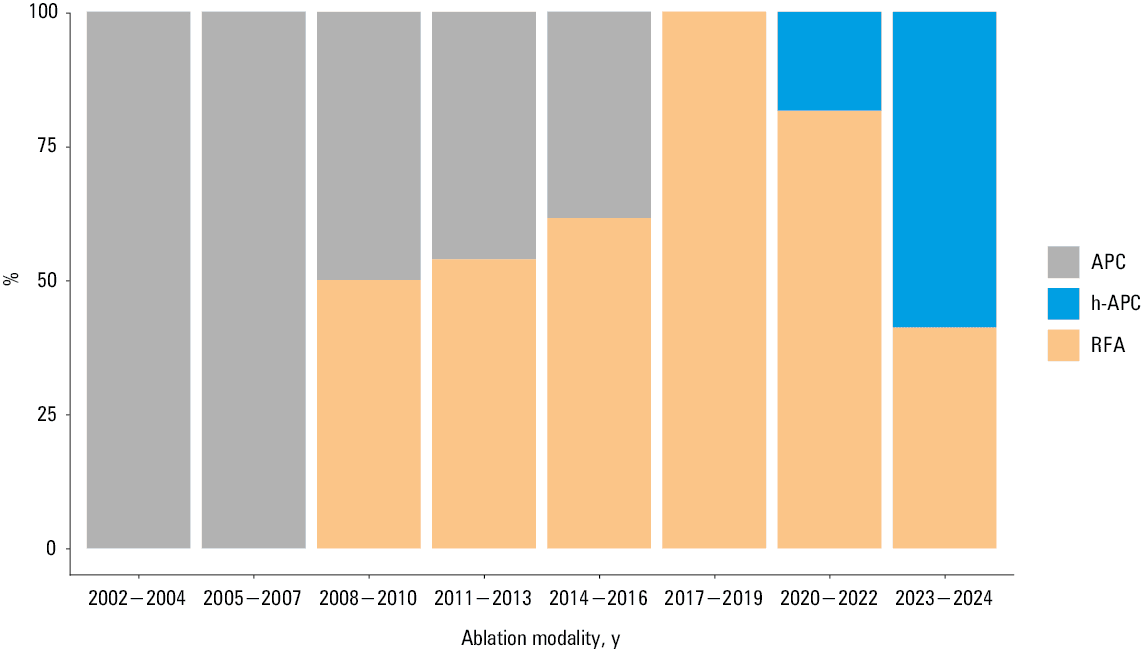
Alongside the evolution of ablation techniques, the patient profile has also changed significantly. Before 2014 (the midpoint of the observation period), only 1% of patients had advanced neoplasia (HGD/EAC) at baseline, whereas in the second half of the study, these patients constituted 50% of the cohort, as illustrated in Figure 4. Interestingly, this shift overlapped with the introduction of RFA treatment. Hence, a higher proportion of patients treated with RFA had advanced neoplasia at baseline (HGD/EAC) as compared with h‑APC/APC (31.1% vs 11.6%; P <0.001). Indeed, RFA was more often applied as adjuvant treatment after resection for a visible lesion than APC/h‑APC (27% vs 7%; P <0.001).
![Kaplan–Meier curves and the relapse-free survival rate in patients treated with argon plasma coagulation (APC/hybrid [h]-APC) and radiofrequency ablation (RFA)](/paim/_next/image/?url=https%3A%2F%2Fpamw.pl%2Fsites%2Fdefault%2Ffiles%2Fjson_zip_files%2Funcompressed%2F16912%2FIMAGES%2FKP_WEB__FIG_04.png&w=3840&q=75)
Outcomes
Altogether, the CR‑IM and CR‑D rates for all ablation techniques were 80% and 93.8%, respectively with a median of 1 ablation per patient (IQR, 1–2). We noted 49 minor AEs (30.6%), most of which constituted intermittent dysphagia / odynophagia (n = 17; 10.6%), and chest pain (n = 13; 8.1%). The major AE rate was 5.6% (n = 9), and most of these were esophageal strictures (n = 7; 4.4%). In all such cases, the strictures were treated endoscopically with a resolution of symptoms after a median of 2 balloon dilatations. A summary of the AEs is presented in Table 2.
Parameter | Value | |
Data are provided as number (percentage).
a AE requiring additional pharmacologic treatment
Abbreviations: AE, adverse event | ||
All AEs | 58 (36.3) | |
Minor AEs | Total | 49 (30.6) |
Dysphagia / odynophagia | 17 (10.6) | |
Fever | 11 (6.9) | |
Esophagitis | 8 (5) | |
Chest paina | 13 (8.1) | |
Major AEs | Total | 9 (5.6) |
Perforation | 1 (0.6) | |
Bleeding | 1 (0.6) | |
Stricture | 7 (4.4) | |
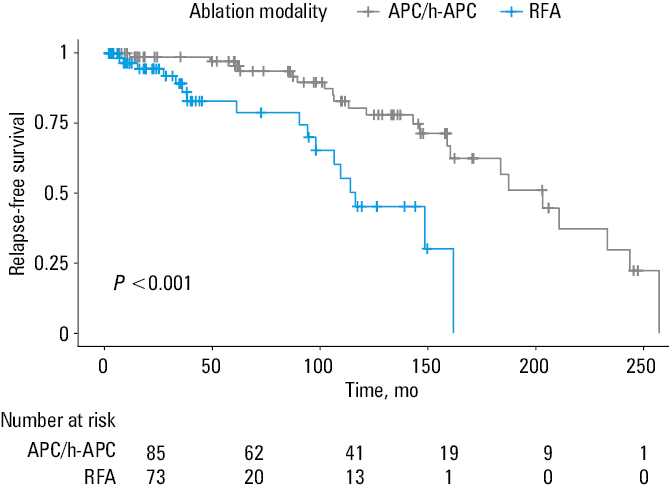
Looking specifically at the ablation techniques, fewer sessions were applied per patient with RFA than APC/h‑APC (median of 1 [1–2] vs 2 [1–2.8] sessions, respectively), and RFA was shown to have a lower rate of CR‑IM than APC/h‑APC (67.6% vs 90.7%; P <0.001). There was, however, no difference in the CR‑D rates between the methods (90.5% vs 97%; P = 0.22). Moreover, no significant difference in the AE rates between the 2 modalities was noted (Table 3). The median (IQR) follow‑up time was 27.5 (8.9–72.7) months for RFA, and 97.1 (49–146) months for APC/h‑APC. Within the follow‑up period, we noticed a higher relapse rate in the RFA group than in the APC/h‑APC group (25.6% vs 23%), as illustrated by the Kaplan–Meier curves in Figure 5 (log‑rank test, P <0.001).
Parameter | APC/h‑APC (n = 86) | RFA (n = 74) | P value | |
Data are presented as number (percentage) or median (interquartile range) unless indicated otherwise.
| ||||
Patient profile | ||||
Age, y, mean (SD) | 60.9 (10.6) | 57.7 (10.8) | 0.73 | |
Indication, initial BE grade | LGD | 76 (88.4) | 51 (68.9) | 0.001 |
HGD | 8 (9.3) | 16 (21.6) | ||
EAC | 2 (2.3) | 7 (9.5) | ||
Previous resection for a visible lesion | 6 (7) | 20 (27) | 0.001 | |
Maximum extent of BE segment, cm | C1M4 (C, 0–4; M, 3–6) | C1M3 (C, 0–3; M, 2–5) | 0.09 | |
Treatment outcomes | ||||
Number of sessions | 2 (1–2.8) | 1 (1–2) | 0.5 | |
CR‑IM rate | 78 (90.7) | 50 (67.6) | <0.001 | |
CR‑D rate | 83 (97) | 67 (90.5) | 0.22 | |
All AEs | 30 (34.9) | 27 (36.5) | 0.96 | |
Stricture rate | 2 (2.3) | 5 (6.8) | 0.29 | |
Follow‑up data | ||||
Follow‑up time, mo | 97.1 (49–146) | 27.5 (8.9–72.7) | – | |
Relapse | 22 (25.6) | 17 (23) | – | |
Risk factors for treatment failure
In a multivariable logistic regression model, we noticed an over 30% increase in treatment failure with every 1 cm of BE segment (OR 1.3; 95% CI, 1.11–1.54; P = 0.002), and over 7‑fold increase with the use of RFA, as compared with h‑APC/APC (OR, 7.48; 95% CI, 2.52–25.45; P = 0.001), and presence of diabetes (OR, 7.62; 95% CI, 1.67–37.53; P = 0.01). The model’s results are presented in Supplementary material, Table S2.
Discussion
In this study, we present multicenter data on ablation therapy for dysplastic BE in 3 Polish centers of different characteristics. We summarized the data from a national oncological referral center (NIO), a high‑quality private endoscopy center (HTC), and a university teaching hospital (UHK). Overall, we found the safety and efficacy of ablative treatment within these centers to be satisfactory, reflected by a major AE rate of slightly over 5% and CR‑M and CR‑D in 80% and 93.8% of the patients, respectively.
However, it should be emphasized that the overall availability of ablative treatment seems insufficient in Poland. The treatment is confined to a few expert centers, and within our cohort, the median number of ablations per patient amounted to a single session. Other landmark multicenter studies, such as the SURF trial and EURO‑II trial reported a median (IQR) of 3 (3–4) ablation sessions with RFA per patient.20,21 We believe that lack of reimbursement within the Polish medical system hinders both the general availability of ablative treatment and continuity in providing repeat ablations. On the other hand, despite a low number of ablations per patient, the CR‑D rate presented in our report (93.8%) seems comparable to previously reported data, such as the 10‑year report from the United Kingdom (UK) National HALO RFA registry (CR‑D, 88%),22 the Dutch RFA registry (CR of BE, 94%),23 or the Belgian RFA registry (CR‑D, 93%).24
Our multicenter analysis included 3 centers with various profiles to provide real‑life data and expand generalizability of our findings. Notably, a previous Belgian study showed a marked difference in remission rates between patients treated within nonacademic and academic centers (CR‑IM, 64% vs 89%; P <0.001).24 This, however, was not reproduced in our report. Nonetheless, we noticed a significant difference in treatment outcomes related to the volume and experience of the endoscopy center, as the lowest CR‑IM and CR‑D rates were noted for the center of the lowest experience (UHK). NIO and HTC have provided ablation services for over a decade, whereas UHK has been offering such treatment for just over 2 years.
There are very few reports that directly compare the outcomes of the APC and RFA methods. Despite some reservations, particularly regarding the different periods during which these treatments were offered in Poland, we were able to examine and compare the outcomes of both treatment modalities. Although the efficacy of eradicating dysplasia was comparable, we noted a significantly lower rate of CR‑IM for RFA than for APC/h‑APC (67.6% vs 90.7%; P <0.001). Indeed, we have shown that the RFA was associated with an over 7‑fold increased risk of treatment failure, as compared with APC/h‑APC (OR, 7.48; 95% CI, 2.52–25.45; P <0.001). It needs to be emphasized, however, that the patients treated with RFA had more advanced initial BE grade, more often underwent previous resection for a visible lesion, and (on average) received only a single session of treatment as compared to a median of 2 APC/h‑APC sessions. As mentioned before, RFA is not reimbursed in the Polish health care system, which could have impacted the decision‑making process and result in a low number of ablation sessions. Interestingly, the reimbursement issues related to RFA are not only confined to Polish health care system, and have been discussed in an earlier Belgian report.24
In terms of safety, the patients who underwent RFA experienced a similar AE rate as those undergoing APC/h‑APC (36.5% vs 34.9%). Notably, however, the stricture rate was numerically higher in the RFA group than in the APC/h‑APC groups (6.8% vs 2.3%). In a randomized study by Peerally et al25 comparing RFA and APC, the stricture rate in the RFA group was similar to that in the APC group, with rates of 8.3% and 8.1% respectively.
Although RFA is generally considered safe, a previous meta‑analysis of 37 studies involving 9200 patients revealed a pooled AE rate of 8.8% (95% CI, 6.5%–11.9%) associated with the procedure. Within this Figure, 5.6% of the patients developed strictures (95% CI, 4.2%–7.4%), 1% bleeding (95% CI, 0.8%–1.3%), and 0.6% perforation (95% CI, 0.4%–0.9%).26 Although we reported a slightly higher rate of esophageal strictures post‑RFA (6.8%) than the more recent long‑term reports from the Dutch national database (15%)23 or the UK HALO Registry (12%),22 our post‑RFA stricture rate remains relatively low. All strictures reported in our study were successfully managed with endoscopic dilatation. Otherwise, we recorded 1 instance of postprocedural bleeding requiring blood transfusion (0.6%) and 1 case of esophageal perforation (0.6%). To conclude, our findings suggest that RFA and APC/h‑APC treatments are both safely administered at the participating 3 Polish medical centers. However, our study does point to the need for further randomized trials to compare the APC method with the RFA one. Moreover, emerging ablation techniques with the potential to even further increase the safety profile of ablation treatment, such as cryoballoon ablation, are increasingly being introduced into clinical practice.27
Despite high efficacy of BE eradication, nearly a quarter of the patients in our cohort experienced relapse during follow‑up, and this occurred more frequently within the RFA than the APC/h‑APC group. To compare, Tan et al28 reported a 29.1% relapse rate post‑RFA within a median of 1.9 years of follow‑up. In our study, the relapse rate post‑RFA was slightly lower at 23%. As for conventional APC, available data vary widely. Madisch et al29 reported a relapse rate as low as 12.1%. On the contrary, Mörk et al30 noted a recurrence rate as high as 66% during 51‑month follow‑up. Similarly, Saligram et al31 documented a 50% recurrence rate after complete BE eradication. Specifically for h‑APC, a recent systematic review and meta‑analysis by Estevinho et al32 showed a recurrence rate of 11% after h‑APC, followed by a prospective multicenter study by Knabe et al33 reporting a 2‑year recurrence rate of 29.2%. Altogether, the relapse rate in the APC/h‑APC cohort of our study falls within those Figures (25.6%). These findings, however, underscore the significant relapse rates associated with both RFA and APC/h‑APC methods. A disparity in follow‑up times between the 2 methods in our report should be emphasized, as the follow‑up time was markedly shorter in the RFA group (27.5 months), as compared with the APC group (97.1 months). Additionally, our analysis combined the conventional- and h‑APC methods for evaluation purposes, without assessing the recurrence rate for these groups separately.
The patient‑related risk factors for treatment failure included the length of the BE (OR, 1.3 for each 1 cm of the segment; 95% CI, 1.11–1.54; P = 0.002), and diabetes (OR, 7.62; 95% CI, 1.67–37.53; P = 0.01). The BE length is a well‑known risk factor for treatment failure, a finding that has been confirmed in other studies.34 Interestingly, we did not find a relation between advanced histology and age and the treatment failure, which was pointed out in some previous reports.34,35 However, we showed a 7‑fold higher risk of treatment failure in patients with diabetes. We hypothesize that it reflects the whole spectrum of metabolic syndrome including obesity that could lead to increased acid burden resulting in difficulty in achieving full remission with ablation.
To our knowledge, this is the first Polish multicenter report summarizing the outcomes and changing trends in ablation therapies for dysplastic BE over the last 20 years. The results are provided based on robust clinical data from 3 experienced and established endoscopy units. However, our study has several limitations. First, its retrospective design presents data from over 20 years, during which both technical aspects of the procedures and equipment improvements have been implemented, which might have introduced some bias regarding the comparison of each treatment. Second, despite the multicenter data, the study cohort remains relatively small, which may be related to a generally low prevalence of BE within the Polish population, as compared with other Western populations. For example, a previous multicenter study from Poland showed a BE prevalence of less than 3% within symptomatic patients undergoing routine upper endoscopy.36 Moreover, our cohort had limited data on certain patient characteristics (eg, BMI was available in less than 50% of patients), limiting the available information for detailed assessment.
In conclusion, despite a limited cohort size, our multicenter study highlights the satisfactory efficacy and safety of ablative therapies for dysplastic BE provided at selected Polish endoscopy centers, despite certain systemic challenges including the lack of reimbursement for such treatment. While both RFA and APC/h‑APC methods proved effective, RFA showed a slightly higher risk of treatment failure, which may have been influenced by patient factors and the limited number of treatment sessions. Our study also identified the length of the BE segment and diabetes as significant risk factors for treatment failure. Lastly, our analysis demonstrated a growing proportion of BE patients with severe dysplasia and EAC throughout the last 2 decades. This worrying trend prompts the need to maintain a high standard of ablation services in the country and further expand their availability.
- Spechler SJ, Souza RF. Barrett’s esophagus. N Engl J Med. 2014; 371: 836‑845. | Crossref
- Sugano K, Spechler SJ, El‑Omar EM, et al. Kyoto international consensus report on anatomy, pathophysiology and clinical significance of the gastro‑oesophageal junction. Gut. 2022; 71: 1488‑1514.
- Marques de Sá I, Marcos P, Sharma P, Dinis‑Ribeiro M. The global prevalence of Barrett’s esophagus: a systematic review of the published literature. United European Gastroenterol J. 2020; 8: 1086‑1105. | Crossref
- Corley DA, Kubo A, Levin TR, et al. Race, ethnicity, sex and temporal differences in Barrett’s oesophagus diagnosis: a large community‑based study, 1994‑2006. Gut. 2009; 58: 182‑188. | Crossref
- Świdnicka‑Siergiejko AK, Marek T, Waśko‑Czopnik D, et al. Diagnostic and therapeutic management in gastroesophageal reflux disease: consensus of the Polish Society of Gastroenterology. Pol Arch Intern Med. 2022; 132: 16196. | Crossref
SUPPLEMENTARY MATERIAL
ARTICLE INFORMATION