
Diffuse pulmonary ossification with pneumoconiosis confirmed on transbronchial lung biopsy

 CC BY 4.0
Diffuse pulmonary ossification with pneumoconiosis confirmed on transbronchial lung biopsy
CC BY 4.0
We present a case of a 49‑year‑old man with a 20‑year history of pneumoconiosis who was initially suspected to have pulmonary alveolar microlithiasis (PAM) and was admitted to our hospital in March 2024. The patient was employed as a wood kiln worker between 1994 and 1998. He began experiencing chest tightness and dyspnea in 2004. Chest radiography findings from 20 years prior led to a diagnosis of pneumoconiosis, but he did not receive any specific treatment. In December 2019, chest computed tomography (CT) showed multiple ground‑glass opacities and calcifications in the posterior lower‑lung fields.
Physical examination after admission to our hospital in 2024 was unremarkable. However, the levels of partial pressure of oxygen (63.8 mm Hg; reference range [RR], 80–100 mm Hg) and carbon dioxide (32.7 mm Hg; RR, 35–45 mm Hg) were low, whereas the Krebs von den Lungen‑6 (KL‑6) level was elevated (1099 U/ml, reference range ≤500 U/ml). Pulmonary function testing showed mild obstructive impairment, with predicted forced expiratory volume in 1 second (FEV1) of 72.8% and forced vital capacity (FVC) of 80.3%, FEV1/FVC ratio of 74.51%, and predicted diffusing capacity of the lungs for carbon monoxide of 68.2%. CT imaging again showed diffuse ground‑glass opacities in both lungs, calcifications, and bone density in the mediastinal window (Figure 1A–1C). Subsequently, transbronchial lung biopsy (TBLB) was performed on segment B8 of the lower lobe of the right lung, using 1.6‑mm biopsy forceps to obtain 2 tissue samples. Histopathology examination showed chronic inflammation with ossification and calcification of the interstitial tissues, confirming the diagnosis of diffuse pulmonary ossification (DPO; Figure 1D). After symptomatic treatment with oxygen therapy, nebulization, bronchodilators, and antitussive and expectorant medications, the patient’s clinical symptoms markedly improved. As of October 2024, he was in a good physical condition.
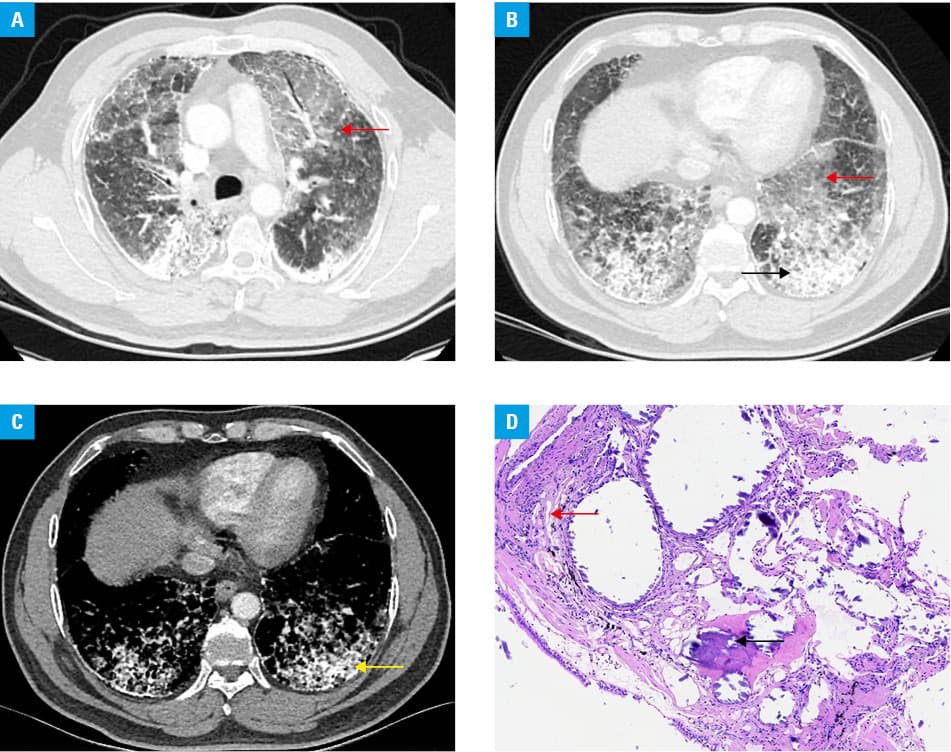
DPO is a rare pathological condition, characterized by the aberrant formation of mature bone within the lung parenchyma.1 Due to its insidious onset and slow progression, as well as radiological features that often resemble those of other pulmonary diseases, DPO has been historically diagnosed postmortem via autopsy.2 Thus, fewer than 100 cases have been documented. Here, we present a DPO case, detailing the diagnostic process from hospital admission to confirmation of DPO.
Understanding the pathogenesis of DPO is crucial for its diagnosis and subsequent treatment strategies. However, the pathogenesis of DPO has been unclear. Based on the reported cases, it is speculated that various abnormal pulmonary irritation processes (eg, pulmonary inflammation and deposition of metallic particles) may contribute to its development.3,4 In our case, the patient had a 4‑year history of occupational dust exposure without receiving treatment. Furthermore, at the most recent admission, the patient’s KL‑6 inflammation marker was significantly elevated, and a blood gas analysis indicated hypoxia. These effects may be key mechanisms contributing to the development of DPO in this patient.
DPO is difficult to distinguish from other pulmonary diseases, such as PAM and interstitial lung disease, because of its subtle clinical manifestations and the overlap of radiographic features with other diseases.5 Notably, histopathological examination is the gold standard for diagnosing DPO. In our case, the definitive diagnosis of DPO was confirmed solely though TBLB under local anesthesia. Compared with traditional diagnostic methods (eg, examination of surgical specimens), TBLB causes less pulmonary trauma and offers important safety and practical advantages in complex diagnostic cases involving diffuse lesions such as DPO, helping to prevent unnecessary treatment delays and incorrect therapeutic decisions.
- Kanne JP, Godwin JD, Takasugi JE, et al. Diffuse pulmonary ossification. J Thorac Imaging. 2004; 19: 98‑102. | Crossref
- Tseung J, Duflou J. Diffuse pulmonary ossification: an uncommon incidental autopsy finding. Pathology. 2006; 38: 45‑48. | Crossref
- Peros‑Golubicić T, Tekavec‑Trkanjec J. Diffuse pulmonary ossification: an unusual interstitial lung disease. Curr Opin Pulm Med. 2008; 14: 488‑492. | Crossref
- Ohtsuki Y, Yamaka A, Ohyama H, et al. Histochemical demonstration of aluminium and iron deposition in pulmonary bony tissues in three cases of diffuse pulmonary ossification. Histol Histopathol. 2008; 23: 137‑141.
- Chen CW, Wu FZ. Progressive sandstorm lung in pulmonary alveolar microlithiasis. Ann Thorac Surg. 2019; 107: e55. | Crossref
ARTICLE INFORMATION