
An unusual etiology of a well-known disease: the first case of infective endocarditis caused by Lactococcus garvieae bacterium reported in Poland

 CC BY 4.0
An unusual etiology of a well-known disease: the first case of infective endocarditis caused by Lactococcus garvieae bacterium reported in Poland
CC BY 4.0
Infective endocarditis (IE) is a serious, often life‑threatening disease. According to the available data, it occurs at a frequency of approximately 3–10 cases per 100 000 people.1 In 90% of cases, it is caused by bacteria. Lactococcus garvieae (from the Streptococcus type), a gram‑positive bacterium primarily pathogenic to freshwater fish in the Far East, was found to be a very unusual etiological factor.2 So far, only 28 cases of IE of this etiology have been documented, making this the first reported case in Poland.
A 75‑year‑old patient, after biological aortic valve prosthesis implantation (surgical aortic valve replacement), with paroxysmal atrial fibrillation, chronic heart failure, after implantation of a cardioverter‑defibrillator, treated for bladder papilloma, was admitted to a hospital with fever up to 38 °C recurring for about 2 months and abdominal pain. The medical history indicated general weakness and deterioration of exercise tolerance. Physical examination showed tenderness in the left lower abdomen on palpation and discrete edema of the lower extremities. Laboratory tests showed elevated inflammatory markers, that is, C‑reactive protein of 1865.9 nmol/l (reference range [RR], 0–47.6 nmol/l), leukocytosis of 11 × 109/l (RR, 4.3–9.64 × 10⁹/l) with neutrophilic shift, elevated parameters of nitrogen retention (creatinine, 159.12 µmol/l; RR, 61.88–106.08 µmol/l), and mild microcytic anemia. Abdominal ultrasound showed features of mild hepatosplenomegaly. Chest X‑ray was unremarkable. Empirical intravenous antibiotic therapy with levofloxacin 2 × 500 mg daily was initially implemented. Two out of 2 blood cultures were positive for L. garvieae bacteria, identified by matrix‑assisted laser desorption / ionization time‑of‑flight mass spectrometry and sensitive to levofloxacin (minimum inhibitory concentration [MIC], 1 mg/l, benzylpenicillin (MIC, 0.38 mg/l), ampicillin (MIC, 0.25 mg/l), ceftriaxone (MIC, 0.19 mg/l), and linezolid (MIC, 1 mg/l). Transthoracic echocardiography did not show morphological changes suggestive of IE. Due to the presence of a biological aortic valve prosthesis, transesophageal echocardiography was performed and demonstrated the presence of active IE located on the prosthesis. Thickened cusp edges were observed, along with the presence of a long, soft echo (corresponding to IE vegetations) measuring 25 mm × 5 mm attached to the noncoronary aortic cusp, and a smaller echo measuring 8 mm attached to the left coronary cusp. In addition, inflammatory infiltration was visualized in the prosthesis ring at the junction of the noncoronary and left coronary cusps, measuring 25 mm × 6 mm (Figure 1A and 1B and Supplementary material). There was no aortic valve insufficiency or paravalvular leak. Due to the presence of these abnormalities, the antibiotic therapy was modified according to the antibiogram, by an addition of ampicillin (6 × 2 g daily) with ceftriaxone (1 × 2 g daily) (currently there are no recommendations for treating IE of this etiology).3 Clinical improvement and reduction of the inflammatory parameters on the control laboratory tests were observed. Further interview indicated that the patient had consumed raw fish in the form of sushi in recent months. As a potential source of dental infection, after consultation, 4 teeth were extracted, that is 26, 34, 43, and 44. Follow‑up blood cultures were sterile. Significant regression of the lesions was observed on follow‑up transesophageal echocardiography (Figure 1C). The patient was consulted by a cardiac surgeon, and due to significant improvement after pharmacotherapy, he was not qualified for surgical intervention. Treatment was complicated by diarrhea of Clostridioides difficile etiology. After completion of a 6‑week long intravenous antibiotic therapy, the patient was discharged in good general condition with a recommendation for regular cardiological care. There were no recurrent symptoms observed in the following months after discharge.
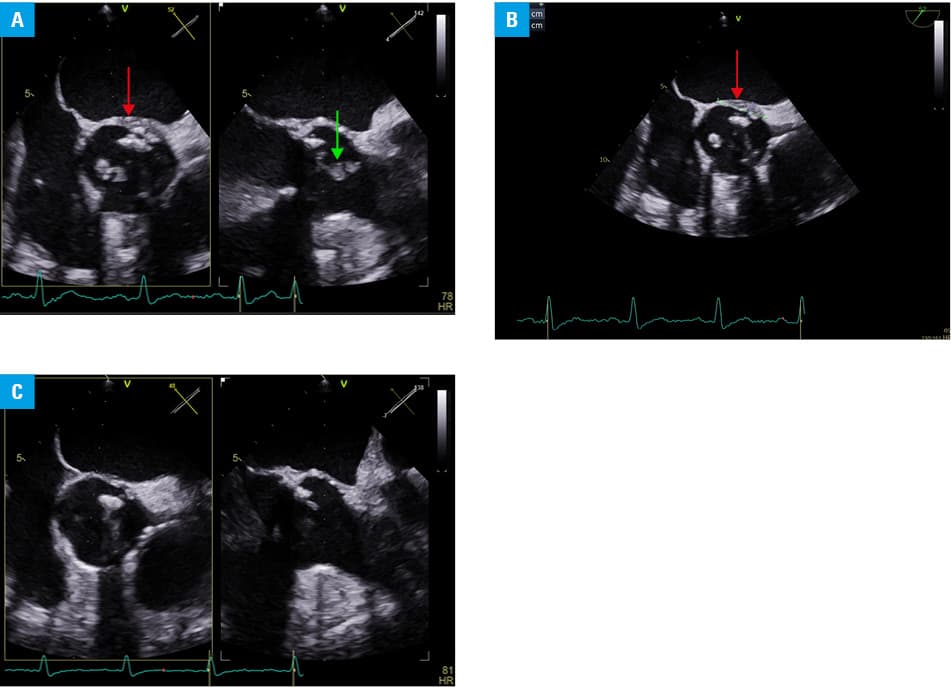
The first available information regarding IE of L. garvieae etiology dates back to 1991. So far, 28 cases of IE of this etiology have been described, with the majority in Europe (almost 50%) and Asia (about 25%).4 Eleven patients required cardiac surgical intervention. The mitral valve was most commonly affected. Bacterial vegetations on the biological aortic valve prostheses have been described in 10 patients and on native aortic valves in 4 patients.5 IE is a diagnosis that should always be considered in a differential diagnosis of fever, especially in patients with a history of cardiac surgical interventions.
- Orzech JW, Zatorska K, Grabowski M, et al. Preliminary results from the Polish Infective Endocarditis Registry (POL‑ENDO): time to change clinical practice. Kardiol Pol. 2024; 82: 609‑616. | Crossref
- Navas ME, Hall G, El Bejjani D. A case of endocarditis caused by Lactococcus garvieae and suggested methods for identification. J Clin Microbiol. 2013; 51: 1990‑1992. | Crossref
- Delgado V, Ajmone Marsan N, De Waha S, et al. 2023 ESC Guidelines for the management of endocarditis: developed by the task force on the management of endocarditis of the European Society of Cardiology (ESC). Eur Heart J. 2023; 44: 3948‑4042.
- Rojas‑Velasco G, Méndez‑Hernández DP, Escobar‑Sibaja LE, et al. Lactococcus garvieae, an unusual etiology of prosthetic valve endocarditis. First case reported in Mexico [in Spanish]. Arch Cardiol Mex. 2023; 93: 369‑371. | Crossref
- Landeloos ER, Berkow EL, Chow N, et al. Lactococcus garvieae prosthetic mitral valve endocarditis: a case report and literature review. Clin Microbiol Newsl. 2017; 39: 99‑103. | Crossref
SUPPLEMENTARY MATERIAL
ARTICLE INFORMATION