
In search for the cause of systolic murmur: a case study of MYH7-positive hypertrophic cardiomyopathy with right ventricular flow obstruction

 CC BY 4.0
In search for the cause of systolic murmur: a case study of MYH7-positive hypertrophic cardiomyopathy with right ventricular flow obstruction
CC BY 4.0
We present a case of a 35‑year‑old woman with dyspnea on exertion, New York Heart Association class II, and heart palpitations lasting for 6 months. On physical examination, a loud systolic murmur was heard at the heart base. Resting electrocardiogram (ECG) showed sinus rhythm, left anterior fascicular block with traits of left ventricular (LV) and right ventricular (RV) hypertrophy (Figure 1A–1D). On transthoracic echocardiography, LV ejection fraction was 70%. There was a massive thickening (24 mm) of the interventricular septum (IVS). The whole IVS was hypokinetic (longitudinal strain of this region was approximately –8.5%, whereas global strain of the LV was –19.2%). Left ventricular outflow tract (LVOT) gradient was 15 mm Hg at rest and 24 mm Hg during the Valsalva maneuver (Supplementary material, Figure S1). The ECG and echocardiography images were suggestive of hypertrophic cardiomyopathy (HCM). Pharmacological treatment was based on bisoprolol 1.25 mg daily. A higher dose was not tolerated due to low blood pressure. The patient’s father died at the age of 45 due to sudden cardiac death (SCD) of unknown etiology. In patients with cardiomyopathies we perform genetic analysis using the next‑generation sequencing including a panel of 17 genes: BAG3, DCM, DSC2, DSG2, DSP, FLNC, HCM, LMNA, MYBPC3, MYH7, MYL2, MYL3, PKP2, RBM20, TNNI3, TNNT2, and TTN. The patient underwent genetic testing and a MYH7 gene mutation was found. Analysis of the sequence of the MYH7 gene revealed a NM_000257.4(MYH7):c.2609G>A (p.Arg870His) variant.
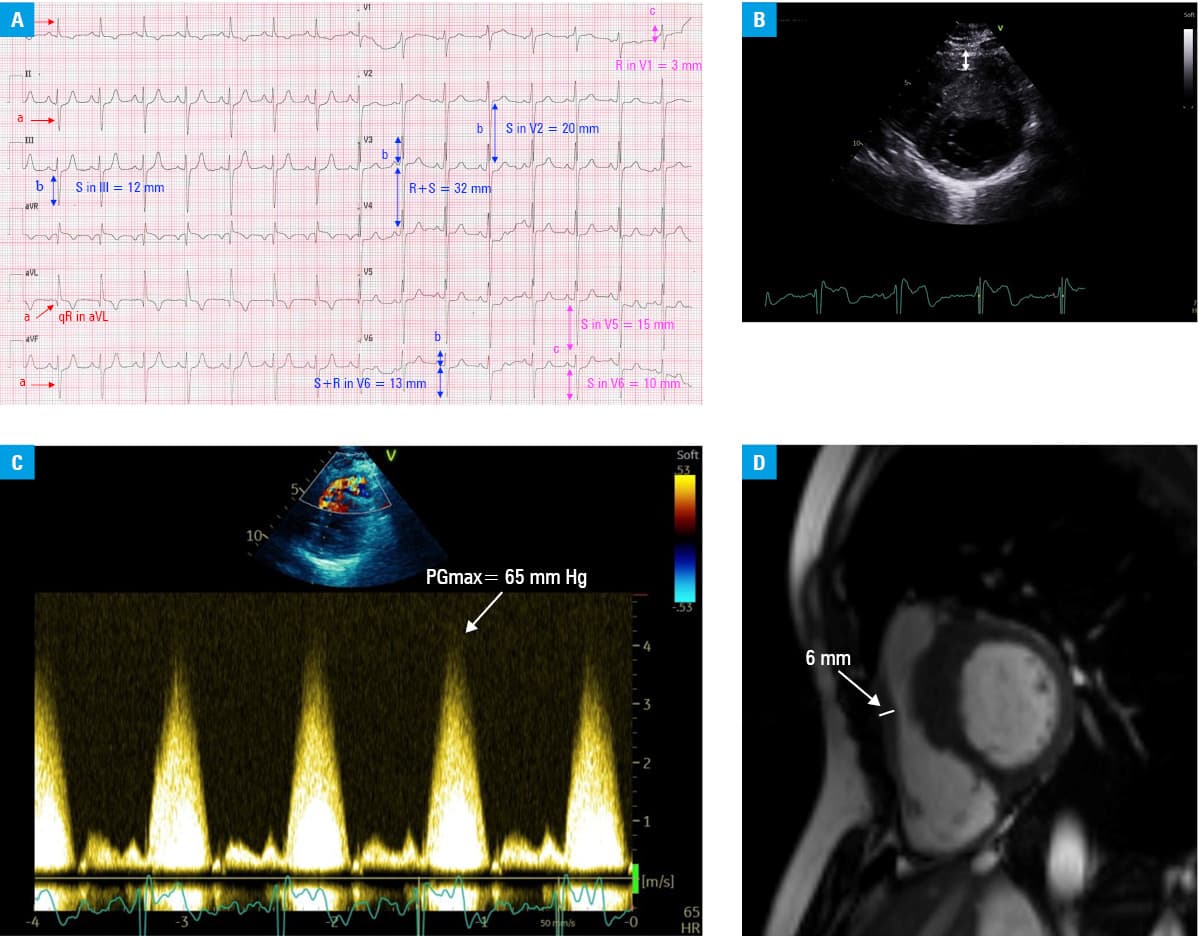
Abbreviations: PGmax, maximum pressure gradient
Since there was a discrepancy between physical examination with the systolic murmur and a lack of significant LVOT obstruction (LVOTO), further detailed echocardiographic examination in a reference center was performed. It revealed thickening of the RV muscle to 7–8 mm, on the border of the inflow and outflow tracts, with visible flow acceleration and a maximum gradient of 65 mm Hg (Figure 1A–1D). Cardiac magnetic resonance corresponded with a diagnosis of HCM with asymmetrical hypertrophy of the IVS with intramural areas of late gadolinium enhancement in the basal and midseptal segments. The scan confirmed localized thickening of the RV wall in an hourglass shape causing narrowing of the RV cavity (Figure 1A–1D and Supplementary material, Figure S1).
Holter ECG monitoring indicated an episode of nonsustained ventricular tachycardia. The 5‑year risk of SCD was estimated at 9.68% using the HCM risk calculator. Electrocardiologic and echocardiographic findings utilized in the calculation of the SCD risk in patients with HCM are summarized in Supplementary material, Figure S2. After a joint discussion, the patient was qualified for implantable cardioverter‑defibrillator (ICD) insertion. Due to his young age and no conduction disturbances, a subcutaneous ICD was chosen. The patient was discharged after the procedure on 2.5 mg bisoprolol daily. Over the 6 months of follow‑up, only mild symptoms of heart palpitations were present. No serious adverse events and no ICD interventions were reported.
HCM is defined as the presence of increased LV wall thickness equal to or above 15 mm in any segment (with or without RV hypertrophy) that is not solely explained by abnormal loading conditions.1 The RV wall thickening is mostly defined with a cutoff value of 5 mm or more.2 Prevalence of RV hypertrophy in the patients with HCM varies between 30% and 45%.3 Involvement of RV was associated with poorer outcome, including a higher risk of arrhythmias, SCD, and heart failure.2,3
The MYH7 gene encodes components of the myosin heavy chain β. The described genetic variant could affect the assembly of the thick filament and stability of the protein, and was classified as pathogenic for HCM according to the ClinVar database and the American College of Medical Genetics and Genomics criteria (ClinVar; [VCV000014120.54], https://www.ncbi.nlm.nih.gov/clinvar/variation/VCV000014120.54; accessed January 15, 2025). The presented genetic alteration has generally been associated with benign course of the disease, mild clinical manifestation in younger patients, and relatively good prognosis. However, cases with severe clinical manifestation of HCM, as well as with SCD have also been described.4
Previous reports described RV systolic obstruction in patients with HCM, usually in coexistence with LVOTO. Isolated RV obstruction, as in our patient, was described only in single cases.3
This case draws attention to a clinical scenario of a loud heart murmur in a patient with HCM and no LVOTO. In such a situation a possibility of RV obstruction should be considered. However, even in HCM patients with RV obstruction, it is advocated to rule out other possible causes of pressure gradient, such as hypertrophied moderator band causing double‑chambered RV, as presented by Tyczynski et al.5 In our patient, the hypertrophied RV wall and IVS contributed to the narrowing of RV cavity and flow acceleration causing the systolic murmur.
- Arbelo E, Protonotarios A, Gimeno JR, et. al. 2023 ESC Guidelines for the management of cardiomyopathies. Eur Heart J. 2023; 44: 3503‑3626.
- Maron MS, Hauser TH, Dubrow E, et al. Right ventricular involvement in hypertrophic cardiomyopathy. Am J Cardiol. 2007; 100: 1293‑1298. | Crossref
- Keramida K, Lazaros G, Nihoyannopoulos P. Right ventricular involvement in hypertrophic cardiomyopathy: patterns and implications. Hellenic J Cardiol. 2020; 61: 3‑8. | Crossref
- Nishi H, Kimura A, Harada H, et al. A myosin missense mutation, not a null allele, causes familial hypertrophic cardiomyopathy. Circulation. 1995; 91: 2911‑2915. | Crossref
- Tyczyński P, Śpiewak M, Chmielewski P, et al. Double chambered right ventricle in a patient with hypertrophic cardiomyopathy. A unique coexistence. Kardiol Pol. 2021; 79: 891‑892. | Crossref
SUPPLEMENTARY MATERIAL
ARTICLE INFORMATION