
Steatotic liver disease in patients treated for chronic hepatitis B
Key words: hepatitis B, nucleos(t)ide analogs, steatotic liver disease

 CC BY 4.0
Steatotic liver disease in patients treated for chronic hepatitis B
CC BY 4.0
Introduction: Steatotic liver disease (SLD) can worsen the prognosis of other chronic liver diseases, including viral hepatitis.
Objectives: The aim of the study was to assess patients with chronic hepatitis B virus (HBV) infection according to the presence or absence of SLD.
Patients and methods: The study included consecutive white patients with chronic hepatitis B treated with nucleos(t)ide analogs (NAs), entecavir or tenofovir, for a median (interquartile range) of 6 (2–11) years, and evaluated between January 2023 and June 2024.
Results: Of the 273 patients included in the analysis, 86 were diagnosed with SLD. Men constituted the majority of the overall population, with a higher percentage in the SLD group (77.9% vs 63.6%; P = 0.02). The burden of comorbidities was higher in the SLD group than in the non‑SLD group (P <0.001), including obesity (P <0.001), diabetes (P = 0.004), and gout (P = 0.03). Cirrhosis was diagnosed in 16.3% of the patients with SLD and 11.8% of those without SLD (P = 0.31). Aminotransferase activity was higher in the SLD group (P <0.001), while HBe antigen positivity was significantly less frequent in this population, and HBV DNA viral load was comparable between the groups. More than 97% of all patients achieved HBV DNA clearance during therapy, with a negative rate of 69.5% and 66.7% in the SLD and non‑SLD groups, respectively, after 1 year of treatment.
Conclusions: Liver steatosis was diagnosed in nearly one‑third of HBV‑infected patients treated with NAs. These patients were more likely to have obesity, diabetes, and gout, as compared with the non‑SLD population. Despite higher baseline aminotransferase activity in the SLD group, virological HBV activity and response to therapy were comparable between the patients with and without SLD.
What's new?
Steatotic liver disease, whose incidence is increasing worldwide, can worsen the prognosis of other chronic liver diseases. Nearly one‑third of patients with chronic hepatitis B virus infection receiving antiviral treatment had coexisting steatohepatitis. Although these patients had higher aminotransferase activity and were more often diagnosed with cirrhosis, their response to antiviral treatment was comparable to that observed in the patients without steatosis. The uniqueness of our analysis lies in the assessment of the coexistence of hepatitis B virus infection and hepatic steatosis in a white population, as most studies on this topic have focused on Asian populations.
Introduction
The term steatotic liver disease (SLD) replaced nonalcoholic fatty liver disease (NAFLD) following publication of the 2023 multisociety Delphi consensus statement.1 SLD serves as an umbrella term for hepatic steatosis of various etiologies, including metabolic disorders, alcohol abuse, specific etiologies in the course of drug‑induced liver injury, monogenic diseases, and other conditions. This new nomenclature is changing our understanding of the disease, whose prevalence is increasing globally.
SLD unrelated to alcohol abuse is estimated to affect approximately one‑third of the world’s adult population. However, when alcoholic steatohepatitis (that fit the current SLD definition) is included, the true burden of the disease appears to be even greater.2 This makes SLD a leading cause of chronic liver disease worldwide. The rising prevalence of diabetes, obesity, and cardiovascular diseases—cardiometabolic risk factors for hepatic steatosis—is expected to further drive the growing incidence of SLD, thus increasing its burden both globally and locally.2,3
Regardless of its etiology, SLD can lead to cirrhosis, increasing the risk of liver failure and hepatocellular carcinoma (HCC).4,5 These risks are further heightened when SLD is complicated by liver damage of other etiologies, such as chronic infection with hepatotropic viruses (eg, hepatitis B virus [HBV] and hepatitis C virus [HCV]).6-8 The global burden of chronic HBV infection and SLD co‑occurrence is particularly significant, with HBV infection affecting an estimated 250 million people worldwide, resulting in over 1 million new infections and about 1.1 million deaths annually, primarily due to cirrhosis and HCC.9
A comprehensive understanding of the interplay between hepatic steatosis and HBV infection—both at the molecular and clinical levels—is crucial for optimizing patient management. This interaction can influence the prognosis of individuals with chronic hepatitis B (CHB) infection as well as the course and outcomes of antiviral therapy.10-12 Most of the studies that have evaluated the characteristics of patients with CHB infection and concomitant hepatic steatosis, its impact on the progression of the disease, and the outcome of antiviral therapy relative to patients without steatosis, have been conducted in highly endemic Asian populations.6,10,13,14 However, given the distinct characteristics of CHB infection in Asian populations—including high prevalence of hepatitis B envelope antigen (HBeAg), increased viral replication, differing HBV genotypes, and varying risk of HCC—studies from other geographic regions are necessary.
To address this gap, we conducted a retrospective, real‑world study comparing patients with and without SLD treated for CHB infection with nucleos(t)ide analogs (NAs) in Poland, a Central European country with low HBV endemicity.
Patients and methods
Study population
A real‑world retrospective study was conducted at 3 hepatology centers in Poland: the Department of Infectious Diseases in Kielce, the Department of Infectious Diseases with Hepatology Subdivision in Łańcut, and the Department of Infectious Diseases and Hepatology in Białystok. Patients were assessed between January 2023 and June 2024 during routine outpatient visits in accordance with the drug program schedule, which requires therapy monitoring tests every 6 months.
The analysis included 273 consecutive patients with CHB who were treated with NAs under the drug program of the National Health Fund. Data were obtained from patients’ medical records and included laboratory, virological, and clinical parameters.
Data collection
Retrospective data were collected at 2 time points: at the start of antiviral therapy and during a follow‑up visit that took place between September 2023 and June 2024. Records included demographic and clinical data, encompassing comorbidities, coinfections with HCV, hepatitis D virus (HDV), and HIV, as well as a history of HBV infection and prior antiviral therapy for this indication.
The status of HBeAg and anti‑HBe antibody, along with HBV DNA viral load, were assessed at baseline and during antiviral treatment. HBV DNA was quantified using the GeneProof real‑time polymerase chain reaction (PCR) method (COBAS, Roche Diagnostics, Basel, Switzerland). Some patients had their HBV genotype determined prior to the therapy using PCR sequencing. All patients were tested for anti‑HDV antibodies using the LIAISON XL Murex anti‑HDV assay (DiaSorin, Saluggia, Italy) via chemiluminescence immunoassay on serum samples. HDV RNA testing was also performed. One patient tested positive for anti‑HDV antibodies. In this case, both qualitative and quantitative determination of HDV RNA were conducted using real‑time PCR.
Additionally, laboratory parameters were gathered at baseline and during treatment. They included blood count, activity of aspartate aminotransferase (AST) and alanine aminotransferase (ALT), creatinine, albumin, and bilirubin levels, and international normalized ratio (INR).
Liver disease
The severity of liver disease was assessed by liver biopsy, noninvasive methods such as transient elastography (TE) with FibroScan or shear wave elastography with Aixplorer (SuperSonic Imagine, Aix‑en‑Provence, France), or clinical evaluation in combination with the serum Fibrosis‑4 (FIB‑4) index.15
SLD was diagnosed based on the presence of hepatic steatosis, identified via imaging modalities, such as abdominal ultrasound, liver biopsy, or TE.1,16 While liver biopsy remains the gold standard for diagnosing hepatic steatosis, its invasiveness and the associated risk of complications limits its widespread use. In contrast, abdominal ultrasound is a widely available, noninvasive, and cost‑effective alternative, utilizing attenuation coefficient, backscatter coefficient, and speed of sound for detection.17 TE not only enables the identification of steatosis, but also allows for the quantification of fat content through the controlled attenuation parameter; however, its use is contingent on FibroScan availability.17
The SLD group was further categorized into metabolic dysfunction–associated SLD, metabolic dysfunction and alcohol–related liver disease, and alcohol‑related liver disease, based on established diagnostic criteria.1
Ethical considerations
This retrospective, cross‑sectional study was approved by the Bioethics Committee of the Jan Kochanowski University in Kielce (57/2024). Access to medical records and data on patient treatment was granted with the prior consent of hospital management of respective facilities. Patients were included in the study after receiving full information regarding its purpose. They gave a written consent to enter the therapeutic program.
Statistical analysis
Qualitative variables were analyzed by determining the frequency and percentage distributions. Group comparisons for qualitative variables were performed using either the χ2 test or Fisher exact test. For quantitative variables, the median, quartiles, minimum, and maximum values were calculated. Due to the non‑normal distribution of quantitative data, comparisons between 2 groups were made using the Mann–Whitney test for independent variables, and the Wilcoxon signed‑rank test was used for dependent samples. The normality of distribution was assessed using the Shapiro–Wilk test. To control for multiple comparisons, the Bonferroni correction was applied. Statistical significance was set at a P value below 0.05. All statistical analyses were performed using Statistica, version 13 (StatSoft, Tulsa, Oklahoma, United States) and GraphPad Prism 5.1 packages (GraphPad Software, Inc., La Jolla, California, United States).
Results
Characteristics of the study population
We included 273 consecutive white patients treated with NAs for CHB. All participants underwent abdominal ultrasound; additionally, 72 patients underwent liver biopsy and 56 underwent FibroScan. SLD was diagnosed in 86 individuals (31.5%); of those, 20 underwent liver biopsy and 23 FibroScan.
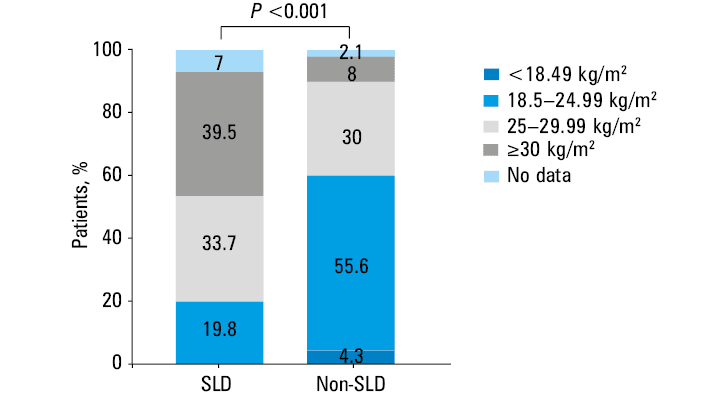
Patient demographic and clinical characteristics are presented in Table 1. At the time of evaluation, the median age was comparable between the SLD and non‑SLD groups. Both subpopulations were predominantly male, with a higher proportion in the SLD group (P = 0.02). The patients with SLD had a higher burden of comorbidities (P <0.001), particularly diabetes, gout, and obesity. The distribution of body mass index in both groups is presented in Figure 1.
Parameter | SLD (n = 86) | Non‑SLD (n = 187) | P value | |
Data are presented as number (percentage) unless otherwise indicated.
Abbreviations: BMI, body mass index; HCC, hepatocellular carcinoma; HCV, hepatitis C virus; IQR, interquartile range; SLD, steatotic liver disease | ||||
Sex | Women | 19 (22.1) | 68 (36.4) | 0.02 |
Men | 67 (77.9) | 119 (63.6) | ||
Age, y, median (IQR; range) | 52 (44–60; 31–71) | 50 (39–60; 28–98) | 0.5 | |
BMI, kg/m2, median (IQR) | 28.5 (25.8–32.5) | 23.8 (21.8–26.2) | <0.001 | |
Overweight | 29 (33.7) | 55 (29.4) | 0.47 | |
Obesity | 34 (39.5) | 15 (8) | <0.001 | |
Any comorbidity | 57 (66.3) | 74 (39.6) | <0.001 | |
Chronic kidney disease | 3 (3.5) | 17 (9.1) | >0.99 | |
Hypertension | 34 (39.5) | 46 (24.6) | 0.14 | |
Ischemic heart disease | 4 (4.7) | 15 (8) | >0.99 | |
Stroke | 0 | 1 (0.5) | >0.99 | |
Non‑HCC malignancy | 11 (12.8) | 24 (12.8) | >0.99 | |
Autoimmune disease | 5 (5.8) | 11 (5.9) | >0.99 | |
Diabetes | 13 (15.1) | 6 (3.2) | 0.004 | |
Dyslipidemia | 19 (22.1) | 19 (10.2) | 0.09 | |
Gout | 5 (5.8) | 0 | 0.03 | |
Chronic respiratory disease | 3 (3.5) | 7 (3.7) | >0.99 | |
History of HCC | 1 (1.2) | 1 (0.5) | 0.53 | |
HCV coinfection | 1 (1.2) | 11 (5.9) | 0.11 | |
HIV coinfection | 0 | 0 | – | |
History of alcohol intake | 7 (8.1) | 7 (3.7) | 0.13 | |
Cirrhosis | 14 (16.3) | 22 (11.8) | 0.31 | |
History of liver decompensation | Ascites | 1 (1.2) | 3 (1.6) | >0.99 |
Hepatic encephalopathy | 1 (1.2) | 0 | 0.32 | |
There were no cases of HIV infection, while HCV coinfection was diagnosed in 12 patients, mainly in the non‑SLD group (Table 1). A small percentage of patients in both groups reported a history of alcohol abuse (defined as alcohol intake >20 g/d for women and >30 g/d for men), but all declared abstinence since qualifying for antiviral therapy and during the treatment. Among the patients with SLD, 79 (91.9%) met the criteria for metabolic dysfunction–associated SLD, 7 (8.1%) for metabolic dysfunction and alcohol–related liver disease, and none for alcohol‑related liver disease.
HBV genotype determination data were available for 64 patients, with a majority being infected with genotype A, and its distribution was comparable between the SLD and non‑SLD groups. Cirrhosis was diagnosed in 16.3% of the patients with SLD and 11.8% of those without SLD (P = 0.31). Liver disease severity was evaluated by liver biopsy in 72 patients, by TE in 56 patients, and by shear wave elastography in 78 patients. In the remaining 67 patients, clinical assessment was supplemented with the calculation of the serum FIB‑4 index.
Treatment characteristics
The treatment characteristics of the study population are presented in Table 2. There were less treatment‑experienced patients in the SLD group, as compared with the non‑SLD group. Lamivudine was the most common drug in the whole study population. The primary reason for switching antiviral drugs in most patients was treatment inefficacy. However, in 4 individuals from each group, the switch to the analog was prompted by changes in the provisions of the National Health Fund drug program, and in these cases, HBV DNA was already undetectable at the start of the current therapy.
Parameter | SLD (n = 86) | Non‑SLD (n = 187) | P value | |
Data are presented as number (percentage) unless otherwise indicated.
Abbreviations: ADV, adefovir; ETV, entecavir; HBV, hepatitis B virus; HDV, hepatitis D virus; HBeAg, hepatitis B envelope antigen; LMV, lamivudine; (peg)IFN, pegylated interferon; TDV, tenofovir disoproxil; others, see Table 1 | ||||
Treatment‑experienced | Total | 31 (36) | 95 (50.8) | 0.02 |
ETV | 5 (16.1) | 16 (16.8) | >0.99 | |
TDV | 2 (6.5) | 1 (1.1) | 0.23 | |
ADV | 2 (6.5) | 4 (4.2) | >0.99 | |
LMV | 13 (41.9) | 49 (51.6) | 0.04 | |
(peg)IFN | 9 (29) | 25 (26.3) | 0.49 | |
Current therapy | ETV | 55 (64) | 128 (68.4) | 0.46 |
TDV | 31 (36) | 59 (31.6) | ||
Time on the current therapy, y, median (IQR; range) | 5 (2–10; 0–16) | 6 (3–11; 0–17) | 0.07 | |
HBeAg(+) at baseline | 7 (8.1) | 42 (22.5) | 0.004 | |
HBe seroconversion during therapy in relation to HBeAg(+) patients, n/N (%) | 3/7 (42.9) | 18/42 (42.9) | >0.99 | |
HBV DNA at baseline, IU/ml, median (IQR) | 6442 (1 280–69 250) | 11 820 (2 180–103 000) | 0.29 | |
HBV DNA clearance in the 1st year of therapy in relation to HBV DNA–positive at baseline, n/N (%) | 57/82 (69.5) | 122/183 (66.7) | 0.65 | |
HBV DNA clearance during therapy in relation to HBV DNA–positive at baseline, n/N (%) | 80/82 (97.6) | 179/183 (97.8) | 0.89 | |
HCC diagnosed during therapy | 1 (1.2) | 3 (1.6) | >0.99 | |
Liver decompensation during therapy | 0 | 0 | – | |
HDV coinfection diagnosed during therapy | 0 | 1 (0.5) | >0.99 | |
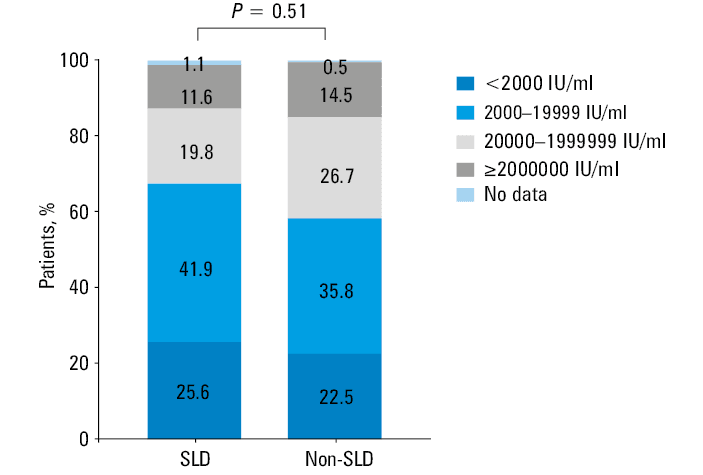
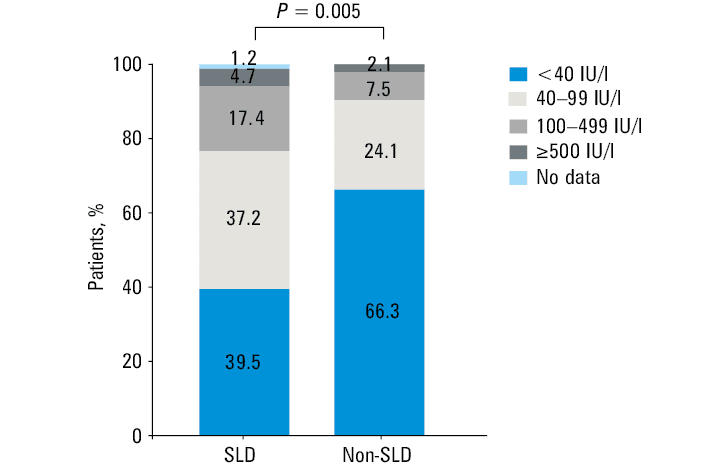
The median HBV DNA load at baseline and the distribution of baseline viremia were comparable between the groups (Table 2, Figure 2). However, the proportion of patients with HBeAg positivity was lower in the SLD group (P = 0.004; Table 2). The patients with SLD also exhibited higher median aminotransferase activity, as compared with those without steatosis (P <0.001 for ALT and P = 0.004 for AST; Table 3, Figure 3). Liver function parameters, including bilirubin level and INR, were similar in both subpopulations, while albumin concentrations were lower in the patients with SLD (P = 0.02).
Parameter | SLD (n = 86) | Non‑SLD (n = 187) | P value |
Data are presented as median (IQR).
SI conversion factors: to convert ALT or AST to µkat/l, multiply by 0.0167; PLT to × 109/l, by 1; creatinine to µmol/l, by 88.4; bilirubin to µmol/l, by 17.1; albumin to g/l, by 10.
Abbreviations: ALT, alanine aminotransferase; AST, aspartate aminotransferase; INR, international normalized ratio; PLT, platelet count; others, see Table 1 | |||
ALT, IU/l | 47 (29–82) | 30 (21–52) | <0.001 |
AST, IU/l | 38 (27–63) | 28 (21–44) | 0.004 |
PLT, × 1000/µl | 174 (147.5–227.5) | 199 (168–244) | 0.005 |
Creatinine, mg/dl | 0.9 (0.8–1.1) | 0.9 (0.8–1.1) | 0.75 |
INR | 1.1 (1–1.1) | 1 (1–1.1) | 0.84 |
Bilirubin, mg/dl | 0.8 (0.6–1.1) | 0.7 (0.6–1) | 0.52 |
Albumin, g/dl | 4.2 (3.8–4.5) | 4.3 (4.1–4.7) | 0.02 |
Treatment outcomes
More than 97% of all patients achieved HBV DNA clearance during NA therapy (Table 2). One year after treatment initiation, the percentage of patients with negative HBV DNA results was comparable between the groups. HBe seroconversion rates were also similar, with 42.9% of those positive at baseline achieving seroconversion.
Both groups demonstrated a biochemical response to NA therapy, reflected by a decrease in median ALT activity (P <0.001 in both SLD and non‑SLD groups). Among the 12 patients coinfected with HCV, 11 had detectable HCV RNA and received antiviral therapy, predominantly direct‑acting antivirals (73%), during the course of NA treatment for HBV, and all achieved a sustained virological response. At the time of analysis, anti‑HDV antibodies were detected in a single patient from the non‑SLD group, but HDV RNA evaluation was negative. No patient in either group experienced liver decompensation during NA treatment. However, HCC was diagnosed in 4 individuals: a single case in the SLD group and 3 cases in the non‑SLD group.
Discussion
The evolution of the terminology related to liver steatosis, with the most recent change in June 2023, has resulted in different terms for steatohepatitis being used in papers published at different time points. This should be acknowledged to clarify any inconsistencies in naming conventions.
A recent global analysis estimated the prevalence of NAFLD at 32.4%. Although the study included data from only 17 of 195 countries, the results are in line with reports from Europe and the National Health and Nutrition Examination Survey, which indicate SLD prevalence of 26.9% and 31.3% in the general population, respectively.6,18,19 Among the HBV‑infected patients, the rate of comorbid SLD was approximately 32% and was higher in men (P = 0.009). No differences in prevalence were noted based on geographic regions or diagnostic techniques.20 Our findings are consistent with these results, as we identified SLD in 31.5% of the patients treated for CHB, with a higher prevalence in men (P = 0.02).
The novelty and uniqueness of our study stem from its evaluation of the coexistence of HBV infection and liver steatosis in a white population, whereas most research on this topic has focused on Asian populations.
The molecular mechanisms underlying liver steatosis in patients with CHB infection remain unclear. The HBx protein has been suggested as a contributing factor, as it interferes with lipid secretion by apolipoprotein B. Additionally, HBx can modulate the expression of genes involved in lipid synthesis and degradation, leading to abnormal lipid accumulation within hepatocytes.10-12
We documented male predominance in our study population, consistent with previous reports indicating a higher risk of HBV chronification in men.21-24 The liver is considered a sexually dimorphic organ, with its cells expressing androgen and estrogen receptors that respond to the respective sex hormones. Androgen stimulation has been shown to increase HBV transcription, whereas estrogen has the opposite effect. In addition, HBx protein increases androgen receptor activity in the liver.24
The predominance of men in the study population was even more pronounced among the patients diagnosed with SLD, which is consistent with the results of a worldwide analysis indicating a higher proportion of men (52.3%) among patients with NAFLD.18 This trend is also influenced by sex hormones, with testosterone increasing the risk of SLD, and estrogen acting as a protective factor through estrogen receptor-α signaling. Estrogen also mitigates the risk of insulin resistance, a known risk factor for SLD, and reduces lipogenesis.25 Differences in chromosomal composition have also been implicated in hepatic steatosis, as demonstrated by studies on animals and individuals with genetic syndromes involving an extra chromosome X.26
Our study revealed a significantly higher burden of comorbidities in the patients with SLD, as compared with those without steatosis. Established metabolic risk factors for SLD, such as diabetes mellitus and obesity, were more prevalent among the patients with steatosis (P = 0.004 for diabetes mellitus and P <0.001 for obesity). Similarly, other risk factors, including dyslipidemia and hypertension, were more common among the patients with SLD than in the HBV‑infected individuals without steatosis, although statistical significance was not reached. These findings are consistent with previous studies.10,27 Additionally, we observed a higher prevalence of gout in the patients with SLD. A cross‑sectional study involving more than 4000 individuals in the United States demonstrated that higher uric acid levels are independently associated with an increased risk of liver steatosis.28
Alcohol consumption is another important risk factor for SLD.29,30 Our findings did not show any difference in the history of alcohol abuse; however, it was more frequently reported in the patients with SLD than in those without steatosis. Notably, since the initiation of antiviral therapy, all patients in our analysis declared abstinence, which allowed us to assess the impact of past alcohol consumption.
The effect of hepatic steatosis on liver disease progression in HBV‑infected patients, including fibrosis and HCC, remains a subject of an ongoing debate. Some studies suggest that fatty liver disease accelerates liver disease progression, while others show no significant association.13,14,20,31 In our study, although the percentage of cirrhosis cases was higher in the SLD group, the difference did not reach significance. Similarly, a retrospective study of 555 patients with CHB infection who received treatment (187 with NAFLD and 368 without) found comparable rates of compensated cirrhosis (P = 0.84) and similar odds of advanced fibrosis / cirrhosis assessed noninvasively by FIB‑4 (P = 0.28).13 Severe or advanced liver fibrosis has been linked more closely to the degree of necrotizing inflammation and host factors rather than hepatic steatosis in patients with CHB infection.31 However, several previous works, including a meta‑analysis of 20 studies involving 6232 patients, indicated an association between hepatic steatosis and advanced fibrosis in CHB infection, suggesting that steatosis may contribute to fibrosis.14,20
We found no difference in HCC history between the SLD and non‑SLD groups. This is in contrast to some studies that reported a limited impact of hepatic steatosis on HCC in patients with CHB infection.32,33 However, our results are in line with those of a retrospective cohort study, which also found no association between hepatic steatosis and HCC risk.34
Elevated liver enzyme activity is often a key indicator of liver damage and inflammation, making its association with hepatic steatosis in HBV‑infected patients a subject of ongoing research. In our study, we observed higher activity of ALT and AST in the SLD group, as compared with the non‑SLD group. However, meta‑analyses of 22 studies on ALT and 16 studies on AST reported no differences in liver enzyme activity between CHB patients with and without hepatic steatosis. These findings suggest that while hepatic steatosis can influence liver enzymes in certain contexts, its effects may not be universally observed across all CHB populations.35
The present analysis showed that HBV DNA levels at the start of antiviral therapy were comparable in the SLD and non‑SLD groups. However, previous studies suggested an inverse relationship between HBV replication and hepatic steatosis. A meta‑analysis of 17 studies including 4100 patients with HBV infection found a strong negative association between HBV DNA levels and steatosis (P <0.001), suggesting a potential protective effect of HBV infection against steatosis.36 A review of studies conducted in Asian populations showed that concomitant NAFLD may inhibit HBV replication and promote the seroclearance of hepatitis B surface antigen.14 In contrast, a meta‑analysis by Jiang et al35 did not show a relationship between HBV DNA levels and SLD.
Despite inconsistent findings regarding HBV DNA, it has been shown that patients with HBeAg‑positive CHB infection have a lower risk of hepatic steatosis. Jiang et al35 reported an odds ratio (OR) of 0.81 (95% CI, 0.7–0.93) based on data from 34 studies. Similarly, another meta‑analysis with data from 13 151 patients found a reduced risk of hepatic steatosis in HBeAg‑positive individuals (OR, 0.82; 95% CI, 0.75–0.91; P <0.001).20 Our study confirms this relationship, showing a lower incidence of HBeAg positivity in the SLD group, as compared with the non‑SLD group (8.1% vs 22.5%; P = 0.004). This concordance highlights the potential interaction between HBV replication and metabolic factors in the pathogenesis of liver disease.
The impact of hepatic steatosis on the outcomes of antiviral treatment in patients with CHB infection remains unclear. An analysis of patients treated with pegylated interferon showed comparable treatment responses between groups with and without steatosis, regardless of HBeAg status.12 Similarly, in patients with CHB infection receiving NA treatment, hepatic steatosis appears to have no impact on virological response.12,37 On the other hand, a prospective study conducted among Chinese patients treated with entecavir showed that hepatic steatosis was an independent factor for treatment failure, possibly due to reduced entecavir bioavailability in hepatocytes caused by lipid accumulation and diminished cytochrome activity.38 Furthermore, a global meta‑analysis identified hepatic steatosis as an independent negative predictor of virological response.35 In our analysis, findings related to HBV DNA clearance and treatment duration were comparable between the groups.
Limitations and strengths
Our study has several limitations impacting the significance of our findings. As an observational study using real‑world evidence and retrospective data, it is subject to potential biases, such as entry errors and underreporting of side effects. Liver disease severity was assessed using different methods, which may introduce inconsistencies and affect the reliability of comparisons of the disease progression. Additionally, steatosis assessment did not include the controlled attenuation parameter in FibroScan, a more precise, noninvasive tool, potentially limiting the accuracy in steatosis measurement.
Metabolic data on lipid and carbohydrate profiles were not detailed, despite their relevance for evaluating metabolic influences on liver disease in patients with CHB infection and SLD. Information on hypoglycemic treatments did not differentiate between insulin and oral medications, which may have distinct interactions with liver disease and treatment response. Concomitant medications, including lipid‑lowering therapies, were also not accounted for, despite their potential influence on SLD and overall liver health. The follow‑up duration varied among patients, complicating long‑term treatment comparisons. Furthermore, alcohol consumption was self‑reported without objective biomarkers, potentially introducing recall bias and underestimation of alcohol intake.
Nonetheless, the strengths of our study include the representative dataset collected from 3 different centers across Poland, ensuring that patients from different geographic regions were treated under uniform guidelines in accordance with drug program regulations and national recommendations. This allows for the generalization of our findings and their application in everyday clinical practice. Additionally, unlike many previous studies that have focused primarily on Asian populations with various serological and virological characteristics of HBV infection, our work uniquely evaluates a white patient cohort.
Conclusions
Liver steatosis was diagnosed in nearly one‑third of patients treated with NAs for chronic HBV infection. These patients were more likely to have obesity, diabetes, and gout, as compared with those without SLD. Despite higher baseline biochemical activity in the patients with SLD, virological HBV activity and response to therapy were comparable between the groups.
- Rinella ME, Lazarus JV, Ratziu V, et al. A multisociety Delphi consensus statement on new fatty liver disease nomenclature. Ann Hepatol. 2024; 29: 101133. | Crossref
- Teng ML, Ng CH, Huang DQ, et al. Global incidence and prevalence of nonalcoholic fatty liver disease. Clin Mol Hepatol. 2023; 29: S32‑S42. | Crossref
- Fernandez CJ, Nagendra L, Pappachan JM. Metabolic dysfunction‑associated fatty liver disease: an urgent call for global action. touchREV Endocrinol. 2024; 20: 5‑9.
- Chen Y‑T, Chen T‑I, Yang T‑H, et al. Long‑term risks of cirrhosis and hepatocellular carcinoma across steatotic liver disease subtypes. Am J Gastroenterol. 2024; 119: 2241‑2250. | Crossref
- Loomba R, Friedman SL, Shulman GI. Mechanisms and disease consequences of nonalcoholic fatty liver disease. Cell. 2021; 184: 2537‑2564. | Crossref
ARTICLE INFORMATION