
Long-term microvascular alterations in kidney transplant recipients after SARS-CoV-2 infection
Key words: chronic kidney disease, COVID-19, kidney transplant recipients, microcirculation


 CC BY-NC-SA 4.0
Long-term microvascular alterations in kidney transplant recipients after SARS-CoV-2 infection
CC BY-NC-SA 4.0
Introduction: Long‑term cardiovascular consequences of COVID‑19 in organ recipients have been insufficiently studied.
Objective: The aim of our study was to evaluate the association between COVID‑19 and microvascular abnormalities in kidney transplant recipients (KTRs) 8 weeks after SARS‑CoV‑2 infection.
Patients and methods: The study population consisted of 54 KTRs, and was divided into 2 subgroups: patients with a history of COVID‑19 (n = 35) and patients without a history of COVID‑19 (n = 21). We assessed the structure and function of microcirculation in both groups.
Results: The mean (SD) age of the study group was 47.6 (12.7) years and 46% were men. The patients with and without a history of COVID‑19 did not differ in their baseline characteristics. As compared with the patients without a history of COVID‑19, those after SARS‑CoV‑2 infection had markedly lower median (interquartile range) values of ischemic response (IR) (IRmax, 7 [5–8.7] vs 9.6 [8.8–11.5]; P = 0.04; IR inde × 3.1 [2.3–4.2] vs 7.2 [5.2–8.2]; P = 0.01), with the IR index further confirmed in a multivariable analysis. A logistic regression analysis showed that estimated glomerular filtration rate was linked to microvascular functional decline, expressed by a poorer normoxia oscillatory index (odds ratio, 0.95; 95% CI, 0.9–0.99; P = 0.047). C‑reactive protein level was associated with arteriole wall thickness (R = 0.42; P = 0.02) and wall‑to‑lumen ratio (R = 0.48; P = 0.01).
Conclusions: We documented that microvascular dysfunction in KTRs was associated with SARS‑CoV‑2 infection, and was detectable 8 weeks after its acute phase.
What's new?
Kidney transplant recipients (KTRs) are particularly prone to developing adverse clinical outcomes of COVID‑19 in both the short and long term. The mechanisms underlying long‑COVID syndrome remain unclear, yet dysfunction of the small arteries may be at play. We evaluated microvascular structural and functional changes in KTRs 8 weeks after SARS‑CoV‑2 infection by employing cutting‑edge technologies to evaluate eye and skin microcirculation in vivo. Our study identified an abnormal microvascular response to ischemic stimuli linked to SARS‑CoV‑2 infection, suggesting that this part of the vascular tree requires further observation and research.
Introduction
COVID‑19, caused by SARS‑CoV‑2, may affect different organs and present with a wide range of clinical manifestations, both acute and chronic (long‑COVID syndrome).1 Patients with chronic kidney disease (CKD), especially those receiving renal replacement therapy, are characterized by increased COVID‑19 incidence rates and greater COVID‑19–related mortality when compared with the general population.2-5 This may be partly explained by common immunosuppressive therapies that alter immune functions, accelerate aging, and exacerbate chronic low‑grade inflammation and endothelial dysfunction, which make kidney transplant recipients (KTRs) particularly vulnerable to communicable diseases and worsen their prognosis.2-7
Several microvascular‑dependent mechanisms have been postulated as responsible for higher morbidity and mortality rates in patients after COVID‑19.8,9 They may include vessel rarefaction, endothelial cell apoptosis and endothelial dysfunction, preponderance of vasoconstriction over vasodilation, hypercoagulation, and clot formation, which together promote solid organ hypoperfusion, ischemia, and failure.2,10-14 This process may be further aggravated by microvascular rarefaction, as recently reported in the deep capillary plexus of the central part of the retina observed in KTRs after COVID‑19.4 Importantly, endothelial damage also results in impaired hemostasis and antithrombotic activity, adding to the risk of acute kidney injury in the course of recent SARS‑CoV‑2 infection.2,15 In contrast to macrovascular complications in CKD, which have been extensively investigated for decades, studies on microcirculation are underrepresented, mostly because of their invasive nature.14 Therefore, the aim of our investigation was to evaluate the association between microcirculatory changes and SARS‑CoV‑2 infection in KTRs using cutting‑edge, noninvasive, in vivo technologies in 2 KTR subgroups (with and without a history of a recent, clinically overt SARS‑CoV‑2 infection). Moreover, we included all KTRs, irrespective of the presence of signs and symptoms of the so‑called long‑COVID syndrome, as defined by the World Health Organization.16 In this study, an Rt × 1e retinal camera (Imagine Eyes, Orsay, France) equipped with adaptive optics technology was employed to assess microvascular structure, and intensity of cutaneous nicotinamide adenine dinucleotide hydrogen (NADH) fluorescence was used a marker of microvascular function.17-19
Patients and methods
Study population
We performed a cross‑sectional observational study of KTRs with a history of mild‑to‑moderate symptomatic SARS‑CoV‑2 infection. The study group consisted of 35 KTRs who suffered from COVID‑19 (COV group), confirmed by a real‑time polymerase chain reaction test from nasopharyngeal swabs (Delta and Omicron variants), between December 2021 and June 2022. Except for 4 patients with modest blood oxygen desaturation (none required admission to an intensive care unit), the patients were not hospitalized during the acute phase of the disease. The patients did not suffer from prolonged COVID‑19 symptoms. The control group (non‑COV group) consisted of 21 KTRs without a history of SARS‑CoV‑2 infection (in 2 patients retinal and cutaneous microvascular assessment was not completed due to technical considerations). The serostatus of nucleocapsid (N)-specific antibodies (DiaSorin, Saluggia, Italy) was used in the non‑COV group to determine if the patients had a prior asymptomatic SARS‑CoV‑2 infection. Abbott Architect SARS‑CoV‑2 immunoglobulin (Ig) G 2 step chemiluminescent immunoassay (Abbott Laboratories, Chicago, Illinois, United States) was performed to evaluate the presence of IgG anti‑N antibodies. The assay yielded a sensitivity / positive percentage agreement of 100% and specificity / negative percentage agreement of 99.63%. The samples were interpreted as positive (seroconversion) or negative with a cutoff specimen / calibrator index value of 1.4. Exclusion criteria comprised diabetes, glaucoma, retinal detachment, retinal vascular disease, macular degeneration, central serous retinopathy, other retinopathies, eye surgery within 6 months of evaluation, opacity of the cornea, lens, or vitreous body, and myopia greater than 6 diopters.
Microvascular structure evaluation
The microvascular structure evaluation was performed in the retinal arterioles using the Rt × 1e noninvasive adaptive optics camera. This camera enables precise assessment of microvasculature with ultrahigh resolution, at a near‑histological scale.20-23 This is made possible by the advanced space technology employed in Rt × 1e that consists of 3 main components: a high‑resolution fundus camera, a Shack–Hartmann wavefront sensor, and a deformable mirror for real‑time correction of the aberrations of the ocular wavefront.20-23 In short, when a beam of light enters the eye, a small amount is reflected to the optical system, and the wavefront aberrations that arise within the eye are corrected by a deformable mirror; therefore, the achieved image resolution is in the order of 1 µm.20-24 The measurements were taken after 15 minutes of rest. The region of interest included a segment of the superficial temporal artery of the right eye, free of the presence of focal arterial nicking or arteriovenous crossings.23 Pupil dilatation was not required. The camera provides software for precise assessment of the arteriole structure, that is, its outer diameter (OD), lumen diameter (LD), wall thickness (WT), wall cross‑sectional area (WCSA), and wall‑to‑lumen ratio (WLR). WT was defined as WT = (OD – LD) / 2. WCSA was defined as WCSA = π × ((OD / 2)2 – (LD / 2)2). WLR was calculated using the formula: WLR = (OD – LD) / LD.
Microvascular function assessment
Microvascular function was assessed using flow‑mediated skin fluorescence (FMSF). FMSF is a noninvasive optical technique used to evaluate microcirculation and metabolic regulation based on measurements of reduced NADH fluorescence intensity in the epidermis.14 Quantification of FMSF was performed using the AngioExpert device (Angionica Ltd., Łódź, Poland), as described previously.18 In short, excitation of the ventral, glabrous side of the forearm with ultraviolet light at 340 nm results in emission of an NADH fluorescence signal from the skin cells. The level of NADH fluorescence corresponds to the balance of mitochondrial oxidation‑reduction processes occurring in the tissue, which is reflected by the balance between the oxidized form of the coenzyme (NAD+) and its reduced form (NADH). Indeed, NADH fluorescence is the strongest component of the fluorescence emitted from human skin. The intensity of the signal also changes with time in response to the blockage and release of blood flow in the brachial artery. The emitted fluorescence of NADH at 460 nm is detected by a receiver diode and reflects the activity of microcirculation.17 Several parameters were measured during NADH fluorescence reading, and they included the ischemic response (IRmax and IR index) and hyperemic response (HRmax and HR index). The IRmax was defined as the percentage ratio of maximal increase in NADH fluorescence intensity to the baseline observed during the cuff occlusion, and HRmax was expressed as the percentage ratio of maximal decrease in NADH fluorescence intensity to the baseline after the cuff release.25 Additionally, IR index and HR index were defined as the areas under the curve of the ischemic and hyperemic responses, respectively, in relation to the baseline.25 The reactive hyperemia response (RHR) parameter was the sum of the IRmax and HRmax parameters, and reflected vascular endothelial function related to nitric oxide (NO) production in blood vessels due to occlusion‑induced hyperemia.26
Frequency analysis showed that blood flow oscillations fitted into several periodic activities, classified as endothelial NO‑independent, endothelial NO‑dependent, neurogenic, myogenic, respiratory, and cardiac.27 Normoxia oscillatory index (NOI) represented the proportion of endothelial and neurogenic oscillations in relation to all oscillations detected in the low‑frequency range (<0.15 Hz).27,28 Direct measurements of the oscillations during the reperfusion stage allowed us to assess hypoxia sensitivity (HS), which covers the intensity of flow motion related to the myogenic oscillations.27
Statistical analysis
The statistical analyses were conducted using R (Version 4.3.1) and RStudio (R Foundation for Statistical Computing, Vienna, Austria). The distribution normality was validated using the Shapiro–Wilk test. Mean and SD were calculated for the data with a normal distribution, whereas median along with interquartile range (IQR) were calculated for the data with a non‑normal distribution. For the group comparisons, we utilized the Fisher exact test for categorical data due to a small sample size. This was done to ensure the accuracy and reliability of the results despite limited data availability. For continuous data, the method of analysis depended on the data distribution. We employed the 2‑sided t test for the data with a normal distribution and the Mann–Whitney (Wilcoxon) test for the data with a non‑normal distribution.
In addition, we performed correlation tests between the variables, tailored according to their distribution. The Pearson correlation coefficient was calculated for the pairs of variables that followed a normal distribution, while the Spearman rank correlation was used for those with a non‑normal distribution.
Logistic regression models were fitted using the FinalFit package (version 1.0.8) to explore the impact of clinical and laboratory parameters on the NOI and IR index. Dichotomized NOI and IR indices were used as the categorical outcome, and were split based on their median values. The models were built using an etiological approach, focusing on preselected explanatory variables based on clinical and theoretical relevance. The analyses were performed for each structural (WL, LD, WCSA, WLR) and functional (IR, HR, RHR, NOI, HS, FM) microvascular parameter using 2 sets of independent variables, that is, 1) COVID‑19, systolic blood pressure (SBP), estimated glomerular filtration rate (eGFR), C‑reactive protein (CRP), and lymphocyte blood count; and 2) body mass index (BMI), SBP, eGFR, CRP, and lymphocyte count.
Additionally, we measured the impact of features used for logistic regression model training (ie, SBP, eGFR, CRP, lymphocyte blood count, BMI, COVID‑19) on the model outcomes by calculating the odds ratio (OR). This strategy aimed to evaluate the predictive capability of these features concerning the specified parameters, thereby offering insights into their potential interrelationships. A P value below 0.05 was considered significant.
Ethics
Ethical approval for the study was obtained from the Medical University of Gdansk (NKBBN/2014/2021). Patient written informed consent was obtained before inclusion in the study.
Results
The baseline characteristics of the study groups are presented in Table 1. The mean (SD) age of the participants was 47.6 (12.7) years (25 men; 46% of the study group). The COV and non‑COV groups were comparable in terms of age, sex, BMI, blood pressure, eGFR (Chronic Kidney Disease Epidemiology Collaboration), comorbidities, and pharmacological treatment.
Variable | Total (n = 56) | COV group (n = 35) | Non‑COV group (n = 21) | P value |
Data are presented as mean (SD) or median (interquartile range) unless indicated otherwise.
SI conversion factors: to convert creatinine to μmol/l, multiply by 88.4; hemoglobin to g/l, by 10.
Abbreviations: ACEI, angiotensin‑converting enzyme inhibitor; ARB, angiotensin receptor blocker; BMI, body mass index; CKE‑EPI, chronic kidney disease epidemiology collaboration; COV, COVID‑19; CRP, C‑reactive protein; DBP, diastolic blood pressure; eGFR, estimated glomerular filtration rate; KTx, kidney transplantation; NOAC, non–vitamin K antagonist oral anticoagulant; LMWH, low‑molecular‑weight heparin; SBP, systolic blood pressure | ||||
Age, y | 47.6 (12.7) | 49.7 (12.5) | 44 (12.6) | 0.11 |
Men, % | 46.4 | 42.9 | 52.4 | 0.58 |
KTx vintage, mo | 77.7 (72.9) | 74.9 (67.2) | 82.6 (83.8) | 0.73 |
BMI, kg/m2 | 24.6 (3.5) | 24.7 (3) | 24.5 (4.3) | 0.87 |
SBP, mm Hg | 135.6 (15.2) | 138.2 (14.9) | 131.1 (15) | 0.11 |
DBP, mm Hg | 84.4 (9.9) | 83.9 (9.5) | 85.2 (10.7) | 0.68 |
Laboratory parameters | ||||
Creatinine, mg/dl | 1.3 (1–1.8) | 1.34 (1.1–1.7) | 1.36 (1–1.8) | 0.66 |
eGFR, ml/min/1.73 m2 (CKE‑EPI) | 57.7 (20.4) | 56.8 (20.2) | 59.4 (21.2) | 0.67 |
CRP, mg/l | 1.5 (0.7–2.6) | 1.6 (0.9–3.1) | 1.1 (0.7–1.9) | 0.24 |
D‑dimer, ng FEU/ml | 451.7 (314.6–808.5) | 459.8 (305.1–801.6) | 443.6 (326.6–779.4) | 0.73 |
Hemoglobin, g/dl | 13.4 (1.7) | 13 (1.8) | 13.9 (1.6) | 0.08 |
Hematocrit, % | 40.3 (37.7–43.5) | 40.2 (36.7–42.1) | 43 (40.1–45.4) | 0.07 |
Leukocytes, 109/l | 8.1 (2.1) | 8.0 (2.2) | 8.2 (2.1) | 0.81 |
Neutrophiles, 109/l | 4.8 (4–6.6) | 4.9 (4.3–6.1) | 4.5 (3.9–7.3) | 0.78 |
Lymphocytes, 109/l | 2.1 (1.3–2.6) | 2.2 (1.3–2.6) | 2 (1.3–2.4) | 0.55 |
Comorbidities, % | ||||
Arterial hypertension | 94.6 | 97.1 | 90.5 | 0.55 |
Stroke | 1.8 | 2.9 | 0 | >0.99 |
Coronary artery disease | 5.4 | 5.7 | 4.8 | >0.99 |
Peripheral artery disease | 0 | 0 | 0 | >0.99 |
Treatment, n (%) | ||||
Statin | 15 (26.8) | 7 (20) | 8 (38.1) | 0.21 |
ACEI/ARB | 14 (25) | 7 (20) | 7 (33.3) | 0.34 |
Acetylsalicylic acid | 11 (19.6) | 5 (14.3) | 3 (14.3) | 0.3 |
LMWH | 2 (3.6) | 1 (2.9) | 1 (4.8) | >0.99 |
NOAC | 1 (1.8) | 1 (2.9) | 0 | >0.99 |
Corticosteroids | 56 (100) | 35 (100) | 21 (100) | >0.99 |
Tacrolimus | 39 (69.6) | 23 (65.7) | 16 (76.2) | 0.55 |
Mycophenolate mofetil | 38 (67.9) | 22 (62.9) | 16 (76.2) | 0.38 |
Cyclosporine | 15 (26.8) | 11 (31.4) | 4 (19) | 0.37 |
Azathioprine | 3 (5.4) | 2 (5.7) | 1 (4.7) | >0.99 |
Microvascular structural characteristics were not significantly different in the COV and non‑COV groups. However, the functional parameters showed differences in both groups, as presented in Table 2. As compared with the non‑COV group, the COV group had significantly lower median (IQR) IRmax values (7 [5–8.7] vs 9.6 [8.8–11.5]; P = 0.04) and IR index values (3.1 [2.3–4.2] vs 7.2 [5.2–8.2]; P = 0.01). Additionally, in Table 3, we present a multivariable logistic regression model analysis in which COVID‑19 was the only variable independently associated with microvascular deterioration, denoted by a decline in IR. The remaining multivariable regression models showed no association between COVID‑19 and microvascular parameters.
Microvascular parameter | COV group | Non‑COV group | P value |
Data are presented as mean (SD) or median (interquartile range).
Abbreviations: FM, flow motion at baseline; FMrep, flow motion at reperfusion; HR, hyperemic response; HS, hypoxia sensitivity; IR, ischemic response; LD, lumen diameter; NOI, normoxia oscillatory response; OD, outer diameter; RHR, reactive hyperemia response; WCSA, wall cross‑sectional area; WLR, wall‑to‑lumen ratio; WT, wall thickness | |||
Structural parameters | |||
LD, µm | 91.7 (11) | 91.4 (14.8) | 0.94 |
OD, µm | 117.2 (11.9) | 113.9 (17.4) | 0.5 |
WT, µm | 11.7 (11–13.5) | 12.5 (10.8–13.8) | 0.58 |
WCSA, µm2 | 4191.9 (810.6) | 3898.3 (1259) | 0.4 |
WLR | 0.28 (0.04) | 0.27 (0.05) | 0.59 |
Functional parameters | |||
IR index, % | 3.1 (2.3–4.1) | 7.2 (5.2–8.2) | 0.01 |
HR index, % | 8.5 (4.7) | 9.4 (4.4) | 0.47 |
IRmax, % | 7 (5–8.7) | 9.6 (8.8–11.5) | 0.04 |
HRmax, % | 15.2 (4.1) | 16.1 (5.1) | 0.52 |
RHR, % | 18.9 (6.3) | 21.3 (7.5) | 0.26 |
NOI, % | 80.6 (67.7–87.9) | 81.2 (59.4–89) | 0.99 |
logHS | 1.1 (0.6) | 1.2 (0.6) | 0.43 |
FM, AU | 11.7 (6.5–24.3) | 23 (7.9–32) | 0.76 |
FMrep, AU | 29.6 (19.1–69.7) | 35 (22.6–65.4) | 0.57 |
A negative correlation was observed between lymphocyte count and IR (R = –0.65; P = 0.02), while CRP positively corelated with microstructural remodeling, as demonstrated for WT (R = 0.42; P = 0.02) and WLR (R = 0.48; P = 0.01; Table 4).
Variable | CRP, mg/l | Lymphocytes, 109/l | ||
R Spearman | P value | R Spearman | P value | |
Structural parameters | ||||
LD, µm | 0.24 | 0.2 | 0.23 | 0.23 |
OD, µm | 0.19 | 0.3 | 0.11 | 0.55 |
WT, µm | 0.42 | 0.02 | 0.29 | 0.12 |
WCSA, µm | 0.09 | 0.63 | 0.14 | 0.48 |
WLR | 0.48 | 0.01 | 0.42 | 0.02 |
Functional parameters | ||||
IR index, % | 0 | 0.99 | 0.65 | 0.02 |
HR index, % | 0.23 | 0.22 | 0.14 | 0.47 |
IRmax, % | 0.06 | 0.85 | 0.28 | 0.36 |
HRmax, % | 0.1 | 0.59 | 0.15 | 0.42 |
RHR, % | 0.27 | 0.14 | 0.05 | 0.8 |
NOI, % | 0.22 | 0.24 | 0.2 | 0.28 |
logHS | 0.01 | 0.95 | 0.09 | 0.63 |
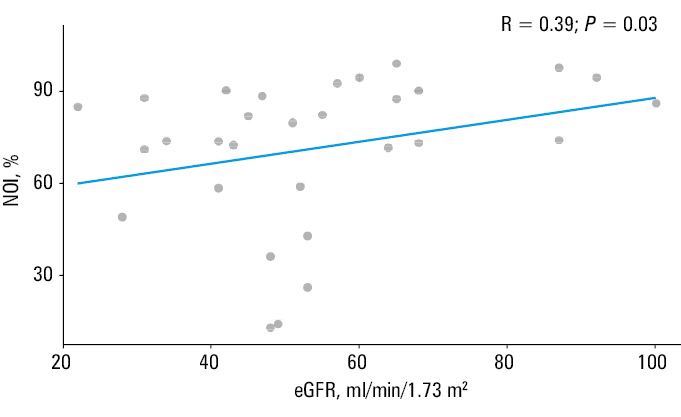
In the COV group, the relationship between eGFR and NOI was evident (R = 0.39; P = 0.03; Figure 1). No such relationship was observed in the non‑COV controls (P >0.05 for both). In the multivariable logistic regression analysis, eGFR was the sole factor associated with deterioration of microvascular function expressed by low NOI (below the median value; Table 5). In the remaining multivariable regression models, there was no association between eGFR and the microvascular parameters.
Discussion
Our study yielded 3 main findings. First, several weeks after COVID‑19, the patients showed altered microvascular IR, which reflects mitochondrial dysfunction. Second, the renal graft function corresponded to microvascular oscillations represented by NOI, implying a link between cutaneous and renal microcirculation in the KTRs after COVID‑19. Third, the severity of the inflammatory process in the KTRs who contracted COVID‑19 was associated with the worsening of structural (WT, WLR) and functional (IR index) microvascular markers, observed 8 weeks after the infection. Our study also showed the feasibility of a comprehensive, noninvasive, and in vivo assessment of the microcirculation phenotype in the KTRs.
We documented that KTRs had significantly lower IR values in the FMSF‑Post Occlusive Reactive Hyperemia (PORH) test several weeks after SARS‑CoV‑2 infection, suggesting deterioration of the mitochondrial function and impaired balance of the mitochondrial oxidation and reduction processes. It is important to emphasize that the FMSF‑PORH test allows for both in vivo and noninvasive measurements of NADH fluorescence, providing insights into the nearly real‑time function of the mitochondria. Several potential mechanisms could partly explain our observations. NAD, when shifting from the oxidized form (NAD+) to the reduced form (NADH), serves as an electron acceptor or donor in several reactions, maintaining intracellular redox equilibrium.29 Under increased oxidative stress, for example, during inflammatory / infectious diseases, it is postulated that NAD additionally protects against oxidative injury. Mitochondrial DNA, when damaged by reactive oxygen species, is repaired by a NAD+-dependent enzyme, that is, poly ADP‑ribose polymerase 1 (PARP).29,30 NAD supplies ADP‑ribose units to PARP and is then catabolized.29 Therefore, excessive oxidative stress during SARS‑CoV‑2 infection and concomitant hyperactivity of PARP lead to the consumption of cellular NAD+ reserves, causing redox imbalance, disrupting mitochondrial energy production, and leading to cell death.30 However, it was somewhat surprising that such abnormalities were documented approximately 8 weeks after overt COVID‑19. The lower values of IR in the KTRs after COVID‑19 observed in our study are consistent with the recent reports of Jedrzejewska et al,31 who showed decreased IR during recovery soon after mild COVID‑19. The relationship between SARS‑CoV‑2 infection and microvascular alterations was also observed in the retinal area visualized by optical coherence tomography‑angiography.32 Kazantzis et al32 reported long‑term microvascular impairment in patients who recovered from COVID‑19, describing reduced vessel density in the deep capillary plexus and enlarged foveal avascular zone, as compared with the control group. Consistent retinal changes suggesting macular ischemia due to COVID‑19 were also found in other studies.33,34 Castellino et al34 additionally observed that the degree of inflammation was linked to the decreased vessel density of the superficial capillary plexus 1 month after the acute phase of COVID‑19. Brantl et al,35 apart from lower vessel density in the surrounding quadrants of the fovea in hospitalized patients, did not observe areas of nonperfusion, microaneurysms, or other microvascular anomalies, indicating that further observation is needed.
From a broader perspective, reduced IR values have only recently been documented in chronic diseases accompanied by oxidative stress, that is, coronary artery disease or hypercholesterolemia.25,36 Interestingly, deterioration of microcirculatory function in the KTRs was detected 8 weeks after acute COVID‑19, which was not the case in the KTRs with no evident history of COVID‑19.
Given that alterations in small‑resistance arteries occur in different vascular districts,11,12,37 microvascular abnormalities found in the skin may correspond to the ones seen in other organs. Importantly, as documented by Park and Shiffrin,38 microcirculation abnormalities may precede clinical evidence for dysfunction of body organs and systems. We found that the KTRs 8 weeks after acute COVID‑19 showed lower endothelial and neurogenic oscillations (NOI). To date, the presence of impaired microvascular oscillations has been reported in type 1 diabetes, cardiovascular and neurodegenerative diseases, and in post‑COVID syndrome.28,39-41 Taken together, our results support noninvasive cutaneous microcirculation phenotyping to identify patients at a higher risk for vascular abnormalities associated with COVID‑19. The suggestion of an extended monitoring in the post‑COVID period is even more justified considering our patients in whom an evident relationship between NOI and eGFR was documented.
Moreover, the correlation analyses indicated a relationship between inflammatory markers and structural (WT, WLR) and functional microvascular parameters (IR index) in the KTRs who had COVID‑19. The clinical value of this finding is not clear; however, studies on wall thickening in the smallest arteries showed detrimental effects of inflammatory processes on NO bioavailability. This, in turn, promotes vasoconstriction and may cause smooth muscle cell proliferation.42,43 Increased WLR constitutes a well‑established hallmark of microvascular remodeling and a surrogate measure of end‑organ damage in several chronic diseases, including heart failure, hypertension, and CKD.24,42-46 Reduced NO bioavailability may facilitate tissue hypoperfusion, ischemia, and organ damage.10,42,44 The relationship between vascular remodeling and inflammatory markers reported in our study is consistent with previous reports.42,43,47 For instance, De Ciuceis et al48 demonstrated associations between specific lymphocyte subpopulations and microvascular structural alterations, that is, increased WLR of subcutaneous small‑resistance arteries.
Strengths and limitations
Our study has apparent strengths and limitations. To our knowledge, this is the first noninvasive, in vivo phenotyping of the microvascular structure and function in the KTRs after clinically overt COVID‑19 and in the KTRs without a history of COVID‑19. Thus, we showed the feasibility of a comprehensive microcirculation evaluation in these high‑cardiovascular‑risk patients. Our data, acquired 8 weeks after acute infection, may provide a basis for further prospective studies focusing on long‑term complications, especially in the context of long‑COVID syndrome.
The cross‑sectional study design did not allow us to confirm the causality of COVID‑19 in microvascular changes, which obviously limits the interpretation of our findings. However, our results justify longitudinal studies of KTR patients with microcirculatory alterations to see if they have the potential to dichotomize the patients with respect to clinical outcomes. Indisputably, small sample size implies lower power to detect differences between the groups (COV and non‑COV). Nevertheless, we found significant differences in the markers of IR between the groups, which is in line with prior studies focused on microvascular changes after COVID‑19.31 Lastly, the vast majority of patients were subjected to antihypertensive treatment or statins, with each potentially modulating endothelial function that plays a key role in microcirculatory responsiveness.25 To mitigate this, pharmacological treatment was comparable in both subgroups.
Conclusions
We documented that functional microvascular changes in the KTRs are evident 8 weeks after SARS‑CoV‑2 infection. Whether these alterations may contribute to long‑COVID syndrome warrants further studies.
- Prasad A, Prasad M. Single virus targeting multiple organs: what we know and where we are heading? Front Med (Lausanne). 2020; 7: 370. | Crossref
- Bonaventura A, Vecchié A, Dagna L, et al. Endothelial dysfunction and immunothrombosis as key pathogenic mechanisms in COVID‑19. Nat Rev Immunol. 2021; 21: 319‑329. | Crossref
- Mohamed IH, Chowdary PB, Shetty S, et al. Outcomes of renal transplant recipients with SARS‑CoV‑2 infection in the eye of the storm: a comparative study with waitlisted patients. Transplantation. 2021; 105: 115‑120. | Crossref
- Ślizień M, Sulecka P, Tylicki L, et al. Comprehensive assessment of eyes in kidney transplant recipients after recovering from COVID‑19. Life (Basel). 2023; 13: 2003. | Crossref
- Malinowska A, Muchlado M, Ślizień Z, et al. Post‑COVID‑19 syndrome and decrease in health‑related quality of life in kidney transplant recipients after SARS‑CoV‑2 infection‑a cohort longitudinal study from the north of Poland. J Clin Med. 2021; 10: 5205. | Crossref
ARTICLE INFORMATION