
Increased turnover of nonmalignant T lymphocytes in patients with chronic lymphocytic leukemia may affect clinical progression
Key words: chronic lymphocytic leukemia, cyclin D2, cyclin-dependent kinase inhibitor 1B, T cell apoptosis, progression

 CC BY 4.0
Increased turnover of nonmalignant T lymphocytes in patients with chronic lymphocytic leukemia may affect clinical progression
CC BY 4.0
Introduction: A unique feature of chronic lymphocytic leukemia (CLL) is the increased number of circulating T cells preventing malignant B cells from undergoing apoptosis. Dysregulated expression of cyclin‑dependent kinase inhibitor 1B (p27Kip1) and cyclin D2 (G1 phase regulators controlling lymphocyte survival) was examined in leukemic B cells but not in nonmalignant T cells.
Objectives: We aimed to assess antiapoptotic p27Kip1 and cyclin D2 expression in peripheral blood leukemic B and T cells in relation to their ex vivo apoptosis in CLL patients with different clinical course.
Patients and methods: Using flow cytometry, we determined the expression of G1 regulators and apoptosis of B and T cells in 47 previously untreated CLL patients (median age 60 [interquartile range, 53–69] years; 26 men) with stable disease (SD) or progressive disease (PD), and 39 controls, matched for age and sex.
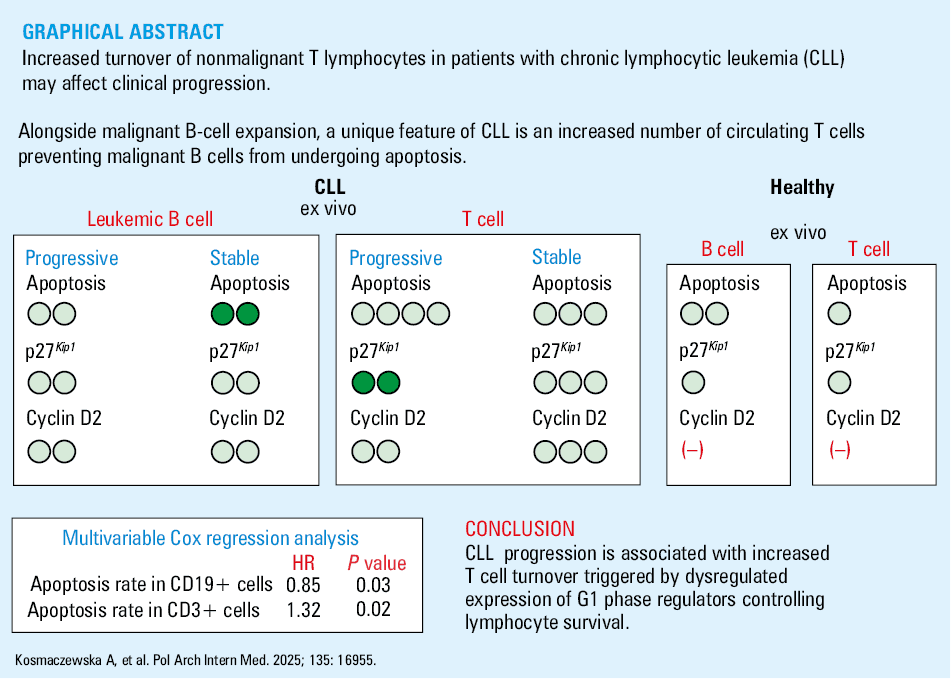
Results: We noted increased apoptosis within T cells in the CLL patients as compared with controls (P <0.001), whereas B cells exhibited failed apoptosis. All patients showed higher expression of p27Kip1 and cyclin D2 in the leukemic B and T cells than the controls (P <0.001). A comparative analysis of B and T cells showed pronounced T cell apoptosis in only PD patients (P <0.001). In SD patients, the expression of G1 regulators was higher in T cells than in B cells (P ≤0.02). Increased p27Kip1 expression and low apoptosis within B cells, and lower cyclin D2 expression and high apoptosis within T cells were predictive of earlier disease progression.
Conclusions: CLL progression is associated with increased T‑cell turnover triggered by dysregulated expression of G1 regulators, suggesting the involvement of the nonmalignant T‑cell compartment in the disease pathogenesis and clinical outcomes.
What's new?
Chronic lymphocytic leukemia (CLL) is characterized by both proliferation and accumulation of long‑lived CLL cell clones and various clinical presentation, ranging from a stable to a progressive course. In addition to malignant B cell expansion, a unique feature of CLL is the increased presence of circulating nonmalignant T cells. Here, we found for the first time that CLL progression is associated with increased T‑cell turnover triggered by dysregulated expression of G1 cell cycle phase regulators controlling lymphocyte survival, implying that during CLL development T cells acquire a unique ability to maintain longevity in vivo to be effective in supporting malignant B cell growth. Therefore, our study clearly suggests the involvement of the nonmalignant T‑cell compartment in the disease pathogenesis and clinical outcomes. Understanding the risk factors for CLL development and its clinical consequences is crucial for determining the optimal management of CLL patients.
Introduction
Chronic lymphocytic leukemia (CLL) is a lymphoproliferative disease that manifests as the clonal proliferation of B lymphoid cells with positive expression of CD5, CD19, and CD23 antigens. These cells spread to the peripheral blood (PB), bone marrow, lymph nodes, and extranodal organs, where they accumulate due to their prolonged lifespan.1,2 With the progression of the disease, lymphadenopathy, hepatosplenomegaly, bone marrow failure, and recurrent infections may occur.1-3 Patients often develop autoimmune hemolytic anemia or autoimmune thrombocytopenia.1-3 Despite remarkable phenotypic and cytological homogeneity, the disease exhibits a highly variable clinical presentation and evolution.1-5 In some patients, the disease progresses slowly and does not require treatment for many years, in contrast to others who experience progression that requires systemic cytostatic treatment soon after a diagnosis is established. Progressive CLL is associated with unique phenotypic and genetic aberrations,1-3,5-7 and the disease evolution is characterized by a dynamic interplay between the ongoing replication and death within the clones of CLL cells.8 CLL patients with higher replication rates are much more likely to develop progressive form of the disease than those with lower replication rates.9 Thus, CLL is considered to be a disease of both proliferation and accumulation of long‑lived clones of CLL cells.8,9
Although the disease affects mature B lymphocytes, patients with CLL usually have abnormalities in the number and function of nonmalignant T cells. Clonal proliferation of malignant B lymphocytes and their accumulation is accompanied by an increase in the absolute number of PB T cells.10-12 Any apparent T cell lymphocytopenia is due to the diluting effect of the large numbers of CLL cell clones. CLL T cells also exhibit several phenotypic and functional differences, resulting in a defective antileukemia response.10-13 The correlation observed between the expansion of dysfunctional T cells and PD has led to a suggestion that CLL T cells may create a microenvironment in which the leukemic clones impede differentiation and apoptosis and exhibit increased proliferative activity, sustaining the malignant B cell clones and promoting disease progression.
Since CLL involves both the proliferation and accumulation of long‑lived clones of CLL cells, abnormalities in the expression and function of intracellular factors that regulate proliferation and apoptosis are considered to play a part in CLL pathogenesis. A specific role in the regulation of lymphocyte turnover has been assigned to proteins involved in early G1 phase regulation, cyclin‑dependent kinase inhibitor 1B (p27Kip1) and cyclin D2.14,15 Although p27Kip1 participates in many cellular processes,16,17 its canonical activity is the inhibition of the majority of known cyclin‑dependent kinases (CDKs), since its crucial role in cell cycle progression.14,18 Unlike the majority of solid tumors, in which high expression of p27Kip1 is linked with a favorable prognosis, the increased expression of this protein in CLL cells is associated with a more aggressive clinical course of the disease.19-21 Alongside p27Kip1, an increased expression of cyclin D2 was found in CLL cells.22-24 Cyclin D2 is a member of the D‑type cyclin family involved in the regulation of B lymphocytes passing through the G1 phase restriction point.25 The literature highlights a special role of cyclin D2 in malignant B cells,22,26 primarily in increasing their longevity in vivo.23
In contrast to the well‑documented increased expression of p27Kip1 and cyclin D2 in CLL cells, information concerning their expression in nonmalignant T cells of CLL patients is lacking. The important roles played by p27Kip1 and cyclin D2 in the regulation of proliferation and apoptosis of CLL cells alongside the massive expansion of nonmalignant T cells prompted us to examine the expression of both G0/G1 phase regulators in relation to ex vivo spontaneous apoptosis of B and T cells in CLL patients. Therefore, our study aimed to compare the apoptosis sensitivity of PB leukemic B and nonmalignant T lymphocytes in relation to the expression of antiapoptotic p27Kip1 and cyclin D2 proteins in CLL patients with different clinical course as the potential prognostic factors.
Patients and methods
Patients and controls
The study was performed on peripheral blood mononuclear cells (PBMCs) of previously untreated patients with CLL and healthy controls. The CLL patients were recruited at the Clinical Department of Hematology, Cell Therapies, and Internal Diseases, Wroclaw Medical University, Wrocław, Poland. The diagnosis of CLL was established according to the generally accepted criteria, in particular the presence of at least 5 × 10⁹/l monoclonal B lymphocytes in PB with the coexpression of CD5, CD19, and CD23 surface antigens. The inclusion criteria comprised good performance status (0 and 1 according to the Eastern Cooperative Oncology Group scale), no indications for immediate start of antileukemic treatment, and anticancer treatment‑naive status in the past. The exclusion criteria were any past or present cancer, current acute or chronic infections, inflammatory or autoimmune disorders, diabetes, renal insufficiency, obesity defined as body mass index above 30 kg/m2, active smoking, and medication history of corticosteroids or other drugs of known immunomodulatory activity. For each patient, a detailed medical history was taken including current and past concomitant diseases, current medications, alimentary habits, and addictions. In the case of doubt concerning the possible presence of any concomitant disorder that might interfere with the results of the study, relevant complementary tests were performed. Besides the blood tests required for the diagnosis of CLL, a complete medical examination and basic blood tests for liver and renal functions were performed. For each patient, the disease stage was determined according to the Rai and Binet classification systems. All patients were followed up in a hematology center, with follow‑up visits at least every 3 months or more frequently if clinically indicated, and the time to the occurrence of at least 1 of the following events was recorded: doubling of peripheral lymphocyte counts as compared with the initial values, progression to a higher Rai stage, progression of lymphadenopathy and / or organomegaly, or the appearance of indications for cytostatic treatment according to National Cancer Institute–sponsored working group recommendations.2
A control group of healthy individuals, originating from the same geographic area as the patients with CLL, were recruited from the Hirszfeld Institute of Immunology and Experimental Therapy, Polish Academy of Sciences, Wrocław, Poland, and the Lower Silesian Oncology Center, Wrocław, Poland. The inclusion and exclusion criteria for the controls were the same as for the CLL patients.
All participants gave written informed consent after the purpose of the study was explained to them. The study design was approved by the local Bioethical Committee at the Medical University of Wroclaw (KB‑467/2016), Poland, and was in accordance with the 1977 Declaration of Helsinki.
Immunostaining of cyclin‑dependent kinase inhibitor 1B and cyclin D2 proteins and flow cytometric analysis
The expression of p27Kip1 and cyclin D2 proteins was assessed in leukemic B (CD19+CD5+) and T (CD3+) cells from CLL patients and in corresponding cells from the healthy controls using triple or double immunostaining with flow cytometry, as described by Wolowiec et al24 (Supplementary material).
Determination of apoptosis
Apoptosis of B (CD19+) and T (CD3+) lymphocytes from the CLL patients and healthy participants was determined by chloromethyl‑X‑rosamine staining (Mito Tracker Red CMXRos, Molecular Probes, Waltham, Massachusetts, United States) according to the manufacturer’s instructions and as described by Bojarska‑Junak et al27 (Supplementary material).
Statistical analysis
Statistical analyses were performed using the Statistica 7.1 package (Tibco Software Inc., Palo Alto, California, United States) and GraphPad Prism 8.01 (GraphPad Software, San Diego, California, United States). Clinical parameters were presented as absolute numbers and percentages for frequencies. For all other analyzed variables, median values and interquartile ranges (IQRs) were calculated. All collected data were examined for normal distribution and homogeneity of variance using the Shapiro–Wilk test and the Levene test, respectively. Since the data did not have a normal distribution and / or exhibited heterogeneous variances, the Mann–Whitney test or the Kruskal–Wallis 1‑way analysis of variance by ranks was used, followed by a post hoc Dunn test. The frequencies of each analyzed event in different patient groups were compared using the χ2 test. When the expected frequency in at least 1 cell was below 5, the Fisher exact test was used. The cumulative probability of CLL progression‑free survival was calculated according to the Kaplan–Meier method. The Kaplan–Meier curves were compared using the log‑rank test. The combined effects of the study variables and clinical parameters were analyzed using the Cox regression analyses. Hazard ratios (HRs) were expressed with 95% CIs. Multivariable analyses were performed with the Cox proportional hazards model by including all significant covariates from the univariable Cox models. In all analyses, differences were considered significant when the P value was below 0.05.
Results
Patient and control characteristics
A total of 47 patients with previously untreated CLL and 39 healthy controls were recruited into the study between April 1994 to May 2018. All of them met the abovementioned inclusion criteria. Their clinical and laboratory characteristics are summarized in Table 1.
Parameter | Patients with chronic lymphocytic leukemia | Controls (n = 39) | P valuea | ||
Overall (n = 47) | SD group (n = 26) | PD group (n = 17) | |||
Data are presented as median (interquartile range) or number (percentage). P values were derived from the nonparametric Kruskal–Wallis 1‑way analysis of variance followed by the Dunn test, the Mann–Whitney test, or χ2 test (nominal values).
a The variables were compared in the patients with stable and progressive disease and controls.
SI conversion factors: to convert CRP to nmol/l, multiply by 95.2; hemoglobin to g/l, by 10; LDH to µkat/l by 0.167.
Abbreviations: C, control; CRP, C‑reactive protein; Hb, hemoglobin; IgVH, immunoglobulin variable heavy chain gene; LDH, lactate dehydrogenase; PD, progressive disease; SD, stable disease; WBC, white blood cells | |||||
Age, y | 60 (53–69) | 63 (56–71) | 55 (52–66) | 57 (48–66) | SD vs PD, 0.19
SD vs C, 0.44
PD vs C, 0.99 |
Sex | |||||
Women | 21 (44.68) | 13 (50) | 7 (41.18) | 23 (59.97) | 0.45 |
Men | 26 (55.32) | 13 (50) | 10 (58.82) | 16 (41.03) | |
Rai stage | |||||
0 | 26 (55.32) | 19 (73.08) | 5 (29.4) | – | 0.009 |
I | 9 (19.15) | 5 (21.73) | 3 (17.65) | – | |
II | 4 (8.51) | 0 | 3 (17.65) | – | |
III | 3 (6.38) | 0 | 3 (17.65) | – | |
IV | 5 (10.64) | 2 (7.69) | 3 (17.65) | – | |
Binet stage | |||||
A | 32 (68.09) | 23 (88.46) | 5 (29.41) | – | <0.001 |
B | 6 (12.77) | 1 (3.85) | 5 (29.41) | – | |
C | 9 (19.14) | 2 (7.69) | 7 (41.18) | – | |
IgHV status | |||||
Unmutated | 16 (34.04) | 1 (3.85) | 12 (70.59) | – | 0.03 |
Mutated | 23 (48.94) | 18 (69.23) | 4 (23.53) | – | |
Undetermined | 8 (17.02) | 7 (26.92) | 1 (5.88) | – | |
Blood parameters | |||||
WBC count, 109/l | 37.81 (22.8–68.05) | 39.5 (20.1–53.9) | 36.11 (27.50–86.9) | 5.8 (4.73–7.78) | SD vs PD, 0.99
SD vs C <0.001 PD vs C <0.001 |
Lymphocyte count, 109/l | 30 (17.3–68.9) | 31.05 (16.5–49.6) | 30 (20.1–79.1) | 2.19 (1.7–3.04) | SD vs PD, 0.99
SD vs C <0.001
PD vs C <0.001 |
Hb, g/dl | 13.1 (11.9–14.15) | 13.4 (12.2–14.9) | 12.8 (10.5–13.2) | 14.3 (13.2–13.9) | SD vs PD, 0.09
SD vs C, 0.98
PD vs C, 0.16 |
Platelet count, 109/l | 148.5 (107–189) | 152 (135–188) | 123 (100–190) | 245 (183–280) | SD vs PD, 0.24
SD vs C, 0.04
PD vs C <0.001 |
Biochemical variables | |||||
LDH, U/l | 184 (164–215) | 182.5 (153–211) | 243 (164–289) | 160 (130–170) | SD vs PD, 0.83
SD vs C, 0.27
PD vs C, 0.049 |
β2‑microglobulin, mg/l | 3.16 (2.06–4.41) | 2.57 (1.69–4.41) | 3.99 (3.06–4.27) | 1.2 (0.89–1.79) | SD vs PD, 0.42
SD vs C, 0.04
PD vs C, 0.002 |
CRP, mg/dl | 0.4 (0.29–0.48) | 0.34 (0.28–0.48) | 0.42 (0.32–0.48) | 0.25 (0.12–0.45) | SD vs PD, 0.68
SD vs C, 0.31
PD vs C, 0.047 |
Lymphocyte CD19+CD5+ count, 109/l | 22.95 (13.36–36.26) | 19.84 (8.37–35) | 26.18 (15.24–37.52) | 0.22 (0.17–0.3) | SD vs PD, 0.99
SD vs C <0.001 PD vs C, 0.004 |
Lymphocyte CD3+ count, 109/l | 3.37 (2.49–4.6) | 3.17 (2.53–4.37) | 3.47 (1.65–5.14) | 1.69 (1.36–2.28) | SD vs PD, 0.99
SD vs C, 0.03
PD vs C, 0.11 |
The comorbidities observed in the patient group included arthropathies and spondylosis, which necessitated an occasional use of nonsteroidal anti‑inflammatory drugs, and arterial hypertension well controlled with typical drugs (diuretics, β-blockers, calcium‑channel blockers, angiotensin‑converting enzyme inhibitors, and angiotensin‑receptor blockers). The prevalence of these conditions was similar in the patient and control groups.
Median follow‑up was 116.8 (range, 19–288) months. During this period, the following clinical features of CLL progression were observed: lymphocyte count doubling (n = 14), disease progression to a higher Rai stage (n = 7), and a significant increase in nodal and / or spleen size (n = 16). Cytostatic treatment needed to be started in 15 patients. The indications for treatment were the appearance of a significant progression of lymphadenopathy and / or splenomegaly (n = 4), anemia due to bone marrow insufficiency (n = 5), or another symptom of the disease activity (n = 6). The treatment consisted of chemo- or immunochemotherapy: fludarabine and cyclophosphamide with or without rituximab (n = 12) or chlorambucil (n = 3).
The CLL patients enrolled in the study were divided into 2 subgroups: stable disease (SD; n = 26) or progressive disease (PD; n = 17). Classification into the PD group was based on the presence of at least 1 progressive CLL feature. In the absence of these criteria, the patients were assigned to the SD group. In the SD group, median follow‑up lasted for 97 (range, 19–288) months. During that time, lymphocyte count doubling over the period of more than 6 months (n = 9) and disease progression to a higher Rai stage (n = 1) were observed. In the PD group, median follow‑up duration was 116.6 (range, 26–227) months. Within this time, we observed lymphocyte count doubling (n = 5), disease progression to a higher Rai stage (n = 6), a significant increase in nodal and / or spleen size (n = 16), and the need to initiate cytostatic treatment (n = 15). The incidence of comorbidities was similar in the SD and PD groups.
Apoptosis rate in CD19+ and CD3+ cells in the chronic lymphocytic leukemia patients
We assessed the apoptosis rate of PB CD19+ and CD3+ cells in the whole CLL group, as well as in the patients divided into subgroups based on the clinical course (SD and PD) and in healthy controls (Table 2). We found no significant difference in the fraction of apoptotic CD19+ cells between the whole CLL group and the controls. In terms of the clinical course of CLL, the lowest fraction of apoptotic CD19+ cells was observed in the PD group; however, the differences were not significant when compared to both the SD group and the controls. Similarly, we observed a marked increase in the proportion of apoptotic CD3+ cells in the whole CLL group, as compared with the corresponding cells from the healthy controls (P <0.001). Moreover, we did not find any significant differences between the SD and PD groups; however, the most abundant fraction of apoptotic CD3+ cells was observed in the PD group.
Apoptotic cellsa | Patients with chronic lymphocytic leukemia | Controls (n = 39) | P value | ||
Overall (n = 47) | SD group (n = 26) | PD group (n = 17) | |||
Data are presented as median (interquartile range). P values were derived from the nonparametric Kruskal–Wallis 1‑way analysis of variance followed by the Dunn or Mann–Whitney tests.
a Percentage of apoptotic cells within peripheral blood CD19+ or CD3+ lymphocytes
Abbreviations: O, overall; others, see Table 1 | |||||
CD19+ | 3.82 (2.48–8.39) | 5.53 (3.14–14.22) | 3.29 (2.04–7.34) | 4.26 (1.5–11) | O vs C, 0.93
SD vs PD, 0.2
SD vs C, 0.85
PD vs C, 0.91 |
CD3+ | 9.69 (3.91–17.1) | 9.67 (3.84–15.88) | 13.02 (4.89–17.1) | 2.46 (1.41–3.84) | O vs C <0.001
SD vs PD, 0.99
SD vs C <0.001
PD vs C <0.001 |
P value | 0.002 | 0.06 | <0.001 | 0.02 | – |
A comparative analysis of apoptosis in CD19+ and CD3+ cells showed that all CLL patients exhibited a higher apoptotic fraction of CD3+ cells than of CD19+ cells (P = 0.002). Regarding the CLL subgroups, we found that the PD group was the one with a higher frequency of apoptotic CD3+ cells than of CD19+ cells (P <0.001). The differences between the corresponding cells found in the SD group were of marginal significance (P = 0.06; Table 2). In contrast, the median frequency of apoptotic CD19+ cells in the controls was higher than the fraction of apoptotic CD3+ cells (P = 0.02).
We did not observe any relationships between the percentage of apoptotic CD3+ or CD19+ cells and patient age or sex in the CLL or control groups. In the CLL patients, we did not see any relationships between immune variables examined and clinical parameters of prognostic significance, that is, peripheral lymphocyte count, hemoglobin concentration, platelet number, serum lactate dehydrogenase (LDH) activity, β2‑microglobulin levels, and Rai / Binet clinical stage.
Cyclin‑dependent kinase inhibitor 1B and cyclin D2 expression in CD19+CD5+ and CD3+ cells in chronic lymphocytic leukemia
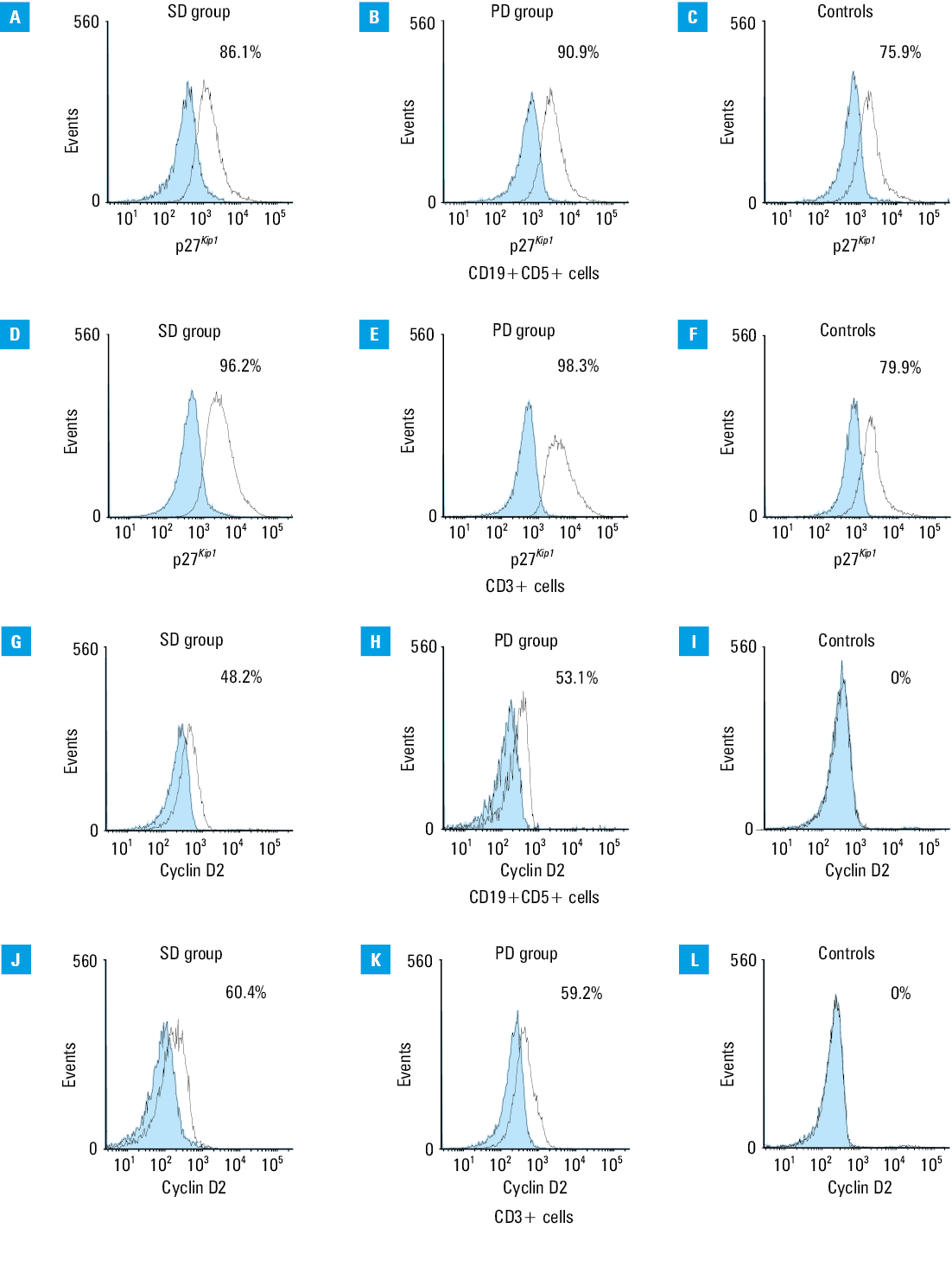
To determine whether the altered longevity of leukemic CD19+CD5+ and CD3+ cells in CLL might be caused by dysregulation in G0/G1 cell cycle regulator expression, we assessed the p27Kip1 and cyclin D2 expression in CD19+CD5+ cells and CD3+ cells in the whole CLL group and CLL subgroups and controls (Table 3; Figure 1).
Cell subsetsa | Patients with chronic lymphocytic leukemia | Controls (n = 39) | P value | ||
Overall (n = 47) | SD group (n = 26) | PD group (n = 17) | |||
Data are presented as median (interquartile range). P values were derived from the nonparametric Kruskal–Wallis 1‑way analysis of variance followed by the Dunn or Mann–Whitney tests.
a Percentage of cells with specific phenotype
| |||||
CD19+CD5+p27Kip1+ | 92.4 (89.3–96.6) | 92.2 (89.3–95.9) | 93.6 (89.3–97.2) | 70.5 (63.8–76.1) | O vs C <0.001
SD vs PD, 0.99
SD vs C <0.001
PD vs C <0.001 |
CD3+p27Kip1+ | 95.3 (91.6–96.6) | 95.4 (92.4–96.6) | 95.6 (91.5–98.2) | 73.8 (66.1–79) | O vs C <0.001
SD vs PD, 0.99
SD vs C <0.001
PD vs C <0.001 |
P value | 0.04 | 0.02 | 0.07 | 0.16 | – |
CD19+CD5+cyclin D2+ | 46.95 (26.9–96.6) | 48.25 (23.6–56) | 46.7 (31.4–65.4) | 0 | O vs C <0.001
SD vs PD, 0.98
SD vs C <0.001
PD vs C <0.001 |
CD3+cyclin D2+ | 53.35 (34.8–56.7) | 54.65 (51.3–61.8) | 49.3 (34.3–67.3) | 0 | O vs C <0.001
SD vs PD, 0.55
SD vs C <0.001
PD vs C <0.001 |
P value | 0.02 | 0.004 | 0.48 | – | – |
Abbreviations: see Table 1
We observed higher proportions of both CD19+CD5+ and CD3+ cells coexpressing p27Kip1 in all CLL patients, as compared with corresponding healthy cells (P <0.001). In terms of the CLL clinical course, there were no significant differences in p27Kip1 expression in CD19+CD5+ and CD3+ cells between the SD and PD subgroups. A comparison between p27Kip1-expressing CD19+CD5+ and CD3+ cells demonstrated that in the whole CLL group, the median frequency of CD3+p27Kip1+ cells was higher than that of CD19+CD5+p27Kip1+ cells (P = 0.04), with the difference being more pronounced in the SD group (P = 0.02). In the PD group, there was only a trend toward a higher CD3+p27Kip1+ cell fraction (P = 0.07). In the controls, no significant differences were observed between the p27Kip1-expressing lymphocyte subpopulations, and both were significantly lower than the corresponding cells seen in all patient cohorts studied.
We also analyzed the expression of cyclin D2 in the whole group of CLL patients, the clinical subgroups, and the controls (Table 3; Figure 1). Unlike p27Kip1, which was found in all individuals, cyclin D2 was detected in CD19+CD5+ and CD3+ cells in the CLL patients only. We did not observe any detectable expression of cyclin D2 in healthy CD19+CD5+ nor CD3+ cells. When we compared the patient subgroups regarding the clinical course, we found no significant differences in cyclin D2 expression in CD19+CD5+ and CD3+ cells. A comparative analysis of cyclin D2‑expressing CD19+CD5+ and CD3+ cells showed that in the whole CLL group the fraction of CD3+cyclin D2+ cells was more abundant than that of CD19+CD5+cyclin D2+ cells (P = 0.02) and, of note, this increase was more pronounced in the SD group (P = 0.004). In the PD group, there was no significant difference between CD19+CD5+ and CD3+ cells coexpressing cyclin D2.
Prognostic significance of cyclin‑dependent kinase inhibitor 1B, cyclin D2, and apoptosis in chronic lymphocytic leukemia progression
To assess the prognostic significance of p27Kip1 and cyclin D2 expression as well as the rate of apoptosis for CLL outcomes, we compared the Kaplan–Meier curves for the disease progression (based on the presence of indications for cytostatic treatment) plotted for 2 patient groups: with the studied variable above (>median, high) and below its median value (≤median, low) (Figure 2).
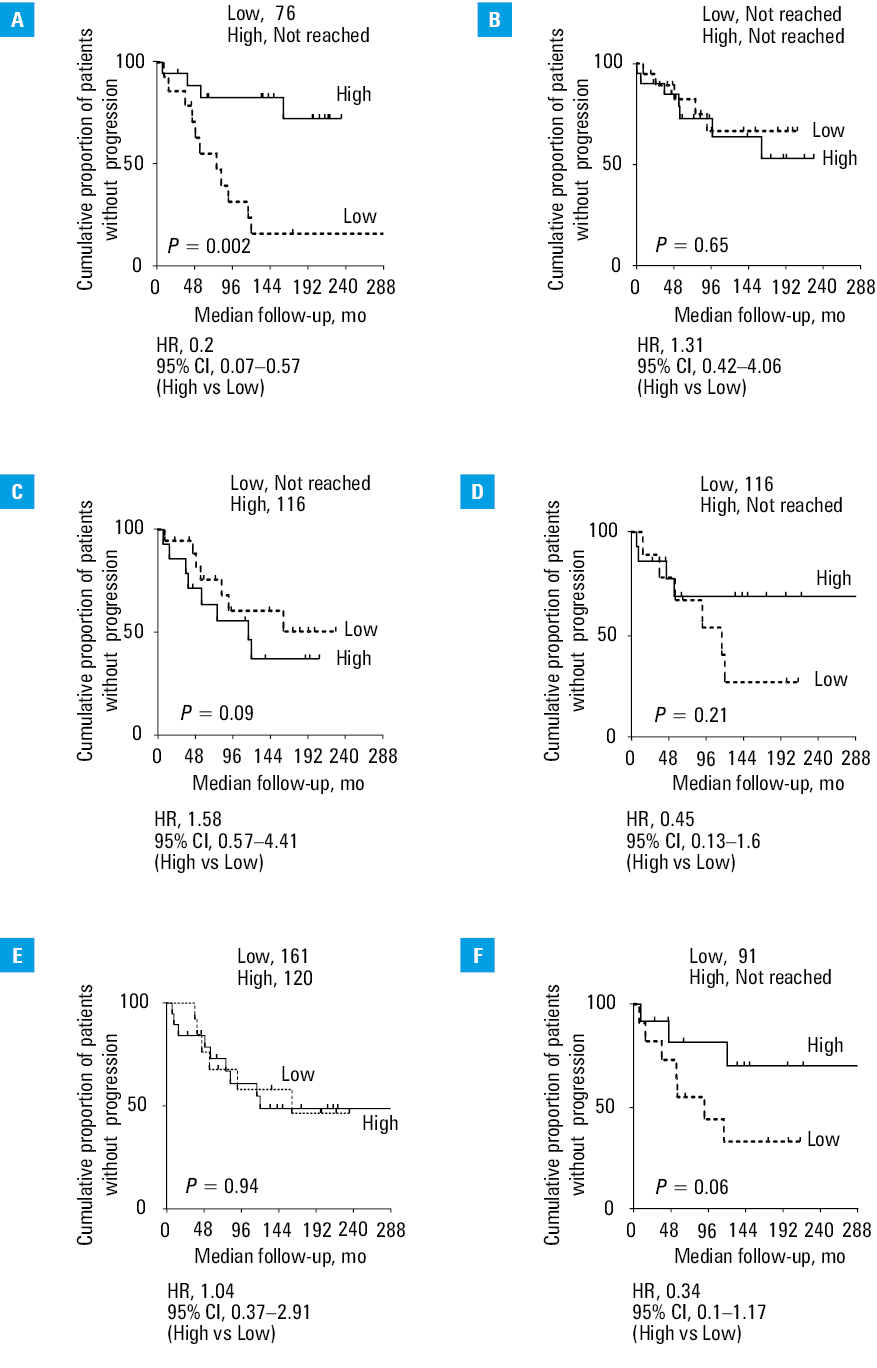
We noted that CLL progression occurred significantly earlier in the patients with a low proportion of apoptotic CD19+ cells than in those with a high frequency of apoptotic CD19+ cells (HR, 0.2; 95% CI, 0.07–0.57; P = 0.002; Figure 2A). In turn, the fraction of apoptotic CD3+ cells showed no significant association with time to CLL progression (Figure 2B).
Having noted the marked differences in the frequencies of p27Kip1+ and cyclin D2+ lymphocytes between the CLL patients and the controls, we then examined the association of the regulators’ expression with the clinical course of CLL. We observed, with a borderline level of significance, that the patients with a higher percentage of CD19+CD5+ cells coexpressing p27Kip1 experienced the disease progression earlier than those with a low fraction of the corresponding cells (P = 0.09; Figure 2C). In addition, as shown in Figure 2F, we noted a tendency toward a shortened time to disease progression in the patients with a low percentage of CD3+ cells coexpressing cyclin D2, as compared with those exhibiting a higher proportion of CD3+cyclin D2+ cells (P = 0.06).
We did not observe any relationship between the expression of p27Kip1 or cyclin D2 in the CLL cells and patient age or sex, as well as clinical parameters, such as peripheral lymphocyte count, hemoglobin concentration, platelet counts, serum LDH activity, β2‑microglobulin concentration, and Rai / Binet clinical stage.
To clarify the association between p27Kip1 and cyclin D2 protein expression, the rate of apoptosis, and clinical indices with a risk of CLL progression, we performed the Cox regression analysis (Table 4). In the univariable analysis, among the clinical characteristics studied, including patient age, sex, white blood cell count, lymphocyte count, platelet count, hemoglobin level, and levels of β2‑microglobulin and LDH, we observed that only higher concentrations of β2‑microglobulin predicted CLL progression (P = 0.04), while the presence of mutated immunoglobulin heavy‑chain variable (IgVH) genes was of a protective value (P = 0.002), thus confirming their prognostic significance and enrollment of suitable patients. Among the immune parameters examined, the same analysis allowed us to identify the rate of apoptosis within PB CD19+ and CD3+ cells (P = 0.03 and P = 0.04, respectively) as opposite predictors of the clinical course of CLL. Furthermore, multivariable Cox regression analysis enabled the independent prognostic value for CLL progression to be identified for the IgVH mutated status (HR, 0.16; 95% CI; 0.05–0.52; P = 0.002) as well as apoptosis within both CD19+ (HR, 0.85; 95% CI, 0.72–0.98; P = 0.03) and CD3+ (HR, 1.32; 95% CI, 1.04–1.66; P = 0.02) cells (Table 4).
Prognostic factors | Univariable | Multivariable | ||||
HR | 95% CI | P value | HR | 95% CI | P value | |
Apoptotic cells within CD19+ cells, % | 0.84 | 0.72–0.99 | 0.03 | 0.85 | 0.72–0.98 | 0.03 |
Apoptotic CD19+ cells within PBMCs, % | 0.8 | 0.63–1.02 | 0.07 | – | – | – |
Apoptotic CD3+ cells within PBMCs, % | 1.29 | 1.01–1.65 | 0.04 | 1.32 | 1.04–1.66 | 0.02 |
β2‑microglobulin | 1.7 | 1.02–2.81 | 0.04 | – | – | – |
IgVH mutation | 0.16 | 0.05–0.52 | 0.002 | 0.16 | 0.05–0.52 | 0.002 |
Discussion
Our study demonstrated for the first time that the rate of protection from apoptosis differs between PB B and T lymphocytes in CLL, and that this CLL characteristic may be associated with the clinical course of the disease. An important observation of the study was that there were no significant differences in B cell apoptosis between the patient cohort and healthy controls. Additionally, despite comparable apoptotic B cell fractions in the patients with stable and progressive CLL, the Kaplan–Meyer analysis showed that the lower rate of ex vivo apoptosis of malignant B cells was predictive of earlier CLL treatment implementation, thus indicating the involvement of failed B cell apoptosis in the disease progression. Accordingly, the fraction of apoptotic B cells was also found to be of protective significance when considering the risk of CLL progression. In our ex vivo experiments, we used the CMXRos dye (Molecular Probes) to detect the earliest events in the apoptotic pathway occurring spontaneously within the lymphocytes immediately after cell isolation from PB. In this context, given the small apoptotic compartment within PB B cells, we cannot exclude the long‑lasting influence of prosurvival extrinsic factors from the microenvironment. Our observation is in line with former studies27-29 showing that leukemic B cells from patients with poor prognosis were more prone to spontaneous apoptosis when the cells were deprived of growth factors in cultures, indicating the presence of stronger prosurvival signals in PB during the disease progression.
Another interesting result of our study was that T cells were found to exhibit the highest rate of spontaneous apoptosis when compared with either leukemic B cells or corresponding healthy T cells. Our results are in line with the study by Bojarska‑Junak et al,27 who demonstrated ex vivo that in CLL the apoptotic fraction was higher in the T cell population than in B cells. In controls, we found that B cells were more prone to apoptosis than T cells, also consistently with previous observations.30 Furthermore, in our ex vivo assay, the rate of T cell apoptosis was shown to be a predictor of earlier CLL progression. This was in opposition to the situation observed within the PB B cell compartment, where the rate of B cell apoptosis demonstrated a protective impact. Accordingly, insignificantly higher fraction of apoptotic T cells was also noted in progressive patients. Taking into account that all samples were incubated under the same conditions, the differences in the apoptosis rate observed between CLL B and T cells strengthen the suggestion that intrinsic factors also play a role in lymphocyte survival, and that resistance to apoptosis is not solely dependent on extrinsic signals. One could speculate that in contrast with B cells, the increased population of PB T cells, as well as ex vivo apoptotic T cells, might indicate that the T cell compartment in CLL becomes more sensitive to intrinsic prosurvival signals than long‑lasting extrinsic ones. Furthermore, the increased T‑cell turnover found in our study may serve to maintain an appropriate size of the T cell population in PB as a relevant support for leukemic B cell growth. This is consistent with recent findings that T cells in CLL patients could prevent apoptosis of malignant B cells.31
Our results showing the opposite apoptosis sensitivity of CLL B and T cells prompted us to search for the intracellular factors involved in the maintenance of PB lymphocyte longevity that could be dysregulated in CLL. Therefore, we examined the expression of p27Kip1 and cyclin D2, which have been shown to be engaged in regulating the G0/G1 phase of the cell cycle by controlling both proliferation and apoptosis pathways.32 We detected a higher population of B and T cells expressing p27Kip1 inhibitor protein in the CLL patients than in the controls, which demonstrated that a larger compartment of PB lymphocytes in CLL is arrested in the G0/G1 phase irrespective of the clinical course, thus supporting their accumulation in PB. Moreover, the association found between p27Kip1 expression in leukemic B cells and the earlier progression of CLL seems to emphasize the role of p27Kip1 in malignant B cell accumulation and CLL clinical course. Similar observations concerning p27Kip1 expression in leukemic B cells were reported by us and other research teams.30,31 We did not find any significant differences in leukemic B or T cells expressing p27Kip1 when considering the CLL clinical course, probably due to the relatively small patient subgroups or methodological differences in the p27Kip1 assessment. Remarkably, when we compared the p27Kip1 distribution between B and T cell populations, a novel and surprising observation was made: the highest expression of p27Kip1 was found in patient T cells, as compared with leukemic B cells and healthy T cells. Available data assessing p27Kip1 content in CLL are limited to leukemic B cells and / or the overall population of PB lymphocytes,20,30 and there are no data on p27Kip1 expression in CLL T cells. In addition, there are several technical differences in the measurement of p27Kip1 protein expression, meaning that any comparison with our results is difficult. The greater p27Kip1 abundance in CLL was previously reported to be associated with G0/G1 cell cycle arrest, indicating a quiescent state in PB, increasing with the disease progression and poorer prognosis.20,30 In contrast, in solid tumors, lower p27Kip1 abundance in the neoplastic cells was shown to be strongly associated with cell cycle progression, promoting malignant cell proliferation and unfavorable clinical outcomes.33-36 While the significance of p27Kip1 in terms of cell cycle arrest and lymphocyte accumulation in CLL is well understood, contradictory results were published regarding the role of p27Kip1 in apoptotic pathways in cancers showing both an anti- or proapoptotic impact.16 However, the inverse association of p27Kip1 with spontaneous apoptosis of PB lymphocytes, as demonstrated in several reports, strengthens the suggestion that in CLL, a high p27Kip1 expression impedes cell cycle progression, prevents in vivo apoptosis by the inhibition of CDK / cyclin complexes, and compromises patient survival.20,30 Of note, although we found a higher population of p27Kip1+ T cells in comparison with p27Kip1+ leukemic B cells in all CLL patients, the difference was significant only in the SD patients. This finding may confirm that p27Kip1+ expression in T cells might be involved in the control of CLL clinical outcomes.
Another interesting observation was that cyclin D2 is expressed in CLL patient samples in approximately 50% of the leukemic B and T cells. The expression of cyclin D2 appears to be a unique feature of PB lymphocytes in CLL, as corresponding healthy cells lack cyclin D2 expression.25,37-39 The lymphocyte expression of cyclin D2 in CLL is considered to be an attribute of cell cycle progression into an early G1 phase, which may, in turn, confer greater sensitivity and responsiveness to the external prosurvival signals.22,23,40 Recent data reported that all hematopoietic cells died after ablation of D‑type cyclins, demonstrating their antiapoptotic function and necessity for lymphocyte survival.41,42 Furthermore, a study by Choi et al42 showed that the prosurvival action of cyclins D in lymphocytes is displayed through the repression of Fas and FasL expression. Notably, they found that hematopoietic stem cells are protected from apoptosis, and this prosurvival activity is strictly dependent on cyclin D expression even in a quiescent state. This observation is in accordance with current knowledge that cyclins D are induced and function in proliferating cells.43 Therefore, the cyclin D2 expression in CLL found in our study might reflect the cell’s attempt to undergo division upon antigen stimulation. This suggests that cyclin D2+ lymphocytes in CLL exhibit a potency to proliferate and control in vivo apoptosis by inhibition of the extrinsic Fas‑mediated pathway.42,44 Accordingly, recent studies have demonstrated that in CLL, lymphocytes from proliferating compartments show a greater ability to undergo spontaneous apoptosis in vitro.27,28 Likewise, we and other authors have previously reported that the expression of cyclin D2 in vivo might be a marker of leukemic B cell activation.22,23,43 Moreover, we had showed earlier that the rate of decrease in cyclin D2 expression observed in cell cultures corresponded with an increase in spontaneous apoptosis of leukemic B cells, thus clearly indicating that cyclin D2 might indeed prevent apoptosis and support survival of PB leukemic B cells.
Remarkably, while we observed higher cyclin D2 expression in a subset of T cells, as compared with leukemic B cells, the difference was significant only in patients with SD, similarly to the findings regarding p27Kip1 expression. In line with this observation, we also found that greater abundance of cyclin D2 within T cells may predict a stable CLL course. Taking into account that p27Kip1 and cyclin D2 have been considered as proteins with an antiapoptotic function in CLL, our results may indicate that PB T cells from stable CLL patients are more protected from apoptosis than those from patients with PD, thus implying an association between the longevity of T cells and CLL outcome. Therefore, our study demonstrates for the first time that despite p27Kip1 and cyclin D2 increase in both CLL patient cohorts, the loss of differences in their expression between the leukemic B and T cells during CLL progression may lead to the induction of the apoptotic pathway in the larger T cell compartment. Our observation appears to be consistent with studies in CLL, indicating that the lymphocytes with higher proliferative potential are more prone to ex vivo apoptosis.27 Based on these findings, we suggest that in CLL, the dynamic interplay of p27Kip1+ and cyclin D2+ fractions within B and T cells may play a role in their diverse resistance to apoptosis and, in consequence, determine the clinical course of the disease.
The main limitation of our study is the relatively small size of both patient and control groups. Therefore, it is possible that some relationships present in the general population were not detected with the statistical tests used. Moreover, it must be noted that the CLL cells that undergo apoptosis in vivo are quickly eliminated from the circulation. For this reason, the ex vivo measure of apoptosis in CLL lymphocytes, whatever the method, probably does not accurately reflect what happens in vivo. Thirdly, the impact of the studied phenomena on the clinical course of CLL could be assessed only regarding the rapidity of the disease progression before treatment. Since the completion of patient recruitment into the study, the standards for anticancer treatment of CLL have substantially changed (immunochemotherapy is rarely used), so the assessment of the effects the parameters tested in our study had on the overall survival would be of very limited practical value.
In conclusion, our study showing the high expression of p27Kip1 and cyclin D2 cell cycle regulators in quiescent lymphocytes in CLL patients strengthens the suggestion of the induction and maintenance of prosurvival signals in leukemic B and nonmalignant T cells. This may be one of the mechanisms underlying the accumulation of both lymphocyte subpopulations in PB of the CLL patients. Taking into account that the fractions of p27Kip1+, cyclin D2+, and ex vivo apoptotic cells were higher in T cells than B cells, we may speculate that T cells during CLL development acquire the unique ability to maintain longevity in vivo to be effective in supporting malignant B cell growth. Our finding on the predictive significance of the spontaneous apoptosis of T cells for CLL progression indicates the involvement of the nonmalignant T cell compartment in CLL pathogenesis and clinical outcomes.
- Jain N, Wierda WG, O’Brien S. Chronic lymphocytic leukaemia. Lancet. 2024; 404: 694‑706. | Crossref
- Shadman M. Diagnosis and treatment of chronic lymphocytic leukemia: a review. JAMA. 2023; 329: 918‑932. | Crossref
- Braish J, Cerchione C, Ferrajoli A. An overview of prognostic markers in patients with CLL. Front Oncol. 2024; 14: 1371057. | Crossref
- Jodlowski G, Borkowski A, Dybko Z, et al. Post‑polycythemia vera myelofibrosis with myelodysplastic‑like progression in a patient with chronic lymphocytic leukemia. Pol Arch Intern Med. 2024; 134: 16735. | Crossref
- Koehrer S, Burger JA. Chronic lymphocytic leukemia: disease biology. Acta Haematol. 2024; 147: 9‑22. | Crossref
SUPPLEMENTARY MATERIAL
ARTICLE INFORMATION