
Changes in lipoprotein(a) concentrations in patients with acute coronary syndrome
Key words: acute coronary syndrome, lipid profile, lipoprotein(a), NSTEMI, STEMI

 CC BY 4.0
Changes in lipoprotein(a) concentrations in patients with acute coronary syndrome
CC BY 4.0
Introduction: Recently, interest has been growing in lipoprotein(a) (Lp[a]) as an independent risk factor for cardiovascular diseases. European Society of Cardiology recommends a single measurement of Lp(a) concentration as a guide to determine cardiovascular risk group and appropriate treatment. Although initially assumed to be genetically determined, a growing number of reports indicate that Lp(a) concentration may change over time.
Objectives: The aim of the study was to compare changes in the concentration of Lp(a) in patients with acute coronary syndrome (ACS) at the moment of ACS and 3 months later.
Patients and methods: Forty patients with ACS were enrolled and divided into ST‑segment elevation myocardial infarction (STEMI) and non‑STEMI (NSTEMI) + unstable angina (UA) groups. The levels of lipids, C‑reactive protein, high‑sensitivity troponin T, N‑terminal pro–B‑type natriuretic peptide, and Lp(a) were determined using routine laboratory methods, with interleukin‑33 levels measured using an enzyme‑linked immunosorbent assay.
Results: Among all ACS patients, 9 (22.5%) had elevated Lp(a) levels (>75 nmol/l). This proportion was higher in the STEMI (n = 8; 35%) than NSTEMI+UA (n = 2; 13%) patients. All patients with ACS showed significantly higher serum Lp(a) levels 3 months after ACS. The Lp(a) level at the moment of ACS and 3 months later differed markedly in the STEMI patients (P = 0.03), all patients with ACS (P = 0.003), and NSTEMI+UA individuals (P = 0.003).
Conclusions: Measuring Lp(a) level during ACS may be insufficient for accurate diagnosis and effective treatment, as its concentration increases 3 months post‑ACS. Therefore, ACS may be regarded as another nongenetic factor influencing Lp(a) concentration.
What's new?
Our study is among the first to evaluate and compare lipoprotein(a) [Lp(a)] levels during acute coronary syndrome (ACS) and 3 months postincident. We observed that Lp(a) levels were higher 3 months after ACS than at the time of ACS, which suggests that a single Lp(a) determination at the moment of ACS does not give a reliable and repeatable result. This observation indicates that ACS may be a nonhereditary factor influencing serum Lp(a) concentrations, highlighting that a single Lp(a) measurement during ACS might be inadequate for accurate cardiovascular risk stratification. Therefore, we recommend reassessing Lp(a) levels when a patient is in a stable condition. This study fills a research gap regarding the practical importance of Lp(a) determination in assessing cardiovascular risk in patients with ACS.
![Dynamics of serum lipoprotein(a) (Lp[a]) levels in patients with acute coronary syndrome (ACS); A – within a 3-month period after the ACS event (n = 40); B – within a 3-month period after ST-segment elevation myocardial infarction (STEMI; n = 23); C – within a 3-month period after non–STEMI + unstable angina (NSTEMI+UA; n = 17)
Significant differences are indicated by P <0.05.](/paim/_next/image/?url=https%3A%2F%2Fpamw.pl%2Fsites%2Fdefault%2Ffiles%2Fjson_zip_files%2Funcompressed%2F16959%2FIMAGES%2FKP_WEB__FIG_95222.png&w=3840&q=75)
Introduction
Elevated lipoprotein(a) (Lp[a]) concentration has become a recognized and independent risk factor for atherosclerotic cardiovascular disease (ASCVD).1 Recent understanding of the atherogenic effects of Lp(a) has led to an increase in the frequency of determining Lp(a) levels, especially in patients with CVDs. This contributed to the development of new treatment strategies aimed at reducing Lp(a) levels and providing patients with greater clinical benefits.1
Lp(a) belongs to low‑density lipoproteins (LDLs). Its core is apolipoprotein A (apoA), which is connected to apolipoprotein B (apoB) by a disulfide bond. Due to its structure, it participates in both atherosclerotic and thrombotic (apoB‑100) and thrombotic‑inflammatory complications (apoA).2
Acute coronary syndrome (ACS) significantly affects the concentration and composition of plasma lipoproteins and lipids. ACS patients demonstrate lower levels of high- and low‑density lipoprotein and total cholesterol, and higher levels of very low‑density lipoproteins and triglycerides in plasma.3 Lp(a) is believed to promote atherogenesis by delivering cholesterol to atherosclerotic plaques.4
The role of inflammatory interleukins (ILs) in the pathogenesis of atherosclerosis is also undeniable. They participate in atherothrombosis, atherogenesis, or rupture of atherosclerotic plaque.5 Expression of the inflammatory response regulator IL‑33 in human atherosclerotic plaques is associated with plaque instability. Additionally, lower levels of IL‑33 were observed in patients with ACS than in patients with stable angina and healthy individuals.6
Current recommendations provided by both European Society of Cardiology (ESC) and Canadian Cardiovascular Society indicate that only a single Lp(a) concentration measurement in a patient’s lifetime is necessary.7,8 Currently, approximately 20%–30% of the population has elevated Lp(a) levels defined as that above 30 mg/dl or 75 nmol/l.9 A recent study of Polish patients consulted by cardiologists showed an elevated Lp(a) level in 21.5% of these individuals.10
Patients with Lp(a) levels above 430 nmol/l or above 180 mg/dl are at a very high risk of ASVD, equivalent to untreated heterozygous familial hypercholesterolemia.11
Although Lp(a) concentration is genetically determined, and is believed to remain constant throughout life, nongenetic factors can also influence it; these can include lifestyle, hormonal disorders, inflammation and its treatment, and chronic kidney disease.12
We hypothesize that Lp(a) concentration may show some variability, with its levels differing between the onset of ACS and 3 months later. Therefore, ACS may become another factor influencing Lp(a) level fluctuations. Hence, this retrospective study aimed to evaluate changes in Lp(a) concentrations at the onset of ACS and at 3‑month follow‑up. It also attempted to identify correlations between Lp(a) concentrations and various inflammatory and lipid parameters.
Patients and methods
Study population
The study involved 40 adult patients with ACS undergoing percutaneous coronary intervention (PCI). The study lasted for 2 years, and involved collecting and analyzing results at the time of ACS and 3 months later. The group included 23 individuals with ST‑segment elevation myocardial infarction (STEMI), 11 with non‑STEMI (NSTEMI), and 6 with unstable angina (UA). The inclusion criteria were emergency hospitalization due to ACS treated at the Hemodynamics Unit. The exclusion criteria comprised the presence of cancer, autoimmune diseases involving connective tissue disease, administration of immunosuppressive treatment, immune deficiencies, severe infection / sepsis, liver cirrhosis, terminal stage of renal disease, and age up to 18 years.
ACS events were diagnosed and treated according to the applicable ESC guidelines.7 Three patients were treated conservatively, and 37 with stent implantation. PCIs were performed according to standard protocols and by experienced interventionists.
During the 3‑month follow‑up, the therapy for chronic diseases remained consistent. The patients did not receive any medications with a proven effect on Lp(a) levels.
All readings were taken at the moment of an ACS event and 3 months later. During the 3‑month follow‑up, none of the patients experienced any recurrent cardiovascular incident.
Ethics
Informed written consent was obtained from each patient included in the study. The study protocol conforms to the ethical guidelines of the 1975 Declaration of Helsinki. Study approval was awarded by the local Ethics Committee (RNN/187/19/KE).
Collecting and processing blood samples
Peripheral blood samples were obtained by venipuncture. They were collected into sodium‑heparin vacuum tubes and processed by centrifugation for 20 minutes at 2200 g to obtain plasma. Serum for most assays was obtained after centrifugation at 3000 g for 5 minutes, in serum separation tubes. The supernatant was stored at –80 °C. All the samples were thawed only once.
Assessment of laboratory parameters
Biochemical tests for serum lipids, C‑reactive protein (CRP), high‑sensitivity troponin T (hs‑TnT), N‑terminal pro–B‑type natriuretic peptide (NT‑proBNP), and Lp(a) were performed using conventional laboratory methods; Lp(a) was determined using the LPA 2 Tina‑quant Lp(a) Gen.2 assay (Roche, Mannheim, Germany). Lipid profiles, cholesterol, high‑density lipoprotein cholesterol, and triglyceride levels were assessed with a colorimetric assay. NT‑proBNP and hs‑TnT were determined by electrochemiluminescence immunoassay. Lp(a) and CRP concentrations were measured using the immunoturbidimetric assay. All biochemical assays were performed on a Cobas 6000 or 8000 system (Roche, Tokyo, Japan). The parameters were assessed at the time of ACS and 3 months later.
Assessment of interleukin‑33 with enzyme‑linked immunosorbent assay
The concentration of IL‑33 was determined in serum with a Human IL‑33 enzyme‑linked immunosorbent assay (Diaclone SAS, Besancon, France) at the time of ACS and 3 months later. The minimum detectable concentration of IL‑33 was 31.2 pg/ml.
Assessment of left ventricular ejection fraction and left ventricular mass index
Transthoracic echocardiographic examination was performed with the Affiniti 50G apparatus (Philips, Tokyo, Japan). Linear measurements were made according to the European Society of Echocardiography guidelines.13 Left ventricular (LV) volumes were determined based on the modified biplane Simpson method, and used to estimate ejection fraction. All echocardiographic measurements were performed by a health professional with subspecialty training in echocardiography. Additionally, the LV mass index was evaluated. The parameters were measured at the time of ACS and 3 months later.
Statistical analysis
The distribution of each variable was verified by the Shapiro–Wilk test. Those with a normal distribution are presented as mean (SD), while those without are given as median and interquartile range (IQR). As Lp(a) levels did not follow a normal distribution, the difference in its concentration over 3 months was analyzed with the Wilcoxon rank test. Comparisons between the groups were performed with the t test for the variables that demonstrated a normal distribution and homogeneous variance, or the Mann–Whitney test for those that did not. Nominal variables were compared between the groups using the Fisher exact test or the χ2 test. Correlations between Lp(a) and other measured parameters were determined using the Spearman correlation coefficient. The qualitative parameters are presented in the dichotomous form. Differences were regarded as significant for a P value below 0.05. All analyses were conducted with Statistica software, version 12.5 (2000 StatSoft, Inc., Tulsa, Oklahoma, United States).
Results
Study population
Of the 40 enrolled patients with ACS, 22 (55%) were men. The mean (SD) age was 66.2 (8.6) years. Eleven patients (27.5%) had previously been diagnosed with coronary artery disease (CAD). In the whole group, 23 patients (57.5%) had STEMI, 11 (27.5%) NSTEMI, and 6 (15%) UA. Due to the small number of UA patients, the NSTEMI and UA patients were combined into a single group. Therefore, the final comparison involved the STEMI vs NSTEMI+UA groups.
Age, serum hs‑TnT, and IL‑33 levels differed significantly between the STEMI and NSTEMI+UA groups (Table 1). The STEMI patients were on average 7 years younger (P = 0.02), had higher median serum concentrations of hs‑TnT by 0.69 ng/ml (P = 0.02), and IL‑33 by 33.2 pg/ml (P <0.001); also more of them were active smokers (52% vs 12%; P = 0.007) at the moment of ACS (Table 1). Furthermore, the NSTEMI+UA patients exhibited greater prevalence of CAD (53% vs 9%; P = 0.003), arterial hypertension (88% vs 43.5%; P = 0.007), and type 2 diabetes mellitus (53% vs 4%; P <0.001; Table 1). The NSTEMI+UA patients were also more frequently treated with angiotensin‑converting enzyme inhibitors or angiotensin receptor blockers.
Parameter | ACS (n = 40) | STEMI (n = 23) | NSTEMI+UA (n = 17) | P value STEMI vs NSTEMI+UA |
Data are presented as mean (SD) and median (interquartile range) unless indicated otherwise.
SI conversion factors: to convert HDL‑C and TC to mmol/l, multiply by 0.0259; hs‑TnT to µg/l by 1; LDL‑C to mmol/l, divide by 38.66; triglycerides to mmol/l, multiply by 0.0113.
Abbreviations: ACEI, angiotensin‑converting enzyme inhibitor; ACS, acute coronary syndrome; ASA, acetylsalicylic acid; BMI, body mass index; CRP, C‑reactive protein; HDL, high‑density lipoprotein, hs‑TnT, high‑sensitivity troponin T; IL, interleukin; LDL, low‑density lipoprotein; Lp(a), lipoprotein(a); NSTEMI, non–ST‑segment elevation myocardial infarction; STEMI, ST‑segment elevation myocardial infarction; TC, total cholesterol; UA, unstable angina | ||||
Clinical features | ||||
Age, y | 66.2 (8.6) | 63.4 (8.7) | 69.9 (6.4) | 0.01 |
Sex, women / men, n | 18/22 | 9/14 | 9/8 | 0.38 |
BMI, kg/m² | 28.4 (25–31.2) | 29 (24.6–32.9) | 26.9 (25.9–31.2) | 0.74 |
History of coronary artery disease, n (%) | 11 (27.5) | 2 (9) | 9 (53) | 0.003 |
Arterial hypertension, n (%) | 25 (62.5) | 10 (43.5) | 15 (88) | 0.007 |
Type 2 diabetes, n (%) | 10 (25) | 1 (4) | 9 (53) | 0.001 |
Current smoker, n (%) | 15 (37.5) | 12 (52) | 2 (12) | 0.007 |
Past smoker, n (%) | 31 (77.5) | 19 (83) | 11 (65) | 0.13 |
Statins, n (%) | 14 (35) | 5 (22) | 8 (47) | 0.17 |
ASA, n (%) | 8 (20) | 4 (17) | 4 (23.5) | 0.7 |
ACEI, n (%) | 16 (40) | 5 (22) | 11 (65) | 0.007 |
β-Blocker, n (%) | 10 (25) | 1 (4) | 9 (53) | 0.001 |
Echocardiography | ||||
Ejection fraction, % | 46.5 (40–48) | 45 (40–48) | 47 (38–50) | 0.57 |
Left ventricular mass, g | 256.5 (65.5) | 257.1 (57.9) | 255.7 (77.2) | 0.95 |
Laboratory variables | ||||
TC, mg/dl | 164 (145–204) | 164 (148–218) | 179 (137–195) | 0.5 |
HDL‑C, mg/dl | 48.5 (39.8–57.8) | 48.8 (40.2–57.8) | 47.4 (35.2–55.7) | 0.99 |
LDL‑C, mg/dl | 102 (70–126) | 103 (85–139) | 109.1 (66–126) | 0.35 |
Non–HDL‑C, mg/dl | 114 (100.7–153.8) | 53.2 (106.4–158.2) | 109.1 (98.5–153.8) | 0.42 |
Triglycerides, mg/dl | 115 (80–49) | 105 (73–141) | 131 (82–196) | 0.11 |
Lp(a), nmol/l | 15.9 (6.7–54.3) | 24.7 (11.9–47.7) | 8.2 (5.5–106.9) | 0.54 |
hs‑TnT, ng/ml | 0.33 (0.6–1.9) | 0.91 (0.09–3.5) | 0.22 (0.03–0.36) | 0.02 |
CRP, mg/l | 3.3 (1.6–9.3) | 3.4 (1.8–10.9) | 3 (1.6–7.3) | 0.75 |
IL‑33, pg/ml | 118.4 (95.4–167.4) | 132.5 (116.3–190.6) | 99.2 (93–116.3) | 0.001 |
None of the patients received proprotein convertase subtilisin / kexin type 9 inhibitors, and all participants were treated with statins.
No difference in median Lp(a) serum level was found between the STEMI and NSTEMI+UA groups (Table 1). Of all ACS patients, 9 (22.5%) had Lp(a) levels above normal (ie, >75 nmol/l). This proportion was lower in the NSTEMI+UA (n = 3; 13%) than the STEMI (n = 6; 35%) group. In the entire group, 5 patients (12.5%) had Lp(a) levels between 75 and 124 nmol/l, 3 (7.5%) between 125 and 449 nmol/l, and 1 (2.5%) above 450 mmol/l.
Serum interleukin‑33 concentration 3 months after acute coronary syndrome
The median (IQR) serum IL‑33 concentration at the time of ACS in all patients with ACS, those with STEMI, and NSTEMI+UA reached 118.4 (95.4–167.4) pg/ml, 132.5 (116.3–190.6) pg/ml, and 99.2 (93–116.3) pg/ml, respectively. Three months after the event, the median (IQR) concentration was 106.1 (95.2–134.4) pg/ml in all patients, 116.3 (97.3–177) pg/ml in the STEMI, and 96.3 (93.9–110.1) pg/ml in the NSTEMI+UA group.
Higher serum lipoprotein(a) levels 3 months after acute coronary syndrome
A median difference of +4.2 nmol/l in Lp(a) levels was observed 3 months after the onset of ACS (P <0.001; Table 2; Figure 1A) in the entire study population. In the STEMI patients, the median difference in Lp(a) levels was +3 nmol/l (P = 0.03; Figure 1B).The median of differences, calculated by subtracting the value at the moment of ACS from that 3 months later, shows a positive value, suggesting an increase in the Lp(a) level in the STEMI group. In the NSTEMI+UA group, the median Lp(a) level 3 months after ACS was higher by 8.05 nmol/l (P = 0.003; Figure 1C). The mean (SD) increase in the Lp(a) levels after 3 months was 30% in all ACS patients (62.9 [105.6] vs 48.5 [80.8] nmol/l), 24% in the STEMI group (61.4 [124.2] vs 49.6 [96] nmol/l) and 38% in the NSTEMI+UA group (64.9 [77.3] vs 47.1 [57] nmol/l).
Variable | ACS (n = 40) | STEMI (n = 23) | NSTEMI+UA (n = 17) | P value STEMI vs NSTEMI+UA |
a Positive median difference indicates that in at least 50% of patients the concentration increased between 0 and 3 months.
Abbreviations: see Table 1 | ||||
The moment of ACS | 15.9 (6.7–54.3) | 24.7 (11.9–47.7) | 8.2 (5.5–106.9) | 0.54 |
3 months after ACS | 17.8 (8.9–76.3) | 21.5a (12.6–58.5) | 12.1 (15.9–157.9) | 0.73 |
P value for the moment of ACS vs 3 months after ACS | 0.001 | 0.03 | 0.003 | – |
Median differencesa | +4.2 (0.35–13.825) | +3 (0.1–12.65) | +8.05 (0.6–15) | – |
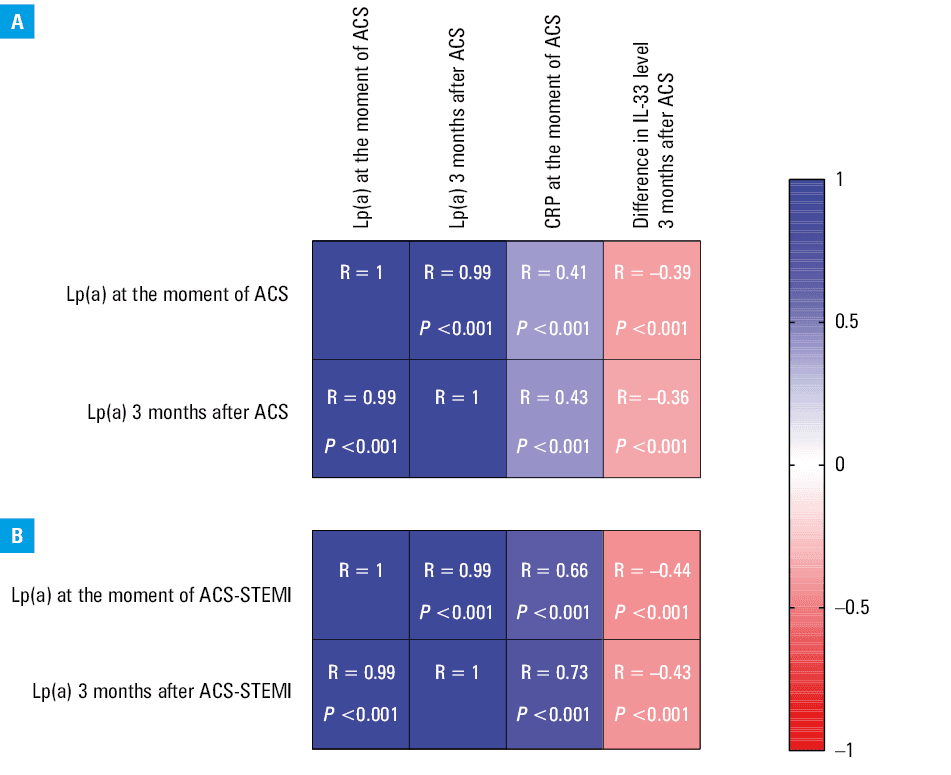
![Correlations of lipoprotein(a) (Lp[a]) levels with laboratory and clinical parameters; A – all patients with acute coronary syndrome (ACS); B – patients with ST-segment elevation myocardial infarction (STEMI)
Significant differences are indicated by P <0.05,
Abbrevitions: R, correlation coefficient; others, see Table 1](/paim/_next/image/?url=https%3A%2F%2Fpamw.pl%2Fsites%2Fdefault%2Ffiles%2Fjson_zip_files%2Funcompressed%2F16959%2FIMAGES%2FKP_WEB__FIG_01.png&w=3840&q=75)
No difference in median serum Lp(a) level was found between the STEMI and NSTEMI+UA groups at the moment of ACS and 3 months later.
Lipoprotein(a) correlations at the moment of acute coronary syndrome and 3 months later
A positive correlation was found between Lp(a) level at the moment of ACS and 3 months later, and CRP level at the moment of ACS. Additionally, a negative correlation was determined between Lp(a) and IL‑33 level. A stronger negative correlation was observed in the STEMI group. No significant correlation was observed in the NSTEMI+UA group between Lp(a) and IL‑33 (Figure 2).
Discussion
Lp(a) is typically measured to estimate the probability of developing CVD, as the result can allow for early detection of potential cardiovascular complications. Our findings indicate that Lp(a) concentration is higher 3 months after ACS than at the moment of the event, suggesting that ACS may be another nongenetic factor influencing Lp(a) concentration, and that a measurement at the moment of ACS may not be an accurate representation of the lifetime Lp(a) level.
Patients with elevated Lp(a) levels have a significantly higher incidence of ACS, major adverse cardiovascular events (MACEs), and recurrent acute myocardial infarction (AMI).14 Lp(a) level has been related with the risk of ASCVD, indicating that it may be an independent risk factor for CVDs. The risk of ACS often persists and atherosclerotic plaque progression continues despite optimization of LDL cholesterol (LDL‑C) levels.7,15 Therefore, Lp(a) concentrations still need to be well characterized in the early postinfarction and peri‑infarction periods. Nevertheless, initial reports indicate that Lp(a) concentration changes in the course of ACS.16,17 Our findings indicate that Lp(a) levels are elevated 3 months after ACS in patients with STEMI and NSTEMI+UA.
The observed differences were more noticeable in the NSTEMI+UA than in the STEMI group. A similar observation was made by Ziogos et al,18 who noted a higher concentration of Lp(a) in patients 6 months after AMI, with more than 20% of individuals demonstrating an increase in Lp(a) of at least 25 nmol/l. In our study, over 17% of patients exhibited an increase in Lp(a) level exceeding 25 nmol/l. However, Ziogos et al18 did not distinguish between the types of ACS in their analysis.
Our findings regarding the Lp(a) increase are in line with a previous report by Sourij et al,19 who observed a significant increase, of approximately 31%, in Lp(a) concentration in STEMI patients from the day of hospital admission until 3 months later. In our study, Lp(a) level increased by 24% in the STEMI group and by 38% in the NSTEMI+UA group. Additionally, while the patients with Lp(a) level equal to or above 75 nmol/l demonstrated a significant increase in the parameter level (34%), only a nonsignificant increase (19%) was observed in the above 75 nmol/l group.
While Lp(a) concentration is known to affect the risk of CVDs, it is not included in the risk assessment used in publicly available Systematic Coronary Risk Estimation calculators. Coronary microcirculation dysfunction has been associated with elevated Lp(a) levels.20 Additionally, it has been reported that elevated Lp(a) level is independently associated with long‑term MACE in individuals with and without baseline ASCVD.21 In the secondary prevention of cardiovascular events, patients with elevated Lp(a) levels are classified into a very high risk category. As such, there may be a need for a new risk stratification based on the degree to which the Lp(a) reference values are exceeded in a given patient. This would account for the extreme risk faced by this patient group.11
Our findings are meaningful, as they suggest a new approach. Although it is reasonable to measure Lp(a) at the moment of ACS to identify patients with its elevated levels, further measurements are needed at different time points. We found that Lp(a) concentration increased 3 months after the ACS event, when the patient’s condition stabilized. This may have therapeutic implications, by influencing a decision to use drugs such as olpasiran, pelacarsen, muvalaplin, and lepodisiran, which are now in clinical trials.22,23
Elevated serum Lp(a) and CRP levels are associated with the development of CAD.24 Our research showed that higher Lp(a) levels are also associated with higher CRP levels at the moment of ACS. Shahid et al25 and Seo et al26 also noticed a significant positive correlation between CRP and Lp(a) concentration. The acute phase reaction may also affect the serum Lp(a) concentration, which may increase during cytokine storm, that is, sudden inflammation associated with excessive production and release of proinflammatory cytokines, including IL‑6, which increases the level of apo(a).27 In COVID‑19 patients, peak IL‑6 concentration preceded an increase in the Lp(a) level.28 Interestingly, Warzywoda et al29 reported higher Lp(a) concentrations during an acute infection, such as with SARS‑CoV‑2, than 1 year after the infection.
Therefore, the presence of inflammation during ACS would suggest increased Lp(a) concentrations. However, Lp(a) concentrations at the time of the ACS event were found to be lower than those obtained 3 months after the event. This may imply a reverse mechanism based on lipoprotein consumption during infarction. Indeed, increased secretion of metalloproteinases and elastases involved in the proteolytic cleavage of the apo(a) Lp(a) component was observed in the course of myocardial infarction.30,31
Apoptosis of macrophages, which produce foam cells with the participation of Lp(a), plays a crucial role in the pathogenesis of atherosclerosis. Macrophages demonstrate extrinsic activation of the Fas/FasL apoptosis pathway during the acute phase of infarction.32,33 Lp(a) can stimulate macrophage apoptosis through a Toll‑like receptor– and CD36 scavenger receptor–dependent pathway34; it may also drive inflammation in other macrophages during infarction by activating caspase‑1 and increasing their secretion of IL‑1β and IL‑18.35
It is well known that IL‑33 is involved in inflammatory and immune reactions; however, it has variable effects in diverse heart diseases. While it promotes inhibition and suppression of inflammation in the acute phase of infarction, its high concentrations may induce a Th2‑type inflammatory response in the chronic phase, resulting in excessive remodeling of the heart muscle, which worsens fibrosis and heart failure.36 Our study shows that IL‑33 concentrations change significantly over time in all patients with ACS and in the STEMI group. Additionally, in the STEMI group, the decrease in IL‑33 level over time correlated negatively with serum Lp(a) concentration at the moment of ACS and 3 months later. The increase in Lp(a) levels observed after myocardial infarction most likely sustains postevent inflammation and inhibits the decline in IL‑33, which has a protective effect on cardiomyocytes. It can, therefore, be concluded that Lp(a) influences the IL‑33‑related immune response.
Although Lp(a) levels are genetically determined, our results suggest that acute clinical conditions, such as ACS, can be nongenetic factors influencing Lp(a) concentration. A single measurement of Lp(a) level during ACS seems insufficient to assess cardiovascular risk; therefore, it should be repeated when a patient is stable. This study sets the stage for further exploration of the dynamics of Lp(a) levels.
- Ochotnicka J, Spryńca M, Pociask E, et al. Measurement of lipoprotein(a) levels in real‑world clinical and laboratory settings: a single‑center experience. Pol Arch Intern Med. 2024; 134: 16891. | Crossref
- Šuran D, Blažun Vošner H, Završnik J, et al. Lipoprotein(a) in cardiovascular diseases: insight from a bibliometric study. Front Public Health. 2022; 10: 923797. | Crossref
- Balci B. The modification of serum lipids after acute coronary syndrome and importance in clinical practice. Curr Cardiol Rev. 2011; 7: 272‑276. | Crossref
- Silverio A, Cancro FP, Di Maio M, et al. Lipoprotein(a) levels and risk of adverse events after myocardial infarction in patients with and without diabetes. J Thromb Thrombolysis. 2022; 54: 382‑392. | Crossref
- Jiang C, Jin X, Li C, et al. Roles of IL‑33 in the pathogenesis of cardiac disorders. Exp Biol Med (Maywood). 2023; 248: 2167‑2174. | Crossref
ARTICLE INFORMATION