
Metabolomic profile associated with coronary artery disease: higher indoleamine 2,3-dioxygenase activity and lower tryptophan concentrations predict worse prognosis
Key words: coronary artery disease, indoleamine 2, 3-dioxygenase, metabolomics, mortality, tryptophan

 CC BY 4.0
Metabolomic profile associated with coronary artery disease: higher indoleamine 2,3-dioxygenase activity and lower tryptophan concentrations predict worse prognosis
CC BY 4.0
Introduction: Metabolite profiling can lead to novel discoveries in cardiovascular disease (CVD) physiology.
Objectives: The aim of the study was to investigate whether a metabolomic profile is associated with mortality in patients with coronary artery disease (CAD).
Patients and methods: The study group consisted of 170 participants with CAD hospitalized for acute coronary syndrome or elective percutaneous coronary intervention 12–26 months (mean [SD], 16.3 [2.2] months) before evaluation. A total of 132 metabolites were profiled by liquid chromatography‑tandem mass spectrometry, and sums / ratios of 102 metabolite concentrations were calculated. Dates of death from all causes were obtained from a registry of the Polish Ministry of Digital Affairs.
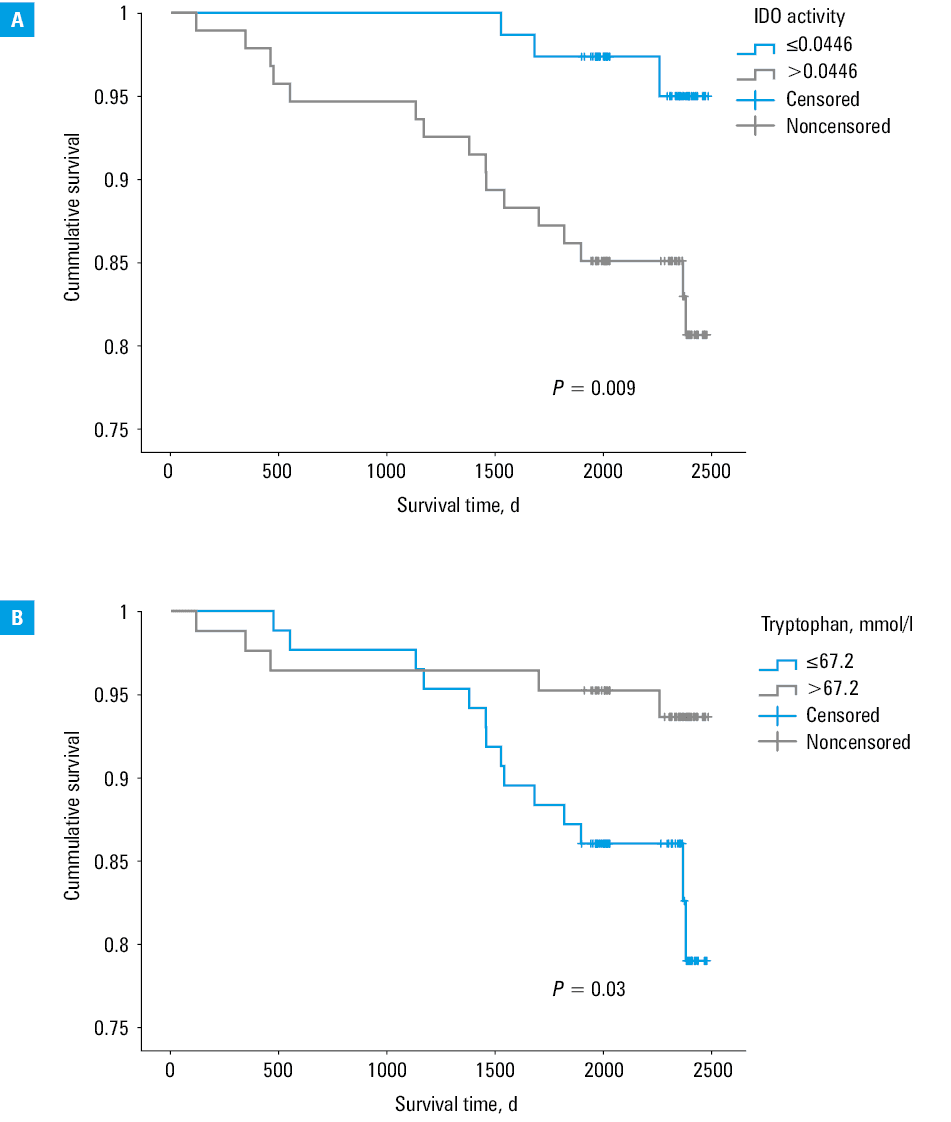
Results: Median (interquartile range [IQR]) age of the group was 62 (58–66) years and 68.8% (n = 117) were men. Median (IQR) follow‑up time was 6.4 (5.5–6.5) years. After adjustment for CVD risk factors affecting survival in the analyzed population (ie, age, statin dose, current smoking, estimated glomerular filtration rate, and high‑sensitivity C‑reactive protein level) with the Bonferroni correction, tryptophan (Trp) level was negatively associated with death (hazard ratio [HR], 0.558; 95% CI, 0.38–0.82; P = 0.003), whereas indoleamine 2,3‑dioxygenase (IDO) activity was positively associated with death (HR, 2.925; 95% CI, 1.71–5.01; P <0.001). Survival analysis showed that the patients with IDO activity above the median experienced shorter survival than the patients with lower IDO activity (log‑rank test; P = 0.009). In contrast, the patients with Trp concentration below the median had worse survival than those with higher Trp levels (log‑rank test; P = 0.03).
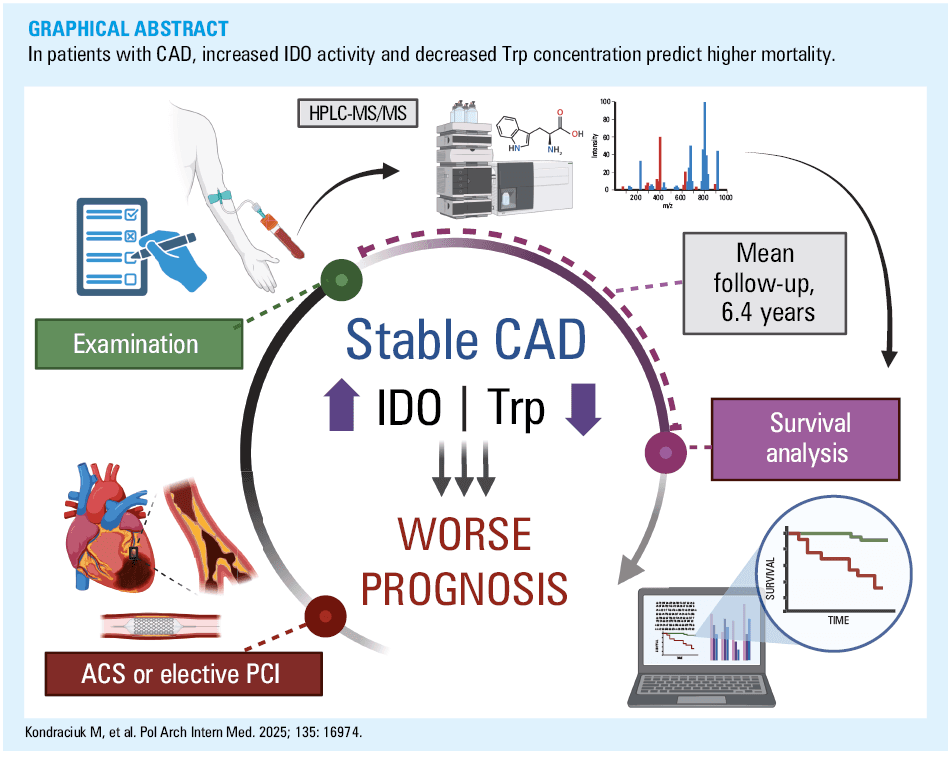
Conclusions: In patients with CAD, increased IDO activity predicts worse long‑term prognosis independently of known CVD risk factors.
What's new?
The study indicated a relationship, which is independent of known cardiovascular disease (CVD) risk factors affecting survival, between indoleamine 2,3‑dioxygenase (IDO) activity and tryptophan (Trp) concentration and worse long‑term prognosis in patients with stable coronary artery disease (CAD). Elevated IDO activity and decreased Trp level were associated with higher mortality. The study provides detailed information on clinical characteristics of the patients with CAD and about 6‑year follow‑up. Its novel finding is that IDO and Trp predict mortality independently of other survival predictors, which means they can have significant implications for CVD risk assessment. Our study highlights a potential role of metabolomic profiling in improving understanding of the biological mechanisms underlying long‑term prognosis in patients with CAD.
Introduction
Metabolites are small molecules synthesized as intermediates or products of metabolism.1 By measuring metabolite levels, it is possible to assess an individual’s metabolic health at a specific time. In some situations, biologically active metabolites can exhibit distinct activities that may produce adverse effects or lead to new medical discoveries.
Cardiovascular disease (CVD) is a leading cause of death and disability worldwide.2,3 The disease affects a large number of people, with coronary artery disease (CAD) accounting for more than 40% of CVD deaths.4 A new avenue for developing complementary CVD assessment strategies has been opened by recent advances in metabolomic profiling, as the metabolome has been shown to be associated with CAD.5
Metabolomics based on high‑resolution analytical techniques combined with statistical analysis is increasingly used in clinical research, including CAD research.6-10 However, the metabolomic profile of patients diagnosed with CAD is not well studied regarding long‑term follow‑up and mortality. Metabolomic profiling is a powerful tool with a potential to identify which patients should undergo prolonged follow‑up and intensified medical interventions that could improve their prognosis.
The aim of the study was to investigate whether a metabolomic profile is associated with mortality in patients with established CAD.
Patients and methods
Study population
In total, we analyzed 170 patients with CAD who experienced acute coronary syndrome (ACS; acute ST‑segment elevation myocardial infarction [STEMI], acute non–ST‑segment elevation myocardial infarction [NSTEMI], unstable angina / acute myocardial ischemia) or elective percutaneous coronary intervention (PCI). The patients were selected from medical records of 3 cardiology departments with a catheterization laboratory (Białystok, Poland). The diagnoses of acute STEMI, acute NSTEMI, unstable angina / acute myocardial ischemia were established according to the European Society of Cardiology (ESC) guidelines for the management of ACSs in patients presenting without persistent ST‑segment elevation11 and ESC guidelines for the management of acute MI in patients presenting with ST‑segment elevation: the ESC Task Force on the management of acute MI in patients with ST‑segment elevation.12
Then, the patients were invited to participate in the study by telephone. Those who accepted the invitation were examined at a research center 12–26 months (mean [SD], 16.3 [2.2] months) after the CVD event. Active cancer was an exclusion criterion. Patients with active infectious diseases were not examined, and their appointment at the study center was postponed until they recovered. The examination phase at the study center lasted for 19 months, from November 2016 to June 2018. The timeline of the study is presented in Figure 1.
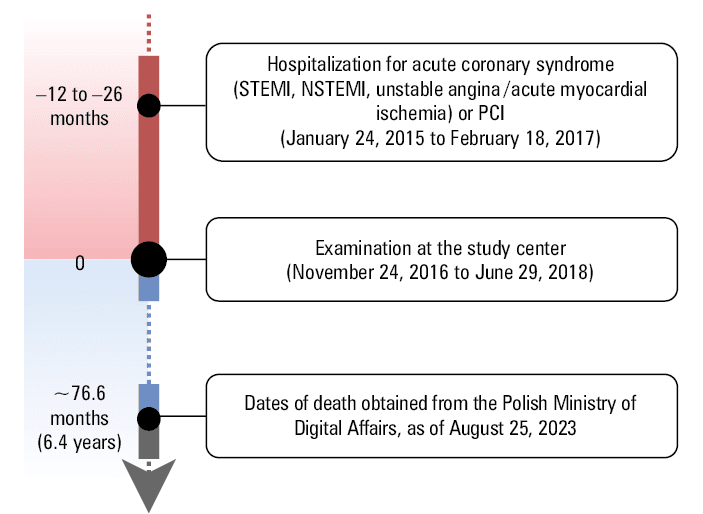
Abbreviations: NSTEMI, non–ST‑segment elevation myocardial infarction; PCI, percutaneous coronary intervention; STEMI, ST‑segment elevation myocardial infarction
At the time of the first examination, data on demographics, anthropometrics, medical history, and current medical treatment were taken using a structured data collection form. The parameters, methods, and equipment used in the study are presented in Supplementary material, Table S1. Details of the methods and standard procedures used in the study were described previously.13-16 Dates of death from all causes were obtained from the records of the Polish Ministry of Digital Affairs as of August 25, 2023. There were no participants who were lost to follow‑up.
Quantitation of metabolites
High‑performance liquid chromatography–tandem mass spectrometry (HPLC‑MS/MS) metabolomics was performed on serum samples. In total, 188 metabolites were measured using an AbsoluteIDQ p180 kit (Biocrates Life Sciences AG, Innsbruck, Austria). The manufacturer’s protocol and methodology were used for sample preparation and measurements.15 Analyses were performed on an HPLC‑MS/MS system composed of 1290 ultra HPLC system coupled with 6470A Triple Quad mass spectrometer (Agilent Technologies, Santa Clara, California, United States). The raw spectra data processing, quantification, and normalization were performed using MetIDQ software (Oxygen DB110‑3005, Biocrates, Life Science AG). Data normalization and cleaning were completed as described in the Biocrates kit user manual.17 Data cleaning included the exclusion of metabolites with low reproducibility, assessed based on the coefficient of variation (CV) calculated from triplicates of the quality control samples for each metabolite in each batch, with a rejection criterion of a CV value greater than 30%. The resulting data were then filtered to reject metabolites below the limit of detection (LOD) in more than 20% of the samples. For the remaining metabolites, the values below the LOD were replaced by half of the LOD for each metabolite in each batch.17 A total of 132 metabolites (listed in Supplementary material, Table S2) were further analyzed.
Sums and ratios of metabolite concentrations
In addition, sums and ratios of metabolite concentrations were calculated according to the protocol of MetaboINDICATOR – AbsoluteIDQ p180 kit (Biocrates Life Sciences AG).18 Formulas were calculated based on the previously obtained metabolites. Finally, 102 sums and ratios of metabolite concentrations were calculated. A list of the metabolite sums and ratios analyzed is provided in Supplementary material, Table S3.
Statistical analysis
Categorical variables were displayed as frequency distribution (n) and percentage (%), and quantitative variables and length of follow‑up were displayed as median and interquartile range (IQR). Normality of continuous data distribution was assessed using the Shapiro–Wilk test. Since most variables had distributions significantly different from normal, the nonparametric Mann‒Whitney test was used. Therefore, the results were presented as medians and IQRs.
To accommodate for skewness of the metabolites and metabolite‑related variables, logarithmic transformation was applied. These variables were also standardized to account for different scales and facilitate the comparison of individual variable effects. Univariable and multivariable Cox proportional hazard regression models were used to analyze the relationships between raw metabolites or their derivative indicators and death. The Bonferroni corrections were applied when drawing conclusions to counteract the multiple comparison problem.
The regression models analyzed only the metabolites and metabolite indicators significantly associated with mortality in the univariable analysis. Model 1 was the starting point, and it was adjusted for basic, nonmodifiable factors, such as age and sex. Model 2 was designed to verify that metabolite effect on death is independent of other known CVD factors influencing death. For this process, a stepwise elimination procedure was applied in multivariable Cox proportional hazard regression models to show which known CVD risk factors affecting survival in our population were most significant. The precise data are provided in Supplementary material, Table S4. The initial model included age, sex, statin dose (converted to simvastatin dose), smoking status, diabetes mellitus, body mass index (BMI), systolic blood pressure, left ventricular ejection fraction, non–high‑density lipoprotein cholesterol, high‑sensitivity C‑reactive protein (hs‑CRP), N‑terminal pro–B‑type natriuretic peptide (NT‑proBNP), high‑sensitivity troponin T, and estimated glomerular filtration rate (eGFR). Finally, parameters such as age, statin dose, current smoking, eGFR, hs‑CRP, and NT‑proBNP remained significant and were then used in the Model 2.
To address the relatively small number of events (n = 19) and ensure a robust approach to covariate selection, we additionally constructed a directed acyclic graph (DAG) based on known biological and clinical relationships between the metabolites, potential confounders, and mortality (Supplementary material, Figure S1). The DAG identified the following minimal sufficient adjustment set of covariates: age, BMI, current smoking, diabetes mellitus, statin dose, eGFR, and hs‑CRP. These variables were included in the multivariable Cox regression models to control for confounding factors and estimate the independent effects of metabolites and metabolite‑related variables on mortality.
The proportional hazards assumption for the Cox regression models was tested using the Schoenfeld residuals approach implemented in the cox.zph function in R software (R Foundation for Statistical Computing, Vienna, Austria). The results for the key variables of interest, indoleamine 2,3‑dioxygenase (IDO) and tryptophan (Trp), indicated no significant deviations from the proportional hazards assumption (P >0.05), supporting the validity of the Cox regression models.
Associations between metabolite concentrations or metabolite sums / ratios and mortality were examined by comparing the Kaplan–Meier survival curves for higher and lower concentrations, using the median as the cutoff point. The significance of differences in survival times between these patient subgroups was evaluated using the log‑rank test.
The statistical analysis was performed using IBM SPSS Statistics 27.0 software (SPSS, Armonk, New York, United States). DAG construction and analysis were conducted using the dagitty package in R (version 0.3.4) and proportional hazards testing was conducted in R (version 4.2.1). A P value below 0.05 was deemed significant.
Ethics
The study was approved by the Bioethics Committee at the Medical University of Bialystok, Poland (R‑I‑002/323/2016). The study was performed following the ethical standards put forward in the 1964 Declaration of Helsinki. Informed written consent was obtained from all participants.
Results
Study population and the metabolomic profiles
Median (IQR) age of the study participants was 62 (58–66) years, 31.2% (n = 53) were women, and 23.4% were current smokers. Median (IQR) time from ACS to blood collection was 16.2 (14.7–7.5) months. Baseline characteristics of the study population are shown in Table 1.
Variable | CAD study group (n = 170) |
Data are presented as number and percentage or median and interquartile range.
SI conversion factors: to convert glucose to mmol/l, multiply by 0.0555; hs‑CRP to nmol/l, by 9.52; TC, LDL‑C, HDL‑C, and non–HDL‑C to mmol/l, by 0.02587; TG to mmol/l, by 0.0113
Abbreviations: BMI, body mass index; CAD, coronary artery disease; DBP, diastolic blood pressure; eGFR, estimated glomerular filtration rate; HbA1c, glycated hemoglobin; HDL‑C, high‑density lipoprotein cholesterol; HOMA‑IR, homeostasis model assessment of insulin resistance; HR, heart rate; hs‑CRP, high‑sensitivity C‑reactive protein; LDL‑C, low‑density lipoprotein cholesterol; OGTT, oral glucose tolerance test; SBP, systolic blood pressure; TC, total cholesterol; TG, triglycerides; others, see Figure 1 | |
Men | 117 (68.8) |
Age, y | 62 (58–66) |
SBP, mm Hg | 130.5 (122–143) |
DBP, mm Hg | 83.5 (77–91) |
HR, bpm | 65.5 (59–73) |
BMI, kg/m2 | 29.5 (27–33) |
Fasting glucose, mg/dl | 105 (97–120) |
OGTT 120 min, mg/dl | 130 (100–161) |
HbA1c, % | 5.8 (5.6–6.2) |
HOMA‑IR | 3.5 (2.2–5.8) |
TC, mg/dl | 154.5 (131–184) |
LDL‑C, mg/dl | 85.1 (69–109) |
HDL‑C, mg/dl | 48 (41–60) |
TG, mg/dl | 114 (77–167) |
Non–HDL‑C, mg/dl | 101.5 (81–133) |
Creatinine, μmol/l | 83.5 (73–97) |
eGFR, ml/min/1.73 m2 | 78.3 (69–94) |
hs‑CRP, mg/l | 1 (0.6–2.4) |
Diabetes | 52 (30.6) |
Heart failure | 18 (10.6) |
Current smoking | 39 (22.9) |
Lipid‑lowering drug intake | 152 (89.4) |
Elective PCI | 58 (34.1) |
STEMI | 49 (28.8) |
NSTEMI | 48 (28.2) |
Unstable angina / acute myocardial ischemia | 15 (8.8) |
Metabolite concentrations in the study group are presented in Supplementary material, Table S5 as medians and IQRs. Results of the metabolite sums / ratios are shown in Supplementary material, Table S6, also as medians and IQRs.
Associations of metabolite levels with survival time
Median (IQR) follow‑up time was 6.4 (5.5–6.5) years. In the analyzed period, 19 participants (11.2%) died.
In the univariable analyses with the Bonferroni corrections, 1 metabolite (Trp) and 6 metabolite sums / ratios (IDO activity, β-oxidation, carnitine esterification, ratio of acetylcarnitine to carnitine, ratio of polyunsaturated fatty acid lysophosphatidylcholines to monounsaturated fatty acid lysophosphatidylcholines, and sum of polyunsaturated fatty acid lysophosphatidylcholines) were significantly associated with mortality (Supplementary material, Tables S7 and S8). In the multivariable models, only the metabolites or sums / ratios significantly associated with mortality in the univariable analysis were taken into account. Following adjustment for age and sex in the model 1, 5 parameters (Trp, lysophosphatidylcholine 18:2, phosphatidylocholine O‑40:1, IDO activity, and carnitine esterification) were significantly associated with mortality.
Model 2 was designed to verify whether the effect of these metabolites on death is independent of other known CVD factors. After adjustment for model 2, Trp level was negatively associated with death (hazard ratio [HR], 0.558; 95% CI, 0.38–0.82; P = 0.003), whereas IDO activity was positively associated (HR, 2.925; 95% CI, 1.71–5.01; P <0.001). Further details are shown in Supplementary material, Table S9 and Figure 2.
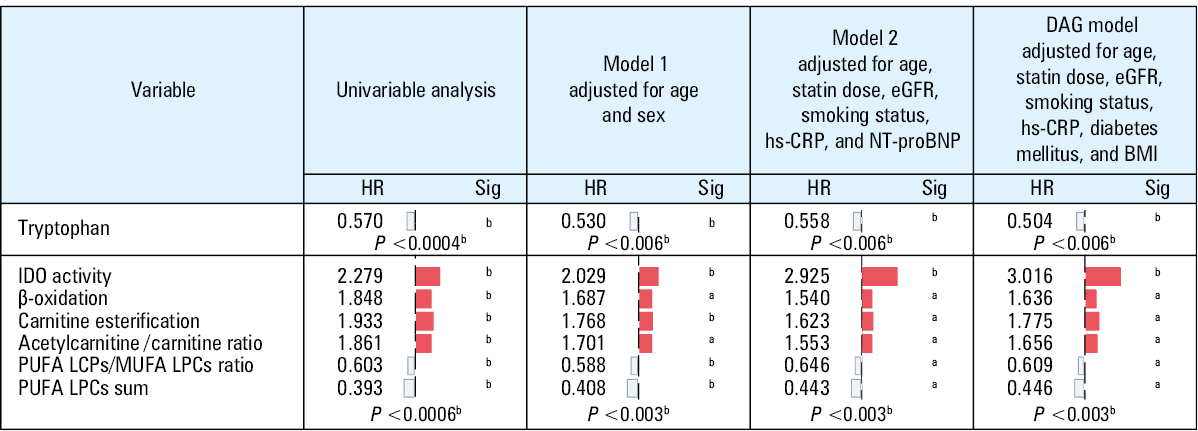
a P value significant (P <0.05)
b P value significant after the Bonferonni correction
Abbreviations: DAG, directed acyclic graph; HR, hazard ratio; IDO, indoleamine 2,3‑dioxygenase; LPC, lysophosphatidylcholine; MUFA, monounsaturated fatty acid; NT‑proBNP, N‑terminal pro–B‑type natriuretic peptide; PUFA, polyunsaturated fatty acid; Sig, significance; others, see Table 1
Furthermore, survival analysis showed shorter survival in the patients with IDO activity above the median than those with IDO activity below this cutoff (log‑rank test, P = 0.009; Kaplan–Meier curves; Figure 3A). In contrast, the patients with Trp concentration below the median showed worse survival than those with higher Trp levels (log‑rank test, P = 0.03; Kaplan–Meier curves; Figure 3B).
Discussion
The study describes the metabolomic evaluation of 170 patients hospitalized for ACS (acute STEMI, acute NSTEMI, unstable angina / acute myocardial ischemia) or elective PCI, that is, with significant CAD. The associations between metabolomics and mortality were demonstrated. Elevated IDO activity and decreased Trp level were associated with worse survival.
Metabolomics in coronary artery disease
Atherosclerosis is a complex phenomenon underlying CAD, which involves multiple metabolic processes and is associated with various metabolite levels.19 If molecular mechanisms of CAD were better understood, the number of CAD cases and associated mortality could be reduced. Current metabolic homeostasis is reflected in the serum or plasma metabolome. Metabolomics is a rapidly growing field of systems biology that assesses metabolic changes in the body. It has become an essential and widely used tool that complements genotyping and RNA sequencing for precise patient characterization.20 Many studies are being conducted to understand the processes involved in atherosclerosis,19 and some specific metabolites may become biomarkers and prognostic indicators of CVD.21-24 Today, omics data, including metabolomics, are effectively analyzed using machine learning methods, and the results are promising in terms of profiling or diagnosing specific diseases.17,20
Fan et al19 described metabolomic evaluation of plasma samples collected from patients who underwent coronary angiography. Phospholipid catabolism, tricarboxylic acid cycle, and primary bile acid biosynthesis declined with CAD progression, while amino acid metabolism and short‑chain acylcarnitine levels increased. In comparison with the patients with normal coronary arteries, those with nonobstructive coronary atherosclerosis had reduced levels of lysophosphatidylcholines, lysophosphatidylethanolamine 18:2, and phosphatidylethanolamine and elevated levels of phytosphingosine. In the same study, the authors compared metabolic profiles of patients with stable and unstable angina, indicating an increase in creatine, 2‑hydroxylauric acid, Trp, isobutyrylcarnitine, propionylcarnitine, and acetylcarnitine levels and a decrease in aspartic acid, phosphocholine, lysophosphatidylcholine 16:0, and lysophosphatidylcholine 18:1 levels in the latter group.19 Tang et al25 suggested that decreased phosphatidylcholine concentrations may play an important role in the pathogenesis of CAD through trimethylamine‑N‑oxide–related mechanisms. Havulinna et al23 showed that elevated ceramide (Cer) levels were associated with a risk of incident major adverse cardiovascular events (MACEs) in apparently healthy individuals. Of the Cer species, Cer (d18:1/18:0) level had the strongest association with incident MACE and the highest unadjusted HR of 1.31 (95% CI, 1.21–1.41). Cason et al26 demonstrated that the concentrations of indole, Trp, and indole‑3‑aldehyde were negatively associated with advanced atherosclerosis, whereas the kynurenine/Trp ratio was positively associated with this parameter.
Relationships between indoleamine 2,3‑dioxygenase activity, tryptophan concentrations, and coronary artery disease
The study showed a positive association between increased IDO activity and mortality in patients with CAD, independently of known CVD risk factors affecting survival. IDO is a cytosolic enzyme that catalyzes the first and rate‑limiting step of Trp catabolism, that is, degradation of Trp to kynurenine. IDO activity was determined as the ratio of kynurenine to Trp. We also confirmed a negative association between mortality and lower Trp levels, which is a consistent outcome.
Our study has the potential to add to existing knowledge on CAD by showing that elevated IDO activity may predict worse prognosis in CAD.27,28 Wongpraparut et al28 showed that patients with significant vessel disease had markedly increased IDO activity and kynurenine levels, as compared with those with insignificant CAD. The increase in IDO activity correlated with the degree of coronary stenosis, particularly in the right coronary artery, suggesting the intensity of counterregulatory mechanisms triggered in an attempt to maintain immunohomeostasis for the ongoing low‑grade inflammation in the vascular wall of advanced stable CAD patients.28 Our study contributes novel data to this field, indicating a relationship between elevated IDO activity and lower Trp levels in the patients with stable CAD who died.
Possible mechanisms of action
Inflammation plays a fundamental role in late‑stage atherosclerosis. It promotes local accumulation of macrophages, which are responsible for weakening the plaque fibrous cap by releasing collagen‑degrading matrix metalloproteinases.29 Destabilization of the cap increases the risk of the plaque rupture, suggesting that inflammation plays an important role not only in atherogenesis but also in the development of ACS. Another study reported that alterations in adaptive immunity, including failure to control the activation of aggressive T cells, may be associated with worse outcomes in ACS patients, is rarely seen in patients with stable CAD, and is never seen in healthy individuals.30 IDO is a crucial enzyme of Trp catabolism.31 Trp acts as an immune stimulant and is required for the synthesis of serotonin. The principal role of IDO is to degrade Trp to N‑formylkynurenine, which is further metabolized to kynurenic acid, quinolinic acid, and picolinic acid.32 Inflammation leads to activation of the kynurenine pathway and increased IDO expression.33 Scientists showed that proinflammatory cytokine‑driven active inflammation in atherosclerosis induces a strong IDO response.34 Proinflammatory cytokines involved in the inflammatory signaling of vascular dysfunction in atherosclerosis include tumor necrosis factor,35 interleukin‑1,35 or interferon γ.36
Specificity of the results for coronary artery disease
IDO was discovered by Osamu Hayaishi’s group in the rabbit intestine as a heme‑containing dioxygenase with broad substrate specificity for various indoleamines, including Trp and serotonin.37 The enzyme initiates the oxidative breakdown of Trp along the kynurenine pathway. Research evidence suggests that IDO is a prominent regulatory factor in various physiological and pathological conditions in vivo, including suppression of potentially dangerous inflammatory processes,38 and is of considerable medical importance. Increased IDO activity is related to many health problems, such as inflammatory diseases, cancer, liver diseases, diabetes, depression, AIDS, and rejection of organ transplants.39 Inhibiting inappropriate IDO activity in tumors in vivo may reduce the tumor ability to escape treatment.40 Conversely, strategies that increase IDO activity in autoimmune or inflammatory diseases may inhibit unwanted T‑cell activities.41 The involvement of IDO in the development of atherosclerosis has been demonstrated through its inhibition, which boosts the innate immune response in the vascular wall and alters lipoprotein metabolism.42 Thus, IDO activity is not specific to a single disease. Other researchers have demonstrated increased Trp metabolism and enhanced kynurenine biosynthesis in patients with pulmonary arterial hypertension (PAH).24 The elevated kynurenine concentration is associated with an adverse clinical course of PAH. It is therefore suggested that Trp and kynurenine levels may be associated with the prognosis of other CVDs.
Strengths and limitations
The main strengths of this work include detailed information on the clinical characteristics of the study participants and the fact that patients with active infectious diseases were not examined, their appointment at the study center was postponed until they recovered.
The study also has some limitations. Follow‑up was ascertained through the records of the Polish Ministry of Digital Affairs, which provide only the date of death. Unfortunately, it was not possible to find out the cause of death in this registry. The study was also limited by the relatively small number of events, which necessitates confirmation of the results in larger cohorts. Another limitation is the problem of unmeasured confounding factors and related observational omics data, including measurement of the specific metabolites in a targeted approach. We did not exclude individuals with chronic inflammatory diseases. The study cannot answer whether IDO activity level or Trp concentration are causally related to outcomes or are innocent bystanders. However, the prognostic value of a biomarker does not necessarily depend on its pathogenic role in mediating events but rather on its ability to mirror pathways involved in the disease trajectory.
Conclusions
In patients with CAD, the increased IDO activity and decreased Trp concentration predict worse long‑term prognosis independently of known CVD risk factors. Biomarker‑based personalized medicine may provide a more effective way to individualized therapy for patients with CAD.
- Sun S, Wesolowski SS. Biologically active metabolites in drug discovery. Bioorg Med Chem Lett. 2021; 48: 128 255. | Crossref
- Wilkins E, Wilson L, Wickramasinghe K, et al. European Cardiovascular Disease Statistics 2017. European Heart Network, Brussels.
- Pikala M, Maniecka‑Bryla I. Fifteen‑year mortality trends due to cardiovascular diseases in Poland using standard expected years of life lost, 2000‑2014. Kardiol Pol. 2017; 75: 1033‑1040. | Crossref
- Pinaire J, Aze J, Bringay S, et al. Hospital burden of coronary artery disease: trends of myocardial infarction and / or percutaneous coronary interventions in France 2009‑2014. PLoS One. 2019; 14: e0 215 649. | Crossref
- Vernon ST, Tang O, Kim T, et al. Metabolic signatures in coronary artery disease: results from the BioHEART‑CT study. Cells. 2021; 10: 980. | Crossref
SUPPLEMENTARY MATERIAL
ARTICLE INFORMATION