
Tailored approaches to transcatheter aortic valve implantation in patients with protruding coronary stents

 CC BY 4.0
Tailored approaches to transcatheter aortic valve implantation in patients with protruding coronary stents
CC BY 4.0
Introduction
Transcatheter aortic valve implantation (TAVI) has become the preferred treatment for high‑risk patients with severe aortic stenosis. However, individuals with pre‑existing coronary stents protruding into the aortic root face unique procedural challenges due to an elevated risk of coronary artery occlusion (CAO), a rare but potentially life‑threatening complication that requires careful procedural planning. The 2021 European Society of Cardiology / European Association for Cardio‑Thoracic Surgery guidelines for the management of valvular heart disease1 emphasize that in such cases, specific procedural adjustments are critical to mitigate this risk. Techniques aimed at achieving commissural alignment have been identified as essential to optimize procedural outcomes, as they help ensure proper valve positioning, reduce the risk of interference with the coronary ostia, and ultimately reduce the likelihood of CAO. The guidelines also stress the central role of advanced imaging modalities, particularly multidetector computed tomography (MDCT), in preprocedural planning. MDCT is invaluable for providing precise, 3‑dimensional spatial visualization of key anatomical features, including coronary heights, sinus of Valsalva widths, and valve‑to‑coronary (VTC) distances. MDCT imaging allows for planning an individualized approach, which is essential for managing complex aorto‑coronary anatomies, and for identifying patients who may benefit from alternative techniques if standard commissural alignment seems insufficient to reduce the risk of CAO.2
CAO incidence in the general TAVI population remains low (<1%), yet in patients with protruding coronary stents, the risk is substantially higher. Techniques such as bioprosthetic or native aortic scallop intentional laceration to prevent iatrogenic coronary artery obstruction (BASILICA) and chimney stenting are used as preventive strategies, though both have limitations. BASILICA, while effective, requires highly specialized skills and technology not available in all centers. Chimney stenting, although useful in preventing CAO, may carry a risk of thrombosis and restenosis, and may cause complications in future coronary access.3,4
In this study, we present a series of 5 patients with severe aortic stenosis and protruding coronary stents who underwent TAVI using tailored techniques to mitigate the risk of CAO. Our aim was to illustrate the importance of customized procedural approaches in high‑risk cases, providing insight into the role of imaging, valve selection, and alignment strategies in achieving optimal outcomes.
Patients and methods
In this case series, we retrospectively analyzed 5 patients with complex coronary anatomies and protruding coronary stents presenting with severe aortic stenosis, each requiring a tailored approach to TAVI to mitigate the risk of CAO. The patients were recruited in 2 centers (Warsaw and Poznan). At the time of the procedure, each case was reviewed by a multidisciplinary heart team to evaluate the individual CAO risk using comprehensive preoperative imaging, including MDCT and transesophageal echocardiography, to obtain precise anatomical measurements.
The patients were included if they met at least 3 of the following criteria (risk factors for CAO): 1) symptomatic severe aortic stenosis, defined by the aortic valve area smaller than 1 cm2 or mean gradient greater than 40 mm Hg, with an indication for TAVI based on a high surgical risk; 2) a history of percutaneous coronary intervention (PCI) with coronary stents that protrude into the aortic root, increasing the risk of CAO; 3) low coronary artery height (≤10 mm from the aortic annulus); 4) shallow sinuses of Valsalva (mean diameter <30 mm).
All procedures were conducted in a hybrid operating room with real‑time imaging. A tailored approach to valve selection and deployment was adopted, with particular focus on commissural alignment and cusp overlap techniques. Baseline clinical and echocardiographic characteristics of the patients undergoing TAVI were reported, including demographics, comorbidities, and preprocedural echocardiographic parameters, to provide a comprehensive overview of the study population.
The study was approved by the Ethics Committee at the Poznan University of Medical Sciences (KB‑749/24). Due to the retrospective design, patient informed consent was not required.
Case descriptions
Patient 1
The first patient was an 84‑year‑old man with a history of coronary artery disease, hypertension, and previous stenting of the right coronary artery (RCA). Preprocedural anatomical evaluation revealed a high risk of CAO due to a low left coronary artery (LCA) height of 9 mm, a shallow sinus of Valsalva measuring 25 mm, and an RCA height of 8 mm, with the stent protruding into the aortic lumen. Given these anatomical challenges, the choice of the transcatheter heart valve was guided by the need to minimize the CAO risk while ensuring optimal hemodynamic performance. An Edwards Sapien 26‑mm valve (Edwards Lifesciences, Irvine, California, United States) was selected due to its balloon‑expandable design, which allows for precise positioning and controlled deployment—key factors in mitigating the CAO risk in this particular anatomy. This choice was particularly important in the context of a shallow sinus of Valsalva and low coronary height, where minimizing the risk of coronary impingement was a priority. While commissural alignment is not a standard feature of the Sapien valve, methods such as orienting the delivery system based on fluoroscopic markers and employing a 3‑cusp overlap technique were utilized to optimize the valve positioning. Postoperative imaging demonstrated trace paravalvular regurgitation, which was deemed clinically insignificant and remained stable during follow‑up.
Patient 2
The second patient was a 75‑year‑old woman with severe aortic stenosis, heart failure with reduced left ventricular ejection fraction (LVEF; approximately 35%), and chronic coronary syndrome. She had previously undergone PCI of the left main (LM) and left anterior descending arteries, with a stent protruding into the aortic lumen, as well as PCI of the RCA in April 2023. Given these anatomical considerations, an Evolut R 29‑mm valve (Medtronic, Minneapolis, Minnesota, United States) was selected to ensure optimal hemodynamic function while maintaining the coronary access. The procedure was performed via the right femoral artery, with predilation using a 20‑mm balloon, followed by successful valve deployment. Commissural alignment was optimized, and postoperative echocardiography showed a small, hemodynamically nonsignificant paravalvular leak. The patient remained hemodynamically stable, and the postprocedural course was uneventful.
Patient 3
The third case involved a 79‑year‑old man with severe aortic stenosis, advanced heart failure (LVEF of approximately 45%), and prior PCI of the LM, with a stent protruding into the aortic lumen. His medical history included paroxysmal atrial fibrillation, bilateral blindness, prior SARS‑CoV‑2 infection, pneumonia, and urinary tract infection. Preprocedural imaging showed massive calcifications with commissural fusion, an aortic valve area of 0.5 cm2, and a high‑risk coronary anatomy with an LCA height of 9 mm and a stent protruding into the aortic lumen. Given the narrow virtual VTC (vVTC) distance and the need for controlled deployment, a Boston Accurate Neo S valve (Boston Scientific, Marlborough, Massachusetts, United States) was chosen. The procedure was performed via the left femoral artery, with valve crossing achieved using a straight guidewire (0.035“ in AL1) that was subsequently changed to a Confida wire (Medtronic). Upon valve crossing, the patient experienced a sudden drop in blood pressure, necessitating immediate balloon predilation with an 18‑mm Valver balloon (Balton, Warszawa, Poland) and hemodynamic support. The intervention resulted in successful stabilization of the patient’s condition, and postprocedural echocardiography confirmed normal valve function with a mean gradient of 11 mm Hg and no significant regurgitation or paravalvular leak. The postoperative course was uneventful, with no periprocedural complications. The patient remained hemodynamically stable and was discharged home on postoperative day 4 in a good clinical condition.
Patient 4
The fourth patient was a 76‑year‑old man who was considered at a high risk of CAO due to severe symptomatic low‑flow, low‑gradient aortic stenosis (New York Heart Association class II/III), chronic coronary syndrome, heart failure with reduced ejection fraction (LVEF, 37%), and prior PCI of the LM with a stent protruding into the aortic lumen. His medical history also included a prior anterior wall myocardial infarction (MI), hypertension, type 2 diabetes, a history of ischemic stroke (January 2022), and peripheral artery disease (PAD) with previous interventions on the left lower limb.
Given his aortic annulus diameter of 24 mm and a vVTC distance of 9.8 mm, an Acurate Neo 2 valve (size M; Boston Scientific) was chosen. The procedure was performed via the right femoral artery, with predilation using a 22‑mm balloon under rapid pacing. The valve was successfully implanted, achieving optimal positioning with no significant paravalvular leak, as confirmed on angiography. Postprocedural echocardiography showed a mean gradient of 3 mm Hg, a maximum gradient of 6 mm Hg, and no pericardial effusion.
On postoperative day 1, the patient reported numbness in the left lower limb. Given his history of PAD and previous interventions, on postoperative day 5 he was transferred a vascular surgery department, where he underwent endarterectomy of the left common femoral artery with patch angioplasty due to significant atherosclerotic plaques and thrombotic occlusion.
Despite this event, the TAVI procedure itself was uneventful, and the patient remained hemodynamically stable throughout the hospital stay.
Patient 5
The last patient, a 73‑year‑old woman, presented with severe symptomatic aortic stenosis, heart failure with reduced ejection fraction, and a complex coronary anatomy following multiple prior MIs. Her medical history was significant for chronic coronary syndrome, non–ST‑segment elevation MI, atrial fibrillation, hypertension, hypercholesterolemia, type 2 diabetes, and obesity. Preprocedural echocardiography showed severe low‑gradient aortic stenosis with a peak velocity of 3.5 m/s, an aortic valve area of 0.7 cm2, and a mean gradient of 30 mm Hg.
Angiographic evaluation identified an RCA height of 9.8 mm, with a coronary stent protruding into the aortic lumen, and an LCA height of 13.7 mm. Precise anatomical assessment using MDCT played a crucial role in procedural planning. The sagittal section (Figure 1A) clearly demonstrated protrusion of the RCA stent into the aortic lumen. The transverse section (Figure 1B) further delineated the proximity of the stent to the aortic annulus, highlighting the potential risk for coronary obstruction. Three‑dimensional reconstructions (Figure 1C and 1D) provided essential spatial insights, significantly influencing valve selection, deployment technique, and commissural alignment strategies during the procedures. Considering this challenging coronary anatomy, an Acurate Neo 2 valve (size M; Boston Scientific) was selected to ensure optimal coronary access preservation. To mitigate the risk of coronary obstruction, the commissural alignment technique was employed.
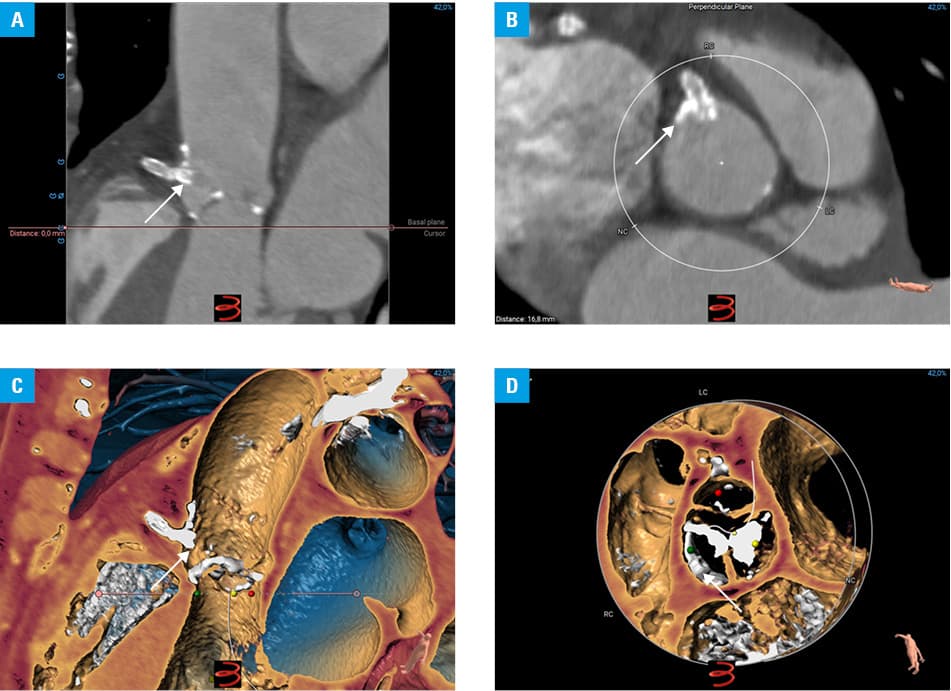
The TAVI procedure was performed in a hybrid operating room under ultrasound guidance via the bilateral femoral artery access. Following predilation of the native aortic valve, the bioprosthetic valve was implanted using meticulous commissural alignment. Postprocedural angiography and echocardiography confirmed optimal valve positioning, without evidence of paravalvular leak or coronary obstruction.
The patient experienced an uneventful postoperative course and was transferred to the cardiac surgery ward in a stable clinical condition. Subsequent contrast‑enhanced imaging reconfirmed proper valve placement, without complications related to coronary stent protrusion.
Discussion
This case series underscores the importance of tailored procedural approaches for TAVI in patients with complex coronary anatomy, particularly involving coronary stents protruding into the aortic lumen. In these challenging scenarios, techniques such as commissural alignment and precise valve positioning are crucial in minimizing the risk of CAO, a serious complication that is associated with high morbidity and mortality, if not effectively prevented.5
The choice of the valve type was guided explicitly by anatomical considerations in each case. In the first patient, the balloon‑expandable Edwards Sapien valve was selected due to its predictable expansion profile, which significantly reduces the risk of coronary impingement, a critical consideration given the patient’s shallow sinus of Valsalva, low LCA height, and a protruding RCA stent. This strategy proved effective, resulting in clinically insignificant trace paravalvular regurgitation and stable gradients at follow‑up.
In contrast, in the second case, the Evolut R self‑expanding valve was utilized due to the slightly higher coronary heights and a favorable sinus width. Here, the commissural alignment technique was successfully applied, optimizing coronary perfusion postprocedurally. However, given the higher frame of the Evolut R valve, future coronary access may be challenging. This limitation underscores the importance of valve selection based on long‑term considerations for coronary access. Balloon‑expandable valves, such as the Edwards Sapien valve, are generally preferred in the cases where future coronary access is anticipated due to their shorter frame height which facilitates access for subsequent coronary interventions.6,7
For the third patient with a narrow vVTC distance, the Accurate Neo S valve provided a beneficial compromise between the radial force and frame height. Immediate hemodynamic instability upon valve crossing highlighted the critical role of rapid balloon predilation and readiness for hemodynamic support, illustrating the necessity for procedural flexibility in complex anatomies.
Similarly, the Acurate Neo 2 valve was used in the fourth case due to the patient’s annulus size and a relatively narrow vVTC distance. Commissural alignment and predilation under rapid pacing facilitated optimal valve placement, achieving excellent hemodynamic outcomes. However, postoperative complications related to PAD reinforced the importance of holistic patient assessment beyond cardiac anatomy alone.
The last patient, with severe low‑gradient aortic stenosis and prior multiple MIs, presented with a protruding RCA stent. Here, commissural alignment combined with meticulous implantation of an Acurate Neo 2 valve enabled optimal valve positioning without coronary obstruction, demonstrating the particular advantage of this technique in patients with complex anatomy.
Advanced imaging techniques, especially MDCT, were integral to procedural planning in all cases, providing detailed spatial information, such as coronary heights, sinus dimensions, and precise valve sizing. In particular, MDCT was pivotal in accurately determining the vVTC distances and identifying protruding stents, directly influencing valve selection and procedural strategies.2,8
Commissural alignment, as utilized in our cases, has demonstrated substantial benefit in aligning valve leaflets with native aortic cusps, thereby minimizing the risk of interference with the coronary ostia. This technique, while not novel, is gaining recognition as a standard approach in high‑risk TAVI cases, particularly for patients with low coronary artery height and narrow sinuses of Valsalva. Several studies highlighted commissural alignment as a viable alternative to more invasive techniques, offering a safer approach for patients ineligible to complex procedures, such as BASILICA or chimney stenting.5
A comparison of these cases highlights the key factors influencing the valve choice: coronary artery heights, sinus dimensions, vVTC distances, and the presence of protruding stents. Balloon‑expandable valves (eg, Sapien S3) were preferred when the risk for immediate coronary obstruction was extremely high, whereas self‑expanding valves (Evolut R and Acurate Neo) provided advantages related to commissural alignment and adaptability in patients with slightly more favorable anatomy, but potentially restricted future coronary access.
Alternative techniques, such as BASILICA (which involves intentional laceration of the aortic leaflet to prevent CAO) and chimney stenting (during which a stented channel is created to ensure coronary perfusion), are also effective. However, each of these methods carries inherent risks and limitations. BASILICA, though beneficial, requires specialized skills, equipment, and expertise that may not be available in all TAVI centers. Additionally, BASILICA is technically demanding, particularly in patients with heavily calcified or asymmetric valves, and may pose a greater risk of vascular complications.3 Chimney stenting has been associated with potential long‑term risks, including stent thrombosis, restenosis, and complications in accessing the coronary arteries in subsequent interventions.9
Our case series demonstrates that for patients with protruding coronary stents, careful valve selection is paramount. Studies comparing valve models suggest that the Edwards Sapien and Evolut R valves may offer specific benefits for patients with low coronary heights or narrow sinuses due to their structural design and deployment characteristics. By selecting the valve type best suited to individual patient anatomy, as done in our series, clinicians can achieve better outcomes and reduce the CAO risk.7 In our study, the choice of the Edwards Sapien, Evolut R, and Accurate Neo valves was guided by anatomical assessments, which significantly contributed to procedural success.
Currently, there are no clear guidelines regarding a safe vVTC distance specifically in the context of protruding coronary stents. Although a vVTC distance below 4 mm is classically considered high‑risk for CAO in valve‑in‑valve procedures, the presence of a protruding coronary stent likely further increases the CAO risk even at distances above this threshold. Our cases, particularly patients 3 and 4, illustrate that even moderate vVTC distances (8–9 mm) in combination with protruding stents represent significant anatomical risk factors, emphasizing the need for individualized procedural planning and careful valve selection.10,11
Limitations and future directions
The limitation of this study is its small sample size; however, the recruitment of patients from 2 centers serves as a strength by providing insights into procedural variability and enhancing the generalizability of the findings. Larger, multicenter trials are essential to further validate these approaches and explore additional patient‑specific factors influencing the outcomes. The role of computational modeling and 3‑dimensional simulation in preoperative planning may offer new avenues for assessing the CAO risk and enhancing procedural precision. As TAVI continues to evolve, future research should also focus on long‑term outcomes of customized techniques, examining the durability of diverse valve models and the impact of CAO prevention strategies on patient survival and quality of life.12
Conclusions
Collectively, these cases demonstrated that tailored TAVI approaches using meticulous imaging‑based planning and precise procedural techniques, such as commissural alignment, substantially improve safety and clinical outcomes in patients with complex coronary anatomy. This individualized approach aligns with emerging recommendations advocating personalized TAVI strategies, reinforcing the technique’s safety and efficacy for patients at an elevated surgical risk.13
- Vahanian A, Beyersdorf F, Praz F, et al. 2021 ESC/EACTS Guidelines for the management of valvular heart disease. Eur Heart J. 2022; 43: 561‑632. Published correction appears in Eur Heart J. 2022; 43: 2022. | Crossref
- Blanke P, Weir‑McCall JR, Achenbach S, et al. Computed tomography imaging in the context of transcatheter aortic valve implantation (TAVI) / transcatheter aortic valve replacement (TAVR): an expert consensus document of the Society of Cardiovascular Computed Tomography. JACC Cardiovasc Imaging. 2019; 12: 1‑24. | Crossref
- Khan JM, Greenbaum AB, Babaliaros VC, et al. The BASILICA trial: prospective multicenter investigation of intentional leaflet laceration to prevent TAVR coronary obstruction. JACC Cardiovasc Interv. 2019; 12: 1240‑1252.
- Chiai T, Chakravarty T, Yoon SH, et al. Coronary access after TAVR. JACC Cardiovasc Interv. 2020; 13: 693‑705. | Crossref
- Costa G, Sammartino S, Strazzieri O, et al. Coronary cannulation following TAVR using self‑expanding devices with commissural alignment: the RE‑ACCESS 2 study. JACC Cardiovasc Interv. 2024; 17: 727‑737. | Crossref
ARTICLE INFORMATION