
Effectiveness of coronary sinus reducer implantation in routine clinical practice: 12-month outcomes
Key words: coronary artery disease, coronary sinus reducer, long-term clinical outcomes, quality of life, refractory angina pectoris

 CC BY 4.0
Effectiveness of coronary sinus reducer implantation in routine clinical practice: 12-month outcomes
CC BY 4.0
Introduction: Refractory angina (RA), due to a lack of therapeutic options, remains a significant health care challenge. Coronary sinus reducer (CSR) has been recently introduced as a therapeutic option for this advanced form of coronary artery disease. However, despite growing evidence of its efficacy, data from routine clinical practice are scarce.
Objectives: We report 12‑month observation data on the efficacy and safety of CSR implantation based on the results from the Lower Silesia Sinus Reducer Registry (NCT06288165).
Patients and methods: The study included data from 67 consecutive patients diagnosed with chronic RA (Canadian Cardiovascular Society [CCS] classes 2–4) despite optimal medical therapy, who underwent CSR implantation. The study end points were defined as changes in angina severity (CCS class, the 7‑item Seattle Angina Questionnaire [SAQ‑7]), safety outcomes, exercise tolerance (6‑minute walking distance [6MWD]), and quality of life assessments (the 36‑item Short Form Health Survey [SF‑36], European Quality of Life 5‑Dimension 5‑Level Version, and EuroQol Visual Analog Scale).
Results: A total of 86.6% of the patients showed improvement by at least 1 CCS class (P <0.001) over the 12 months of follow‑up, as compared with the baseline. Significant improvement in 12‑month angina control was demonstrated, as measured by the SAQ‑7 total score (mean [SD], 39.9 [15.2] vs 54.6 [19.7]; P <0.001). A similar improvement in the 12‑month quality of life assessment measured by the SF‑36 total score (mean [SD], 112.7 [23.2] vs 98.4 [31.9]; P <0.001) was noticed. One year after CSR implantation, a significant improvement in exercise tolerance was also observed (mean [SD] 6MWD, 265.9 [136.9] m vs 234.9 [109.1] m; P = 0.03).
Conclusions: One‑year data from the Lower Silesia Sinus Reducer Registry indicate that CSR implantation is an effective therapeutic option for patients with RA. Additionally, we did not observe any long‑term adverse effects associated with the device implantation.
What's new?
Chronic refractory angina is a disabling condition affecting patients with coronary artery disease who continue to experience angina symptoms despite optimal pharmacotherapy and are not eligible for future revascularization. Coronary sinus reducer (CSR) implantation is a novel therapeutic option that targets this unmet clinical need by modulating the coronary venous outflow. Notwithstanding the growing evidence of CSR efficacy, data derived from routine clinical practice focusing on patient‑reported quality of life remain relatively scarce. This study provides valuable insights into the findings of 1‑year implementation of CSR in routine practice. The most significant improvement in symptom control was noted during the initial 3–6 months following implantation, with flattening of the benefits curve in longer follow‑up. There was no evidence of any deleterious long‑term effects. Moreover, the presented data suggest that CSR may have an impact on microcirculation, which might be a potential additional mechanism of angina control. Further studies are necessary to comprehensively evaluate this finding.
Introduction
Persistence of chronic refractory angina (RA) despite the implementation of optimal medical and interventional therapies represents a significant challenge. RA remains an important disabling condition in individuals with chronic coronary syndrome, significantly affecting their quality of life (QoL).1 The chronic nature of this condition, which results in multiple exacerbations necessitating rehospitalization, places a considerable burden on the limited resources of the public health care system.2 Moreover, RA is associated not only with obstructive coronary artery disease (CAD), but also multiple additional clinical conditions, including microvascular disease, various forms of cardiomyopathy, and left ventricular diastolic dysfunction.3-5 Given the relatively long life expectancy of individuals with RA (on average, 4% mortality per year),6 permanent improvement in symptom control remains a key medical objective. Previous studies7-10 indicate that the coronary sinus reducer (CSR; ShockWave Medical, Santa Clara, California, United States), an hourglass‑shaped stent made of stainless steel, designed for permanent narrowing of the CS, may enhance short- and mid‑term symptom control in patients with RA. Still, data from routine clinical practice observation are scarce.11,12 Therefore, we collected real‑life 12‑month data from the single‑center observational Lower Silesia Sinus Reducer Registry to fully assess the efficacy of CSR implantation in routine clinical practice.
Patients and methods
Study population
The registry comprises data on all consecutive patients diagnosed with chronic (≥3 months) disabling RA (Canadian Cardiovascular Society [CCS] classes 2–4) despite receiving optimal medical therapy, who underwent CSR implantation at the Department of Cardiology of the Copper Health Center in Lubin, Poland. All patients undergoing the qualification process for the procedure were subjected to a comprehensive physical examination and medical history investigation. All concomitant pathologies, particularly regarding CAD and cardiovascular risk factors, were categorized based on the patients’ previous medical records and in accordance with generally accepted diagnostic criteria.13-15 Prior to the CSR implantation, angina symptoms were objectified using exercise stress electrocardiography. Additionally, each participant underwent a comprehensive evaluation by the local heart team, during which they were deemed ineligible for potential revascularization. Furthermore, all patients were assessed for any potential exclusion criteria that would preclude their participation in the study. These criteria were almost analogous to the contraindications to CSR implantation, that is, a history of acute coronary syndrome within the past 3 months, recent (<3 months) coronary revascularization, presence of advanced chronic heart failure (New York Heart Association [NYHA] classes 3–4) or severe left ventricular systolic function impairment (<35%), high mean right atrial pressure (>15 mm Hg), or coronary sinus size inappropriate for implantation (proximal diameter <10 mm or / and >14 mm), and life expectancy of less than 12 months. All hemodynamic assessments, which are fundamental to the qualification for the procedure, were conducted immediately before the CSR implantation.
Study device and implantation procedure
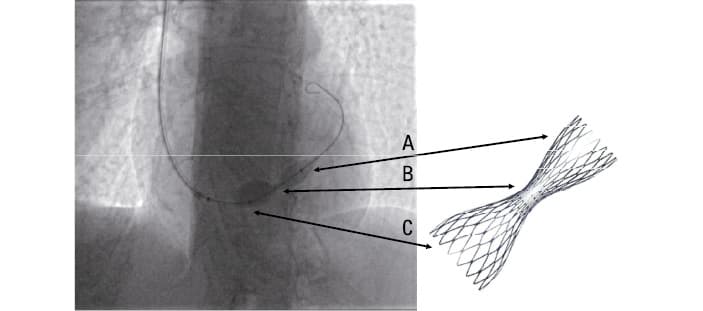
CSR, which is an hourglass‑shaped stainless steel stent, is delivered into the CS using a standard over‑the‑wire balloon catheter system. The device delivery system has 3 radiopaque markers: 2 situated on the distal edges of the scaffold, and a third one located proximally to the balloon. This marker is used to determine the precise position of the device during the implantation procedure (Figure 1).
The vascular access site (using a 9‑French [F] introducer sheath) for CSR implantation is primarily the internal jugular vein; however, in selected cases, a femoral approach is employed to deliver the device. Subsequently, upon reaching the central vein system with a standard 0.035‑inch wire, the multipurpose diagnostic catheter is advanced into the right atrium to measure the arterial pressure, with a target mean pressure value below 15 mm Hg. Next, diagnostic catheter venography is performed to identify the optimal implantation site, which should have a diameter between 10 and 14 millimeters, and no side branches or vascular anomalies. Following the transition to a 9‑F guiding catheter, the CSR is implanted (4–6 atm) with a maximum device oversize of up to 20%, as compared with the CS size. Each patient was administered a standard dose of unfractionated heparin (100 UI/kg) during the procedure. Additionally, dual antiplatelet therapy was implemented at the day of implantation for up to 3 months.
Study end points
The primary outcome of the study was defined as a change in the severity of angina, as assessed by the CCS classification system.
The secondary outcomes included safety end points, defined as serious periprocedural complications (perforation, abrupt closure, slow flow or no‑reflow, unstable ventricular arrhythmias), and device failure (inability to cross the CS, inability to expand, unplanned relocation of the device), as well as changes in the severity of angina, as assessed using the 7‑item Seattle Angina Questionnaire (SAQ‑7) and the 6‑minute walking distance (6MWD), and alterations in QoL, as evaluated with the 36‑item Short Form Health Survey (SF‑36), the European Quality of Life 5‑Dimension 5‑Level Version (EQ‑5D‑5L) questionnaire, and the EuroQol Visual Analog Scale (EQ‑VAS).
Follow‑up
Prior to implantation, all patients underwent an initial clinical and physical evaluation. A comprehensive examination of angina symptoms was also conducted, encompassing an assessment of the CCS class, SAQ‑7 scores, NYHA functional class, and 6MWD. Moreover, all patients underwent a QoL assessment using the SF‑36, EQ‑5D‑5L questionnaire, and EQ‑VAS. At the end of hospitalization, all data concerning the safety of the procedure were collected. Each patient was scheduled for clinical follow‑up visits at 1, 3, 6, and 12 months postimplantation. A comprehensive re‑evaluation of the patients’ angina symptoms and QoL was conducted during the follow‑up visits, similar to the initial assessment performed prior to implantation. Furthermore, data regarding potential hospital readmission due to CAD exacerbation were collected.
Statistical analysis
The data are presented as means with SD or medians with interquartile ranges (IQRs), depending on the normality of distribution and variance homogeneity, previously assessed using the Shapiro–Wilk and Levene tests, as appropriate. Continuous data were analyzed using either the paired t test or the Wilcoxon signed‑rank test, and are presented as numbers and percentages of the population. The results of the t test are reported using the P value with the difference of means and its 95% CI. The results of the Wilcoxon signed‑rank test are reported using the P value with the pseudomedian of difference of samples and its 95% CI. The significance of changes in CCS levels was evaluated by the McNemar test. Post hoc comparisons of CCS subgroups were conducted using the McNemar test comparing a given category with other categories, with the Holm–Bonferroni correction for multiple testing.
All analyses were conducted by professional statisticians in accordance with the standards established for medical study analyses. The R statistical software package (R Foundation for Statistical Computing, Vienna, Austria) was used for the analysis. All tests were performed at a significance level of P below 0.05.
Ethics
The study received an approval of the local ethics committee (Lower Silesian Medical Chamber, Wrocław, Poland; 02/BOBD/2022) and was registered at ClinicalTrials.gov (NCT06288165). Prior to the procedure, all patients were adequately informed and provided their written consent for participating in the study.
Results
The study population comprised 67 consecutive patients who underwent implantation of the CSR between July 2022 and July 2023 and completed the 1‑year postimplantation clinical follow‑up. General characteristics of the study group are presented in Table 1. A majority of the patients were men (n = 55 [82.1%]), and the mean (SD) patient age was 72.9 (6.9) years. The study population was characterized by a high prevalence of cardiovascular risk factors, including hypertension (100%), dyslipidemia (91%), and glucose tolerance disorders (67.1%).
Parameter | Value | |
Data are presented as number (percentage) of patients or mean (SD) unless indicated otherwise.
Abbreviations: BMI, body mass index; CAD, coronary artery disease; CKD, chronic kidney disease; COPD, chronic obstructive pulmonary disease; IQR, interquartile range; LVEF, left ventricular ejection fraction; NYHA, New York Heart Association; TIA, transient ischemic attack | ||
Age, y | 72.9 (6.9) | |
Men | 55 (82.1) | |
BMI, kg/m2 | 28.5 (4.5) | |
Hypertension | 67 (100) | |
Dyslipidemia | 61 (91) | |
Diabetes mellitus | 39 (58.2) | |
Insulin‑dependent | 6 (9) | |
Impaired glucose tolerance | 6 (9) | |
CAD | 67 (100) | |
Years since CAD diagnosis, median (IQR) | 14 (8.2–20.8) | |
LVEF, %, median (IQR) | 55 (42.5–60) | |
Heart failure | Overall | 17 (25.4) |
NYHA class I | 5 (7.5) | |
NYHA class II | 12 (17.9) | |
COPD | 12 (17.9) | |
Atrial fibrillation | 20 (30.9) | |
Stroke / TIA | 8 (11.9) | |
CKD | Overall | 12 (17.9) |
Stage 2 | 2 (3) | |
Stage 3 | 10 (14.9) | |
Peripheral arterial disease | 27 (40.3) | |
Hyperuricemia | 9 (13.4) | |
Hypothyroidism | 5 (7.5) | |
Depression | 2 (3) | |
Antianginal drugs, n, median (IQR) | 4 (3.5–5.5) | |
Before the CSR implantation, all patients were diagnosed with various forms of CAD. A total of 56 participants (83.6%) underwent percutaneous revascularization. Nearly half of the patients (n = 32) underwent both CABG and percutaneous coronary intervention (PCI), while 10.4% (n = 7) received isolated CABG, and 35.8% (n = 24) were revascularized only with PCI. An overwhelming majority of patients presented with advanced obstructive CAD (91%); however, 6 individuals (9%) underwent CSR implantation due to severe, nonobstructive CAD with confirmed advanced coronary microcirculation dysfunction (Table 2).
Parameter | Value | |
Data are presented as number (percentage) of patients unless indicated otherwise.
Abbreviations: Ao, aorta; CABG, coronary artery bypass grafting; CTO, chronic total occlusion; Cx, circumflex artery; D, diagonal artery; LAD, left anterior descending artery; LIMA, left internal mammary artery; NSTEMI, non–ST‑segment elevation myocardial infarction; OM, obtuse marginal artery; PCI, percutaneous coronary intervention; RCA, right coronary artery; STEMI, ST‑segment elevation myocardial infarction; others, see Table 1 | ||
Obstructive CAD | 61 (91) | |
Nonobstructive CAD | 6 (9) | |
Microvascular dysfunction | 11 (16.4) | |
No‑option patient (revascularization not feasible) | 26 (38.8) | |
Myocardial infarction | 41 (63.1) | |
History of STEMI | 15 (22.4) | |
History of NSTEMI | 26 (38.8) | |
History of PCI | 56 (83.6) | |
PCI location | LM | 12 (17.9) |
LAD | 27 (40.3) | |
Cx | 34 (50.7) | |
RCA | 41 (61.2) | |
Number of stents per patient, mean (SD) | 8 (2) | |
History of CABG | 39 (58.2) | |
CABG type | LIMA‑LAD | 32 (47.8) |
Ao‑RCA | 26 (38.8) | |
Ao‑OM | 24 (35.8) | |
Ao‑D | 12 (17.9) | |
Ao‑LAD | 5 (7.5) | |
CTO | LAD | 44 (65.7) |
Cx | 22 (32.8) | |
RCA | 19 (28.4) | |
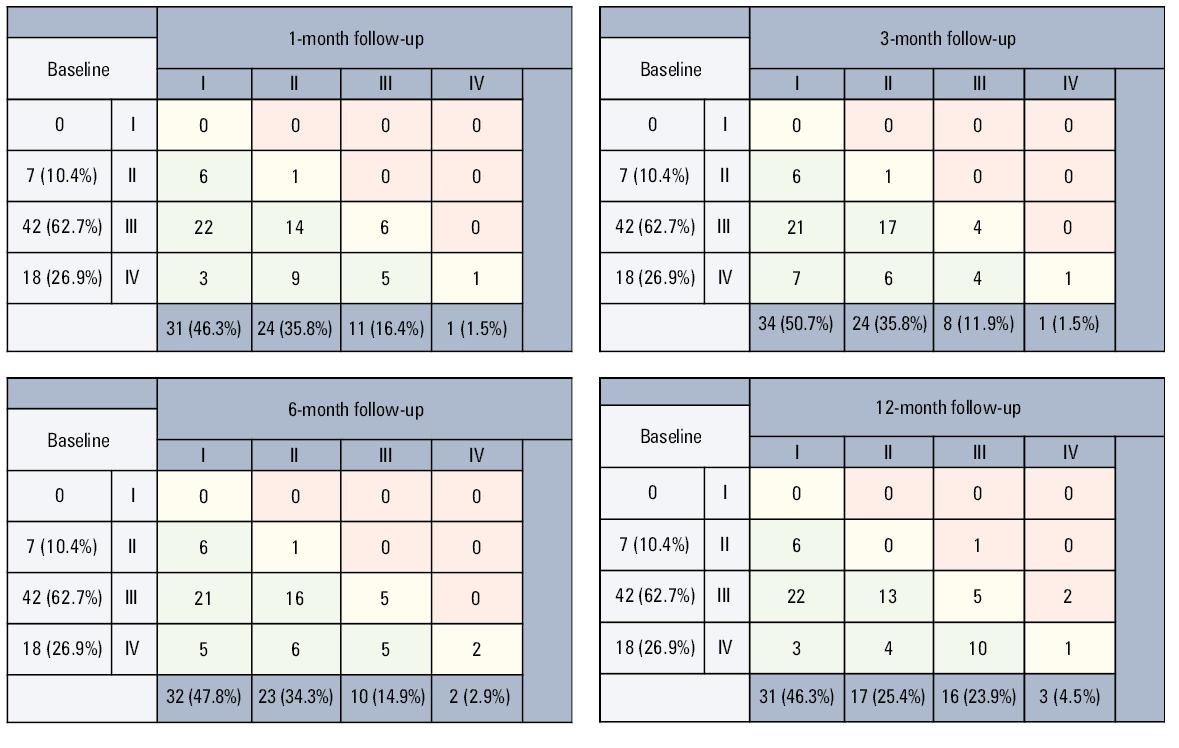
A vast majority of patients (88.1%; P <0.001) exhibited an improvement by at least 1 CCS class 1 month following CSR implantation, relative to the baseline. This positive effect was sustained (86.6%; P <0.001) for up to 12 months (Figure 2). All changes in the CCS angina class during the observation period are pooled in Figure 3.

In terms of the safety outcomes, all patients underwent successful device deployment with negligible frequency of site complications, including 6 cases (8.9%) of hematoma at the vascular access site not requiring significant medical intervention. As previously reported,16 a single case of migration of the CSR into the pulmonary artery was observed in the study cohort. The device was retrieved using percutaneous loops, and the patient underwent a second successful attempt at CSR implantation during the index procedure.
In terms of the secondary end points, favorable outcomes of implantation were confirmed by a significant improvement in 12‑month angina control, as assessed by the total SAQ‑7 score (mean [SD], 39.9 [15.2] vs 54.6 [19.7]; P <0.001; Figure 4). The initial poor exercise tolerance (mean [SD] 6MWD of 234.9 [109.1] m) also improved postimplantation, reaching the highest value at the 3‑month follow‑up (310.6 [120.1] m; P <0.001). One year after the CSR implantation, a slight reduction in exercise tolerance was observed in the study cohort, although a significant improvement was still found, as compared with the baseline (mean [SD] 6MWD, 265.9 [136.9] m vs 234.9 [109.1] m; P = 0.03; Figure 5). Of note, the time‑period landmark analysis demonstrated that the most pronounced clinical response (measured by the capacity to undertake exercise—6MWD) occurred during the initial 3‑month period postimplantation. This was followed by an absence of significant clinical gains in the subsequent follow‑up period (Table 3).
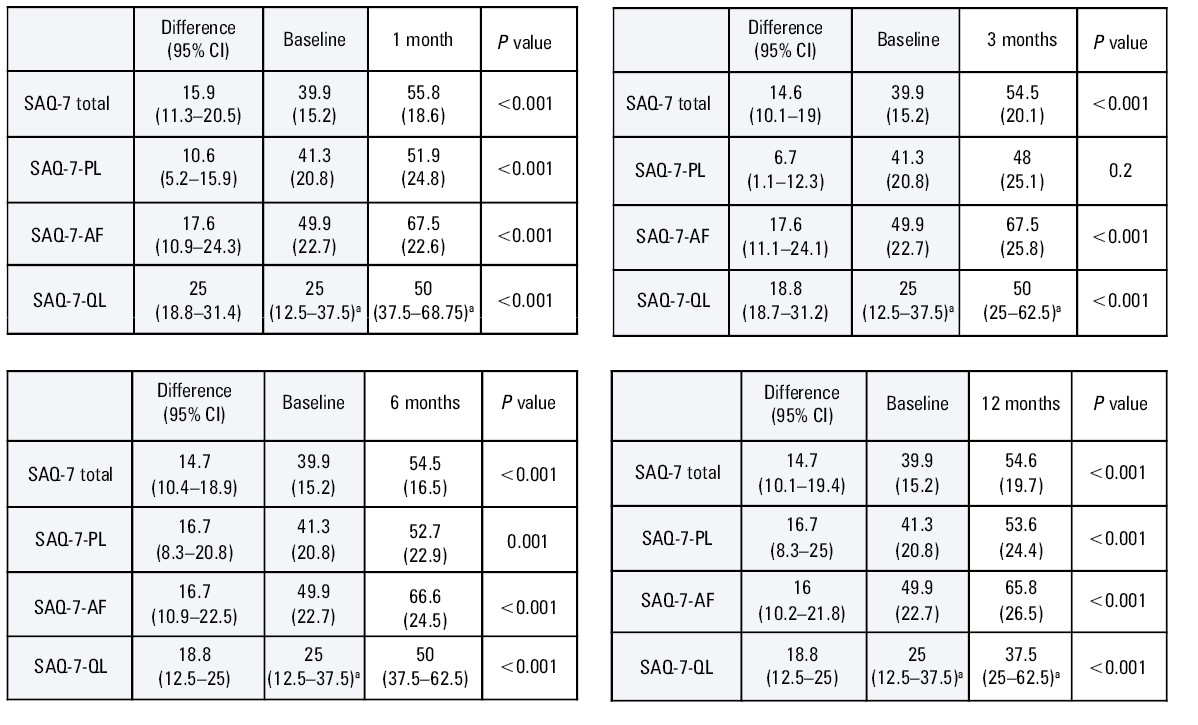
a Data not following a normal distribution are shown as median (interquartile range).
Abbreviations: AF, angina frequency; PL, physical limitation, QL, quality of life

Parameter | Normality (P value) | ∆Distancea, m | 95% CI | P valueb |
a For the results with a normal distribution, the difference in mean value with 95% CI is presented; for the results without a normal distribution, the difference in pseudomedian with 95% CI is presented.
b P value was derived from the paired t test for the normally distributed data, and the Wilcoxon signed‑rank test for the data without a normal distribution.
Abbreviations: ∆, average distance change; M, month | ||||
Baseline vs 1M | 0.06 | 55.7 | 31.8–79.7 | <0.001 |
1M vs 3M | <0.001 | 45 | 0–67.5 | 0.03 |
3M vs 6M | 0.005 |
| –60 to 0 | 0.13 |
6M vs 12M | <0.001 |
| –90 to 0 | 0.04 |
In terms of the quality of life, the patients reported a significant improvement in this regard throughout the entire 12‑month follow‑up period. The EQ‑5D‑5L, EQ‑VAS, and SF‑36 results are summarized in Supplementary material, Figure S1.
The antianginal pharmacotherapy remained unchanged (median [IQR] number of drugs used, 4 [3.5–5.5] vs 3.9 [3.4–5.5]; P = 0.88) throughout the observation period. A complete overview of patient therapeutic data is presented in Supplementary material, Figure S2). At the end of follow‑up, CAD progression necessitating hospital readmission was observed in 8 participants (11.9%); of those, 4 individuals (5.9%) underwent a subsequent PCI.
Discussion
The objective of this study was to evaluate 12‑month outcomes of CSR implantation in a real‑world population of patients with RA. The primary findings of this study are as follows: 1) The clinical benefit observed following CSR implantation was maintained over a long‑term period, with a reduction in angina severity observed despite the use of intensive antianginal medication. The most significant improvement in symptom control was noted during the initial 3–6 months following implantation. After this critical period, a flattening of the benefits curve was observed, accompanied by a lack of notable clinical gains in the longer follow‑up. 2) CSR implantation is a safe procedure with a low rate of device‑oriented unfavorable clinical events.
The concept of angina symptom alleviation resulting from CS narrowing was first articulated before the introduction of CABG to clinical practice,17 and was initially linked with potential improvement in perfusion of the ischemic myocardial regions.18 However, due to the continued evolution of techniques in the field of cardiac revascularization, for an extended period, these procedures remained limited to animal models and preclinical studies. Over 5 decades elapsed before this concept was incorporated into clinical practice. Preliminary findings indicate that CSR is a safe and efficacious therapy for patients with RA who were previously deemed unsuitable for any revascularization procedures.19,20 Recently published collective data21 suggest that CSR markedly alleviated angina symptoms, and improved health‑related quality of life measures. These findings are supported by significant improvements in patient self‑reported angina features, the CCS classification, and SAQ scores. Although the efficacy of symptom control has been well documented in short‑term follow‑up studies,9,10,22-25 data on long‑term impact remain limited.26-28 Nevertheless, CSR has been introduced to clinical guidelines as an optional therapy for patients with advanced CAD.29 The data on self‑reported angina symptom control obtained from our cohort indicate a notable improvement (by at least 1 CCS class) in a significant proportion of patients (88.1%) at the initial follow‑up (1 month), which persisted at the 1‑year mark (86.6%). This finding is consistent with the collective data from previous studies conducted over an analogous timeframe (12 months), which suggest improvement in 76% of patients.21 With respect to the QoL, similar correlations were identified between our cohort and other studies, particularly concerning real‑world data.21,30 Although both QoL and symptom control are subjective measures, it is important to remember that they have been postulated to be associated with mortality, myocardial infarction, and the need for coronary revascularization.31 We also noted a significant improvement in exercise capacity, which is generally in line with a majority of published studies.20,21 However, it is important to note that not all previous reports have yielded results that confirm this favorable effect of CSR implantation. The ORBITA‑COSMIC (Coronary Sinus Reducer Objective Impact on Symptoms, MRI Ischaemia and Microvascular Resistance) trial32 demonstrated no significant improvement in exercise capacity. This finding is not only inconsistent with the results of our study but also with the outcomes of other randomized trials.33
Notably, the 6MWD demonstrated fluctuations throughout the follow‑up period. The initial improvement was observed for up to 3 months, after which a gradual decline ensued. Nevertheless, this decline did not reach significance, as compared with the baseline value. Several important factors may be potentially involved. Firstly, the natural, slow progression of CAD34,35 may overwhelm the positive effect of CSR implantation. Secondly, the placebo effect of the procedure may be a significant favorable factor, and further follow‑up may reveal a gradual alleviation of this effect manifested by a shorter 6MWD. Lastly, changes in the alternative venous drainage system (increased activity) may occur following CSR implantation. Some data suggest that this factor may impact the 6MWD results after the procedure.36
Concerns have emerged regarding the long‑term cost‑effectiveness of CSR implantation, particularly in the context of the nonresponder populations.37 In our real‑life cohort, we observed 9 nonresponders (13.4%) to CSR therapy. A high‑volume cost‑effectiveness analysis of the procedure has yet to be conducted, largely due to the novelty of this therapy. However, preliminary data for Western European countries suggest that the device is feasible in this field.38 Although the results of the preceding study, together with our present findings, indicated a notable long‑term reduction in the rate of rehospitalizations for angina exacerbations, it is important not to overlook the fact that we observed no reduction in antianginal drug use, which is generally in line with previous evidence.39 Evaluation of these parameters under local health system conditions remains an important issue, as it could establish a new range of cost‑effectiveness thresholds and influence a national reimbursement policy in the future.
Experimental animal models suggested that a potential mechanism of action of the CSR in patients with RA might have been an improvement in perfusion of ischemic myocardial segments.18 The initial data derived from human models seem to be in line with this finding—Giannini et al40 postulated that CSR implantation may provide greater benefit in ischemic regions of the myocardium supplied by the left coronary artery, as compared with other regions. However, a recent study focused on cardiac magnetic resonance perfusion assessment has challenged this finding, suggesting that the improvement is more likely related to the redistribution of perfusion from the subepicardial to subendocardial myocardium in ischemic regions.41 This finding appears to be consistent with the results of the randomized ORBITA‑COSMIC trial,32 which, apart from a clinical evaluation of CSR, investigated the potential mechanisms of action of CSR on stress magnetic resonance imaging. The results appear to contradict the theory of perfusion transfer (from nonischemic to ischemic regions) as a potential mechanism of CSR action. Nevertheless, they suggest that potential redistribution of perfusion within the ischemic segments may be a contributing factor to the observed favorable clinical effect.
We did not investigate the potential mechanism of action of CSR; however, a relevant finding is that all patients with nonobstructive CAD and no microvascular dysfunction showed significant improvement in angina control (by at least 1 CCS class). This observation is in line with initial reports42,43 indicating that coronary microvascular function improves (as reflected by a reduction in the index of microcirculatory resistance and an increase in coronary flow reserve values) subsequent to CSR implantation. This may form a basis for the novel potential mechanism of action of the device that we intend to investigate further in separate studies.
The limitations of the present study are primarily attributable to its observational, nonrandomized design. Due to an absence of a control group, it was not possible to definitively exclude a possibility that outcomes were related to the potential placebo effect. Furthermore, the study protocol did not include objective imaging studies to measure the reduction of myocardial ischemia following the CSR implantation. The study cohort was relatively heterogeneous, comprising individuals with obstructive and nonobstructive CAD. Also, it must be highlighted again that we did not investigate the potential mechanisms of action of CSR. Consequently, the analysis of changes in clinical outcomes during the study period was significantly hindered.
Conclusions
The 1‑year data from our real‑world registry indicate that CSR implantation represents an efficacious therapeutic option for patients with RA in routine clinical practice. Furthermore, the favorable clinical outcomes appear to extend to sustained enhancements in quality of life indicators and potential exercise capacity even up to 1 year postimplantation. Additional data from the study indicate that adverse effects associated with CSR implantation are rare in routine practice. To fully evaluate this technology, it is necessary to conduct larger‑scale randomized controlled trials focusing on potential mechanisms of action, as well as long‑term safety and cost‑effectiveness.
- Davies A, Fox K, Galassi AR, et al. Management of refractory angina: an update. Eur Heart J. 2024; 42: 269‑283. | Crossref
- Ajmal M, Chatterjee A, Acharya D. Persistent or recurrent angina following percutaneous coronary revascularization. Curr Cardiol Rep. 2022; 24: 1837‑1848. | Crossref
- Abouelnour A, Gori T. Vasomotor dysfunction in patients with ischemia and non‑obstructive coronary artery disease: current diagnostic and therapeutic strategies. Biomedicines. 2021; 9: 1774. | Crossref
- Iwańczyk S, Woźniak P, Smukowska‑Gorynia A et al. Microcirculatory disease in patients after heart transplantation. J Clin Med. 2023; 12: 3838. | Crossref
- Rola P, Włodarczak A, Włodarczak S et al. Invasive assessment of coronary microvascular dysfunction in patients with long COVID: outcomes of a pilot study. Kardiol Pol. 2022; 80: 1252‑1255. | Crossref
SUPPLEMENTARY MATERIAL
ARTICLE INFORMATION