
Antithrombotic therapy in patients with inherited bleeding disorders: practical considerations
Key words: antithrombotics, arterial thromboembolism, hemophilia, inherited bleeding disorders, venous thromboembolism

 CC BY 4.0
Antithrombotic therapy in patients with inherited bleeding disorders: practical considerations
CC BY 4.0
For decades hemophilia and allied bleeding disorders caused by inherited deficiency of clotting factors have been considered conditions protecting against thromboembolism (TE). This opinion was coined over 60 years ago, when average life expectancy of people with hemophilia (PWH) was below 30 years, long‑term antihemorrhagic prophylaxis of bleeding episodes was unattainable, and the main cause of premature death of PWH were life‑threatening bleeds. At that time, arterial or venous thromboembolism were simply not observed among people with inherited bleeding disorders. With the progress of hemophilia management leading to improved hemostasis, resulting in reduction of severity and frequency of bleeding episodes and longer life expectancy, it became obvious that hemophilia patients may and do develop TE episodes. This review is focused on how to manage arterial and venous TE in people with inherited bleeding disorders. Anticoagulant therapy should be avoided in severe or moderate hemophilia without antihemorrhagic prophylaxis. Use of anticoagulants at therapeutic doses is safer when plasma activity of factor (F) VIII or FIX is permanently equal to or above 20 IU/dl rather than below 20 IU/dl. Taking into account their efficacy, safety profile, and convenience, direct oral anticoagulants are the first choice as oral anticoagulation therapy for stroke prevention in nonvalvular atrial fibrillation as well as in venous TE treatment in PWH. PWH may be offered many treatment options that allow to minimize exposure to antithrombotic agents, for example, cardioversion, catheter ablation, left atrial appendage occlusion, newer‑generation drug‑eluting stents, bioprosthetic heart valves, or mechanical thromboprophylaxis methods.
Introduction
Hemophilia is an X‑linked, recessive bleeding disorder, defined as deficiency of clotting factor VIII (FVIII) for hemophilia A (HA) and FIX for hemophilia B (HB).1 In its severe form (FVIII or FIX plasma activity <1 IU/dl), hemophilia manifests with repeated, spontaneous and post‑traumatic bleeds into joints, muscles, and other organs. Without appropriate treatment, severe hemophilia inevitably leads to disability (hemophilic arthropathy), reduced health‑related quality of life (HR‑QoL), and in most cases premature death due to uncontrollable hemorrhages.2 In contrast to severe hemophilia, moderate (FVIII or FIX plasma activity 1–5 IU/dl) or mild (FVIII or FIX plasma activity from >5 to <40 IU/dl) hemophilia presents with bleeding after surgery or trauma but only occasionally leads to spontaneous hemorrhages.1
The natural course of severe hemophilia can be modified with available hemostatic therapies, which consist in intravenous infusions of the deficient clotting factor (factor replacement therapy) or, more recently, subcutaneous administrations of so called nonfactor therapies or antihemorrhaging agents, including FVIII mimetic emicizumab, anti‑tissue factor pathway inhibitor antibody concizumab or marstacimab, and several other novel agents (eg, fitusiran, Mim8) currently undergoing advanced testing in phase 3 clinical trials.3 Moreover, 3 adeno‑associated virus (AAV)-based gene therapies (GTs) have recently received approval for treatment of severe HA and HB, but they are not yet commonly used outside the clinical trials.4
The major goal in the management of severe hemophilia (and moderate or mild hemophilia with severe bleeding phenotype) is the prevention of spontaneous (and ideally also some posttraumatic) bleeds. To achieve this goal, all the abovementioned agents are administered on a regular basis using dosing regimens that ensure sustained hemostasis at the best possible level.1 Current therapies allow to significantly improve hemostasis in people with hemophilia (PWH) but still do not allow to completely normalize hemostasis for lifetime, therefore, the ultimate goal for PWH, that is, “living without bleeding,” has not yet been achieved. Since novel nonfactor therapies are designated exclusively for long‑term prophylaxis, in the patients with breakthrough bleeds or after major surgical procedures, adequate factor replacement therapy must be administered intravenously.
The prognosis for PWH is nowadays better than ever in the history of the disease. Adequately treated people with severe hemophilia are at relatively low risk of developing severe bleeding episodes, have healthy joints, good HR‑QoL, and their life expectancy is comparable to that of men in the general population.1 Now, however, paradoxically, the success of managing hemophilia is accompanied by new challenges resulting from increasing number of elderly PWH developing comorbidities typical for aging. Among them are conditions such as coronary artery disease (CAD), atrial fibrillation (AF), ischemic stroke (IS), or venous thromboembolism (VTE) requiring treatment with antithrombotic agents.
Do people with hemophilia develop conditions requiring antithrombotic therapy?
For decades hemophilia has been considered a condition protecting against thromboembolism (TE), but when this opinion was coined, average life expectancy of PWH was below 30 years, long‑term prophylaxis of bleeding episodes was unattainable, and the main cause of premature death of hemophiliacs were life‑threatening bleeds.5,6 At that time, arterial thromboembolism (ATE) or VTE were simply not observed among PWH. However, with the progress of hemophilia management leading to improved hemostasis, resulting in reduction of severity and frequency of bleeding episodes and longer life expectancy, it became obvious that hemophilia patients may and do develop TE episodes.7-10 In the European Haemophilia Safety Surveillance register, the incidence of ATE and VTE is around 1 per 1000 patient‑years on replacement or nonfactor therapy (unpublished data).
Large, retrospective epidemiologic study carried out in the United States at the turn of 20th and 21th century showed that CAD was admittedly very uncommon in PWH younger than 30 years; however, in those aged at least 60 years the prevalence of CAD was as high as 15%.11 A Dutch study published in 2006 demonstrated that CAD‑related mortality among PWH increased from 2% in the 1970s to 6% in 2001.12 Italian authors observed a 2‑fold increase in standardized mortality ratio (SMR, defined as a ratio or percentage quantifying the increase or decrease in mortality of a study cohort with respect to the general population) for CAD in PWH between the last decade of the 20th century and the years 2000–2007.13 Another large American study demonstrated an SMR value of 3 for myocardial infarction (MI) in PWH.14 On the other hand, in a systematic review published in 2010, cardiovascular mortality was nonsignificantly reduced in PWH, as compared with peers from the general population (SMR, 0.51; 95% CI, 0.24–1.09), suggesting that hemophilia may, to certain degree, protect against cardiovascular diseases (CVDs).15 However, in the most recent, large epidemiologic study with 3500 PWH and more than 16 000 matched controls without hemophilia, carried out in the United States, the authors demonstrated that the incidence of MI and pulmonary embolism was similar in both groups, whereas IS and deep vein thrombosis (DVT) was even more prevalent in PWH than in non‑HA individuals.16 The American authors concluded that PWH are not protected against thrombosis.16
Based on the available data it is fair to conclude that hemophilia itself does not eliminate the risk of TE. It may be that the occurrence of TE episodes is lower in PWH than in the male peers from the general population, but aging PWH are subjected to the same risk factors of ATE (obesity, smoking, hyperlipidemia, metabolic syndrome, arterial hypertension, etc.) as the general population.17-19 PWH are also at risk of developing VTE.16,20 Major orthopedic surgery, a well‑known risk factor for DVT remains a common major surgical procedure in older people with hemophilia suffering from hemophilic arthropathy.21 Also, central venous access device–related thrombosis is not uncommon in PWH (central venous catheters are still relatively frequently utilized in PWH on long‑term prophylaxis with clotting factor concentrates [CFCs] administered intravenously 2–3 times per week).16 As in the general population, all provoked and unprovoked risk factors for VTE need to be addressed and mitigated to decrease the occurrence of VTE also in PWH.
Are people with hemophilia naturally anticoagulated?
Logically, PWH are naturally anticoagulated because their baseline plasma levels of FVIII or FIX are below the lower limit of normal, and ensuing hypocoagulability results in bleeding tendency. But the truth is that PWH with only slightly decreased plasma baseline levels of FVIII or FIX may be completely free of bleeding diathesis (asymptomatic or latent hemophilia), and therefore their natural hypocoagulability could be questioned. Moreover, people with severe or moderately severe hemophilia, receiving regular antihemorrhagic prophylaxis have their hemostatic potential constantly improved, resulting in a significant mitigation of the inborn bleeding tendency. Even 10%–15% of patients with the severe disease have surprisingly minimal bleeding tendency. On the other hand, the hemostatic potential of PWH receiving long‑term antihemorrhagic prophylaxis is lower than that of healthy individuals.1,22 Two interesting questions arise from these considerations: 1) Can we indicate the plasma activity thresholds of FVIII and FIX when the hemostatic potential of PWH is noninferior (comparable) to that of healthy individuals?, and 2) Can we estimate the plasma levels of FVIII and FIX which may correspond to the therapeutic range of oral anticoagulants (OACs), for example, the international normalized ratio (INR) in patients on vitamin K antagonists (VKAs)? Fortunately, we have some data on both issues.
de Koning et al23 compared the results of endogenous thrombin potential (ETP) measured in 143 PWHA and in 97 patients on VKAs or healthy controls. Nearly all people with severe HA had ETP below 400 nM/min, compatible with all patients on VKA with INR above 2 (Table 1). All healthy individuals had ETP above 800 nM/min. Interestingly, 63% of the patients on VKA with INR 1.5–1.9 and 63% of PWH with FVIII plasma activity of 10–19 IU/dl had ETP below 400 nM/min (median ETP, 340 nM/min and 338 nM/min, respectively). In PWH with FVIII plasma activity between 20 and 50 IU/dl, the median ETP was 397 nM/min, and 48% of them had ETP above 400 nM/min. These results indicate that there are significant similarities with respect to ETP between people with severe HA and patients on VKA with INR above 2, as well as between PWH with FVIII levels 10–19 IU/dl and patients on VKA with INR 1.5–1.9, and finally that in some PWH with FVIII levels above 20 IU/dl the ETP is comparable with that of healthy controls. However, we would like to highlight that reduced activity (by 50%–70%) of several vitamin K‑dependent CFs, that is, FII (prothrombin), FVII, FIX, or FX leads to reduced thrombin generation, but simultaneously lowered levels of vitamin K‑dependent protein C and protein S have the opposite effect.
Population
factor levels, IU/dl | Median ETP, nM/min, IQR / % of normal | Percentage of individuals with ETP <400 nM/min |
Abbreviations: ETP, endogenous thrombin potential; F, factor; INR, international normalized ratio; IQR, interquartile range; PWHA, people with hemophilia A; VKA, vitamin K antagonist | ||
PWHA FVIII <1 | 185 (116–307 / 20.6) | 93 |
PWHA FVIII 1–9 | 278 (210–408 / 31) | 74 |
PWHA FVIII 10–19 | 338 (197–541 / 37.6) | 63 |
PWHA FVIII 20–50 | 397 (219–632 / 44.2) | 52 |
Patients on VKA with INR >2 | 156 (90–225 / 17) | 100 |
Patients on VKA with INR 1.5–1.9 | 340 (238–429 / 37.9) | 63 |
Healthy controls | 898 (803–1104 / 100) | 0 |
Unfortunately, we lack such studies in PWHB as well as in patients on other OACs, in particular direct OACs (DOACs). Several research groups compared ETP in people with mild HA and healthy controls, showing significant differences between them, although most hemophilia patients with FVIII levels above 25 IU/dl had ETP above the lower limit of normal.24-27 Also, the thrombin generation potential in healthy volunteers at the standard tissue factor (TF) concentration of 5 pM, which actually overrules hemophilia, shows 4–5‑fold variability. One may ask, what is normal thrombin generation?
It should be emphasized that ETP is only a surrogate marker of coagulation potential. Therefore, we cannot be sure that the same value of ETP in a patient with deficiency of a single CF (eg, FVIII in a man with HA) and in a patient with combined deficiency of vitamin K‑dependent factors (on VKA therapy) represents the same hemostatic potential. Secondly, low ETP value may indicate a tendency toward bleeding diathesis but does not determine the type of bleeds occurring in an individual patient. For instance, people with severe hemophilia experience spontaneous joint bleeds (hemarthroses), whereas patients with INR above 2 may develop a variety of bleeding complications but hemarthroses are very uncommon.
Despite all these caveats and doubts, the studies on ETP provide an interesting insight into the nature of hypocoagulability in response to low TF concentration in untreated (not receiving hemostatic therapy) and treated (receiving long‑term antihemorrhagic prophylaxis) PWH. In general, untreated people with severe hemophilia have deep hypocoagulability, and therefore antithrombotic drugs as well as other drugs compromising hemostasis should be avoided. On the other end, some people with mild HA in whom baseline plasma activity of FVIII is above 20–25 IU/dl may have hemostatic potential comparable to healthy people, and theoretically antithrombotic agents may be used relatively safely in this subset of PWH. Finally, the most interesting group of PWH is the one with low baseline levels of FVIII, whose inborn weak coagulation potential has been improved trough the administration of long‑term antihemorrhagic prophylaxis with FVIII concentrates or emicizumab, and in future also with other factor and nonfactor or rebalancing therapies. PWHA receiving regular infusions of FVIII concentrates have fluctuating coagulation potential depending on the time after injection of the concentrate. Immediately after injection, peak FVIII plasma activity (and accordingly peak ETP) can be comparable to healthy people, but over time FVIII plasma activity gradually declines within a day or two. Directly before the next injection of FVIII concentrate, the coagulation potential can be as low as in a treatment‑naive patient with severe or moderate hemophilia (trough FVIII plasma activity in such situation is usually 1–5 IU/dl). Thus, this subset of PWHA treated with antithrombotic agents would have variable risk of bleeding and thrombotic complications depending on the time from the last injection of FVIII concentrate and current concentration of an antithrombotic agent.
In contrast, in PWHA on emicizumab with completely different pharmacokinetics from that of FVIII, the coagulation potential is constantly at the same level, estimated at FVIII plasma activity between 10 and 40 IU/dl.28-30 In other words, one can assume that PWHA on emicizumab have the coagulation potential comparable to that of patients receiving VKA with INR between 1.5 and 1.9. We know that PWHA on emicizumab are very well protected, although not completely, against hemophilia‑related bleeds, but we do not know if their coagulation potential is sufficient to protect them against bleeding complications while on antithrombotic drugs.31,32
What is the impact of antithrombotic agents on the risk of bleeding complications in people with hemophilia?
To answer this question, we refer to the prospective case‑control COCHE study (Comorbidités Cardiovasculaires chez les patients Hemophiles), carried out in France between 2011 and 2018, and published in 2020.33 The study comprised 68 people with HA or HB (median age, 65 years; 48 mild, 10 moderate, and 10 severe hemophilia) who received antithrombotic drugs for acute coronary syndrome (ACS; n = 50), AF (n = 17) or both ACS and AF (n = 1). The control group involved 68 PWH without antithrombotic treatment. The authors found several factors that increased the risk of bleeding in PWH receiving antithrombotic agents, namely: 1) baseline level of FVIII or FIX below 20 IU/dl; 2) antihemorrhagic regimen (episodic vs prophylaxis) in severe (hazard ratio [HR], 16.7; 95% CI, 8.2–47.3) and moderate (HR, 42.4; 95% CI, 1.9–966) hemophilia; 3) type of antithrombotic therapy in mild hemophilia (the highest risk of bleeding for dual‑pathway therapy [HR, 15.6; 95% CI, 1.6–116], then a single anticoagulant [HR, 9.9; 95% CI, 1.3–73.5], dual antiplatelet [HR, 5.3; 95% CI, 1.2–22.9], and finally single antiplatelet therapy [HR, 3.8; 95% CI, 1.1–12.5]); 4) HAS‑BLED score equal to or above 3 (odds ratio [OR], 33; 95% CI, 1.4–761). An important finding of the COCHE study was that PWH on antithrombotic therapy (particularly on antiplatelet agents) had significantly increased risk of gastrointestinal (GI) bleeding as compared with patients with hemophilia not receiving antithrombotic drugs (OR, 15; 95% CI, 1.84–268).
Despite numerous limitations of the COCHE study, that is, low number of included patients, lack of representation of certain indications for antithrombotic therapy (eg, VTE, IS), small number of patients with severe hemophilia on regular long‑term prophylaxis, the obtained results may importantly impact the clinical practice. Firstly, the results of the COCHE study indicate that antithrombotic therapy should be avoided in people with severe or moderate hemophilia, not receiving antihemorrhagic prophylaxis. Secondly, if indications for antithrombotic therapy are very strong, commencement of antithrombotic treatment in people with severe or moderate hemophilia should be combined with regular antihemorrhagic prophylaxis. Thirdly, in PWH with plasma activity of FVIII or FIX permanently equal to or above 20 IU/dl, the use of antithrombotic therapy is most likely safer than for PWH whose FVIII or FIX levels are permanently or even periodically below 20 IU/dl. Fourthly, before starting antithrombotic therapy, contraindications to this treatment should be evaluated. These contraindications may result not only from too low plasma levels of FVIII or FIX, but also from risk factors for bleeding unrelated to hemophilia that can be estimated using some scoring systems, that is, HAS‑BLED. One should realize, however, that scoring systems utilized in the general population have not been validated in PWH and their predictability in general is suboptimal.31,33,34 Fifthly, various antithrombotic regimens carry different risk of bleeding complications; in the COCHE study the highest risk of bleeding complications was associated with the use of combined anticoagulant‑antiplatelet therapy, then single anticoagulant therapy followed by dual antiplatelet therapy (DAPT). The lowest risk of bleeding was associated with single antiplatelet therapy (SAPT). Similar observations were made by other authors.31,32
Since the use of antiplatelet drugs significantly increased the risk of GI bleeding in PWH, it seems rational to start proton pump inhibitors (PPIs) in all PWH on antiplatelet therapy.33
What are the safety concerns of antithrombotic therapy in people with hemophilia on factor replacement or on emicizumab?
We have to reach out to the published case series, expert opinions, and expert panel consensus statements, because there are no randomized trials on these topics.17,19,31-33,35 Table 2 presents 6 position papers on both issues, published between 2021 and 2023.17,19,31-33,35 Generally, the minimum trough levels of FVIII or FIX suggested for PWH receiving SAPT are 1–5 IU/dl, those on DAPT 10–30 IU/dl, and for PWH receiving single OAC (VKA or DOAC) or a combination of a single OAC and a single antiplatelet agent 20–30 IU/dl. The World Federation of Haemophilia (WFH) consensus guideline on treatment of COVID‑19 in PWH suggested maintaining trough plasma levels of FVIII or FIX above 30 IU/dl in those receiving prophylactic doses of low‑molecular‑weight heparin (LMWH) and 50–100 IU/dl in those on therapeutic anticoagulation.35 In the very rare case of triple therapy (OAC plus DAPT), the authors suggest to achieve and maintain a minimum trough FVIII or FIX level of 80 IU/dl.31
Reference, year of publication | SAPT | DAPT | VKA | DOAC | LMWH | OAC + SAPT/DAPT |
a Paper dedicated to COVID‑19 coagulopathy
b While on prophylactic doses of LMWH (eg, 50 IU anti‑Xa/kg once daily)
c While on therapeutic doses of LMWH (eg, 100 IU anti‑Xa/kg twice daily)
Abbreviations: –, not acceptable; +, acceptable use in patients on emicizumab monotherapy (ie, without additional replacement therapy); DAPT, dual antiplatelet therapy; DOAC, direct oral anticoagulant; LMWH, low‑molecular‑weight heparin; ND, not discussed; OAC, oral anticoagulant; OD, once daily; SAPT, single antiplatelet therapy; others, see Table 1 | ||||||
Guillet et al, 202133 | 1–5 | ND | 20 | 20 | ND | ND |
Pipe et al, 202135a | ND | ND | ND | ND | >30b
>50c | ND |
Emicizumab | ND | ND | ND | ND | + (if LMWH dose ≤50 IU anti‑Xa/kg OD) | ND |
Shapiro et al, 202217 | 5 | 20 | 20 | 20 | ND | ND |
Klamroth et al, 202332 | 3 | 10 | 15–20 | 15–20 | ND | 20 for OAC+SAPT |
Emicizumab | + | + | – | – | ND | – |
Franchini et al, 202319 | 5 | 30 | 30 | 30 | ND | ND |
Schutgens et al, 202331 | 1–5 | 20 | 20 | 20 | ND | 80 for OAC+DAPT |
Emicizumab | + | – | – | – | ND | – |
Schutgens et al31 recommended to maintain the same INR ranges for a given indication in PWH using VKA as in nonhemophilic patients on VKA. With respect to DOACs, this group of experts recommended administering them at fixed standard doses. In other words, the authors did not see the need to reduce the dose of OACs because of hemophilia, provided the trough level of a deficient CF is maintained at above 20 IU/dl. The need for a close clinical monitoring of the patients was emphasized, and in the case of bleeding or thrombotic complications, a modification of VKA, DOAC, or replacement therapy was recommended.31
We are of the opinion that there are no sufficient data to draw firm conclusions on the safety of DAPT or OACs in PWHA receiving solely emicizumab for long‑term antihemorrhagic prophylaxis.31 This opinion is based on the available data, which do not allow to assume that hemostatic potential of all PWHA on emicizumab corresponds to plasma activity of FVIII above 20 IU/dl. Therefore, even though subcutaneously administered emicizumab would be a tempting option to be used in PWHA receiving antithrombotic therapy, Schutgens et al31 did not recommend to switch PWHA from FVIII prophylaxis to emicizumab because of concomitant use of antithrombotics. On the other hand, the coagulation potential of PWHA on emicizumab seems sufficient to safely use SAPT.31
Klamroth et al32 took a similar (but not identical) stance on the role of emicizumab in the management of PWHA receiving antithrombotic therapy. These authors highlighted the fact that the exact equivalence between steady‑state levels of emicizumab and plasma levels of FVIII cannot be determined, due to substantial interpersonal variability of trough emicizumab levels and inconsistency of assays used to monitor emicizumab coagulation potential. According to this expert group, PWHA receiving emicizumab do not require additional factor replacement when being treated with SAPT or DAPT, but additional FVIII replacement is required in PWHA receiving OAC (alone or in combination with SAPT).32
To sum up this subsection of our review, the decision on starting antithrombotic therapy in a patient with hemophilia should always be preceded by meticulous evaluation and balancing of potential benefits and risks associated with making such a decision. A patient with hemophilia will always be considered at risk of bleeding complications, therefore, if a decision on starting antithrombotic therapy is made, the patient must be offered the best possible protection against excessive bleeds. Such protection depends on both type and duration of antithrombotic regimen as well as the type of antihemorrhagic prophylaxis, and the other risk factors for reoccurring thrombosis and / or poor hemostasis.
Should one prefer specific antithrombotic drugs and antithrombotic regimens in people with hemophilia?
Taking into account their efficacy, safety profile, and convenience, DOACs are the first choice as OAC therapy for stroke prevention in nonvalvular AF as well as in VTE treatment in both the general population and PWH.34,36-38 It does not mean that VKAs cannot be used in PWH (as in valvular heart disease), but VKAs pose a significantly greater risk of most severe bleeding complications than DOACs. The risk for intracranial hemorrhage (ICH) was significantly lower with all DOACs (dabigatran has the highest level of safety) than with VKAs; the risk for fatal bleeds was significantly lower with “xabans” (apixaban, rivaroxaban, and endoxaban) than with VKAs.36,37,39 Only for the incidence of GI bleeds, the use of DOACs and VKAs did not differ.
The potential advantage of VKAs over DOACs stems from easiness of reversing the anticoagulant effect. In the case of excessive bleeding, the intravenous infusion of prothrombin complex concentrate (PCC) or fresh frozen plasma enables restoring hemostasis within minutes in a patient on VKA.40 Admittedly, there are some specific antidotes also for DOACs (idarucizumab for dabigatran and andexanet α for “xabans”), nevertheless, they are costly and not easily accessible everywhere.41 Moreover, considering a lower risk of bleeding complications associated with DOACs as compared with VKAs, most experts agree that antidote accessibility should not be a major consideration in anticoagulant drug choice in PWH.31 Schutgens et al31 highlighted potential difficulties in interpretation of INR in PWHB due to interference of FIX deficiency, and therefore they recommended DOAC over VKA in patients with HB.
When it comes to APT, SAPT (low‑dose aspirin or clopidogrel) is acceptable, provided the adequate trough plasma levels of FVIII or FIX are maintained (Table 2). The situation is more complex, when there are indications for DAPT, that is, low‑dose aspirin plus P2Y12 inhibitor. Generally, cardiology guidelines favor ticagrelor and prasugrel as the P2Y12 inhibitor for DAPT due to a greater reduction in thrombotic episodes in comparison with clopidogrel.42-44 However, since ticagrelor and prasugrel carry a higher risk of bleeding complications, clopidogrel is a preferred P2Y12 inhibitor in PWH requiring DAPT.31,32,45 Obviously, if DAPT is used in PWH, the trough FVIII/FIX plasma levels must be maintained above certain threshold which, depending on the group of experts, varies from equal to or above 10 IU/dl to equal to or above 30 IU/dl (Table 2), and the duration of this therapy should be as short as possible.
In certain clinical settings, for example, during ACSs requiring percutaneous coronary intervention (PCI), patients receive short‑term therapeutic doses of parenteral anticoagulant, that is, unfractionated heparin (UFH) or bivalirudin. In such cases, immediately before PCI the peak FVIII/FIX plasma level of 80–100 IU/dl should be achieved, and then FVIII/FIX trough levels should be maintained at above 50 IU/dl throughout the time of therapeutic anticoagulation.31
As PWH receiving any antithrombotic regimen should be considered at a high risk of bleeding complications, the general rule is to maximally reduce the exposure time to antithrombotic drugs carrying a high risk of excessive bleeds. Schutgens et al31 recommended for PWH with ACS a short duration of DAPT, that is, 1 month after newer generation drug eluting stent (DES) placement followed by long‑term monotherapy with clopidogrel or low‑dose aspirin. Also, Klamroth et al32 recommended the duration of DAPT therapy in PWH after PCI to be as short as possible. The reduced time of exposure to anticoagulants is also recommended for PWH with acute VTE. For instance, Schutgens et al31 suggested to shorten the course of anticoagulation from normally recommended at least 3 months to 6 weeks. Of note, Schutgens et al31 and Franchini et al19 suggested to use, respectively, CHADS2 or CHA2DS2-VASc score for individual stroke risk assessment, but only the Franchini’s group indicated the specific threshold for commencement of anticoagulation as CHA2DS2-VASc equal to or above 2.
Is it feasible to maintain persisting trough levels of factor VIII/IX equal to or above 20 IU/dl in a patient with severe or moderate hemophilia?
It is not a big issue to maintain a high plasma level of a deficient CF for a limited period of time. We do that routinely in PWH undergoing major surgical procedures, applying replacement therapy with standard half‑life (SHL) or extended half‑life (EHL) CFCs, administered 1–3 times daily for several weeks if necessary.1 However, to maintain FVIII or FIX trough levels above 20 IU/dl in people with severe or moderate hemophilia for months or even longer is a challenge. For example, in a recently published clinical trial, a group of patients with severe HA received long‑term prophylaxis with EHL FVIII product to maintain FVIII trough level of 8–12 IU/dl.46 The aim was achieved but at the cost of nearly 200 intravenous injections of FVIII concentrate per person per year (around 4 injections weekly), and a very high consumption (around 7500 IU/kg/year) of EHL FVIII.46 Based on the evidence available in the literature, one may conclude that, in patients with severe or moderate hemophilia on long‑term antihemorrhagic prophylaxis with either SHL or EHL FVIII or FIX concentrates, most of the time plasma levels of a deficient CF is well below 10–20 IU/dl.1,46 EHL concentrates, particularly EHL FIX, may help to get closer to the threshold of 20 IU/dl, but in most cases this threshold will be out of reach.1,31,46 As mentioned earlier, emicizumab provides a very good protection against hemophilia‑related bleeding events in PWHA; however, its FVIII equivalent hemostatic potential seems to be below 20 IU/dl. Perhaps the next‑generation EHL FVIII product efanesoctocog α, novel nonfactor therapies administered subcutaneously, or AAV‑GTs will enable maintaining adequate level of coagulation in PWH receiving antithrombotic drugs, but for the time being we have to look for other solutions.
How should people with hemophilia at a risk of or with atrial or venous thromboembolism be managed to minimize the risk of bleeding?
PWH on antithrombotic therapy are vulnerable to several types of bleeds. On the one hand, hemophilia is constantly associated with increased risk of bleeds typical for this disease, that is, hemarthroses, but on the other hand, the antithrombotic agents additionally increase the associated risk of bleeds, for example, GI bleeds or ICH. It is worth recalling that anticoagulation in the general population (ie, without hemophilia) markedly increases the risk of excessive bleeds, for example, 2%–4% of patients with AF who receive OACs experience major bleeding34,47; in VTE patients major bleeding occurs with the frequency of 7.2 per 100 patient‑years, depending on the prescribed anticoagulant drug class, with a case fatality rate of around 9%.38,48 The frail elderly patients have an increased risk of bleeds due to a tendency to falling, polypharmacy, anemia, and impaired renal function, adding to the impaired hemostasis in hemophilia.
The available scientific data suggest that maintaining FVIII or FIX trough levels above 20 IU/dl should protect PWH receiving OACs against bleeding complications. However, as shown in Table 1, healthy controls have higher ETP than hemophiliacs with FVIII/FIX level above 20 IU/dl. Thus, we cannot be sure that starting OAC in a patient with hemophilia who meets the requirement of having FVIII/FIX levels above 20 IU/dl will not put this patient at a high risk of severe bleeding complications. Based on all the abovementioned theoretical considerations and clinical data, we believe that antithrombotic agents should be reserved for PWH with strong indications for this type of therapy. By the same token, if alternative treatment strategies, carrying a lower risk of bleeding complications are available, one should consider their use in PWH, for example, left atrial appendage occlusion (LAAO) in AF.49,50
Is thromboprophylaxis needed in association with surgery?
PWH are always treated with high doses of CFCs in the perioperative period, and therefore pharmacologic VTE prophylaxis is allowed in the same fashion (the same doses of anticoagulants but always started after restoring hemostasis with replacement therapy) as in nonhemophilic patients undergoing the same type of surgery.21 Nevertheless, the data on symptomatic DVT prevalence among PWH undergoing, for example, hip and knee arthroplasty are highly inconsistent, ranging from 0.5% up to 4.3%.20,51 Therefore, the decision to start perioperative thromboprophylaxis in PWH should always be preceded by a diligent analysis of indications, risk factors, and contraindications to the anticoagulant prophylaxis. If the risk of excessive bleeding seems to outweigh the risk of thrombotic complications (eg, in young, lean hemophiliacs who will be quickly mobilized after surgery), then mechanical instead of pharmacologic thromboprophylaxis or simply not applying any form of thromboprophylaxis is the typical management strategy. Indeed, Schutgens at al31 are rather against routine pharmacologic thromboprophylaxis in PWH undergoing surgery. By contrast, Mannucci et al,21 referring to the most recent studies that showed relatively high prevalence of symptomatic VTE in PWH undergoing major orthopedic surgery, favor the use of pharmacologic thromboprophylaxis in the perioperative period. Schutgens et al31 were against routine pharmacologic VTE thromboprophylaxis in PWH who are medically ill, unless they receive high doses of CFCs and are at high risk of thromboembolism (eg, oncologic patients undergoing major abdominal surgery).
How to treat venous thromboembolism?
In rare events of acute VTE in PWH, a shorter course (eg, 6 weeks instead of 3 months) of anticoagulation is suggested while maintaining trough levels of FVIII or FIX above 20 IU/dl.31 This recommendation may be changed if the risk of VTE recurrence is very high, for instance in patients with permanent vein compression or in the case of cancer‑associated thrombosis as well as in patients with basal FVIII/FIX level above 20 IU/dl. Close clinical monitoring and laboratory and imaging studies to control the course of VTE may be very helpful in choosing the optimal therapeutic strategy in this setting.
How to manage nonvalvular atrial fibrillation?
In PWH with nonvalvular AF not eligible to long‑term anticoagulation, alternative options, for example, cardioversion, catheter ablation, or LAAO should be considered.19,31 These interventions have been successfully used both in nonhemophilic patients with high risk of bleeding complications (ie, with HAS‑BLED >3) and in people with hemophilia.49,52-55 Dutch authors reported on successful outcome in 5 patients with HA and 1 with von Willebrand disease (VWD) who underwent 8 procedures of pulmonary vein isolation (PVI), a type of cardiac ablation.56 All patients obtained long‑term sinus rhythm (2 after the second PVI), and only 1 of them developed late recurrent AF after 42 months. Target FVIII level above 80 IU/dl before PVI was achieved in all patients. Postprocedural anticoagulation (VKA or dabigatran) was given for at least 4 weeks concurrently with CF substitution to maintain plasma activity of FVIII above 20 IU/dl. No relevant bleeding was observed in patients on dabigatran. However, 2 procedures were complicated by groin bleeds; in both cases the bleeding complications occurred during bridging of VKA with LMWH. An unquestionable advantage of cardiac ablation besides its high efficacy is a short‑term anticoagulation therapy. Nevertheless, this short period of anticoagulation and adequate antihemorrhagic prophylaxis is definitely required in PWH with baseline FVIII/FIX level below 20 IU/dl.31
It is estimated that about 90% of emboli in patients with AF originate in the LAA.52 In addition, LAA is a potential source of cardiac arrhythmia. Thus, LAA closure can be beneficial for patients with AF. It has been demonstrated that percutaneous LAAO is noninferior to long‑term anticoagulation with VKA in the prevention of thromboembolic complications (including IS) with a trend for lower bleeding rates and AF recurrence on long‑term follow‑up.57 The results of another study, carried out in nonhemophilic patients with persistent AF, showed that at 1 year after a single ablation procedure and off antiarrhythmic therapy, 65% of the patients who also had LAAO were free from AF vs 39% of patients who underwent ablation without LAAO.58 There are no studies comparing efficacy and safety of long‑term anticoagulation vs LAAO in PWH with AF. Nevertheless, over the last years, several groups of authors published encouraging reports on successful LAAO in PWH.53-55 Additionally, there is no reason to expect that the outcome of LAAO in PWH will differ from that in nonhemophilic patients.
Importantly, all patients, including PWH undergoing LAAO, must be protected against device‑related thrombosis, irrespective of the occluding device used.31,32,59,60 It is recommended to continue antithrombotic treatment until complete endothelization of the device surface has occurred, which usually happens within 3 months.11 Generally, it is suggested in PWH to target FVIII or FIX levels at around 100 IU/dl in the periprocedural period (usually 48 h) when UFH and DAPT are being used, then maintain FVIII/FIX trough levels above 20–30 IU/dl for 4 weeks during DAPT, and subsequently to keep FVIII/FIX trough levels above 1–5 IU/dl for the next 2 months during SAPT (acetylsalicylic acid or clopidogrel monotherapy).19,31 A recently published randomized trial indicated that low‑dose DOAC may be a good alternative to DAPT in nonhemophilic patients.61 It should be emphasized, that peri- and postprocedural antithrombotic and replacement therapies must be personalized in every patient with hemophilia and according to a consultation chain between a surgeon, cardiologist, and coagulation specialist.
Coronary syndromes
The principle of reducing exposure time to antithrombotic drugs in PWH also refers to chronic and acute coronary syndromes. Various groups of hemophilia experts accept long‑term use of low‑dose aspirin or clopidogrel in PWH with stable angina provided the trough plasma levels of FVIII or FIX are above 1–5 IU/dl.19,31,32 Of note, the use of antiplatelet drugs increases the risk of GI bleeding in PWH, therefore all PWH on antiplatelet therapy should concurrently receive PPIs.33
The management of ACSs in PWH should generally follow the same principles as in nonhemophilic patients with ACS, provided all cardiac interventions and antithrombotic therapy are carried out under adequate hemostatic cover of FVIII or FIX concentrates.31,32,62 Non–ST‑segment elevation MI is treated with parenteral anticoagulation and DAPT until PCI is performed, normally within 24–72 h. ST‑segment elevation MI (STEMI) requires immediate revascularization (restoration of blood flow in the occluded artery) with PCI, preferably within 12 hours after the symptom onset.62 An alternative option to PCI in patients with STEMI is systemic thrombolysis. Klamroth et al32 and Franchini et al19 allow thrombolysis in PWH with STEMI if timely primary PCI cannot be performed, provided the patients receive adequate replacement therapy (trough and peak plasma levels of FVIII/FIX maintained at >50 and >80–100 IU/dl, respectively). Schutgens et al31 consider systemic thrombolysis to be relatively contraindicated in all PWH.
UFH (preferred) and bivalirudin are the recommended anticoagulants for PWH undergoing PCI or conservative treatment of ACS.19,31,32 As long as therapeutic doses of anticoagulants are used (usually for 24–48 h in patients undergoing PCI), PWH should receive replacement therapy to maintain plasma levels of FVIII/FIX at 50–100 IU/dl19,31,32 and the anticoagulant under control (UFH with activated partial thromboplastin time; LMWH with anti‑FXa activity or bivalirudin with adjusted thrombin time).
Similar to nonhemophilic patients, radial artery access route is recommended for PCI in PWH due to a lower risk of bleeding complications than with femoral access.63 It should be emphasized that arterial punctures can be complicated by pseudoaneurysm formation in PWH.64 To reduce the risk of this complication, arterial puncture should be performed when FVIII/FIX plasma levels are around 80–100 IU/dl; afterwards, the minimum levels of FVIII/FIX should be maintained at above 50 IU/dl for another 24–48 h. Hemophilia experts agree that newer‑generation DESs should be used in PWH undergoing PCI, because these stents allow the shortest DAPT time (usually 1 month) followed by long‑term SAPT without an increase in the risk of stent thrombosis.31,45,65-67 As previously mentioned, clopidogrel is a preferred P2Y12 inhibitor for use in PWH requiring DAPT, as it carries a lower risk of bleeding complications than prasugrel and ticagrelor.
How about cardiac valve replacement?
Schutgens et al31 also addressed management of heart valve replacement and acute neurological conditions (transient ischemic attacks [TIAs] and acute IS) in PWH. The authors recommended implantation of bioprosthetic over mechanical heart valves to avoid life‑long anticoagulation with VKA in PWH. They also mention the mechanical On‑X valve, which requires less intense anticoagulation after 3 months of implantation, and therefore could be a preferable option for those PWH who are unable to receive a bioprosthetic valve for various reasons.68
Transient ischemic attacks and ischemic stroke
When it comes to noncardioembolic TIA in PWH, the experts recommended aspirin regardless of the ABCD2 risk score (an estimate of the risk of stroke after a suspected TIA), provided the FVIII/FIX trough levels are above 1 IU/dl.31,69 In PWH with high‑risk noncardioembolic TIA (ABCD2 risk score ≥4), the authors suggested to consider the use of DAPT (aspirin plus clopidogrel) for a maximum of 21 days after TIA (longer exposure to DAPT may increase the rate of hemorrhagic complications), followed by long‑term aspirin.70 However, it is not recommended to start more intensive antihemorrhagic prophylaxis merely to be able to start DAPT in the discussed setting.31
Schutgens et al31 recommend not to use systemic thrombolysis in PWH with acute IS. This recommendation is extrapolated from the recent European Stroke Organisation and American Heart Association / American Stroke Association guidelines, which stated that intravenous thrombolysis is contraindicated in the general population of patients with acute IS taking VKAs who have INR above 1.7 or in whom the results of coagulation testing are unknown.71,72 However, mechanical endovascular thrombectomy (MET) may be appropriate in PWH with anterior‑circulation IS due to large vessel occlusion, provided the eligibility criteria for the intervention are met (only 10% of all strokes in the general population are eligible for MET).73-75 For clotting factor correction, Schutgens et al31 suggested to use the same thresholds as for cardiac interventions, that is, 80–100 IU/dl during the procedure and above 50 IU/dl for the next 24–48 h. In PWH with acute minor IS (National Institutes of Health Stroke Scale ≤3; this scoring scale quantifies stroke severity), the authors recommended the same treatment as for PWH with TIA (see above). In the case of TIA or IS associated with AF, management of PWH should be based on the principles discussed in the subsection on AF.
There is another potential treatment option to reduce the risk of bleeding complications in PWH in whom anticoagulation is considered due to, for example, AF or VTE. In such cases, one may try to adapt long‑term CFC prophylaxis to maximum peak levels of FVIII/FIX around 25 IU/dl without any anticoagulation.31 This strategy is based on the assumption that PWH with peak plasma levels of FVIII/FIX below or equal to 25 IU/dl should be in the state of natural anticoagulation (Table 1). If at the same time FVIII/FIX trough levels do not drop below 3–5 IU/dl (ideally 10–15 IU/dl), such patients should be well protected against spontaneous hemophilia‑related bleeding episodes. The advantage of this strategy is cost savings resulting from reduced CFC use. The potential disadvantages are lack of strong evidence favoring this strategy and potential difficulties in maintaining plasma levels of FVIII/FIX within a relatively narrow range for a long time.
Hemophilia complicated by inhibitors
As a response to replacement therapy with exogenous FVIII or FIX concentrates, around 30% of patients with severe HA and 10% with severe HB develop alloantibodies (inhibitors) neutralizing the deficient CF.1 The inhibitors are the most severe complication of the replacement therapy in hemophilia. In many PWH with inhibitors, the replacement therapy will lose its efficacy and another hemostatic treatment option must be used. Fortunately, the so‑called by‑passing agents (BPAs) will enable thrombin generation despite the lack of FVIII or FIX, which means that they by‑pass the presence of the inhibitor, that is, recombinant activated FVII and activated PCCs (aPCC) can be highly efficient in such situations. Both BPAs are utilized in the management of breakthrough bleeds, during perioperative period, and aPCC is also approved for long‑term prophylaxis.1 Another available treatment option in patients with HA complicated by FVIII inhibitor is emicizumab. This agent is approved for long‑term prophylaxis only, and when administered subcutaneously once weekly or every 2 or 4 weeks is highly effective in preventing bleeding episodes.1,76
The major issue with BPAs and emicizumab is a lack of simple and easily available laboratory assays to monitor their efficacy. In other words, while in PWH without inhibitors one can monitor plasma levels of FVIII and FIX following infusions of CFCs, this is not possible in patients with inhibitors treated with BPAs or emicizumab. Another issue with these drugs is that BPAs and emicizumab are perceived as potentially more thrombogenic than CFCs. This is because TE events have been reported in PWH receiving BPAs or emicizumab, and moreover, in people with HA on emicizumab concurrently treated with BPAs, specifically aPCC, also thrombotic microangiopathy episodes have been observed.1,77 It does not mean that PWH receiving BPAs and / or emicizumab should receive routine thromboprophylaxis.31 However, management of antithrombotic therapy in PWH treated with BPAs and / or emicizumab is definitely a challenge.1
The general rule is to avoid antithrombotic therapy in PWH complicated by FVIII or FIX inhibitors, as those patients are considered to be at a greatest risk of developing uncontrolled bleeds.1 Nevertheless, there are clinical scenarios when antithrombotic therapy is indicated in those patients. Most experts agree that PWHA on emicizumab may safely receive SAPT.31,32 On the other hand, the same experts are against the use of DAPT or OACs in patients with inhibitors being on emicizumab without additional hemostatic therapy.31,32 The authors of WFH guidelines recommend against the use of pharmacologic VTE prophylaxis in patients with inhibitors undergoing surgery under hemostatic cover of BPAs, and instead suggest using mechanical thromboprophylaxis.1
Management of acute conditions, such as ACS or acute VTE is particularly challenging in patients with inhibitors. Generally, most authors agree that the decision on starting antithrombotic therapy in a patient with inhibitor should be based on individual indications and contraindications to this therapy, presence of other risk factors for bleeding and thrombosis, and should also depend on currently used antihemorrhagic therapy.1 Such decisions should be made by a multidisciplinary team comprising an experienced hematologists and specialists in other areas of medicine, such as cardiology or neurology.
Other inherited clotting factor deficiencies
HA and HB are not the only inborn deficiencies of coagulation factors that may lead to bleeding tendencies. The inherited deficiency of fibrinogen, prothrombin, FV, FVII, FX, FXI, FXIII, vitamin‑K dependent CFs, and combined deficiency of FV and FVIII are called rare factor deficiencies or rare coagulation disorders (RCDs), because all have very low prevalence ranging from 1:500 000 to 1:2 000 000 inhabitants.78,79 An exception is VWD, which is in fact the most prevalent inherited bleeding disorder.80 Table 3 presents some features of RCDs and VWD; all of them have autosomal pattern of inheritance so, in contrast with hemophilia, they equally affect men and women.
Deficient factor (approximate plasma half‑life) | Asymptomatic levels that could be suggested while on antithrombotic therapya | Suggested treatment | Doses in long‑term prophylaxis | Doses in the case of bleeding complication (repeated depending on bleeding severity) |
a Achieving these levels is recommended to avoid bleeds associated with inherited bleeding diathesis. There is limited evidence that these levels are sufficient to avoid bleeding complications associated with concurrent use of antithrombotic agents.
b Caused by genetic variants on lectin mannose‑binding protein or multiple coagulation factor deficiency genes; both genes are involved in the intracellular transport of FV and FVIII.
c In selected VWD patients in whom desmopressin is effective. Desmopressin is contraindicated in patients with acute TE and cardiovascular diseases.
Abbreviations: bw, body weight; FFP, fresh frozen plasma; NA, not applicable; PCC, prothrombin complex concentrate; pd, plasma‑derived; r, recombinant; TE, thromboembolism; U, unit; VWD, von Willebrand disease; VWF, von Willebrand factor; others, see Table 1 | ||||
Fibrinogen (2–4 days) | ≥1 g/l | Fibrinogen concentrate | 20–30 mg/kg/week | 50–100 mg/kg |
Cryoprecipitate | 1 bag / 10 kg, 7–10 days | 1–2 bags/10 kg | ||
Prothrombin (60 h) | ≥10–20 IU/dl | PCC | 20–40 U/kg/week | 20–40 U/kg |
FFP | NA | 15–25 ml/kg | ||
Factor V (36 h) | ≥10–20 IU/dl | FFP | 20 ml/kg, 2 times/week | 15–25 ml/kg |
Platelet transfusion: can be considered in the case of no response to FFP; doses unknown | ||||
Combined factor V and VIIIb (FV 36 h, FVIII 12 h) | ≥40 IU/dl | FV – see above; FVIII – as in hemophilia A | ||
Factor VII (4–6 h) | ≥20–25 IU/dl | rFVIIa | 20–40 mg/kg, 2–3 times/week | 15–30 mg/kg (if need to repeat: every 4–6 h) |
pdFVII | 30–40 U/kg, 3–4 times/week | 30–40 U/kg | ||
Factor X (40–60 h) | ≥40 IU/dl | PCC | 20–40 U/kg, 2 times/week | 20–30 U/kg |
FFP | NA | 10–20 ml/kg | ||
pd FX concentrate | 25 U/kg/week | 25 U/kg | ||
Factor XI (50 h) | ≥25 IU/dl | FFP | Not indicated | 15–20 ml/kg |
pdFXI concentrate | Not indicated | 15–20 U/kg | ||
Factor XIII (9–12 days) | ≥30 IU/dl | pdFXIII concentrate | 20–40 U/kg, every 4 weeks | 20–40 U/kg |
rFXIII‑A concentrate | 35 U/kg, every 4 weeks | 35 U/kg | ||
FFP | NA | 3–5 ml/kg | ||
Combined vitamin K dependent factor deficiency | Unknown (see specific factors) | 4‑factor PCC | NA | 20–30 U/kg |
FFP | NA | 15–25 ml/kg | ||
Vitamin K1 | 5–20 mg/d orally or 5–20 mg/week parenterally | 10 mg in the case of minor bleeding | ||
VWD (deficiency of VWF activity, which may be accompanied by deficiency of FVIII) | VWF ≥30–50 IU/dl
FVIII as in hemophilia A | Concentrates containing VWF ± FVIII | Dosing depends on baseline levels of VWF and FVIII; typical dosing in severe VWD 40–80 VWF activity U/kg, repeated as necessary | |
Desmopressinc | NA | 0.3 mg/kg (maximum 20 mg/dose) intravenously or subcutaneously; intranasal spray: 150 mg (<50 kg bw) or 2 × 150 mg (≥50 kg bw) | ||
It is beyond the scope of this paper to discuss in detail the clinical course and management of bleeding episodes in people with RCDs or VWD. Those interested are referred to other publications.78-81 However, it should be emphasized that similarly to PWH, patients with RCDs or VWD may develop ATE and VTE.50,56,82-87 On the one hand, the use of antithrombotic agents in people with RCDs and VWD is acceptable, provided adequate plasma levels of deficient coagulation factors have been achieved and maintained with replacement therapy. On the other hand, the problem is that we do not have evidence‑based knowledge on hemostatic thresholds of different coagulations factors at which antithrombotic agents can be safely administered. Therefore, similarly to PWH, the principle of reducing the exposure time to antithrombotic drugs and use of alternative methods (ie, not requiring antiplatelet and anticoagulant therapy) for management of various conditions associated with increased risk of TE is highly advocated in people with RCDs and VWD. Table 3 shows the suggested minimum levels of different CFs that should be maintained to (probably) safely use antithrombotic therapy, but the final decision to start the antithrombotic therapy should always be preceded by thorough weighing the risk of thrombosis against the risk of bleeding complications. Overall; however, the primary prevention, supporting avoidance of the strong risk factors for CVD is critical in bleeding disorder clinics.
It is worth mentioning that in VWD patients undergoing surgical procedures, replacement therapy with VWF/FVIII concentrates may lead to supranormal levels of both proteins that may raise concerns regarding the elevated risk of TE complications.83 The most recent reports indicate that the TE risk during periods of high levels of VWF and FVIII is; however, not as high as it was thought before.88 Nevertheless, routine thromboprophylaxis should be considered in patients with VWD with concomitant VTE risk factors in the perioperative period, particularly when VWF and FVIII are in the supranormal range.89
Conclusions
Handling thrombosis and bleeding at the same time is a real clinical challenge but managing that in PWH and associated bleeding disorders is even more challenging. Considering the uncertainties of the bleeding risk in all PWH, and particularly in those with FVIII or FIX levels below 20 IU/dl, strategies aiming at avoiding the need for long‑term antithrombotic therapy should be considered and implemented when feasible (Figure 1). Fortunately, nowadays PWH may be offered many treatment options which allow to minimize exposure to antithrombotic agents, for example, cardioversion, catheter ablation, LAAO, newer‑generation DESs, bioprosthetic or mechanical On‑X heart valves, MET, or mechanical thromboprophylaxis methods.
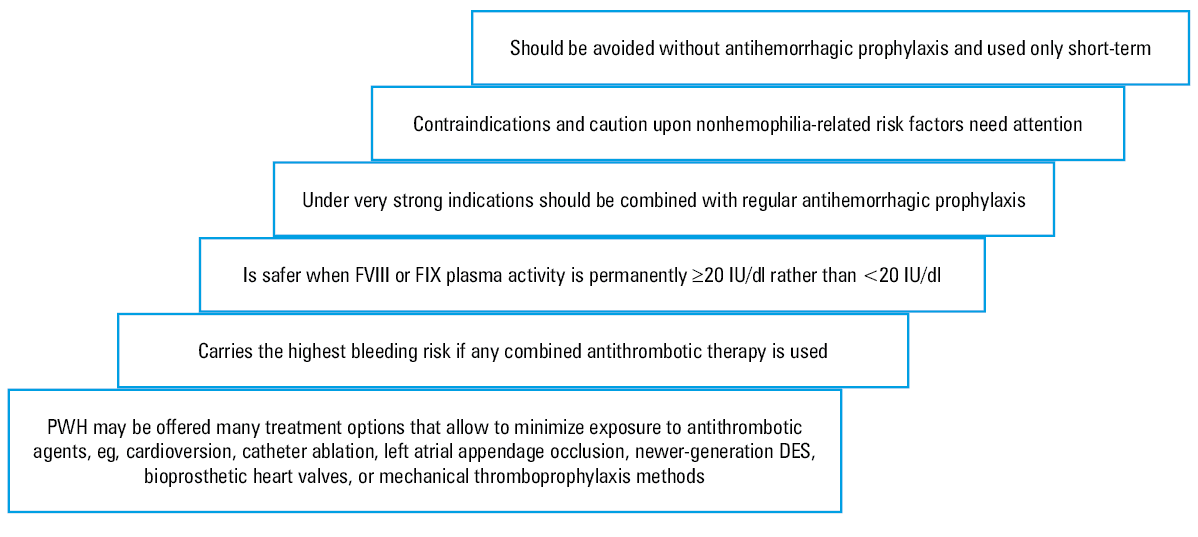
Abbreviations: DES, drug‑eluting stent; others, see Table 1
One should not forget about recent progress in the treatment of hemophilia itself. EHL factors, ultra‑long FVIII (efanesoctocog α), nonfactor replacements (eg, emicizumab, Mim8), nonreplacement agents (eg, concizumab, marstacimab, fitusiran) and finally AAV‑GTs have already improved or will improve in the near future the efficacy of prophylaxis and treatment of hemophilia‑associated bleeding episodes, but they will also likely allow for more effective and safer use of antithrombotic agents in PWH, including those with hemophilia complicated by the inhibitors. Finally, it is of paramount importance to remember that PWH should be screened for all age‑related disorders just as the general population, and regularly educated on how to change their lifestyle in order to avoid high‑risk behaviors for CVDs and other conditions carrying high risk of TEs. Only register‑based efforts, broader laboratory screening on hemostasis, and shared knowledge and decisions will secure the best possible outcomes of our hemophilia patients who have undergone or are at a high risk for thrombosis.
- Srivastava A, Santagostino E, Dougall A, et al. WFH Guidelines for the management of hemophilia, 3rd edition. Haemophilia. 2020; 26: 1‑158. | Crossref
- Windyga J. Is continuous low‑dose prophylaxis superior to on‑demand treatment for patients with hemophilia? Semin Thromb Hemost. 2016; 42: 533‑540. | Crossref
- Peyvandi F, Seidizadeh O, Mohsenian D, Garagiola I. Exploring non‑replacement therapies’ impact on hemophilia and other rare bleeding disorders. Res Pract Thromb Haemost. 2024; 8: e102434. | Crossref
- Di Minno G, Miesbach W, Castaman G, Peyvandi F. Next‑generation strategies to improve safety and efficacy of adeno‑associated virus‑based gene therapy for hemophilia: lessons from clinical trials in other gene therapies. Haematologica. 2024; 109: 3879‑3891. | Crossref
- Darby SC, Kan SW, Spooner RJ. Mortality rates, life expectancy, and causes of death in people with hemophilia A or B in the United Kingdom who were not infected with HIV. Blood. 2007; 110: 815‑825. | Crossref
ARTICLE INFORMATION