
Closing the sex gap in time delays and mortality in ST-segment elevation myocardial infarction: insights from the National Registry of Invasive Cardiology Procedures (ORPKI)
Key words: myocardial infarction, registry, sex gap, women

 CC BY 4.0
Closing the sex gap in time delays and mortality in ST-segment elevation myocardial infarction: insights from the National Registry of Invasive Cardiology Procedures (ORPKI)
CC BY 4.0
Introduction: Despite improvements in cardiovascular care, sex disparities persist in the outcomes of patients presenting with ST‑segment elevation myocardial infarction (STEMI).
Objectives: This study aimed to investigate the change in sex‑based differences in treatment delays, procedural complications, and outcomes among patients admitted for STEMI over the years.
Patients and methods: Data from the National Registry of Invasive Cardiology Procedures recorded between 2014 and 2022 were retrospectively analyzed, focusing on patients without cardiogenic shock who underwent primary percutaneous coronary intervention (PCI).
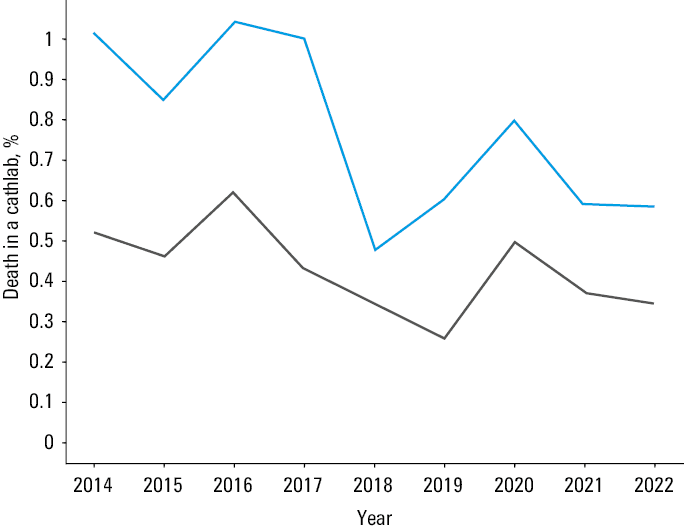
Results: Women comprised 32% of a total of 123 829 STEMI patients. Treatment delays from chest pain onset to the first medical contact and PCI were longer in women (239 vs 216 min; P <0.001 and 123 vs 114 min; P <0.001, respectively). Women were less likely to be treated with stents (86.8% vs 89%; P <0.001). Periprocedural complications, including cardiac arrest (1.5% vs 1.3%; P = 0.03), perforation (0.3% vs 0.2%; P = 0.03), no‑reflow (1.6% vs 1.3%; P = 0.002), and mortality in a catheterization laboratory (0.8% vs 0.6%; P <0.001), were higher in women. Over time, we have noted a reduction of this mortality gap between men and women since 2014, and an absolute decrease in deaths in the catheterization laboratory for women.
Conclusions: This study shows significant sex‑based disparities in STEMI care. Women experience longer treatment delays, receive less aggressive revascularization, and have worse periprocedural outcomes than men. However, the gap is gradually closing, which may reflect recent underscoring the need for sex‑specific approaches in STEMI management.
What's new?
Our large data sample analysis from Poland has demonstrated for the first time that differences between treatment of men and women with ST‑segment elevation myocardial infarction have changed throughout the years. Although female sex was found to be an independent predictor of mortality in a catheterization laboratory, and women experience longer treatment delays, receive less aggressive revascularization, and have worse periprocedural outcomes than men, these differences are gradually decreasing. A lot of effort has been undertaken both educational and at the level of national cardiac societies to underscore the sex gap and overcome it. The results can be finally clearly seen.
Introduction
Cardiovascular disease (CVD) remains a major worldwide cause of mortality and morbidity, claiming roughly 18 million lives each year.1 Cardiovascular outcomes in ST‑segment elevation myocardial infarction (STEMI), which largely depend on timely coronary artery revascularization, have shown an improvement over time, with prolonged survival seen as a result of enhanced adoption of early invasive treatment strategy, coupled with guideline‑driven secondary prevention.2 Yet, despite these advances, women have traditionally been shown to have worse clinical outcomes than men, following admission for acute coronary syndromes (ACSs), including STEMI.3-5 However, one of the limitations of some previous studies was a lack of information pertaining to time delays, including timing from chest pain to the first medical contact (FMC), and from the FMC to percutaneous coronary intervention (PCI). Moreover, most of the available data on sex‑based outcomes in STEMI have largely been derived from North American studies, and it is unclear whether these findings apply to European countries.
In this study, we aimed to examine the sex differences between women and men in Poland admitted for STEMI and referred for primary PCI in terms of treatment delays, periprocedural complications, and outcomes, including mortality in a catheterization laboratory.
Patients and methods
Data from patients hospitalized for STEMI between 2014 and 2022, collected in the National Registry of Invasive Cardiology Procedures (ORPKI), were retrospectively analyzed and stratified according to sex. The ORPKI is a national online electronic database encompassing 163 PCI centers across Poland.6 Since 2004, electronic case report forms have been used to collect data in the ORPKI by a majority of interventional cardiology centers in Poland. No personal data are collected in the registry, and therefore local ethics committee approval was waived. The study was a retrospective analysis of the data from the national registry with anonymized patient personal information.
Outcomes
In this analysis, we included all patients with STEMI without cardiogenic shock (Killip class 4), who underwent primary PCI over the 8‑year period, from 2014 to 2022. Time delays from the onset of chest pain to the FMC and from the FMC to PCI were analyzed after propensity score matching for baseline characteristics. The following periprocedural outcomes in the catheterization laboratory were examined: death, PCI complications (no‑reflow, perforation, bleeding at the puncture site), and cardiac arrest during PCI.
Statistical analysis
Nominal variables were presented as number (percentage), and continuous variables were presented as mean with SD or median with interquartile range (IQR) for normally and non‑normally distributed variables, respectively. Normality of the distribution was assessed using the quantile–quantile plots and Kolmogorov–Smirnov–Lilliefors test. The normally distributed continuous variables were compared across sex groups using the t test, whereas the non‑normally distributed variables were compared using the Mann–Whitney test. The Welch correction for heteroscedasticity was applied to the t test, if necessary.
The propensity score was used to match men to women in a 1:1 ratio. The matching took into account the following baseline variables: age, weight, diabetes, previous stroke, previous MI, previous PCI, previous coronary artery bypass grafting, smoking status, hypertension, and kidney disease. Standardized differences were calculated to check the balance between the groups. We used the nearest neighbor method. Outcomes after the propensity score matching were compared using mixed effects to account for correlated (matched) observations.
Predictors of death in the catheterization laboratory were identified using logistic regression. All potential demographic, baseline, and procedural characteristics were included in the multivariable model. Then, the final model was constructed by minimization of the Akaike Information Criterion. The model validation was performed using bootstrap resampling (1000 repetitions). Variance inflation factors were used to assess multicollinearity. The results were presented as odds ratios (ORs) with 2‑sided 95% CIs. A P value below 0.05 was assumed significant. The statistical analysis was performed with R software, version 4.3.1 (‘MatchIt’ version 4.7.0, ‘lmerTest’ version 3.1–3, and ‘boot’ version 1.3–30; R Foundation for Statistical Computing, Vienna, Austria).
Results
Population characteristics
A total of 123 829 STEMI patients were included in this analysis, of whom 39 236 were women (32%; Table 1). Women were older (69.9 vs 62.8 years), and more likely to have existing comorbidities, such as diabetes, hypertension, previous stroke, and chronic kidney disease, while men were more likely to have had previous MI and revascularization (Table 1).
Parameter | Women (n = 39 236) | Men (n = 84 593) | P value |
Data are presented as number (percentage) or mean (SD).
Abbreviations: CABG, coronary artery bypass graft; COPD, chronic obstructive pulmonary disease; LMCA, left main coronary artery; MI, myocardial infarction; MVD, multivessel disease; PCI, percutaneous coronary intervention; POBA, plain old balloon angioplasty; SVD, single vessel disease; TIMI, thrombolysis in myocardial infarction | |||
Age, y | 69.9 (11.8) | 62.8 (12) | <0.001 |
Diabetes mellitus | 8901 (22.7) | 12 706 (15) | <0.001 |
Previous stroke | 1477 (3.8) | 2346 (2.8) | <0.001 |
Previous MI | 4048 (10.3) | 11 464 (13.6) | <0.001 |
Previous PCI | 3749 (9.6) | 10 970 (13) | <0.001 |
Previous CABG | 443 (1.1) | 1564 (1.9) | <0.001 |
Current smoking | 9118 (23.2) | 30 152 (35.6) | <0.001 |
Hypertension | 25 626 (65.3) | 49 069 (58) | <0.001 |
Chronic kidney disease | 1631 (4.2) | 2084 (2.5) | <0.001 |
COPD | 721 (1.8) | 1500 (1.8) | 0.43 |
Access site for angiography | |||
Radial | 28 858 (73.6) | 68 877 (81.4) | <0.001 |
Femoral | 10 073 (25.7) | 15 309 (18.1) | |
Other | 290 (0.7) | 380 (0.5) | |
Result of angiography | |||
LMCA only | 2164 (5.5) | 5530 (6.6) | <0.001 |
MVD | 18 255 (46.6) | 39 771 (47.1) | |
SVD | 18 759 (47.9) | 39 149 (46.3) | |
Thrombectomy | 4476 (11.4) | 11 284 (13.3) | <0.001 |
Thrombolysis during PCI | 177 (0.5) | 444 (0.5) | 0.08 |
TIMI before PCI | |||
0 | 21 795 (57) | 48 139 (58.3) | <0.001 |
1 | 5739 (15) | 11 786 (14.3) | |
2 | 5766 (15) | 12 332 (14.9) | |
3 | 4944 (13) | 10 265 (12.5) | |
TIMI 3 after PCI | 35 006 (91.4) | 77 036 (93.2) | <0.001 |
Contrast used, ml | 150 (120–200) | 150 (120–200) | <0.001 |
Radiation dose, mGy | 576 (320–1013) | 760 (437–1280) | <0.001 |
Number of implanted stents | |||
0 – POBA | 5172 (13.2) | 9340 (11) | <0.001 |
1 | 28 207 (71.9) | 62 701 (74.1) | |
2 or more | 5857 (14.9) | 12 552 (14.9) | |
Time delays
Time delays from the onset of chest pain to the FMC and from the FMC to PCI are presented in Table 2. Data were missing for no more than 1 time point for 1.24% of the patients.
Parameter | Women (n = 39 236) | Men (n = 84 593) | P value |
Data are provided as median (interquartile range).
Abbreviations: FMC, first medical contact; others, see Table 1 | |||
Pain to FMC, min | 120 (60–300) | 120 (60–240) | <0.001 |
FMC to PCI, min | 83 (58–131) | 80 (55–120) | <0.001 |
Total time: pain to PCI, min | 240 (150–435) | 214 (135–390) | <0.001 |
Treatment
In terms of treatment, women were less likely to be treated via the radial route (73.6% vs 81.5%), to have stents implanted (86.8% vs 89%), to have thrombolysis in myocardial infarction (TIMI)-3 flow restored after primary PCI (91.4% vs 93.2%), and they were more likely to be treated with plain old balloon angioplasty (POBA) only (13.2% vs 11%; P <0.001 for all; Table 1). It was also noted that women were treated with less contrast (162 vs 173 ml) and less radiation (806 vs 1010 mGy; P <0.001 for both).
Clinical outcomes
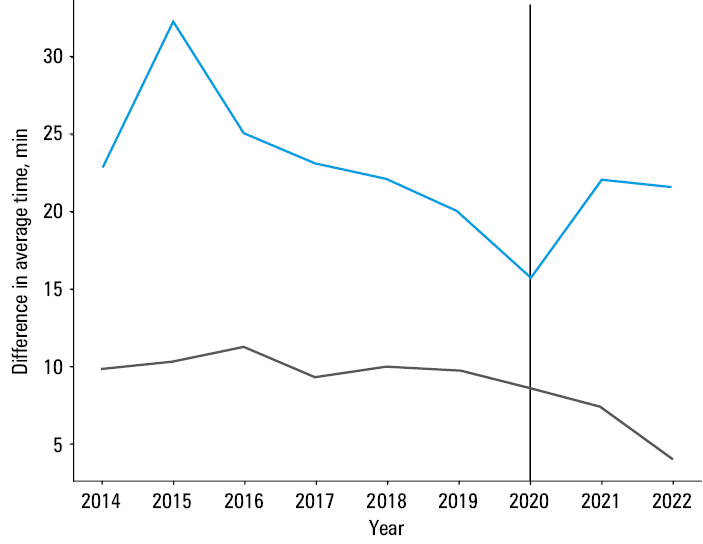
Clinical outcomes before propensity score matching are presented in Table 3. After propensity score matching, women were noted to have poorer periprocedural outcomes than men, including cardiac arrest in the catheterization laboratory, coronary artery perforation, no‑reflow, and death in the catheterization laboratory (Table 4). Women were less likely to have TIMI‑3 flow restored following PCI for STEMI (91.4% vs 93.2%; P <0.001). Following adjustment for differences in baseline characteristics, female sex was found to be an independent predictor of periprocedural mortality (OR, 1.21; 95% CI, 1.03–1.45; P = 0.02; Table 5). Other important independent predictors of mortality included age, diabetes, previous stroke, previous MI, smoking, operator annual volume, and time from the pain onset to the FMC (Table 5). Over time, we noticed a reduction of this mortality gap between men and women since 2014, and an absolute decrease in the number of deaths in the catheterization laboratory for women (Table 6, Figure 1). Indeed, while mortality was initially (2014–2019) significantly higher in women experiencing STEMI, the difference did not reach significance from 2020 to 2022. Overall, a significant trend toward lower periprocedural mortality during PCI in STEMI patients was observed from 2014 to 2022. Finally, we noted that the gap in time delay differences between women and men experiencing STEMI has been gradually narrowing since 2021 (Figure 2).
Parameter | Women (n = 39 236) | Men (n = 84 593) | P value |
Data are presented as numbers (percentage).
Abbreviations: cathlab, catheterization laboratory | |||
Cardiac arrest in a cathlab | 611 (1.6) | 952 (1.1) | <0.001 |
Bleeding at puncture site in a cathlab | 79 (0.2) | 67 (0.1) | <0.001 |
Coronary artery perforation | 112 (0.3) | 126 (9.2) | <0.001 |
No‑reflow | 640 (1.7) | 1048 (1.2) | <0.001 |
Stroke in a cathlab | 6 (0.02) | 11 (0.01) | 0.75 |
Death in a cathlab | 318 (0.8) | 376 (0.4) | <0.001 |
Parameter | Women (n = 36 821) | Men (n = 36 821) | P value |
Data are provided as median (interquartile range) or number (percentage).
| |||
Pain to FMC, min | 120 (60–259) | 120 (60–288) | <0.001 |
FMC to PCI, min | 80 (55–125) | 82 (58–139) | <0.001 |
Total time: pain to PCI, min | 225 (140–415) | 240 (150–438) | <0.001 |
Cardiac arrest in a cathlab | 568 (1.5) | 496 (1.3) | 0.03 |
Bleeding at puncture site in a cathlab | 73 (0.2) | 32 (0.1) | <0.001 |
Coronary artery perforation | 106 (0.3) | 76 (0.2) | 0.03 |
No‑reflow | 594 (1.6) | 492 (1.3) | 0.002 |
Stroke in a cathlab | 6 (0.02) | 9 (0.02) | 0.76 |
Death in a cathlab | 302 (0.8) | 216 (0.6) | <0.001 |
Predictor | OR | 95% CI | P value |
Female sex | 1.21 | 1.03–1.45 | 0.02 |
Age, y | 1.05 | 1.04–1.06 | <0.001 |
Diabetes mellitus | 1.52 | 1.26–1.82 | <0.001 |
Previous stroke | 1.77 | 1.31–2.35 | <0.001 |
Previous MI | 1.97 | 1.51–2.56 | <0.001 |
Smoking | 0.79 | 0.64–0.98 | 0.03 |
Psoriasis | 3.23 | 1.53–5.94 | <0.001 |
Hypertension | 0.63 | 0.54–0.75 | <0.001 |
Chronic kidney disease | 1.35 | 1.001–1.81 | 0.048 |
Operator annual volume | 0.98 | 0.98–0.99 | <0.001 |
Time from pain to FMC | 1.018 | 1.003–1.034 | 0.02 |
Year | Men | Total | Women | Total | P value |
Data are presented as number (percentage). | |||||
2014 | 64 (0.53) | 11 986 | 59 (1.01) | 5822 | 0.002 |
2015 | 54 (0.47) | 11 471 | 45 (0.85) | 5298 | 0.02 |
2016 | 68 (0.62) | 10 968 | 53 (1.04) | 5103 | 0.02 |
2017 | 47 (0.45) | 10 434 | 51 (1.02) | 5016 | <0.001 |
2018 | 33 (0.35) | 9463 | 21 (0.47) | 4423 | 0.27 |
2019 | 23 (0.26) | 8823 | 24 (0.6) | 3987 | 0.02 |
2020 | 37 (0.5) | 7440 | 28 (0.85) | 3275 | 0.11 |
2021 | 27 (0.37) | 7335 | 19 (0.59) | 3224 | 0.27 |
2022 | 23 (0.34) | 6673 | 18 (0.58) | 3088 | 0.27 |
Discussion
To the best of our knowledge, this is one of the largest contemporary registry studies in Europe that has investigated sex‑based differences in STEMI, with a comparison of revascularization times, as well as clinical outcomes. There are 5 key findings. First, women treated for STEMI were older, with a higher burden of cardiovascular comorbidities, such as diabetes and hypertension. Second, women continue to have both longer presentation times (mean chest pain to FMC time about 23 min longer) and treatment times (mean FMC to PCI time about 9 min longer). Third, women were less likely to be treated with stents in favor of POBA. Fourth, women experienced worse periprocedural outcomes following STEMI, including death in the catheterization laboratory, as well as complications, such as no‑reflow and cardiac arrest in the catheterization laboratory. Fifth, the sex‑related mortality gap has been shrinking over the last few years, as have been sex‑related time delay differences (pain to FMC and FMC to PCI).
Previous works, including a recent meta‑analysis by Shah et al,7 as well as registry studies,8 have highlighted a higher prevalence of cardiac risk factors among women admitted for STEMI. These studies found an increased incidence of cardiovascular comorbidities in women, possibly stemming from their tendency to present with coronary artery disease (CAD) at an older age than men. Notably, women are typically around 20 years older than men at the time of their first MI, which could be linked to a presumed delayed onset of CAD.9,10 This delay might partially be attributed to the protective effects of estrogen until menopause in women.11,12
Our finding of significant time delay for the FMC and PCI in women presenting with STEMI is in line with previous studies.13,14 A possible explanation for this is the fact that women may present more frequently than men with atypical symptoms or pain in other locations, such as the shoulder, neck, back, or epigastric region, thus leading to delayed recognition and diagnosis. In fact, a recent study15 found that 85% of women with ACS presented with atypical symptoms, such as palpitations, fainting, back pain, dizziness, or sweating, while in men this rate was 70%. There might also exist a subconscious systematic bias or insufficient training among health care providers,16 which could account for the delay in identifying STEMI in women and streamlining their transfer to a catheterization laboratory. Thus, the lack of awareness of atypical or unique symptoms, clinical features, or sex‑specific risk factors related to the perception of health care professionals, can result in treatment differences, hence perpetuating the notion that CVD remains underdiagnosed and undertreated in women.
As compared with men, women treated for STEMI were noted to have fewer stents implanted, but were more frequently managed with POBA. An explanation for this could be that, due to their delayed presentation, women would be more susceptible to having heavy, organized coronary thrombus by the time they arrive at a catheterization laboratory. In keeping with this, a previous study17 has shown pain‑to‑balloon time to be an independent predictor of heavy thrombus burden. In situations where there is a high burden of thrombus in the infarct‑related artery, stent implantation may increase the risk of dislodging the thrombus both proximally and distally, causing distal embolization of clot, with resulting microvascular occlusion and no‑reflow.18 In such cases, deferred stenting with POBA alone in the acute scenario might be a preferable option, in order to restore distal vessel flow, while minimizing the risk of no‑reflow. In fact, studies such as DEFER‑STEMI (Deferred Stent Trial in STEMI)19 showed that in reperfused STEMI patients with at least 1 risk factor for no‑reflow, a deferred strategy reduced no‑reflow and improved myocardial salvage, when compared with an immediate stenting approach.
Women had worse periprocedural outcomes, with female sex being an independent predictor of mortality. This finding is likely to have multiple explanations. First, the significant delay in presentation and treatment experienced by women is an important consideration. Evidence shows that every minute of delay in primary angioplasty for STEMI affects 1‑year mortality, with the risk of 1‑year mortality rising by roughly 7% for each 30‑minute delay. Furthermore, women in our study were less likely to be fully reperfused (TIMI‑3 flow) after primary angioplasty (91.4% vs 93.2%).20 Animal studies have demonstrated the relationship between infarct size and the duration of coronary obstruction, hence explaining why late or suboptimal revascularization in STEMI would result in a smaller degree of myocardial salvage.21 While delays in presentation and treatment might, to some extent, explain the worse outcomes seen in women, other factors might be at play, including the fact that women were seen to be generally older and with a higher burden of comorbidities than men. Hence, a sustained, organized effort by health care providers and campaigners is key to examine these disparities and thus identify mitigating strategies.
Unfortunately, our study could not provide additional data on symptom presentation or patient education, income, and socio‑economic status, since these are not reported in the ORPKI database. We believe that these factors may play a role in delaying treatment, especially in Poland, since regional variations in time delays have been previously observed.22,23 On the other hand, there is only a single public health care provider that treats MI in Poland (National Health Fund), and a unified homogenous structure of primary PCI service has been observed for many years now.6 Access to primary PCI in STEMI meets the European Society of Cardiology recommended standards in each part of the country.24
Interestingly, the gap is gradually bridging between the sexes, in terms of not only the time delays (pain to FMC and FMC to PCI), but also in terms of periprocedural mortality. This can perhaps be explained by the recent adoption of protocol‑guided management of STEMI patients, which includes a global drive to improve early recognition of STEMI, shorten the transfer time to the nearest catheterization laboratory, reduce door‑to‑balloon times, and implement guideline‑based therapies pre- and post‑PCI.
Limitations
We need to acknowledge various limitations that are inherent to this study design. First, similarly to any administrative database, there is a possibility of coding errors that could introduce bias, along with potential underreporting of secondary diagnoses. Secondly, follow‑up was confined to the periprocedural period, thus impeding our ability to evaluate longer‑term outcomes and major adverse cardiovascular events of STEMI in both women and men. Moreover, we did not have access to data on pharmacologic treatment started following STEMI, and therefore we could not determine whether there were any differences in secondary prevention between women and men. Data completeness and quality are often regarded as the main drawbacks of observational studies; however, they may be overcome by statistical adjustments that were utilized for the purpose of this analysis.
Conclusions
In this large, contemporary, real‑world registry study, we report significant sex‑based disparities in STEMI care. Female sex was found to be an independent predictor of periprocedural mortality; women experience longer treatment delays, receive less aggressive revascularization, and have worse periprocedural outcomes than men. These findings underscore the need for tailored, sex‑specific approaches in STEMI management. Finally, we have noted a reduction of this gap since 2014, and an absolute decrease in deaths in a catheterization laboratory for women, which is the first report so far.
- World Health Organization. https://www.who.int/news‑room/fact‑sheets/detail/cardiovascular‑diseases-(cvds) Accessed January 15, 2025.
- Szummer K, Wallentin L, Lindhagen L, et al. Relations between implementation of new treatments and improved outcomes in patients with non‑ST‑elevation myocardial infarction during the last 20 years: experiences from SWEDEHEART registry 1995 to 2014. Eur Heart J. 2018; 39: 3766‑3776. | Crossref
- Udell JA, Koh M, Qiu F, et al. Outcomes of women and men with acute coronary syndrome treated with and without percutaneous coronary revascularization. J Am Heart Assoc. 2017; 6: e004319. | Crossref
- Benamer H, Bataille S, Tafflet M, et al. Longer pre‑hospital delays and higher mortality in women with STEMI: the e‑MUST Registry. EuroIntervention. 2016; 12: e542‑e549. | Crossref
- Ziwei X, Hong Q, Tingting G, et al. Contemporary sex differences in mortality among patients with ST‑segment elevation myocardial infarction: a systematic review and meta‑analysis. BMJ Open. 2022; 12: e053379. | Crossref
ARTICLE INFORMATION